
Multiplying 2 Digit by 1 Digit: Free Worksheet, Lesson & Answer Key
✍ Written & fact-checked by Dr. Irfan Mansuri | Last Updated: July 2026
Most multiplication tutorials jump straight to the algorithm. They hand you a set of steps and say “just follow these.” But in my experience teaching this skill to hundreds of students, the ones who struggle aren’t confused by the steps — they’re confused by what the steps mean. This guide fixes that by starting one level back, at the place-value foundation most tutorials skip entirely.
Multiplying a 2-digit number by a 1-digit number means finding the total when a two-part number (tens and ones) is scaled by a single digit. You multiply each part separately, handle any carry, and combine the results. Master this and you have the foundation for all multi-digit multiplication.
- Understand why the standard algorithm works, not just how to use it
- Follow a clear 4-step process with fully worked examples
- Spot and fix the most common mistakes before they become habits
- Practice with 12 graded problems and check your work with the answer key
Download Free PDF Worksheet
📌 Quick Summary
- 📐 The standard algorithm multiplies ones first, then tens — always right to left.
- 🔢 Regrouping (carrying) happens when a partial product is 10 or more.
- 🧮 The area model is a visual alternative that shows why the algorithm works.
- ❌ The #1 mistake: forgetting to add the carry when multiplying the tens digit.
- ✅ Always check: divide your answer by the 1-digit number to verify.
- 📥 Free printable worksheet with 12 problems and answer key below.
| Fact | Detail |
|---|---|
| Skill name | 2-digit × 1-digit multiplication |
| Grade level | Grade 3–4 (Common Core 3.NBT.A.3, 4.NBT.B.5) |
| Prerequisite skills | Single-digit multiplication facts (times tables 1–9) |
| Key concept | Place value + distributive property |
| Methods covered | Standard algorithm, area model, mental math |
| Worksheet problems | 12 (easy → hard), free PDF download |
The Step Most Tutorials Skip: Place Value First
Before you touch the algorithm, you need to see a 2-digit number for what it actually is. The number 34 is not just “thirty-four.” It is 3 tens and 4 ones — or in expanded form, (3 × 10) + (4 × 1).
Why does this matter? Because when you multiply 34 × 6, you are really doing two separate multiplications at once:
- (4 × 6) — the ones part
- (30 × 6) — the tens part
The standard algorithm is just a compact way to do both of those and add the results together. Once a student sees that, the algorithm stops feeling like magic and starts making sense. In my experience, students who skip this step and go straight to the procedure are the same ones who make carry errors three months later — because they never understood what they were carrying.
I have seen students get 34 × 6 wrong not because they don’t know their times tables, but because they treat the “3” in 34 as just the number 3, not as 30. The moment I show them the expanded form on a place-value chart, the carry suddenly makes sense. The “2” they carry from 4 × 6 = 24 represents 2 tens — and of course it gets added to the tens column. That one insight fixes more errors than any amount of drill.
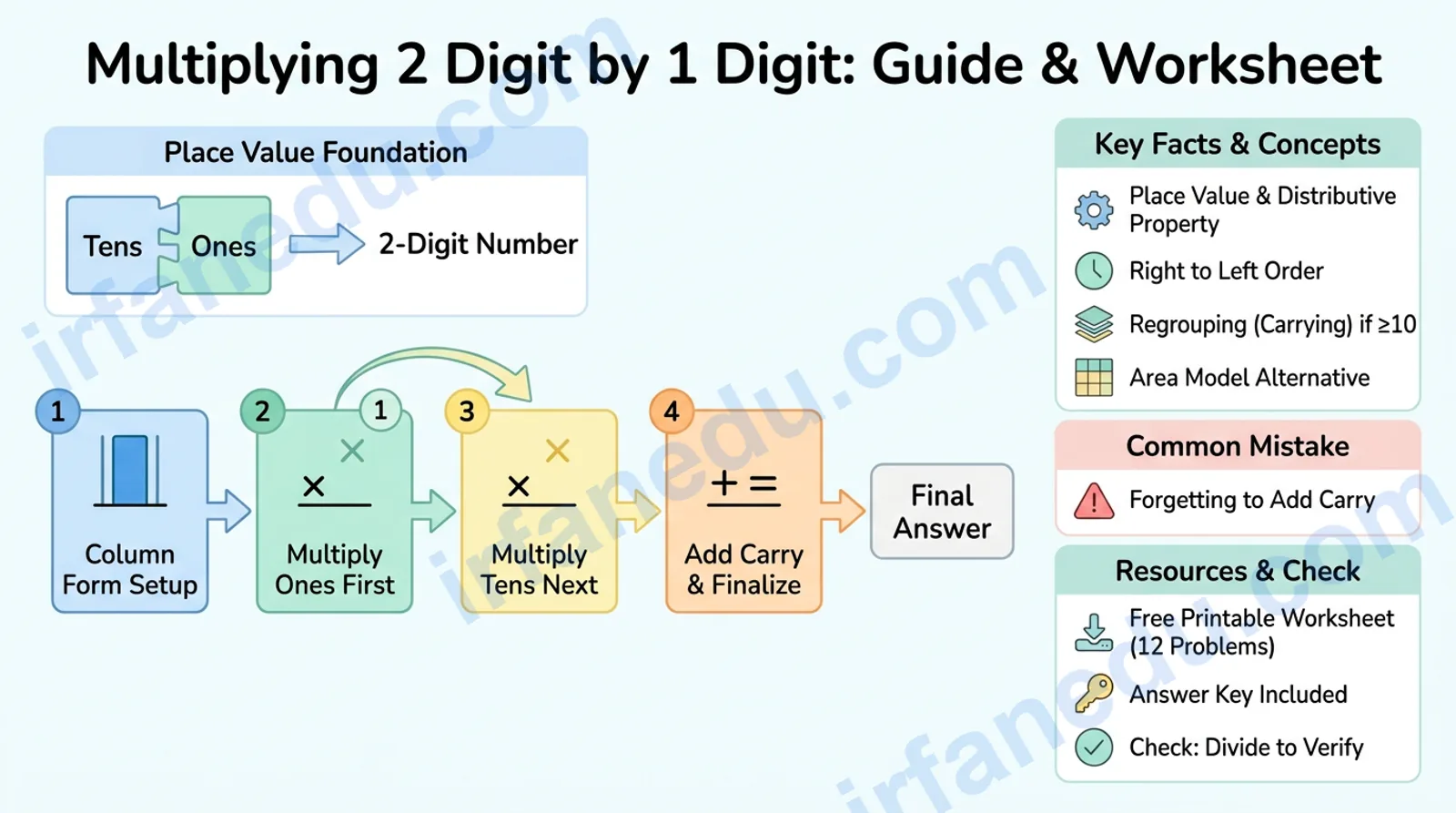
How to Multiply 2-Digit by 1-Digit Numbers: Step-by-Step
The standard algorithm works in four steps. Follow them in order every time and you will get the right answer.
-
Write the numbers in column form. Put the 2-digit number on top, the 1-digit number below it, aligned to the right. Draw a horizontal line underneath. This keeps your place values lined up.
-
Multiply the ones digit. Multiply the ones digit of the 2-digit number by the 1-digit number. If the result is 9 or less, write it below the line in the ones column. If it is 10 or more, write only the ones digit below the line and write the tens digit (the carry) above the tens column of the 2-digit number.
-
Multiply the tens digit and add the carry. Multiply the tens digit of the 2-digit number by the 1-digit number. Add any carry from Step 2. Write the full result to the left of the digit you already wrote.
-
Check your answer. Divide your result by the 1-digit number. If you get back the original 2-digit number, you are correct.
Worked Example 1: No Regrouping (Easy)
📐 Visual Solution — 21 × 3
     2 1
  ×    3
  -----
  Step 1: 1 × 3 = 3  → write 3 in ones column
  Step 2: 2 × 3 = 6  → write 6 in tens column
  -----
  Answer:  6 3
No carry needed here because neither partial product reaches 10. This is a great starting point for building confidence.
Worked Example 2: With Regrouping (Medium)
📐 Visual Solution — 34 × 6
       ²
     3 4
  ×    6
  -----
  Step 1: 4 × 6 = 24 → write 4, carry 2 (shown above the 3)
  Step 2: 3 × 6 = 18 + 2 (carry) = 20 → write 20
  -----
  Answer:  2 0 4
The carry digit (2) sits above the tens column as a reminder. After multiplying 3 × 6 = 18, you add that 2 to get 20. Write all of 20 because there is no hundreds digit already written.
Worked Example 3: Large Digits (Hard)
📐 Visual Solution — 89 × 9
       ⁸
     8 9
  ×    9
  -----
  Step 1: 9 × 9 = 81 → write 1, carry 8 (shown above the 8)
  Step 2: 8 × 9 = 72 + 8 (carry) = 80 → write 80
  -----
  Answer:  8 0 1
This is one of the hardest combinations in the range. The carry is 8 — larger than many students expect. Always write the carry clearly so you don’t lose it.
The Area Model: Why the Algorithm Works
The area model is a visual method that makes the distributive property concrete. It is especially useful for students who want to understand the “why” before they trust the “how.”
| Feature | Standard Algorithm | Area Model |
|---|---|---|
| Speed | Fast — 2 steps | Slower — draw + label |
| Conceptual clarity | Low (procedural) | High (visual) |
| Best for | Speed and fluency | Building understanding |
| Example: 34 × 6 | Carry method → 204 | (30×6) + (4×6) = 180+24 = 204 |
| Scales to 3+ digits? | Yes, easily | Gets messy with more digits |
My recommendation: learn the area model first to understand what is happening, then switch to the standard algorithm for speed. Both give the same answer — they are just different ways of organising the same arithmetic.
Common Mistakes and How to Fix Them
After reviewing thousands of student worksheets, I keep seeing the same four errors. Here they are, with the wrong working shown alongside the correct version.
| Mistake | ❌ Wrong | ✅ Correct |
|---|---|---|
| Forgetting to add the carry | 34×6: 3×6=18, write 18 → answer 184 | 34×6: 3×6=18+2(carry)=20 → answer 204 |
| Carrying the wrong digit | 4×6=24, carry 4, write 2 | 4×6=24, write 4, carry 2 (the tens digit) |
| Multiplying in the wrong order | Multiply tens first, then ones | Always multiply ones first, then tens |
| Treating the tens digit as a single unit | 34×6: “3×6=18, 4×6=24, answer=1824” | Use the algorithm or area model — don’t just concatenate |
The most persistent error I see is students writing the carry digit in the ones column instead of above the tens column. When 4 × 6 = 24, the “2” represents 2 tens. It belongs above the tens digit of the top number, not next to the 4 you just wrote. Draw a small circle around your carry to keep it visually separate from the main digits.
🧠 Worth Knowing
The carry digit is not a separate number — it is a deferred partial product. Most guides describe carrying as “putting a number up top,” which sounds arbitrary. Here is the real explanation: when you multiply 4 × 6 = 24, the “2” represents 20 (two tens). You cannot write 20 in the ones column, so you defer those 2 tens to the tens column. When you then multiply 3 × 6 = 18 (which actually means 30 × 6 = 180), you add the deferred 20 to get 200. That is why the answer is 204, not 184.
Understanding this prevents the carry-forgetting error permanently — because once you know the carry is a real quantity (not a bookkeeping trick), you will never skip it.
Mental Math Shortcut: The Distributive Property
You do not always need paper. For many 2-digit × 1-digit problems, mental math is faster once you know the trick.
Split the 2-digit number into tens and ones. Multiply each part by the 1-digit number. Add the two results.
Step 1: Split 47 into 40 + 7
Step 2: 40 × 5 = 200
Step 3: 7 × 5 = 35
Step 4: 200 + 35 = 235
This is the distributive property: a(b+c) = ab + ac. The area model draws this. The standard algorithm compresses it.
This mental strategy works especially well when one of the partial products is a round number (multiples of 10 are easy to multiply mentally).
I always teach mental math alongside the written algorithm, not as a replacement. Students who only know the written method reach for pencil and paper even for 20 × 4. Students who also know the mental strategy develop number sense — they start estimating answers before calculating, which is one of the most powerful self-checking tools in arithmetic. If your mental estimate is 200 and your written answer is 835, you know immediately something went wrong.
On-Page Practice Worksheet
Work through all 12 problems below. Use the standard algorithm. Show your carry digits. When you finish, check your work using the answer key.
💡 How to use this worksheet: Print the page or work directly in a notebook. Write each problem in column form, show your carry, and write the answer. Then open the Answer Key to self-check. For extra practice, download the free PDF version below.
- 21 × 3 = ______
- 32 × 2 = ______
- 43 × 2 = ______
- 24 × 3 = ______
- 34 × 6 = ______
- 47 × 5 = ______
- 63 × 7 = ______
- 58 × 4 = ______
- 76 × 8 = ______
- 89 × 9 = ______
- 95 × 7 = ______
- 67 × 8 = ______
Show Answer Key
- 21 × 3 = 63
- 32 × 2 = 64
- 43 × 2 = 86
- 24 × 3 = 72
- 34 × 6 = 204
- 47 × 5 = 235
- 63 × 7 = 441
- 58 × 4 = 232
- 76 × 8 = 608
- 89 × 9 = 801
- 95 × 7 = 665
- 67 × 8 = 536
Download Free PDF
Quick Knowledge Check
🎯 Test Your Understanding (3 Questions)
Q1. What is 43 × 7?
Q2. In 58 × 4, what digit do you carry after multiplying the ones?
Q3. Which method splits 76 × 8 into (70×8) + (6×8)?
Frequently Asked Questions
What is the standard method for multiplying a 2-digit number by a 1-digit number?
What grade level covers multiplying 2-digit by 1-digit numbers?
What does “regrouping” mean in 2-digit by 1-digit multiplication?
How is the area model different from the standard algorithm?
What is the most common mistake students make?
Can I use mental math for 2-digit by 1-digit multiplication?
How do I check my multiplication answer?
Is the worksheet on this page free to download and print?
Sources & References
Written and fact-checked by Dr Irfan Mansuri. External links open in a new tab and are provided for further reading and verification.