
🌿 Pine Straw Calculator: How Many Bales Do You Need?
📋 Table of Contents
Think of your garden bed like a bathtub. You know the length and width — that is the floor of the tub. The depth of pine straw you want is the water level. Your job is to figure out how many “buckets” (bales) it takes to fill it to that level. Get the math wrong and you either run out mid-job or haul 20 extra bales back to the store.
This pine straw calculator does that math for you in one click. Enter your bed’s length, width, and desired depth. The tool calculates your total area, the volume of mulch needed, and the exact number of bales to buy — with a step-by-step breakdown you can screenshot and take to the garden center.
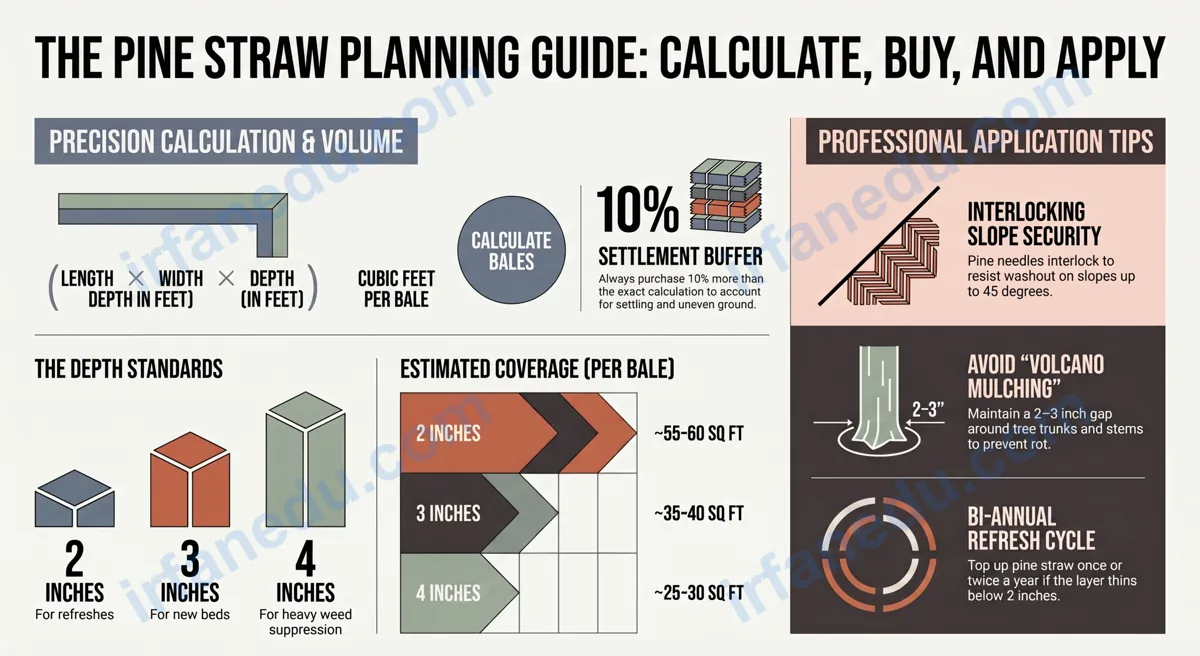
To find how many pine straw bales you need: multiply bed length × width to get area (sq ft), then multiply by depth in feet. Divide by the volume one bale covers (typically 40 sq ft × 0.25 ft = 10 cubic feet per bale). For a 3-inch depth, one standard bale covers roughly 35–40 sq ft. Always buy 10% extra for settling.
⚡ TL;DR – Quick Summary
- 🌿 One standard bale covers ~35–40 sq ft at 3-inch depth.
- 📐 Formula: Bales = (Area × Depth in ft) ÷ Coverage per bale.
- ➕ Always add 10% extra for settling and uneven ground.
- 🌡️ Best depth: 2–4 inches; 3 inches is the sweet spot.
- 🔄 Refresh pine straw once or twice a year as it thins.
- 🧮 Use the calculator below — it shows every step of the math.
Pine Straw Calculator
Enter your bed dimensions and depth — get your bale count instantly
bales
Exact: — bales
Volume: — cu ft
📋 Step-by-Step Solution
🪜 How to Use This Pine Straw Calculator
- Enter bed length — measure the longest side of your garden bed in feet.
- Enter bed width — measure the shorter side in feet. For irregular beds, break them into rectangles and add the results.
- Enter desired depth — 2 inches for a light refresh, 3 inches for a new bed, 4 inches for heavy weed suppression.
- Check coverage per bale — the default is 40 sq ft at 3-inch depth, which matches most standard bales. Adjust if your supplier's label says otherwise.
- Click Calculate — the tool shows your exact bale count, total area, volume, and a numbered solution you can screenshot.
🌲 What Is Pine Straw — and Why Use It as Mulch?
Pine straw is the collective term for fallen pine needles raked, baled, and sold as mulch. It is one of the most popular ground covers in the southeastern United States, though gardeners worldwide use it wherever pines grow. A single mature longleaf pine drops enough needles each year to fill several bales.
Unlike wood chips, pine straw needles interlock as they settle, forming a mat that resists wind and heavy rain. That interlocking structure is also why pine straw does not wash away on slopes — a genuine advantage over most other mulch types.
In my experience advising homeowners on landscaping math, the single biggest mistake I see is choosing bark mulch for sloped beds. After the first heavy rain, half of it ends up in the driveway. Pine straw's interlocking needle structure holds on slopes up to about 45 degrees without any additional anchoring. For flat beds, either works — but for anything with a grade, pine straw wins every time.
📐 The Pine Straw Formula Explained
The core calculation treats your garden bed as a rectangular prism. You need to fill that prism with mulch to a specific depth.
Volume (cu ft) = Length (ft) × Width (ft) × Depth (ft)

Bales needed   = Volume (cu ft) ÷ Volume per bale (cu ft)

Volume per bale = Coverage per bale (sq ft) × Reference depth (ft)
                = e.g. 40 sq ft × 0.25 ft (3 in) = 10 cu ft/bale

Recommended purchase = ceil(Exact bales × 1.10)
The 1.10 multiplier adds a 10% buffer for settling, uneven ground, and waste.
📊 Variables & Symbols Table
| Symbol | Meaning | Unit |
|---|---|---|
| L | Bed length | feet (ft) |
| W | Bed width | feet (ft) |
| D | Desired mulch depth | inches → convert to ft (÷12) |
| V | Total volume of mulch needed | cubic feet (cu ft) |
| C | Coverage per bale at reference depth | sq ft/bale |
| Vb | Volume per bale | cu ft/bale |
| N | Exact bales needed | bales |
| Nrec | Recommended purchase (10% buffer) | bales (rounded up) |
📏 Depth Guide: Coverage per Bale at Different Depths
| Depth | Coverage per Standard Bale | Best Use |
|---|---|---|
| 2 inches | ~55–60 sq ft | Light refresh on existing beds |
| 3 inches | ~35–40 sq ft | New beds, weed suppression (recommended) |
| 4 inches | ~25–30 sq ft | Heavy weed areas, winter insulation |
🔢 Worked Examples
- Area = 10 × 6 = 60 sq ft
- Depth in feet = 3 ÷ 12 = 0.25 ft
- Volume = 60 × 0.25 = 15 cu ft
- Volume per bale = 40 × 0.25 = 10 cu ft/bale
- Exact bales = 15 ÷ 10 = 1.5 bales
- With 10% buffer: 1.5 × 1.10 = 1.65 → buy 2 bales
- Area = 40 × 15 = 600 sq ft
- Depth in feet = 0.25 ft
- Volume = 600 × 0.25 = 150 cu ft
- Volume per bale = 10 cu ft/bale
- Exact bales = 150 ÷ 10 = 15 bales
- With 10% buffer: 15 × 1.10 = 16.5 → buy 17 bales
- Area = 25 × 8 = 200 sq ft
- Depth in feet = 2 ÷ 12 = 0.1667 ft
- Volume = 200 × 0.1667 = 33.33 cu ft
- Volume per bale at 2-in: use adjusted coverage 57 sq ft → 57 × (2/12) = 9.5 cu ft/bale
- Exact bales = 33.33 ÷ 9.5 = 3.51 bales
- With 10% buffer: 3.51 × 1.10 = 3.86 → buy 4 bales
📐 Visual: Garden Bed as a Rectangular Prism
  ┌─────────────────────────────────────┐  ← Width (W)
  │                                     │
  │         Garden Bed (top view)       │  Length (L)
  │                                     │
  └─────────────────────────────────────┘
         ↕ Depth (D) — side view:
  ┌─────────────────────────────────────┐
  │░░░░░░░░ Pine Straw Layer ░░░░░░░░░│  ← D inches
  │▓▓▓▓▓▓▓▓▓▓ Soil ▓▓▓▓▓▓▓▓▓▓▓▓▓▓▓▓│
  └─────────────────────────────────────┘
  Volume = L × W × D(ft)
  Bales  = Volume ÷ Volume-per-bale
The pine straw layer (░) sits on top of soil (▓). You are filling that orange-shaded volume.
⚠️ Common Pine Straw Mistakes — Wrong vs. Right
| ❌ Wrong | ✅ Right |
|---|---|
| Using the stated "sq ft coverage" directly without adjusting for your actual depth | Always convert depth to feet and calculate true volume — the calculator does this automatically |
| Piling pine straw against tree trunks or plant stems ("volcano mulching") | Keep a 2–3 inch gap around stems to prevent rot and pest harborage |
| Buying the exact number of bales with no buffer | Always add 10% — bales vary in density and ground is rarely perfectly flat |
| Using pine straw on alkaline-soil plants expecting pH benefits | Pine straw has minimal pH effect; choose mulch based on moisture and weed needs, not pH myths |
Most online pine straw calculators ask for your depth and a single "coverage per bale" number — but they never explain that the coverage figure on a bale's label is almost always stated at a 3-inch reference depth. If you enter a 2-inch depth but use the 3-inch coverage number without adjusting, you will under-buy by 33%. The correct approach (which this calculator uses) is to derive the bale's true cubic-foot volume first, then divide your required volume by that. That way, the math is accurate at any depth — not just 3 inches.
Before I finalize any pine straw order, I always flip the bale over and look for the actual weight or volume spec. In my experience, "standard bale" coverage ranges from 35 sq ft to 50 sq ft depending on the supplier and the pine species (longleaf needles are longer and pack differently than slash pine). That 15 sq ft difference on a large project can mean 5–10 extra bales. Thirty seconds of label-reading saves a second trip.
⚡ Explore More Calculators on IrfanEdu →
🧠 Quick Quiz — Test Your Pine Straw Knowledge
3-Question Pine Straw Quiz
Q1. A bed is 20 ft × 10 ft. At 3-inch depth with 40 sq ft/bale coverage, how many exact bales do you need?
Show answer
Q2. Why do you add a 10% buffer when buying pine straw?
Show answer
Q3. Which depth is best for new garden beds that need strong weed suppression?
Show answer
❓ Frequently Asked Questions
How many square feet does one bale of pine straw cover?
How deep should pine straw mulch be?
Is pine straw better than wood mulch?
How often should I replace pine straw?
Does pine straw make soil more acidic?
Sources & References
Written and fact-checked by Dr Irfan Mansuri. External links open in a new tab and are provided for further reading and verification.