
Flag Size Calculator: Get the Right Flag Dimensions Fast
In This Guide
Getting the flag size wrong is one of the most common and most visible home-improvement mistakes. A flag that is too small looks like a postage stamp on a tall pole. One that is too large strains the hardware and droops. This calculator gives you the exact recommended dimensions in seconds — enter your pole height, pick your unit, and get the hoist, fly, and area instantly.
⚡ TL;DR – Quick Summary
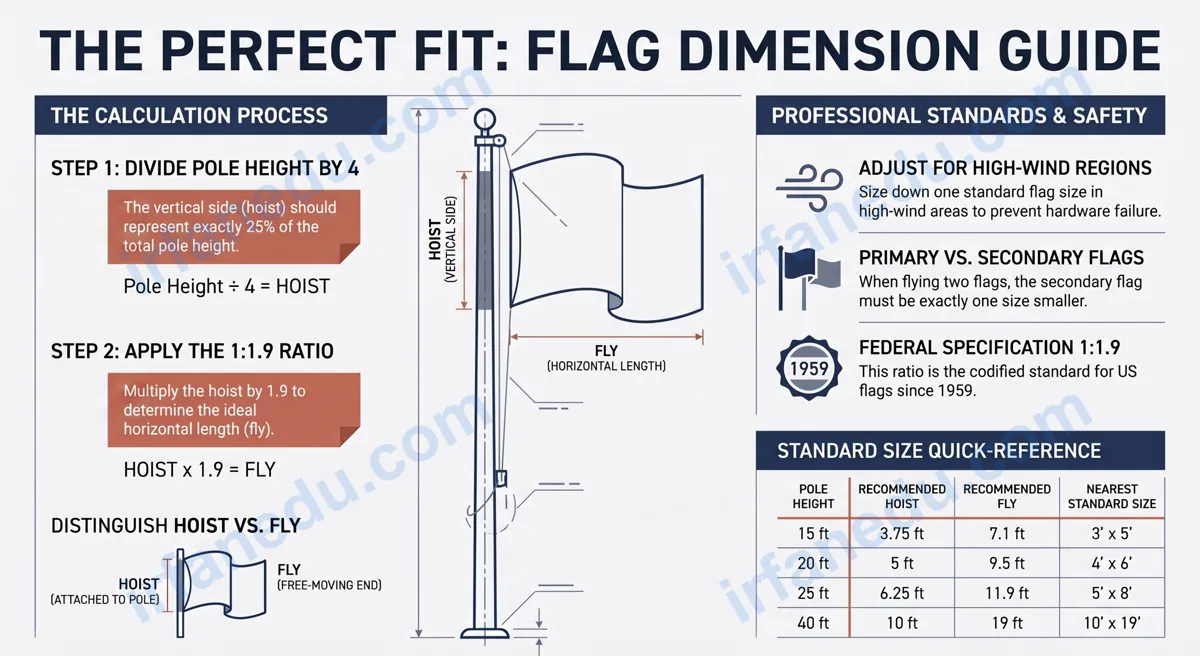
- Standard rule: flag hoist = pole height ÷ 4; fly = hoist × 1.9.
- Most residential 20 ft poles use a 4×6 ft flag; 25 ft poles use 5×8 ft.
- The US flag ratio is exactly 1:1.9 (hoist to fly) per federal specification.
- Oversized flags damage hardware; undersized flags look wrong — sizing matters.
- This calculator shows hoist, fly, area, and the nearest standard size in one click.
| Pole Height | Recommended Hoist | Recommended Fly | Nearest Standard Size |
|---|---|---|---|
| 15 ft | 3.75 ft | 7.1 ft | 3×5 ft |
| 20 ft | 5 ft | 9.5 ft | 4×6 ft |
| 25 ft | 6.25 ft | 11.9 ft | 5×8 ft |
| 30 ft | 7.5 ft | 14.25 ft | 6×10 ft |
| 40 ft | 10 ft | 19 ft | 10×15 ft or 10×19 ft |
| 60 ft | 15 ft | 28.5 ft | 15×25 ft |
Flag Size Calculator
Flag Size Calculator
Enter your pole height to get the recommended flag dimensions instantly.
Step-by-Step Solution
How to Use This Flag Size Calculator
- Choose a mode. Select "Pole Height → Flag Size" if you know your pole height. Select "Hoist → Fly & Area" if you already know the vertical flag dimension and want the horizontal.
- Enter your measurement. Type the pole height or hoist value in the input box. Choose feet or metres from the unit dropdown.
- Click Calculate. The result card shows the recommended hoist, fly, area in both units, and the nearest standard flag size.
- Check the step-by-step solution to see exactly how the result was derived.
- Compare to the standard size chart above and order the closest available size from your flag supplier.
What Is the Standard Flag Size Formula?
The standard flag size formula is based on two ratios used across the US flag industry. The first ratio links pole height to flag hoist. The second ratio links hoist to fly.
Hoist = Pole Height ÷ 4
Fly   = Hoist × 1.9
Area  = Hoist × Fly
| Symbol | Meaning | Unit |
|---|---|---|
| H | Hoist — vertical dimension of the flag (side attached to pole) | ft or m |
| F | Fly — horizontal dimension of the flag (free end) | ft or m |
| P | Pole height — total height of the flagpole | ft or m |
| A | Flag area | ft² or m² |
| 1.9 | US standard hoist-to-fly ratio (federal specification) | dimensionless |
The 1:1.9 ratio is specified in US Executive Order 10834 (1959), which codified the proportions of the US flag. Most commercial flags sold in the US follow this ratio. Some decorative flags use a 2:3 ratio (fly = 1.5 × hoist), but for flagpole display, 1:1.9 is the standard.
Visual: Flag Dimensions on a Pole
        |
        |  <-- Pole height (P)
        |
        +--[=====HOIST (H)=====]
        |  |                   |
        |  |   FLAG AREA       |  FLY (F) = H x 1.9
        |  |                   |
        +--[===================]
        |
        |
      (ground)

  H = P / 4
  F = H x 1.9
  A = H x F
Worked Examples
Pole height = 20 ft
Hoist = 20 ÷ 4 = 5 ft
Fly = 5 × 1.9 = 9.5 ft
Area = 5 × 9.5 = 47.5 ft²
Nearest standard size: 4×6 ft (the most common residential choice; the 5×9.5 ft is non-standard, so 4×6 ft is the practical pick).
Pole height = 6 m = 19.69 ft
Hoist = 19.69 ÷ 4 = 4.92 ft (1.5 m)
Fly = 4.92 × 1.9 = 9.35 ft (2.85 m)
Area = 4.92 × 9.35 = 46.0 ft² (4.28 m²)
Nearest standard size: 4×6 ft (1.2×1.8 m).
Pole height = 40 ft
Hoist = 40 ÷ 4 = 10 ft
Fly = 10 × 1.9 = 19 ft
Area = 10 × 19 = 190 ft²
Nearest standard size: 10×19 ft (exact match — common for commercial and government buildings).
In my experience advising on flag display, the pole-height ÷ 4 rule works perfectly for calm to moderate wind areas. But if you live in a consistently high-wind region, I recommend going one size smaller than the formula suggests. Wind load on a large flag is substantial — I have seen halyard hardware fail on a 30 ft pole flying a 6×10 ft flag in sustained 30 mph winds. Size down, use a nylon flag (lighter than polyester), and your hardware will last years longer.
Common Flag Sizing Mistakes
Many people measure only the visible pole height and forget that the finial (ornamental top) adds 1-2 ft. Always use the total pole length from ground to tip.
The hoist is the vertical side (attached to the pole). The fly is the horizontal side (the free end). When you order a "3×5 ft flag," the 3 ft is the hoist and the 5 ft is the fly — not the other way around.
A 10×19 ft flag in a 25 mph wind exerts hundreds of pounds of force on the pole and hardware. Always check your pole's rated wind-load capacity before sizing up.
If you fly two flags on the same pole (e.g., US flag + state flag), the secondary flag should be one size smaller than the primary. On a 25 ft pole: primary = 5×8 ft, secondary = 4×6 ft.
💡 Unique Insight: What Most Flag Size Guides Get Wrong
Almost every flag size guide online repeats the same pole-height ÷ 4 formula and stops there. What they miss: the formula assumes a single flag on a free-standing outdoor pole in an open area. If your pole is mounted on a building facade (angled bracket mount), the effective "visual pole height" is the distance from the mount point to the tip — not the full building height. I have seen homeowners order a 6×10 ft flag for a 30 ft building with a 10 ft bracket mount, when a 3×5 ft flag would look proportional. Always calculate from the mount point, not the roofline.
In my experience, most US flag suppliers only stock imperial sizes. If you calculate in metres and get, say, 1.5×2.85 m, you will not find that exact size at a US retailer. The closest imperial standard (4×6 ft = 1.22×1.83 m) is what you will actually buy. This calculator shows both units and the nearest standard size precisely because of this gap — it saves you the conversion headache.
Quick Quiz: Flag Sizing
Test Your Knowledge
Q1. What is the recommended flag hoist for a 20 ft pole?
Q2. The US standard flag ratio (hoist to fly) is:
Q3. Which dimension is the "fly" of a flag?
Sources & References
Written and fact-checked by Dr Irfan Mansuri. External links open in a new tab and are provided for further reading and verification.