
Questions on Banking: Interactive Quiz + Complete Study Guide
| Concept | Key Fact |
|---|---|
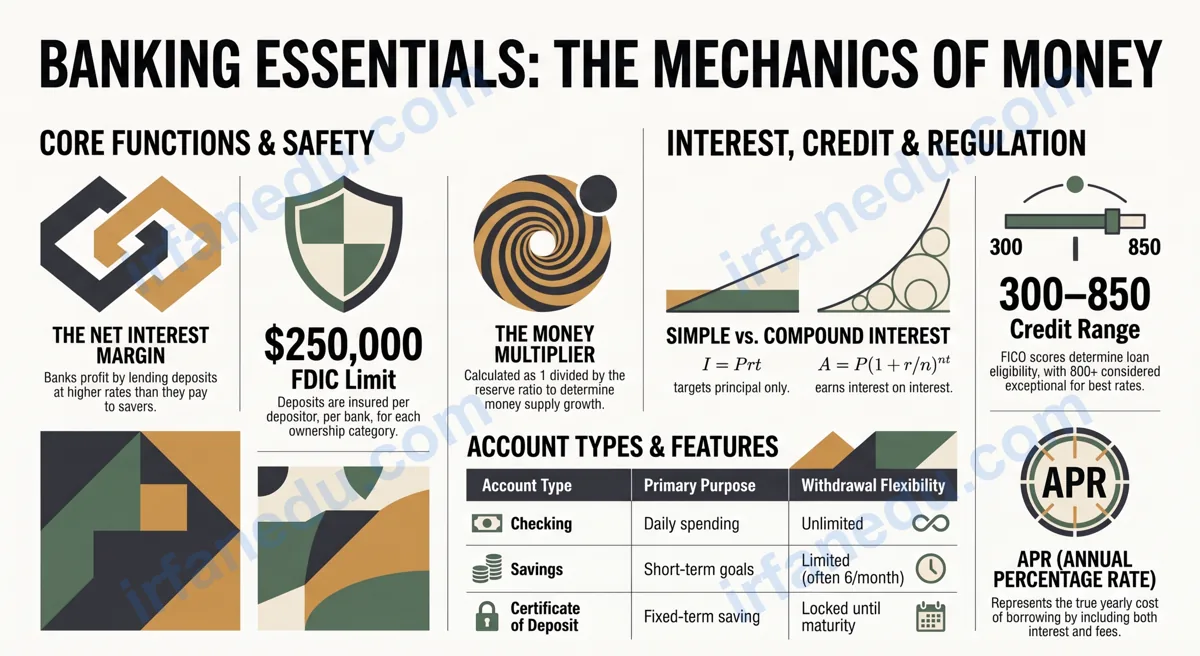
| Commercial bank purpose | Accept deposits, make loans, earn the interest-rate spread |
| FDIC insurance limit (USA) | $250,000 per depositor, per insured bank, per ownership category |
| Simple interest formula | I = P × r × t (principal × rate × time) |
| Compound interest formula | A = P(1 + r/n)nt |
| Credit score range | 300 (poor) to 850 (exceptional) — FICO scale |
| U.S. central bank | Federal Reserve (the “Fed”), established 1913 |
| APR vs. interest rate | APR includes fees; interest rate does not |
| Fractional reserve ratio | Banks lend out most deposits; keep a fraction as reserves |
Banking is the system through which financial institutions accept deposits, extend credit, and facilitate payments. Understanding how banks work is a foundational financial literacy skill — and one of the most tested topics in economics and personal finance courses at the high school level.
If you have ever wondered how a bank makes money, why your savings account earns interest, or what happens to your money when a bank fails, this guide answers all of it. I have taught these concepts to hundreds of students, and I know exactly where confusion creeps in. By the end of this page, you will be able to answer the most common questions on banking with confidence.
You will also get an 8-question interactive quiz with instant feedback and explained answers — so you can test yourself right here without leaving the page.
- Understand the core functions of a bank
- Distinguish between account types and their uses
- Calculate simple and compound interest correctly
- Explain the role of the central bank and FDIC insurance
- Interpret APR and credit scores
- Score well on banking questions in any economics or personal finance exam
Banking questions cover how banks accept deposits, pay interest, issue loans, and manage money safely. Key concepts include types of accounts (checking, savings, certificate of deposit), simple vs compound interest, the role of the central bank, FDIC insurance up to $250,000, and credit scores. Mastering these topics prepares students for personal finance decisions and standardized exams.
⚡ In Short
- Banks earn money by lending deposits at a higher rate than they pay savers.
- Checking accounts are for spending; savings accounts are for growing money.
- Compound interest grows faster than simple interest because interest earns interest.
- The Federal Reserve controls U.S. monetary policy and sets benchmark interest rates.
- FDIC insurance protects deposits up to $250,000 if a bank fails.
- Your credit score (300-850) determines your loan eligibility and interest rate.
What Is Banking and Why Does It Matter?
Banking is the business of safeguarding money, extending credit, and facilitating financial transactions. A bank acts as a financial intermediary: it sits between people who have extra money (depositors) and people who need money (borrowers).
Without banks, a person who wanted to start a business would have to find a willing lender on their own. Banks solve that problem by pooling thousands of small deposits and making them available as large loans. This process drives economic growth — and it is why banking is one of the first topics covered in any economics or personal finance course.
- Deposit-taking: Banks accept money from individuals and businesses, keeping it safe and paying interest.
- Lending: Banks lend that pooled money to borrowers at a higher interest rate, earning a profit called the net interest margin.
- Payment services: Banks process checks, debit card transactions, wire transfers, and electronic payments.
In my experience teaching this topic, students often assume banks simply store money in a vault. The reality is more dynamic: most of your deposit is immediately lent out to someone else. That is the fractional reserve system, and it is central to how modern economies function.
What Are the Main Types of Bank Accounts?
The three most common account types are checking accounts, savings accounts, and certificates of deposit (CDs). Each serves a different purpose, and exam questions frequently ask you to match the account type to a financial scenario.
| Account Type | Primary Purpose | Interest Earned? | Withdrawal Flexibility | Best For |
|---|---|---|---|---|
| Checking | Daily spending | Little or none | Unlimited | Bills, groceries, debit purchases |
| Savings | Short-term saving | Yes (low-moderate) | Limited (often 6/month) | Emergency fund, short-term goals |
| Certificate of Deposit (CD) | Fixed-term saving | Yes (higher rate) | Locked until maturity | Money you won’t need for 6-60 months |
| Money Market | Hybrid saving/spending | Yes (moderate) | Limited with check-writing | Larger balances needing some access |
A common exam trap: students confuse a CD with a savings account. The key difference is that a CD locks your money for a fixed term (say, 12 months). If you withdraw early, you pay a penalty. In exchange, the bank offers a higher interest rate than a standard savings account.
Explore More Study Guides on IrfanEdu
What Is the Difference Between Simple and Compound Interest?
Simple interest is calculated only on the original principal; compound interest is calculated on the principal plus all previously accumulated interest. This distinction is one of the highest-frequency topics in banking questions at every level.
Simple Interest Formula
Where: I = interest earned, P = principal, r = annual rate (decimal), t = time in years
Example: You deposit $2,000 at 4% simple interest for 3 years.
I = 2,000 × 0.04 × 3 = $240
Total balance = $2,000 + $240 = $2,240
Compound Interest Formula
Where: A = final amount, P = principal, r = annual rate (decimal), n = compounding periods per year, t = years
Same example, compounded monthly (n=12):
A = 2,000(1 + 0.04/12)12×3 = 2,000(1.003333)36 ≈ $2,254.54
Interest earned = $254.54 (vs. $240 with simple interest)
The difference looks small over 3 years, but over 30 years at the same rate, compound interest produces dramatically more wealth. That is the core argument for starting to save early.
Simple Interest Growth (4%, $2,000)
Year 0  |========| $2,000
Year 1  |=========| $2,080
Year 2  |==========| $2,160
Year 3  |===========| $2,240   (+$240 total)

Compound Interest Growth (4% monthly, $2,000)
Year 0  |========| $2,000
Year 1  |=========| $2,081.60
Year 2  |==========| $2,165.96
Year 3  |===========| $2,254.54  (+$254.54 total)

Each "=" = ~$100. Compound grows wider each year
because interest earns interest on itself.
How to Calculate Compound Interest Step by Step
- Identify the principal (P). Write down the starting deposit or loan amount.
- Find the annual rate (r) and convert to decimal. 6% becomes 0.06.
- Determine compounding frequency (n). Monthly = 12, quarterly = 4, annually = 1.
- Note the time period (t) in years. 18 months = 1.5 years.
- Plug into A = P(1 + r/n)nt and solve. Subtract P to find interest earned.
In my experience, the single biggest mistake students make on banking exams is applying the simple interest formula when the question says “compounded.” Always read the problem twice and circle the compounding frequency. A question that says “compounded annually” with n=1 is still compound interest — not simple — and the formulas give different answers even when n=1 over multiple periods.
What Does a Central Bank Do?
A central bank is a government-linked institution that manages a country’s money supply, sets benchmark interest rates, and acts as a lender of last resort to commercial banks. In the United States, the central bank is the Federal Reserve System, commonly called “the Fed.”
The Fed has two main goals, known as the dual mandate: maximum employment and stable prices (low inflation). It pursues these goals primarily by raising or lowering the federal funds rate — the rate at which banks lend to each other overnight. When the Fed raises rates, borrowing becomes more expensive, which slows spending and cools inflation. When it cuts rates, borrowing becomes cheaper, which stimulates the economy.
- Federal funds rate: The benchmark short-term interest rate that influences all other rates.
- Open market operations: Buying or selling government bonds to add or remove money from the banking system.
- Reserve requirements: The minimum fraction of deposits banks must hold (currently set to zero in the U.S., but the concept is still tested).
- Discount rate: The rate the Fed charges banks that borrow directly from it.
What Is FDIC Insurance and Who Needs It?
The FDIC (Federal Deposit Insurance Corporation) is a U.S. government agency that insures deposits at member banks up to $250,000 per depositor, per insured bank, per ownership category. If an insured bank fails, the FDIC pays depositors back up to that limit — usually within a few business days.
FDIC insurance covers checking accounts, savings accounts, money market deposit accounts, and CDs. It does NOT cover investment products like stocks, bonds, or mutual funds, even if you bought them through a bank branch.
- Stocks, bonds, and mutual funds
- Annuities and life insurance products
- Cryptocurrency held at a bank
- Safe deposit box contents
- Losses from fraud (that is a separate legal matter)
How Do Credit Scores and Loans Work?
A credit score is a three-digit number that summarizes your history of borrowing and repaying money. The most widely used model is the FICO score, which ranges from 300 to 850. Banks use credit scores to decide whether to approve a loan application and what interest rate to charge.
| Score Range | Category | Typical Loan Impact |
|---|---|---|
| 800 – 850 | Exceptional | Best rates available; easy approval |
| 740 – 799 | Very Good | Near-best rates; strong approval odds |
| 670 – 739 | Good | Competitive rates; most loans approved |
| 580 – 669 | Fair | Higher rates; some lenders decline |
| 300 – 579 | Poor | Very high rates or denial; secured cards only |
The five factors that determine your FICO score are payment history (35%), amounts owed (30%), length of credit history (15%), new credit (10%), and credit mix (10%). Payment history is the single biggest factor — one missed payment can drop your score significantly.
What Is APR and How Is It Different From an Interest Rate?
APR (Annual Percentage Rate) is the true yearly cost of borrowing, expressed as a percentage. It includes both the interest rate and any fees charged by the lender. A loan advertised at 5.9% interest might carry a 6.4% APR once origination fees are factored in. Always compare APRs when shopping for loans — not just the headline interest rate.
Master Exponential Functions Used in Finance
Most banking guides teach compound interest as a savings tool and stop there. But the same math works against you when you borrow. A credit card charging 24% APR compounded daily means your debt grows at roughly (1 + 0.24/365)365 − 1 ≈ 27.1% effective annual rate — not 24%. That gap is why minimum-payment traps are so powerful. In my experience, students who understand this calculation are far more cautious about carrying a credit card balance than those who only hear “24% is high.”
A second non-obvious point: the Federal Reserve does not print money directly. The U.S. Treasury’s Bureau of Engraving and Printing physically prints currency. The Fed creates money electronically through open market operations — buying assets and crediting bank reserve accounts. This distinction trips up many students on economics exams.
How Does Fractional Reserve Banking Work?
Fractional reserve banking is the system in which banks hold only a fraction of deposits as cash reserves and lend out the rest. This practice multiplies the money supply beyond the physical currency in existence.
Here is a simplified example. Suppose the reserve ratio is 10%. You deposit $1,000. The bank keeps $100 and lends $900 to a business. That business deposits the $900 at another bank, which keeps $90 and lends $810. This chain continues until the original $1,000 deposit has theoretically supported up to $10,000 in total deposits across the banking system. This multiplier effect is called the money multiplier, calculated as 1 / reserve ratio.
Money Multiplier = 1 / Reserve Ratio
If reserve ratio = 10% (0.10): Multiplier = 1 / 0.10 = 10
A $1,000 deposit can support up to $10,000 in the money supply.
Note: The actual multiplier is lower in practice because banks hold excess reserves and not all money is re-deposited.
What Do Most Students Get Wrong About Banking Questions?
After reviewing hundreds of student answers, I have identified five recurring errors that cost marks on banking exams.
- Confusing APR with interest rate. APR is always equal to or higher than the stated interest rate because it includes fees. Never treat them as interchangeable.
- Applying simple interest to compound interest problems. If the question says “compounded,” use A = P(1 + r/n)nt, not I = Prt.
- Thinking FDIC covers investments. FDIC covers deposit accounts only — not stocks, bonds, or mutual funds held at a bank.
- Assuming the Fed prints money. The Fed creates money electronically through open market operations; physical currency is printed by the Treasury.
- Mixing up the discount rate and the federal funds rate. The federal funds rate is what banks charge each other; the discount rate is what the Fed charges banks that borrow from it directly.
Interactive Banking Quiz (8 Questions)
Select an answer to see instant feedback and an explanation.
1. A bank’s primary way of earning profit is by:
2. You deposit $5,000 at 3% simple interest for 4 years. How much interest do you earn?
3. The FDIC insures deposits up to what amount per depositor, per insured bank?
4. Which account type typically locks your money for a fixed term in exchange for a higher interest rate?
5. The Federal Reserve’s “dual mandate” refers to its goals of:
6. A loan advertises a 5.5% interest rate but a 6.1% APR. The difference is most likely due to:
7. If the reserve ratio is 20%, the money multiplier is:
8. Which of the following is NOT covered by FDIC insurance?
Related guides
Sources & References
Written and fact-checked by Dr Irfan Mansuri. External links open in a new tab and are provided for further reading and verification.