
Science for Eighth Graders: The Complete Study Guide
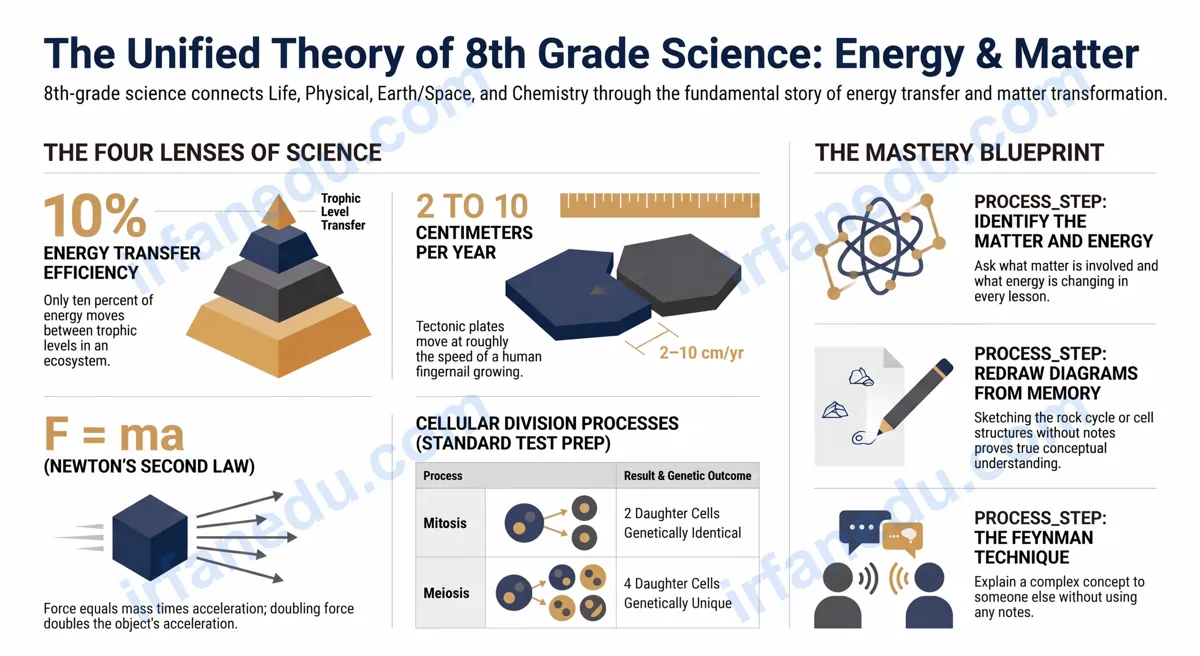
Here is the part most people miss about 8th grade science: it is not four separate subjects. It is one subject — energy and matter — told through four different lenses. Once you see that thread, everything clicks faster.
Most guides list the topics. This one connects them. By the end, you will understand not just what each concept is, but why it sits in the 8th grade curriculum and how it feeds directly into high school physics and chemistry.
Science for eighth graders is a four-domain course covering life science, physical science, earth and space science, and introductory chemistry. The curriculum builds on 6th and 7th grade foundations and prepares students for high school science by introducing forces, Newton’s laws, cell division, genetics, plate tectonics, the periodic table, and chemical reactions — all connected by the central themes of energy transfer and matter transformation.
- Understand the four domains and how they connect
- Master the key concepts, vocabulary, and formulas in each domain
- Apply concepts through worked examples and practice problems
- Avoid the most common mistakes 8th graders make on tests
- Build a study strategy that actually works for science
⚡ TL;DR – Quick Summary
- 8th grade science spans four domains: life, physical, earth/space, and chemistry.
- Newton’s three laws of motion are the core of physical science this year.
- Cell division (mitosis vs. meiosis) is the most-tested life science concept.
- The periodic table organizes all elements by atomic number and properties.
- Plate tectonics explains earthquakes, volcanoes, and mountain formation.
- Energy transfer connects all four domains — that is the real theme of the course.
| Domain | Core Topics | Key Formula / Rule | Connects To |
|---|---|---|---|
| Life Science | Cells, DNA, mitosis, meiosis, genetics, ecosystems | Punnett square ratios | Biology / AP Bio |
| Physical Science | Forces, Newton’s laws, motion, waves, energy | F = ma | Physics / AP Physics |
| Earth & Space | Plate tectonics, rock cycle, weather, solar system | Density = mass / volume | Earth Science / Geology |
| Chemistry | Atoms, periodic table, bonding, reactions | Conservation of mass | Chemistry / AP Chem |
The Part Most Students Miss About 8th Grade Science
Every 8th grade science topic is secretly about two things: matter (what stuff is made of) and energy (what makes stuff change). That is not a motivational statement — it is a structural fact about the curriculum.
Cells use chemical energy from food. Forces transfer kinetic energy between objects. Tectonic plates move because of heat energy from Earth’s core. Chemical reactions rearrange matter while releasing or absorbing energy. When you frame every new concept as “what kind of matter?” and “what kind of energy?”, you cut your memorization load in half.
In my experience teaching middle school science, the students who struggle most are the ones who treat each unit as a fresh start. The students who excel are the ones who ask, “Where did the energy go?” at the end of every lesson. That single habit — tracking energy — is worth more than any flashcard deck.
What Are the Four Domains of 8th Grade Science?
The four domains are the organizing framework for the entire year. Each domain has its own vocabulary, tools, and way of asking questions — but they share the same underlying logic.
- Life Science — studies living things: their structure (cells), reproduction (mitosis/meiosis), inheritance (genetics), and relationships (ecosystems).
- Physical Science — studies matter and energy in motion: forces, Newton’s laws, waves, and the electromagnetic spectrum.
- Earth and Space Science — studies Earth’s systems (plate tectonics, rock cycle, weather) and its place in the solar system.
- Chemistry — studies the composition of matter: atoms, elements, the periodic table, chemical bonds, and reactions.
Life Science: Cells, Genetics, and Ecosystems
Life science in 8th grade focuses on three big ideas: how cells work and divide, how traits are inherited, and how organisms interact in ecosystems.
Cells and Cell Division
Every living thing is made of cells. Animal cells and plant cells share most organelles — nucleus, mitochondria, ribosomes, endoplasmic reticulum — but plant cells also have a cell wall, chloroplasts, and a large central vacuole.
A skin cell (46 chromosomes) divides by mitosis to repair a cut. Result: 2 daughter cells, each with 46 chromosomes, genetically identical to the parent.
A reproductive cell divides by meiosis to form sperm or eggs. Result: 4 daughter cells, each with 23 chromosomes, genetically unique (due to crossing over).
The key distinction: mitosis preserves chromosome number; meiosis halves it. This halving is essential — when sperm (23) meets egg (23), the resulting zygote has the correct 46 chromosomes.
Genetics and Heredity
Genetics explains why offspring resemble but are not identical to their parents. Gregor Mendel’s work with pea plants established the foundational rules: dominant alleles mask recessive ones, and alleles segregate independently during meiosis.
A parent with genotype Bb (brown eyes, B dominant) crosses with a parent also Bb.
Punnett square results: BB (25%), Bb (50%), bb (25%)
Phenotype ratio: 3 brown : 1 blue
Takeaway: even two brown-eyed parents can have a blue-eyed child if both carry the recessive allele.
Ecosystems and Energy Flow
An ecosystem is a community of living organisms interacting with their physical environment. Energy enters through producers (plants, algae) via photosynthesis and flows through consumers and decomposers.
Only about 10% of energy transfers from one trophic level to the next. This is why food chains rarely exceed five links — there is simply not enough energy left to support a sixth level.
[IMAGE: Food web diagram showing grass, rabbit, fox, and decomposers with energy-flow arrows | ALT: 8th grade science food web diagram showing energy flow from producers to consumers]
Physical Science: Forces, Motion, and Energy
Physical science is where 8th grade gets most mathematical. Newton’s three laws of motion are the centerpiece, and they appear on virtually every standardized test.
Newton’s Three Laws — Plain English
| Law | Plain English | Classic Example |
|---|---|---|
| 1st — Inertia | Objects keep doing what they are doing unless a force acts on them. | A ball rolling on ice keeps rolling; friction eventually stops it. |
| 2nd — F = ma | Force equals mass times acceleration. | Pushing a shopping cart harder makes it accelerate faster. |
| 3rd — Action-Reaction | Every action has an equal and opposite reaction. | A rocket pushes gas down; gas pushes the rocket up. |
A 5 kg box is pushed with a net force of 20 N. What is its acceleration?
F = ma → a = F ÷ m = 20 ÷ 5 = 4 m/s²
Now double the force to 40 N: a = 40 ÷ 5 = 8 m/s². Doubling the force doubles the acceleration — exactly what the 2nd law predicts.
          Applied Force (F = 20 N) →
  ┌─────────────────┐
  │                 │  ← Friction (opposing motion)
  │    5 kg Box     │
  │                 │
  └─────────────────┘
        ↓ Weight (mg)
        ↑ Normal Force (N)

  Net Force = Applied Force - Friction
  If friction = 0: a = 20 N ÷ 5 kg = 4 m/s²
Waves and Energy Transfer
Waves transfer energy without transferring matter. The two main types are mechanical waves (need a medium — sound, water waves) and electromagnetic waves (need no medium — light, radio waves, X-rays).
Key wave vocabulary: amplitude (height of the wave, relates to energy), wavelength (distance between peaks), frequency (waves per second, measured in Hz), and wave speed = frequency × wavelength.
Earth and Space Science: Plate Tectonics and Beyond
Earth and space science covers the dynamic systems that shape our planet and its place in the universe. The unifying concept is that Earth is not static — it is constantly changing.
Plate Tectonics
Earth’s lithosphere is divided into about 15 major tectonic plates that move 2-10 cm per year — roughly the speed your fingernails grow. This movement is driven by convection currents in the mantle: hot rock rises, spreads, cools, and sinks in a slow conveyor belt.
| Boundary Type | Plates Move | Result | Example |
|---|---|---|---|
| Convergent | Toward each other | Mountains, trenches, volcanoes | Himalayas, Mariana Trench |
| Divergent | Away from each other | New ocean floor, rift valleys | Mid-Atlantic Ridge |
| Transform | Past each other | Earthquakes | San Andreas Fault |
The Rock Cycle
Rocks are not permanent. Igneous rock (cooled magma) can be broken down into sediment, compressed into sedimentary rock, heated and pressurized into metamorphic rock, and melted back into magma. The cycle has no start or end point — it is continuous.
The Solar System
Our solar system contains eight planets, dwarf planets, moons, asteroids, and comets — all orbiting the Sun due to gravity. The inner four planets (Mercury, Venus, Earth, Mars) are rocky; the outer four (Jupiter, Saturn, Uranus, Neptune) are gas or ice giants.
The most underrated topic in 8th grade earth science is the rock cycle. Students memorize the three rock types but miss the process. In my experience, the best way to remember it is to think of rocks as matter in a slow recycling program — the same atoms that were once in a volcano are now in the chalk on your desk. That reframe makes the cycle feel real, not abstract.
Chemistry: Atoms, Elements, and Reactions
Chemistry in 8th grade introduces the atomic model and the periodic table — the two tools that make all of chemistry possible.
Structure of the Atom
An atom has three subatomic particles: protons (positive charge, in the nucleus), neutrons (no charge, in the nucleus), and electrons (negative charge, orbiting the nucleus in shells). The number of protons defines the element — change the proton count and you have a different element entirely.
Carbon (C) has atomic number 6 and atomic mass ~12.
Protons = 6, Electrons = 6 (neutral atom), Neutrons = 12 – 6 = 6.
Carbon-14 (used in radioactive dating) has 6 protons and 8 neutrons — same element, different isotope.
The Periodic Table
The periodic table organizes all 118 known elements by increasing atomic number. Elements in the same group (column) share similar chemical properties because they have the same number of valence electrons. Elements in the same period (row) have the same number of electron shells.
Chemical Reactions
A chemical reaction rearranges atoms to form new substances. The Law of Conservation of Mass states that atoms are never created or destroyed in a reaction — the same atoms appear on both sides of the equation, just rearranged.
Unbalanced: H₂ + O₂ → H₂O
Count atoms: Left: 2H, 2O. Right: 2H, 1O. Oxygen is unbalanced.
Balanced: 2H₂ + O₂ → 2H₂O
Check: Left: 4H, 2O. Right: 4H, 2O. Balanced.
How to Study 8th Grade Science Effectively
The right study method depends on the type of content. Vocabulary requires spaced repetition. Formulas require worked examples. Diagrams require drawing from memory. Concepts require explaining out loud.
- Map the four domains. Identify which domain your current unit falls under and activate prior knowledge from that domain.
- Learn vocabulary first. Write each term, its definition, and one example sentence. Science tests are largely vocabulary tests in disguise.
- Work through at least one example problem per concept. Reading a formula is not the same as using it.
- Draw diagrams from memory. Redraw the cell, the force diagram, or the rock cycle without looking. If you can draw it, you understand it.
- Connect concepts across domains. Ask “how does energy appear in life science, physical science, and earth science?” Cross-domain thinking separates A students from B students.
- Test yourself with practice questions. Active recall beats re-reading every time. Use the quiz and problems below.
Common Mistakes in 8th Grade Science (Wrong vs. Right)
These are the errors I see most often — and the corrections that fix them fast.
| Common Mistake | Why It’s Wrong | The Correct Thinking |
|---|---|---|
| “Meiosis is just mitosis with fewer chromosomes.” | Meiosis has two rounds of division and produces genetically unique cells via crossing over. | Meiosis is a fundamentally different process with a different purpose: genetic diversity for reproduction. |
| “Heavier objects fall faster.” | In a vacuum, all objects fall at the same rate (9.8 m/s²) regardless of mass. | Air resistance makes a feather fall slower than a rock, but gravity accelerates both equally. |
| “Elements and compounds are the same thing.” | An element is one type of atom; a compound is two or more different elements bonded together. | Oxygen (O₂) is an element. Water (H₂O) is a compound. They behave very differently. |
| “Tectonic plates move because of earthquakes.” | Cause and effect are reversed. Earthquakes happen because plates move. | Mantle convection drives plate movement; the resulting stress releases as earthquakes. |
| “A food chain and a food web are the same.” | A chain is one linear path; a web shows all feeding relationships in an ecosystem. | Food webs are more accurate because most animals eat and are eaten by multiple species. |
Most guides teach the four domains as separate silos. But the NGSS (Next Generation Science Standards) framework that underpins most US 8th grade curricula is explicitly built around crosscutting concepts — patterns, cause and effect, energy and matter, systems — that appear in every domain. The students who score highest on standardized assessments are not the ones who memorized the most facts per domain; they are the ones who can apply a concept like “energy transfer” to an unfamiliar scenario in any domain. When you study, always ask: “What crosscutting concept is this unit really about?” That question alone will lift your test performance more than any extra hour of re-reading notes.
Quick Quiz: Test Your 8th Grade Science Knowledge
3-Question Science Check
1. A 10 kg object accelerates at 3 m/s². What is the net force acting on it?
2. Which process produces genetically unique cells for reproduction?
3. At a convergent plate boundary, what most commonly forms?
Reveal-on-Click Practice Problems
Problem 1: A plant cell and an animal cell both have mitochondria. What does this tell us about their common ancestor?
Problem 2: A wave has a frequency of 200 Hz and a wavelength of 1.5 m. What is its speed?
Problem 3: Balance this equation: Fe + O₂ → Fe₂O₃ (iron rust)
Check — Left: 4 Fe, 6 O. Right: 4 Fe (2×2), 6 O (2×3). Balanced. The key is to balance iron first, then adjust oxygen, then verify both sides match.
Problem 4: Two parents are both carriers of a recessive disease (Aa × Aa). What is the probability their child will have the disease?
Frequently Asked Questions
What science topics are covered in 8th grade?
What is Newton’s Second Law in simple terms?
What is the difference between mitosis and meiosis?
How do atoms relate to elements and compounds?
What causes earthquakes and volcanoes?
What is the difference between a food chain and a food web?
How do you read the periodic table in 8th grade?
Key Takeaways
- 8th grade science covers four domains: life science, physical science, earth/space science, and chemistry.
- The unifying theme across all four domains is energy transfer and matter transformation.
- Newton’s Second Law (F = ma) is the most-used formula in physical science this year.
- Mitosis produces identical cells for growth; meiosis produces unique cells for reproduction.
- Tectonic plate movement — driven by mantle conv
Sources & References
Reviewed by Dr. Irfan Mansuri. External links open in a new tab and are provided for further reading and verification.