
Long Division Polynomials Calculator: Solve Any Problem Step by Step

Polynomial long division trips up more algebra students than almost any other topic — not because the concept is hard, but because one misaligned column or a forgotten sign flip derails the whole problem. This page gives you a working calculator that shows every single step, plus a method guide that builds from the easiest case to the hardest, so you can see exactly where your work goes wrong.
Polynomial long division is an algorithm that divides a higher-degree polynomial (the dividend) by a lower-degree polynomial (the divisor) to produce a quotient and a remainder. The process repeats four steps — Divide, Multiply, Subtract, Bring Down — until the remainder’s degree is less than the divisor’s degree.
Polynomial Long Division Calculator
Enter polynomials using ^ for exponents (e.g. x^3+2x^2-x-2)
Standard form, highest degree first. Use ^ for powers. Spaces are OK.
Must be degree 1 or higher and lower degree than the dividend.
Step-by-step solution
How to use this calculator
- Type the dividend — the polynomial you want to divide — in the first field. Write it in standard form, highest degree first (e.g.
x^3+2x^2-x-2). - Type the divisor in the second field (e.g.
x-1). It must be at least degree 1. - Click Calculate. The result card shows the quotient, remainder, and a numbered step-by-step breakdown.
- Click Reset to clear everything and try a new problem.
Missing terms? The calculator handles them automatically. If your polynomial is x^3-8, just type it as-is — the parser fills in zero coefficients for missing degrees.
From easiest to hardest: the four levels of polynomial long division
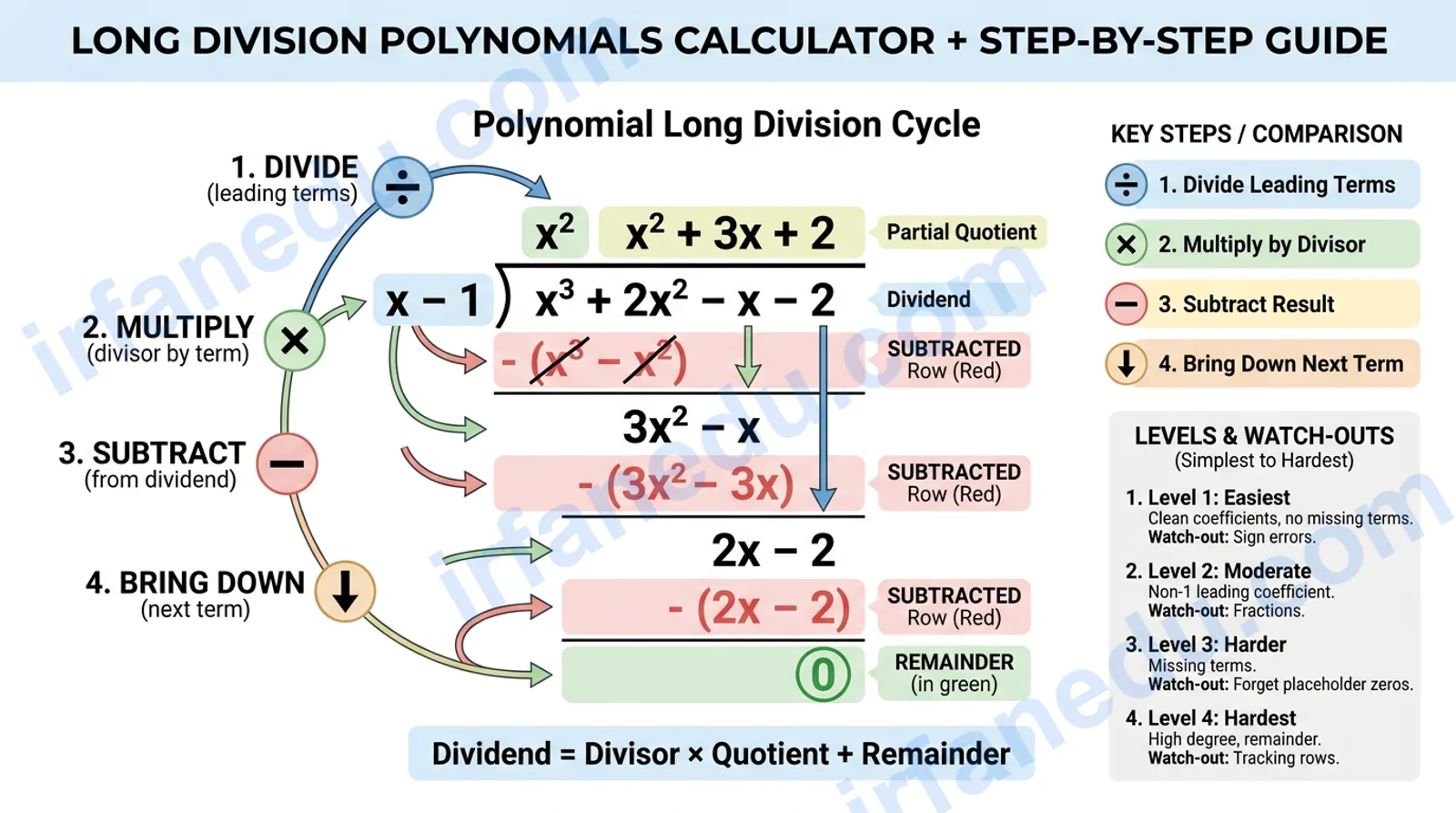
Not all polynomial division problems are the same. Here is how I rank them by difficulty, and what changes at each level.
| Level | Example | What makes it harder | Key watch-out |
|---|---|---|---|
| 1 — Easiest | (x²+3x+2) ÷ (x+1) | Nothing — clean integer coefficients, no missing terms, exact division | Sign errors in subtraction |
| 2 — Moderate | (2x²+5x+3) ÷ (2x+3) | Non-1 leading coefficient in divisor | Dividing leading terms with fractions |
| 3 — Harder | (x³−8) ÷ (x−2) | Missing terms (x² and x are absent) | Forgetting placeholder zeros |
| 4 — Hardest | (2x⁴+x³−3x+1) ÷ (x²+x−1) | High degree + non-1 divisor + remainder | Tracking 5+ rows without misalignment |
In my experience teaching algebra, students who struggle at Level 3 almost always forgot to insert the zero placeholder. Once they add +0x²+0x, the problem becomes Level 1 again.
What is polynomial long division?
Polynomial long division is an algorithm for dividing a polynomial of degree n by a polynomial of degree m (where m ≤ n), producing a quotient of degree n−m and a remainder of degree less than m. The relationship that always holds is:
This is identical in structure to integer division: 17 ÷ 5 = 3 remainder 2, so 17 = 5 × 3 + 2. The same logic applies to polynomials.
The divide-multiply-subtract-bring-down cycle
Every iteration of polynomial long division follows the same four-step cycle. Repeat it until the remainder’s degree drops below the divisor’s degree.
- Divide the leading term of the current dividend by the leading term of the divisor. This gives the next quotient term.
- Multiply the entire divisor by that quotient term.
- Subtract the product from the current dividend. (This is where most sign errors happen.)
- Bring down the next term from the original dividend to form the new working dividend.
| Symbol | Meaning | Example |
|---|---|---|
| P(x) | Dividend polynomial | x³+2x²−x−2 |
| D(x) | Divisor polynomial | x−1 |
| Q(x) | Quotient polynomial | x²+3x+2 |
| R(x) | Remainder polynomial (deg < deg D) | 0 |
| deg | Degree (highest exponent) | deg(x³) = 3 |
Worked examples (matching the calculator’s output)
Example 1 — Level 1: (x²+3x+2) ÷ (x+1)
         x + 2
       ─────────────
x + 1 ) x² + 3x + 2
        x² +  x          ← multiply (x+1) by x
        ─────────
             2x + 2
             2x + 2       ← multiply (x+1) by 2
             ───────
                  0       ← remainder = 0
Answer: Quotient = x + 2, Remainder = 0. Since the remainder is zero, (x+1) is a factor of x²+3x+2.
Example 2 — Level 3: (x³−8) ÷ (x−2)
The dividend is missing the x² and x terms. Insert placeholders: x³ + 0x² + 0x − 8.
           x² + 2x + 4
         ───────────────
x − 2  ) x³ + 0x² + 0x − 8
          x³ − 2x²             ← multiply (x−2) by x²
          ──────────
               2x² + 0x
               2x² − 4x        ← multiply (x−2) by 2x
               ─────────
                    4x − 8
                    4x − 8     ← multiply (x−2) by 4
                    ───────
                         0     ← remainder = 0
Answer: x² + 2x + 4, Remainder = 0. This confirms the factorization: x³ − 8 = (x−2)(x²+2x+4).
Every tutorial tells you to “subtract carefully.” What they don’t say is why subtraction is the step that breaks most students’ work: when you subtract a polynomial, you are distributing a negative sign across every term of the product row — not just the first one. A common error is writing x² − 2x² correctly but then adding (instead of subtracting) the constant term in the same row. The fix: rewrite the subtraction as adding the opposite. Instead of subtracting x² − 2x, add −x² + 2x. This one habit eliminates the most common sign error in polynomial long division.
A second non-obvious point: the Remainder Theorem gives you a fast sanity check. If you divided P(x) by (x − c), evaluate P(c). If P(c) equals your remainder, your division is correct. For Example 2 above, P(2) = 8 − 8 = 0, which matches the remainder of 0.
Common mistakes and how to fix them
Wrong vs. right: the four most frequent errors
- Missing placeholder zeros — Wrong: divide x³−8 as if it has 4 terms. Right: write x³+0x²+0x−8 before you start.
- Sign flip on subtraction — Wrong: subtract only the first term of the product. Right: flip the sign of every term in the product row, then add.
- Stopping too early — Wrong: stop when the remainder looks “small.” Right: keep dividing until the remainder’s degree is strictly less than the divisor’s degree.
- Miswriting the final answer — Wrong: write only the quotient. Right: write Quotient + Remainder/Divisor when the remainder is non-zero.
Want to master the full geometry and algebra formula toolkit for standardized tests? My complete reference has every formula you need in one place:
Complete Geometry Formula Sheet →
Quick check: test your understanding
3-question quiz
1. What is the first step in polynomial long division?
2. When dividing (x³−8) by (x−2), what should you write for the missing terms?
3. If dividing P(x) by (x−3) gives remainder 7, what is P(3)?
Sources & References
Written and fact-checked by Dr Irfan Mansuri. External links open in a new tab and are provided for further reading and verification.