
ASE Practice Test: How the Exam Works and How to Pass It
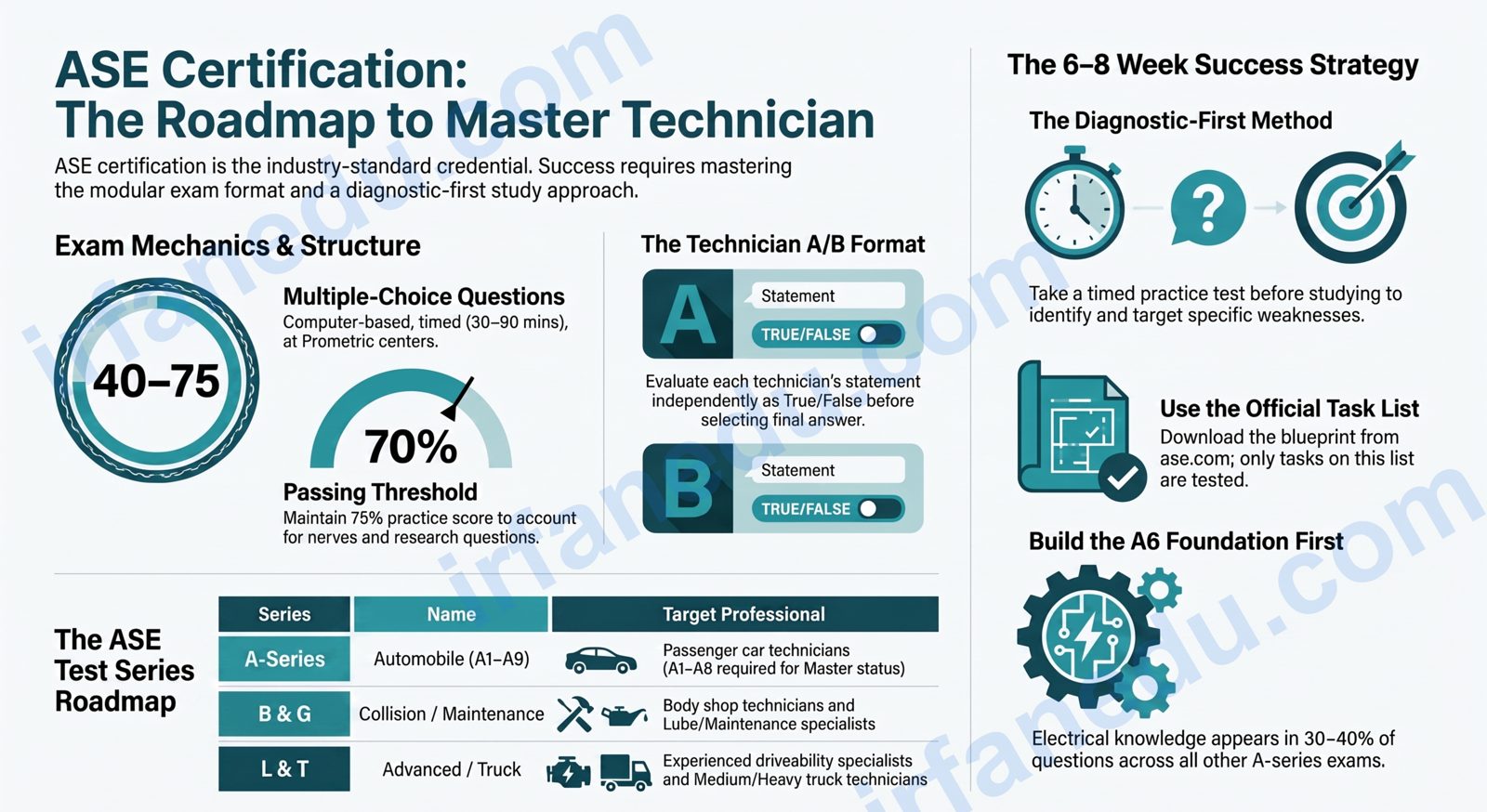
The ASE (Automotive Service Excellence) certification is the most recognized credential in the automotive repair industry. Whether you are preparing for your first A1 Engine Repair test or working toward Master Technician status, knowing exactly how the exam is built — before you sit it — is the single biggest advantage you can give yourself.
An ASE practice test is a simulated exam that replicates the format, question style, and topic weighting of the official ASE certification tests. Each real ASE exam contains 40 to 75 multiple-choice questions, covers one specific vehicle system, and is administered at a Prometric testing center. Practicing under realistic timed conditions before exam day is the most reliable way to close knowledge gaps and build the pacing skills the real test demands.
- Understand the structure of every major ASE test series.
- Learn how to use practice tests diagnostically, not just as review.
- Follow a step-by-step study plan that fits a 6–8 week window.
- Identify the most common question traps and how to avoid them.
📌 Quick Summary
- ASE tests are 40–75 multiple-choice questions per series, timed at a Prometric center.
- The A-series (A1–A9) covers the full range of automobile repair specialties.
- You need roughly 70% correct to pass; practice consistently above 75% to build a safety margin.
- The official ASE task list is the exact exam blueprint — study it before anything else.
- Diagnostic practice tests (taken before studying) reveal weak spots faster than re-reading notes.
- Two years of hands-on experience is required to receive the credential after passing.
How the ASE Exam System Works
The ASE certification program tests automotive technicians on specific vehicle systems through standardized, computer-based multiple-choice exams administered at Prometric testing centers worldwide. ASE does not run its own test centers — it partners with Prometric, which means you book your seat the same way you would for many other professional licensing exams.
Each test is independent. You do not have to pass all tests in a series at once. You can sit A1 (Engine Repair) in one testing window and A5 (Brakes) in the next. This modular design lets working technicians earn credentials one specialty at a time without taking extended time off.
Core Mechanics of the ASE Exam
- Format: Multiple-choice, four answer options per question (one correct, three distractors).
- Question count: 40–75 questions depending on the series.
- Time limit: Approximately 30–90 minutes per test (varies by series).
- Delivery: Computer-based at a Prometric testing center.
- Scoring: Scaled score; approximately 70% correct is the passing benchmark.
- Credential validity: 5 years, then recertification is required.
- Experience requirement: 2 years hands-on (or 1 year + a 2-year automotive degree) to receive the credential.
One detail most guides skip: ASE includes “research questions” (unscored pilot items) embedded in the live exam. You cannot identify them, and they do not count toward your score. This means the effective question count is slightly lower than the total shown — another reason to practice pacing so you are not rattled by questions that seem unusually obscure.
ASE Test Series: What Each One Covers
ASE organizes its certification tests into lettered series, each targeting a different segment of the automotive and heavy-duty industry. Understanding which series applies to your career path is the first step before you pick a practice test.
| Series | Name | Tests Included | Who It Is For |
|---|---|---|---|
| A | Automobile | A1–A9 (Engine, Auto Trans, Manual Drive, Steering, Brakes, Electrical, HVAC, Engine Performance, Light Vehicle Diesel) | Passenger car technicians |
| B | Collision Repair & Refinish | B2–B6 | Body shop technicians |
| C | Service Consultant | C1 | Service advisors / writers |
| G | Auto Maintenance & Light Repair | G1 | Lube/maintenance technicians |
| H | School Bus | H1–H8 | School bus fleet technicians |
| L | Advanced Engine Performance | L1, L2, L3 | Experienced driveability specialists |
| P | Parts Specialist | P2 | Auto parts counter professionals |
| T | Medium/Heavy Truck | T1–T8 | Commercial truck technicians |
If your goal is the prestigious ASE Master Technician designation for automobiles, you must pass all eight A-series tests (A1–A8). The A9 (Light Vehicle Diesel) is separate and not required for Master status.
In my experience working with automotive students, the biggest mistake I see is jumping straight to A8 (Engine Performance) practice tests because it sounds impressive — when the candidate has not yet built the foundational electrical knowledge tested in A6. I always recommend starting with A6 (Electrical/Electronic Systems) even if it is not your target test, because roughly 30–40% of questions in other A-series tests assume that electrical foundation. Build the base first.
What ASE Questions Actually Look Like
ASE questions follow a consistent structure: a stem (the scenario or question), four answer choices labeled A through D, and one correct answer. Understanding the three question types ASE uses helps you answer faster and more accurately.
The Three ASE Question Types
Type 1 — Direct Knowledge: Tests a single fact or definition. Example: “What is the purpose of a PCV valve?” These are the fastest to answer if you know the material.
Type 2 — Technician A / Technician B: Two technicians make statements about a diagnosis or procedure. You must decide which technician is correct (A only, B only, both, or neither). This type trips up more candidates than any other — see the Unique Insight section below.
Type 3 — Most Likely / Least Likely: A symptom or condition is described, and you select the most probable cause or the least likely cause. These test diagnostic reasoning, not just memorization.
  ┌─────────────────────────────────────────────────────────────┐
  │  STEM (scenario + question)                                 │
  │  "A vehicle has a hard start when cold. Technician A says   │
  │   the coolant temp sensor is faulty. Technician B says the  │
  │   fuel pressure regulator is leaking. Who is correct?"      │
  ├─────────────────────────────────────────────────────────────┤
  │  A. Technician A only                                       │
  │  B. Technician B only                                       │
  │  C. Both Technician A and Technician B    ← common trap     │
  │  D. Neither Technician A nor Technician B                   │
  └─────────────────────────────────────────────────────────────┘
  KEY RULE: Evaluate each technician's statement INDEPENDENTLY
  before looking at the answer choices. Do not let A influence B.
The Technician A/B format is designed to test whether you can hold two independent claims in your head simultaneously. Candidates who read both statements together and look for a “story” that connects them consistently pick the wrong answer. Treat each statement as a true/false question first, then match your T/F pair to the answer choices.
Step-by-Step Study Plan for ASE Certification
A structured 6–8 week study plan built around the official ASE task list outperforms any amount of random practice-question grinding. Here is the exact process I recommend.
- Choose your target test series — identify the one or two tests most relevant to your current job role or career goal.
- Download the official ASE task list from ase.com — this is the exact blueprint examiners use to write questions. Every task on the list is fair game; anything not on the list will not appear.
- Take a full diagnostic practice test (timed) before opening any study guide. Your score does not matter here — what matters is which task areas you missed. Mark every wrong answer and group them by task area.
- Study weak task areas first using an official study guide (ASE, Delmar, or Motor Age). Spend 60–70% of your study time on the bottom third of your diagnostic results.
- Take a second timed practice test at week 3 and compare your task-area scores to the diagnostic. If a weak area has not improved, go back to hands-on workshop review — some knowledge only sticks through physical practice.
- Repeat weekly practice tests until you score consistently above 75% on three consecutive tests. The 5% buffer above the ~70% pass mark accounts for test-day nerves and unfamiliar question phrasing.
- Register and book your Prometric slot at ase.com at least two weeks in advance to secure your preferred date and location.
Pre-Exam Checklist (Final 48 Hours)
- Confirm your Prometric appointment and center address
- Check the ID requirements (government-issued photo ID required)
- Review your three most recent practice test wrong answers only — no new material
- Sleep 7–8 hours the night before (fatigue is a leading cause of careless errors)
- Arrive 15 minutes early — late arrivals may forfeit their seat
- Bring a snack/water for the break if your test series allows one
- Trust your first instinct on Technician A/B questions — second-guessing is the #1 score killer
Common Mistakes Candidates Make (and How to Fix Them)
Most first-time ASE failures are not caused by lack of knowledge — they are caused by predictable, fixable study and test-taking errors. Here are the four I see most often.
Mistake 1: Studying from outdated materials
Wrong approach: Using a study guide that is more than two years old without checking the current task list.
Fix: ASE updates task lists periodically. Always download the current version from ase.com and compare it to your study guide’s table of contents before you begin.
Mistake 2: Skipping timed practice
Wrong approach: Doing practice questions in an open-book, untimed format.
Fix: Simulate real conditions from week one. Set a timer. The time pressure of the real exam is a separate skill from knowing the content.
Mistake 3: Memorizing answers instead of understanding systems
Wrong approach: Drilling the same question bank until you recognize the correct answer by memory.
Fix: Use at least two different practice test sources. ASE question banks are not public, so no commercial practice test uses the exact real questions. Understanding the system always beats memorizing one bank’s answers.
Mistake 4: Ignoring the “EXCEPT” and “LEAST LIKELY” qualifiers
Wrong approach: Reading quickly and missing the negative qualifier in the stem.
Fix: Circle or mentally flag every “EXCEPT,” “NOT,” and “LEAST LIKELY” before reading the answer choices. These words completely invert the correct answer.
The single most underrated study tool for ASE prep is a blank piece of paper. After reading a task-list item, I ask students to close the book and explain the system out loud — or draw it. If they cannot explain it in plain language, they do not know it well enough to answer a tricky Technician A/B question about it under time pressure. Verbal and written recall is far more diagnostic than re-reading the same paragraph.
Free vs. Paid ASE Practice Resources: A Comparison
Not all practice materials are equal. Here is an honest breakdown of what free and paid resources actually deliver, based on what I have reviewed across multiple test series.
| Feature | Free Resources | Paid Resources |
|---|---|---|
| Task-list alignment | Variable — often outdated | Usually current (check edition date) |
| Question quality | Inconsistent; some errors | Generally higher, peer-reviewed |
| Technician A/B question count | Low — most free banks avoid them | High — mirrors real exam ratio |
| Detailed answer explanations | Rare | Standard feature |
| Timed exam mode | Rarely available | Standard feature |
| Task-area performance tracking | Not available | Available on most platforms |
| Cost | Free | $20–$80 per series |
| Best use case | Initial exposure, quick review | Primary study tool, diagnostic testing |
My recommendation: use free resources for a rough first pass to gauge your starting point, then invest in one quality paid resource (Delmar ASE Test Prep or Motor Age Training are the two I have seen produce the best results) for your main study cycle. The cost of a retake fee at Prometric far exceeds the cost of a good study guide.
💡 Unique Insight: Why “Diagnostic-First” Beats “Study-Then-Test”
Every major ASE prep guide tells you to study first, then test yourself. In my experience, this is backwards — and the research on retrieval practice backs this up. Taking a full-length timed practice test before you open a study guide does something studying alone cannot: it forces your brain to confront exactly what it does not know, creating a “desirable difficulty” that makes subsequent study stick far better.
More importantly, the ASE task list has roughly 50–80 tasks per series. A diagnostic test taken cold will typically reveal that 60–70% of your wrong answers cluster in just 3–5 task areas. That means you can ignore 75% of the task list for the first two weeks and focus entirely on your personal weak cluster. Candidates who study this way consistently reach passing scores 2–3 weeks faster than those who read the study guide cover-to-cover first. This is not a tip you will find in the official ASE prep materials — but it is the single biggest efficiency gain I have seen in practice.
Quick Knowledge Check: ASE Exam Basics
Select an answer, then click “Show Answer” to check.
1. How many A-series tests must you pass to earn the ASE Master Automobile Technician designation?
2. In a Technician A/B question, what is the best strategy before reading the answer choices?
3. What document should you download from ase.com before starting any study plan?
Practice Problems: Apply What You Know
Click each question to reveal the answer and explanation.
A vehicle cranks normally but will not start. Technician A says a faulty crankshaft position sensor could cause this. Technician B says low fuel pressure could cause this. Who is correct?
A faulty crankshaft position sensor prevents the PCM from triggering spark and/or injection events, causing a no-start. Low fuel pressure (below injector opening threshold) also causes a no-start. Both statements are independently valid diagnoses for a crank-no-start condition. This is a classic “both correct” Technician A/B scenario — the trap is assuming only one cause is possible.
A brake pedal sinks slowly to the floor under steady pressure but the vehicle stops normally with repeated pumping. What is the MOST LIKELY cause?
A pedal that sinks under steady hold but firms up with pumping is the textbook symptom of a master cylinder with worn internal cup seals allowing fluid to bypass internally. There is no external leak (the vehicle stops normally when pumped), ruling out a caliper or wheel cylinder leak as the primary cause. This is a high-frequency A5 (Brakes) question type.
An A/C system blows warm air. The compressor clutch engages. Refrigerant pressure on the high side reads 350 psi and on the low side reads 150 psi (ambient temp 90°F). What does this indicate?
Normal high-side pressure at 90°F ambient should be roughly 200–250 psi; 350 psi is abnormally high. Normal low-side should be 25–45 psi; 150 psi is abnormally high. Both sides elevated with warm air output points to a restriction preventing refrigerant from expanding properly — the classic symptom of a blocked expansion device. This is a common A7 (HVAC) diagnostic scenario.
Frequently Asked Questions About the ASE Practice Test
What is an ASE practice test?
How many questions are on the ASE exam?
What score do you need to pass the ASE exam?
How long do you have to complete an ASE test?
Where can I find free ASE practice tests?
Sources & ReferencesWritten and fact-checked by Dr Irfan Mansuri. External links open in a new tab and are provided for further reading and verification.