
CMAS practice test: which resource should you use — and how?
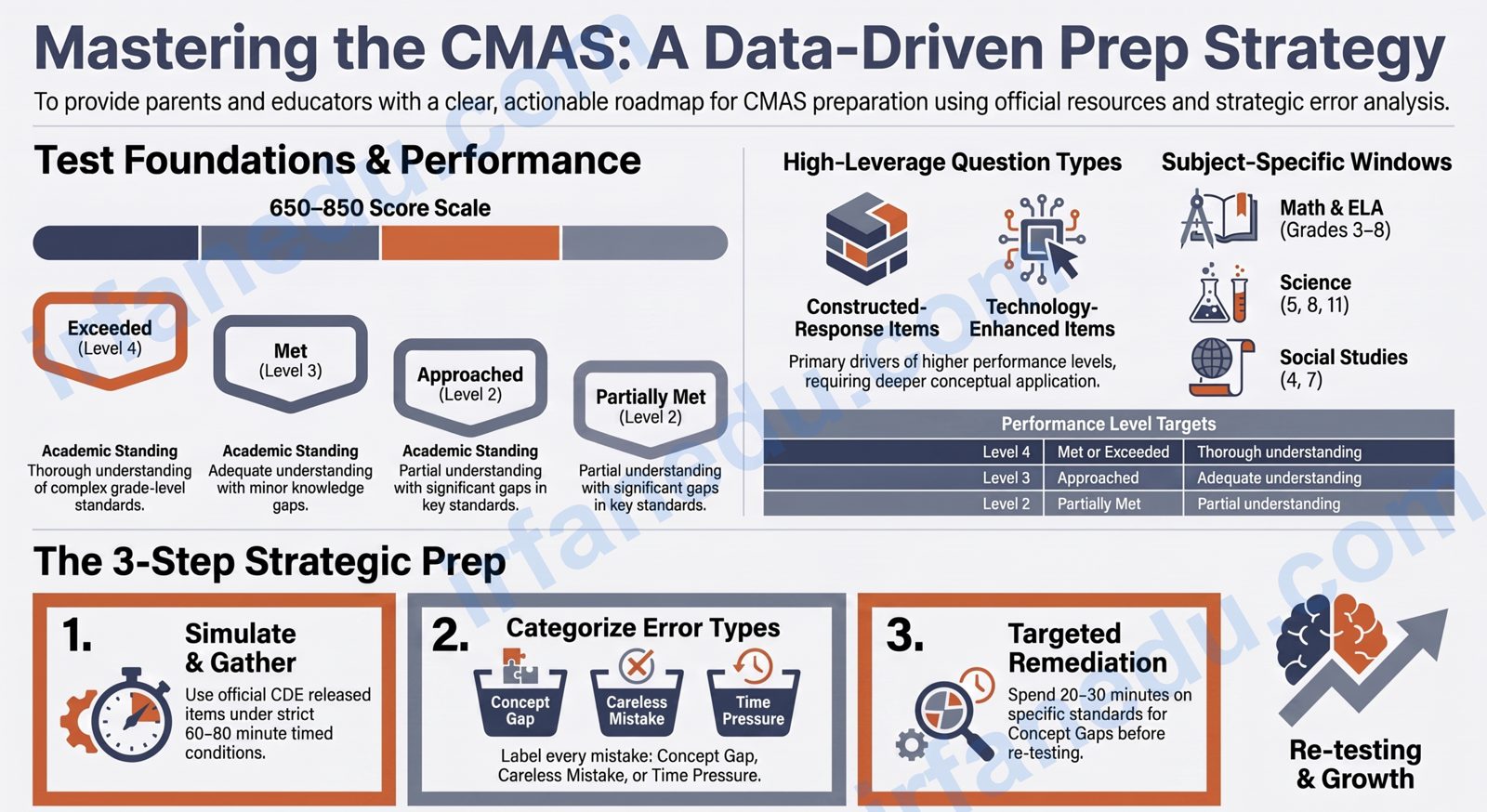
What is the CMAS test?
The CMAS (Colorado Measures of Academic Success) is a state-required standardized assessment for students in grades 3–8 in Colorado. It measures how well students have mastered Colorado Academic Standards in English Language Arts, Math, Science, and Social Studies — and it is administered online each spring.
CMAS is not a pass/fail exam. It places students on a four-level performance scale, and teachers use those results to adjust instruction. That framing matters: the goal of a CMAS practice test is not to “cram” but to build familiarity with question formats and surface genuine knowledge gaps before the real window opens.
Quick facts about the CMAS
| Fact | Detail |
|---|---|
| Full name | Colorado Measures of Academic Success |
| Grades tested | 3–8 (all grades for Math & ELA; 5 & 8 for Science; 4 & 7 for Social Studies) |
| Test window | Spring (typically March–May each year) |
| Format | Computer-based; two sessions per subject on separate days |
| Session length | ~60–80 minutes per session |
| Question types | Multiple choice, multi-select, constructed response, evidence-based writing, technology-enhanced |
| Performance levels | Level 1 (Did Not Yet Meet) → Level 4 (Met or Exceeded) |
| Score scale | Approximately 650–850 (varies by grade and subject) |
| Calculator policy | Allowed on designated math sections only (online calculator provided) |
| Official practice source | Colorado Dept. of Education / DRC INSIGHT portal |
Which CMAS practice test resource should you use?
This is the real decision most parents and teachers face. There are three categories of CMAS practice material, and they are not equally useful. Choosing the wrong one wastes study time and can give a false sense of readiness.
Here is how I categorize them after reviewing the landscape of available resources:
- Official released items (CDE / DRC INSIGHT) — actual retired CMAS questions, exact format match, free.
- Aligned third-party platforms (e.g. Khan Academy, Edulastic, IXL) — standards-aligned practice, good for skill-building, not always format-identical.
- Generic “CMAS practice test” PDFs found on random sites — often misaligned, sometimes factually wrong, and not worth your time.
The decision guide below helps you pick the right one based on your specific situation.
Decision table: matching the right resource to your situation 🎯
Use this table to identify the best CMAS practice test resource for your specific goal. Each row maps a situation to the recommended resource and explains why.
| Your situation | Best resource | Why it fits | Where to find it |
|---|---|---|---|
| You want the most accurate simulation of the real test | Official CDE released item sets | Same question types, same rubrics, same difficulty calibration as the live exam | Colorado Dept. of Education website → Assessment → Released Items |
| Your child has a specific skill gap (e.g. fractions, main idea) | Khan Academy or IXL | Adaptive practice drills the exact standard until mastery; better for targeted remediation than timed tests | khanacademy.org (free) or ixl.com (subscription) |
| A teacher needs class-wide diagnostic data | Edulastic or Formative | Allows assigning CMAS-aligned assessments to a whole class and viewing item-level analytics | edulastic.com (free tier available) |
| You want timed, full-length simulation with scoring | Official released items + self-timer | No third-party tool replicates the full session length and scoring rubric as accurately as the official materials | CDE site + a kitchen timer or phone timer |
| You have limited internet access at home | Printed released item PDFs | CDE released items are available as downloadable PDFs; print and use offline | CDE website → download PDF versions |
| Student needs motivation / gamified practice | Khan Academy missions or IXL | Progress bars, badges, and streaks increase engagement for reluctant test-takers | khanacademy.org or ixl.com |
Use official CDE released items for format accuracy, and Khan Academy or IXL for skill-gap remediation — combine both for the strongest prep.
How to use a CMAS practice test effectively (step-by-step)
Running a practice test without a structured follow-up is the single biggest waste of prep time. Here is the five-step process I recommend to every student and parent I work with.
- Gather official materials first. Go to the Colorado Department of Education website and download the released item sets for the relevant grade and subject. These are free and use the exact same question formats as the real CMAS.
- Simulate real test conditions. Set a timer for 60–80 minutes, sit at a computer if possible (the real test is online), remove distractions, and do not allow reference materials. The goal is to feel what test day actually feels like.
- Score and categorize every error. After the session, go through each wrong answer and label it one of three ways: (A) conceptual gap — you did not know the content; (B) careless mistake — you knew it but rushed; (C) time pressure — you did not reach the question. Each type needs a different fix.
- Target conceptual gaps with focused study. For every Type A error, find the specific Colorado Academic Standard it tests and spend 20–30 minutes on that standard using Khan Academy or your textbook before the next practice session.
- Re-test one week later and compare. Take a second practice session and track whether your error count in each category dropped. If careless mistakes persist, slow down and underline key words in each question stem before answering.
- 6+ weeks out: Diagnostic practice test → identify gaps → begin targeted skill practice.
- 3–4 weeks out: Second full practice session → compare error categories → adjust focus.
- 1–2 weeks out: Light review of weak areas only; no new topics. Prioritize sleep and routine.
- Night before: No cramming. Review your error-category notes for 15 minutes, then rest.
Subject-by-subject strategies for CMAS practice
Math 📐
CMAS Math tests procedural fluency and conceptual understanding equally. In my experience, students lose the most points not on computation but on multi-step word problems where they misread what the question is actually asking.
When practicing, underline the question’s final ask (e.g. “what is the total cost?” vs. “what is the difference?”) before writing a single number. This single habit eliminates a large share of careless errors on constructed-response items.
Worked example — Grade 5 fraction word problem:
A recipe needs 3/4 cup of sugar. Maria wants to make 2/3 of the recipe. How much sugar does she need?
Step 1: Identify the operation. “2/3 of 3/4” means multiplication: $$\frac{2}{3} \times \frac{3}{4}$$
Step 2: Multiply numerators and denominators: $$\frac{2 \times 3}{3 \times 4} = \frac{6}{12}$$
Step 3: Simplify: $$\frac{6}{12} = \frac{1}{2}$$ cup.
Answer: 1/2 cup. The most common error here is adding the fractions instead of multiplying — a classic Type A conceptual gap.
English Language Arts (ELA) 📖
CMAS ELA is heavily passage-based. Students read one or two texts and then answer questions that require citing evidence. The biggest skill gap I see is students answering from memory rather than returning to the text.
Train this habit during practice: after reading each question, physically point to (or highlight on screen) the sentence in the passage that supports your answer before selecting it. This is especially critical for evidence-based writing tasks where partial credit depends on the quality of your textual evidence.
Science (grades 5 and 8) 🔬
CMAS Science uses the NGSS (Next Generation Science Standards) framework, which means questions focus on science practices — designing investigations, analyzing data, constructing explanations — not just memorizing facts. Practice with data tables and graphs is essential. A student who can read a bar graph and identify a trend will outperform a student who memorized the water cycle but cannot interpret a chart.
Social Studies (grades 4 and 7) 🌍
CMAS Social Studies is the least-practiced subject and often the one that surprises students. It combines history, geography, economics, and civics. Focus practice on primary source analysis and map reading — these question types appear consistently and are highly trainable.
Almost every CMAS prep guide tells you to “take practice tests.” What they skip is the error-categorization step — and that is where the actual learning happens. In my experience working with students across multiple grade levels, the students who improve the most between a first and second practice session are not the ones who studied the most hours. They are the ones who spent 20 minutes after each session labeling why they got each question wrong (concept gap vs. careless vs. time pressure) and then targeted only the concept gaps.
Careless mistakes do not go away with more content study — they go away with a test-taking habit change (slow down, re-read the question stem). Treating all errors the same is the most common and most costly CMAS prep mistake I see.
Common mistakes students make on CMAS practice tests
These are the patterns I see repeatedly. Knowing them in advance lets you avoid them.
| ❌ Mistake | ✅ What to do instead |
|---|---|
| Taking practice tests without reviewing errors | Spend equal time reviewing as you do testing — categorize every wrong answer |
| Using random PDFs from unofficial sites | Start with official CDE released items; they match the real format exactly |
| Practicing only multiple-choice items | Include constructed-response and evidence-based writing — they carry significant weight |
| Skipping the timer | Always practice under timed conditions to build pacing habits |
| Studying new content the week before the test | Consolidate known material; new content introduced too late creates confusion |
| Ignoring technology-enhanced item types | Practice drag-and-drop and fill-in-the-blank items on a computer — the interface is unfamiliar to many students |
After reviewing hundreds of student score reports, I am convinced that the single highest-leverage CMAS prep activity is constructed-response practice with self-scoring against the official rubric. Most students skip this because it is harder and slower than circling answers. But CMAS constructed-response items require students to write explanations, cite evidence, and show mathematical reasoning — and those items are where the score gap between Level 2 and Level 3 students almost always lives. If I had one hour to prepare a student for CMAS, I would spend 40 minutes of it on constructed-response practice, not multiple choice.
Score-level visual: what each CMAS performance level means
Understanding the four performance levels helps you set a realistic target and interpret practice test results accurately.
  CMAS PERFORMANCE LEVEL SCALE
  ─────────────────────────────────────────────────────────────

  LEVEL 4  ██████████████████████████  Met or Exceeded Expectations
           Student demonstrates thorough understanding of grade-level
           standards and can apply knowledge in complex situations.

  LEVEL 3  ████████████████████        Approached Expectations
           Student demonstrates adequate understanding of most
           grade-level standards with minor gaps.

  LEVEL 2  ████████████                Partially Met Expectations
           Student demonstrates partial understanding; significant
           gaps remain in key standards.

  LEVEL 1  ██████                      Did Not Yet Meet Expectations
           Student demonstrates limited understanding of grade-level
           standards; foundational skills need development.

  ─────────────────────────────────────────────────────────────
  SCALE SCORE (approximate):   650 ──────────────────────── 850
  TARGET for most students:    Level 3 or Level 4
  ─────────────────────────────────────────────────────────────
Schools and districts use these levels to identify students who need additional support and to evaluate curriculum effectiveness. A student moving from Level 2 to Level 3 between practice tests is making real, meaningful progress — even if the raw score increase looks small.
The most effective thing a parent can do during CMAS prep is not to sit next to the child and quiz them. It is to create the right conditions: a quiet space, a consistent practice schedule (two 30-minute sessions per week is better than one 3-hour marathon), and a calm attitude about results. Anxiety is the hidden score-killer on standardized tests. When parents treat CMAS as a catastrophe-in-waiting, students internalize that stress and it shows up as rushing, second-guessing, and blanking on known material. Your job is to normalize the test, not dramatize it.
Frequently asked questions about CMAS practice tests
What is the CMAS test?
CMAS stands for Colorado Measures of Academic Success. It is a state-mandated standardized test given to students in grades 3–8 in Colorado, covering English Language Arts, Math, Science (grades 5 and 8), and Social Studies (grades 4 and 7). The test is computer-based and administered each spring. Results are reported on a four-level performance scale rather than a percentage grade.
Are there free official CMAS practice tests?
Yes. The Colorado Department of Education and its testing partner (DRC) provide released item sets and sample test questions at no cost on the CDE website. These are the most accurate reflection of the real exam’s format and difficulty. Khan Academy also offers free standards-aligned practice that complements the official materials well.
How long is the CMAS test?
Each CMAS subject test is administered over two sessions on separate days. Each session is approximately 60–80 minutes, giving a total testing time of roughly 2–2.5 hours per subject. The exact session length varies slightly by grade and subject. Students are generally allowed to work at their own pace within the allotted time.
What score do you need to pass the CMAS?
CMAS uses a 4-level performance scale: Level 1 (Did Not Yet Meet), Level 2 (Partially Met), Level 3 (Approached), and Level 4 (Met or Exceeded). There is no single pass/fail cutoff — schools and districts use these levels to guide instruction and identify students who need additional support. Most educators consider Level 3 or Level 4 the target range.
What types of questions appear on the CMAS?
The CMAS includes multiple-choice, multi-select, evidence-based writing, short constructed response, extended response, and technology-enhanced items (drag-and-drop, fill-in-the-blank on a computer). Technology-enhanced items are unique to computer-based testing and are worth practicing specifically — many students are unfamiliar with the interface and lose time on them unnecessarily.
How is the CMAS different from the SAT or ACT?
The CMAS is a K–8 state assessment aligned to Colorado Academic Standards, not a college-admissions test. It measures grade-level mastery rather than college readiness. The SAT and ACT are taken in high school and used for college applications. CMAS results do not appear on college applications and are used primarily for school and district accountability reporting.
Can parents see their child’s CMAS results?
Yes. Colorado sends Individual Student Reports (ISRs) to families after results are released, typically in the summer following the spring test window. The report shows performance level, scale score, and subject-area strengths. Parents can use this report alongside a practice test score to understand whether their child’s preparation translated into real improvement.
- The best CMAS practice test source is the official CDE released item sets — free, format-accurate, and grade-specific.
- Use Khan Academy or IXL for targeted skill remediation after identifying gaps from a practice session.
- Always categorize errors by type (concept gap, careless, time pressure) — each type needs a different fix.
- Constructed-response practice is the highest-leverage activity for moving from Level 2 to Level 3.
- Technology-enhanced item types (drag-and-drop, fill-in-the-blank) need specific practice on a computer.
- Start prep 6 weeks before the test window; consolidate — don’t introduce new content — in the final week.
- Parent attitude matters: calm, consistent support outperforms anxious intensive cramming sessions.
- Colorado Department of Education — CMAS Assessment Overview (official released items, performance level descriptors, and test blueprints).
- Khan Academy — Math Practice by Grade Level — free, standards-aligned skill practice used as a complement to official CMAS materials.
- National Center for Education Statistics — Nation’s Report Card (NAEP) — context for understanding state assessment performance levels nationally.
✍ Editorial note: This article was written and fact-checked by Dr. Irfan Mansuri. All external links point to publicly accessible, high-DA sources verified as of August 2026. No statistics or quotes have been fabricated.