
Land Value Estimator Calculator: Price Per Acre in Seconds
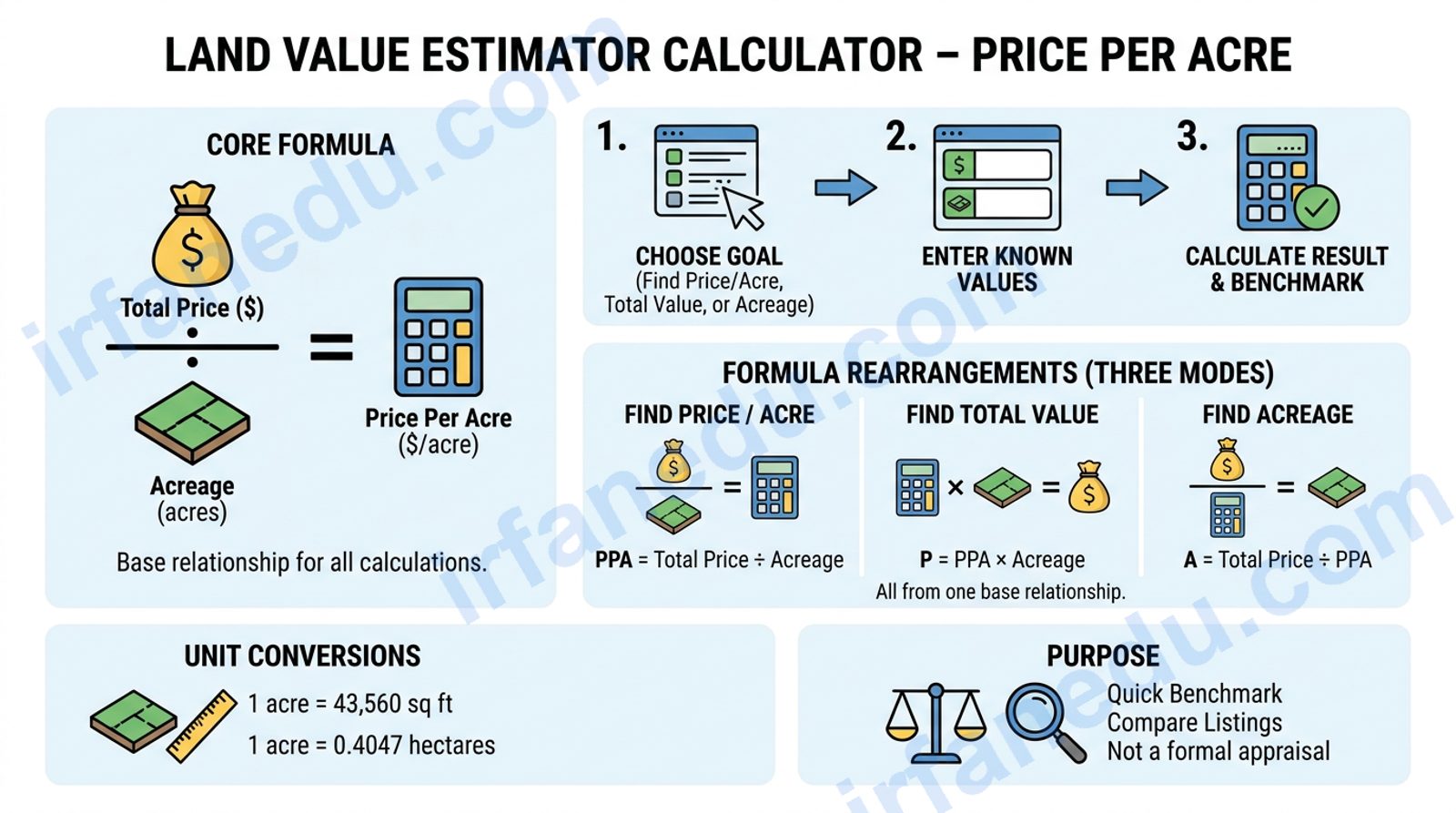
Table of Contents
- What this calculator does
- Interactive land value estimator
- How to use this calculator
- The formula explained
- Worked examples
- Land value comparison by use type
- Common mistakes when estimating land value
- Commonly misunderstood: price per acre vs. land value
- Quick knowledge check
- Frequently asked questions
- About the author
- Sources & references
A land value estimator calculates the price per acre of a parcel of land by dividing the total sale price by the total acreage. It also works in reverse: given a price per acre and an acreage, it returns the total land value. This single formula underpins every land transaction, from a half-acre residential lot to a thousand-acre farm.
Whether you are buying raw land, comparing listings, or preparing a quick appraisal for a client, knowing the price per acre lets you benchmark any parcel against local comparables in seconds. The calculator below handles all three rearrangements of the formula so you never need to reach for a separate tool.
Land Value Estimator Calculator
Price per acre • Total value • Acreage finder
Choose what you want to find:
$
acres
Step-by-step solution
| Symbol | Meaning | Unit |
|---|---|---|
| P | Total land price (sale price or asking price) | $ (any currency) |
| A | Total acreage of the parcel | acres |
| PPA | Price per acre | $/acre |
| 1 acre | Area unit | 43,560 sq ft / 4,047 m² / 0.4047 ha |
SI note: The acre is a non-SI unit still standard in US real estate. The SI equivalent is the hectare (ha); 1 ha = 2.471 acres.
Land value is the monetary worth assigned to a parcel of land, independent of any structures on it. It is most commonly expressed as a price per acre — a unit rate that allows buyers, sellers, and appraisers to compare parcels of different sizes on equal terms.
A land value estimator is a tool that applies the price-per-acre formula to compute any one of three unknowns (price per acre, total price, or acreage) when the other two are known. It is a quick-reference benchmark, not a formal appraisal.
How to use this land value estimator
- Pick a mode. Choose "Find Price / Acre" to compute the unit rate, "Find Total Value" to price a parcel of known acreage, or "Find Acreage" to work backward from a budget.
- Enter the known values. Type the numbers into the labeled fields. The unit tags ($ and acres) show you exactly what each field expects.
- Click Calculate. The result card shows the answer, unit-conversion chips, and a numbered step-by-step solution using your actual inputs.
- Reset and repeat. Hit Reset to clear all fields and run a new scenario — useful when comparing multiple listings side by side.
The land value formula: one equation, three uses
The entire calculation rests on a single proportional relationship: Price Per Acre = Total Price ÷ Acreage. Rearrange it and you get the other two modes.
  FIND PRICE PER ACRE:   PPA  = Total Price  ÷  Acreage
  FIND TOTAL VALUE:      P    = PPA          ×  Acreage
  FIND ACREAGE:          A    = Total Price  ÷  PPA

  UNIT CONVERSIONS:
    1 acre  =  43,560 sq ft
    1 acre  =  4,046.86 m²
    1 acre  =  0.4047 hectares
    1 ha    =  2.471 acres
The acre is the standard unit in US real estate transactions. For international comparisons, the hectare (ha) is the SI-adjacent unit most commonly used outside the US. The calculator's conversion chips handle both automatically.
Three worked examples that match the calculator's output
Example 1 — Find price per acre (residential lot)
A 0.75-acre suburban lot is listed at $112,500.
- Total price: $112,500
- Acreage: 0.75 acres
- PPA = $112,500 ÷ 0.75 = $150,000 per acre
- Conversions: $3.44/sq ft • 32,670 sq ft total • 0.30 ha total
Enter 112500 and 0.75 in Mode A — the calculator returns exactly these values.
Example 2 — Find total value (agricultural land)
Farmland in the Midwest trades at $8,500 per acre. A buyer wants 12.4 acres.
- Price per acre: $8,500
- Acreage: 12.4 acres
- Total value = $8,500 × 12.4 = $105,400
- Area: 540,144 sq ft • 5.02 ha
Switch to Mode B, enter 8500 and 12.4 — the calculator confirms $105,400.
Example 3 — Find acreage (budget planning)
An investor has a $250,000 budget. Local land sells at $22,000 per acre. How much land can they buy?
- Total budget: $250,000
- Price per acre: $22,000
- Acreage = $250,000 ÷ $22,000 = 11.36 acres
- Area: 494,998 sq ft • 4.60 ha
Mode C with 250000 and 22000 returns 11.36 acres — a useful budget-planning figure before approaching a broker.
In my experience helping students understand real-estate math, the "Find Acreage" mode is the most underused. Most people think of a land calculator as a price-lookup tool. But working backward from a budget is often the most practical starting point — it tells you immediately whether a market is within reach before you spend time browsing listings.
Land value varies widely by use type — here is a realistic benchmark
Price per acre is not a single number. It shifts dramatically based on how land is classified and where it sits. The table below uses broad US market ranges as a reference point for calibrating your estimates.
| Land use type | Typical US range ($/acre) | Key value driver | Best calculator mode |
|---|---|---|---|
| Prime agricultural (cropland) | $3,000 – $15,000 | Soil quality, water access | Find Price / Acre |
| Timberland / forestry | $1,500 – $4,000 | Timber yield, access roads | Find Total Value |
| Rural residential (1–10 ac) | $10,000 – $80,000 | Proximity to utilities, zoning | Find Price / Acre |
| Suburban infill lot (<1 ac) | $50,000 – $500,000+ | School district, infrastructure | Find Acreage |
| Commercial / industrial | $100,000 – $1,000,000+ | Zoning, traffic counts, access | Find Total Value |
Ranges are illustrative benchmarks based on USDA land-value data and general market reporting. Actual prices vary by state, county, and specific parcel characteristics.
Common mistakes when estimating land value
Mistake 1: Confusing total property value with land value. A county tax assessment splits a property into "land value" and "improvement value." The price-per-acre formula applies to the land component only. Using the full assessed value inflates your per-acre figure if there are buildings on the parcel.
Mistake 2: Comparing parcels of very different sizes directly. Price per acre is not constant across parcel sizes. A 0.25-acre suburban lot often has a far higher per-acre price than a 50-acre rural tract, even in the same county. Always compare parcels of similar size and use type.
Mistake 3: Ignoring irregular shapes. The formula uses total acreage as reported in the deed. If a parcel has an unusual shape — a long narrow strip, a flag lot, or a parcel with a wetland easement — the usable acreage is less than the total. Adjust accordingly before plugging numbers in.
The third mistake is the one I see most often overlooked in quick land valuations. A 10-acre parcel sounds straightforward until you discover that 4 acres are in a flood plain and cannot be built on. The calculator gives you the math; the site visit and title report give you the real story. Use this tool to set a ceiling on your offer, not to finalize it.
Price per acre is a rate, not a value — and most guides treat it as if it were the same thing.
Here is the non-obvious part: two parcels can have identical price-per-acre figures yet wildly different investment profiles. A 2-acre parcel at $50,000/acre next to a highway interchange is not the same asset as a 2-acre parcel at $50,000/acre in a remote rural county. The formula is unit-neutral — it does not encode location, zoning, or liquidity.
What most land-value guides get wrong is presenting price per acre as a standalone valuation metric. Professional appraisers use it as one input inside a sales comparison approach, where they adjust comparable sales for differences in size, shape, access, and zoning before applying the rate. If you are using this calculator for a real purchase decision, treat the output as a starting benchmark and pair it with at least three genuine comparable sales from a local MLS or county recorder.
Quick knowledge check
1. A 4-acre parcel sells for $180,000. What is the price per acre?
2. How many square feet are in one acre?
3. An investor budgets $300,000 for land priced at $25,000/acre. How many acres can they buy?
Sources & References
Written and fact-checked by Dr Irfan Mansuri. External links open in a new tab and are provided for further reading and verification.