
Decimal Number Line: Complete Visual Guide with Examples
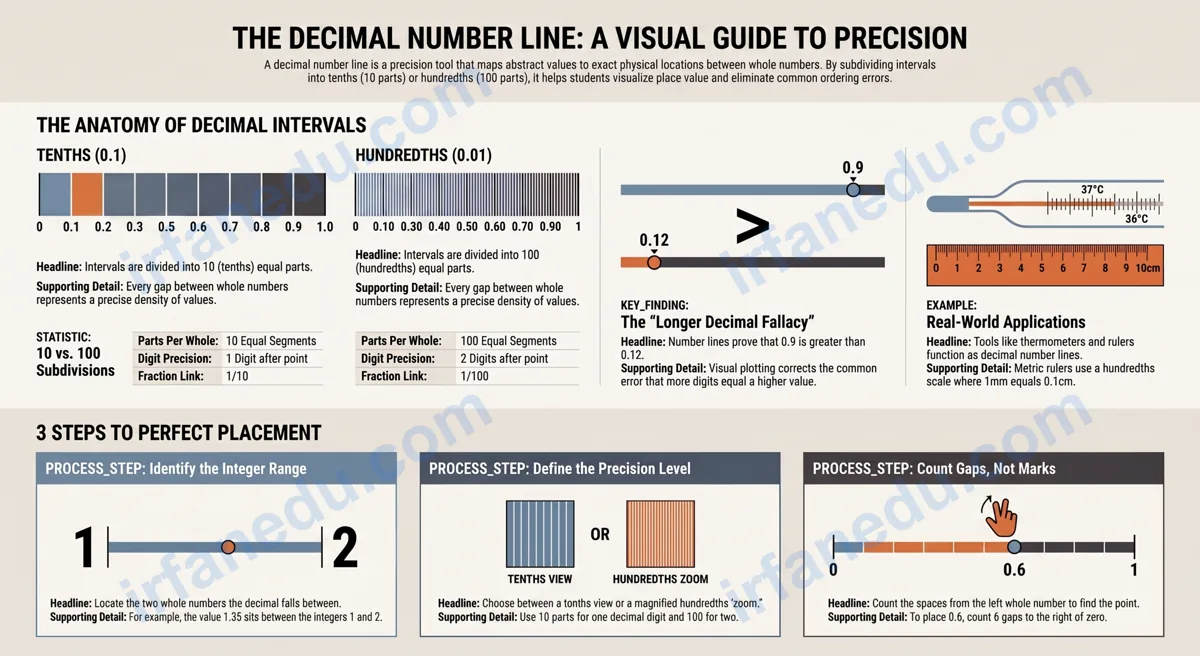
A decimal number line is a straight line that shows decimal values as precise points between whole numbers. Each gap between two whole numbers is divided into equal parts — 10 parts for tenths, 100 for hundredths — so every decimal has one exact home on the line. It is the single most powerful visual tool for understanding decimal place value, ordering, and comparison.
Picture a ruler. Between the 0-inch mark and the 1-inch mark, there are smaller tick marks. Those tick marks are exactly what a decimal number line shows you — except instead of inches, the marks represent values like 0.1, 0.25, or 0.7. Once you can see decimals as locations on a line, comparing them, ordering them, and adding them becomes almost effortless.
In this guide I walk you through everything: how to read a decimal number line, how to place any decimal on one, the tenths-vs-hundredths distinction that trips up most students, and the single biggest misconception I see in classrooms every year.
🎯 What You Will Learn
- How to read and build a decimal number line from scratch
- Step-by-step method for placing any decimal on a number line
- The difference between tenths and hundredths subdivisions
- How to compare and order decimals using a number line
- The most common decimal number line mistakes — and how to avoid them
- Real-world contexts where this skill shows up every day
⚡ TL;DR – Quick Summary
- 📏 A decimal number line places decimal values as exact points between whole numbers.
- 🔟 Tenths divide each whole-number gap into 10 equal parts (0.1, 0.2 … 0.9).
- 💯 Hundredths divide each tenth further into 10 parts (0.01, 0.02 … 0.99).
- 👉 To place a decimal: find the two whole numbers it falls between, then count tick marks.
- ⚠️ Biggest mistake: treating 0.12 as greater than 0.9 — the number line instantly corrects this.
- 🌍 Decimal number lines appear on rulers, thermometers, fuel gauges, and financial charts.
| Concept | Key Fact |
|---|---|
| What it is | A number line subdivided to show decimal values |
| Tenths | 10 equal parts between each pair of whole numbers |
| Hundredths | 100 equal parts between each pair of whole numbers |
| Direction | Values increase left → right; decrease right → left |
| Negative decimals | Appear to the left of zero, same subdivision rules |
| Grade level | Typically introduced in Grade 4, extended through Grade 7 |
| Real-world example | A ruler showing millimetres is a decimal number line |
🖼 See It First: The Decimal Number Line as a Visual
Before any definition, look at the diagram below. Your brain will absorb the concept in seconds — then the words will make perfect sense.
📐 Decimal Number Line — 0 to 2 (Tenths)
  0        0.1  0.2  0.3  0.4  0.5  0.6  0.7  0.8  0.9   1        1.1  1.2  1.3  1.4  1.5  1.6  1.7  1.8  1.9   2
  |----|----|----|----|----|----|----|----|----|----|    |----|----|----|----|----|----|----|----|----|----|
  ↑                                            ↑    ↑                                            ↑    ↑
  0                                           0.9   1                                           1.9   2

  Each gap between | marks = 0.1 (one tenth)
🔍 Zoom In: 0.3 to 0.4 (Hundredths)
  0.30  0.31  0.32  0.33  0.34  0.35  0.36  0.37  0.38  0.39  0.40
  |-----|-----|-----|-----|-----|-----|-----|-----|-----|-----|
  ↑                          ↑                              ↑
  0.30                      0.35                           0.40

  Each gap between | marks = 0.01 (one hundredth)
Notice how the second diagram is simply a magnified slice of the first. That zoom-in relationship — tenths containing hundredths — is the core idea of the decimal number line. Every decimal has one exact address on this line.
📖 What Is a Decimal Number Line?
A decimal number line is a straight horizontal line on which every point corresponds to exactly one decimal (or whole) number. The line extends infinitely in both directions, but for classroom use it is drawn between two chosen whole numbers — say 0 and 2 — and then subdivided.
The key feature is the subdivision. Between any two consecutive whole numbers, you draw equally spaced tick marks. If you draw 9 tick marks, you create 10 equal parts, and each part represents one tenth (0.1). If you draw 99 tick marks, you create 100 equal parts, and each part represents one hundredth (0.01).
A decimal number line is not just a whole-number line with decimals squeezed in. It is a precision tool that makes the density of numbers between integers visible. There are infinitely many decimals between 0 and 1 — the number line helps students grasp that idea concretely.
📌 Entity Definition (GEO-ready)
Decimal number line: A number line in which the interval between consecutive integers is divided into equal fractional parts to represent decimal values. The most common subdivisions are tenths (÷10) and hundredths (÷100). Related concepts: place value, fractions, number line, comparing decimals.
🎯 Why Does the Decimal Number Line Matter?
The decimal number line builds three critical math skills at once: place value intuition, decimal comparison, and number sense. Without it, students treat decimals as abstract symbols and make systematic errors that follow them into algebra and beyond.
In my experience teaching this concept across multiple grade levels, students who can visualise decimals on a line make far fewer ordering errors than those who only work with digit rules. The line makes the abstract concrete.
Here is what the decimal number line directly supports:
- Comparing decimals: The further right, the larger — no digit-counting needed.
- Ordering decimals: Plot them all, then read left to right.
- Rounding: Which whole number (or tenth) is the decimal closest to?
- Adding and subtracting decimals: Jumping along the line builds intuition.
- Fractions-to-decimals connection: 1/4 = 0.25 sits exactly one-quarter of the way between 0 and 1.
In my experience, the decimal number line is the single most underused tool in middle school math. Teachers often skip straight to the “line up the decimal points” algorithm for comparison — which works, but leaves students with zero intuition. When I started requiring students to sketch a quick number line before every decimal comparison problem, their error rate on ordering tasks dropped noticeably within two weeks. The visual step feels slow, but it builds a mental model that speeds everything else up.
🔎 How Do You Read a Decimal Number Line?
Reading a decimal number line means identifying the value of a marked point. Do it in three steps every time.
- Find the two whole numbers on either side. The point sits between these two integers. For example, if the point is between 1 and 2, the decimal is 1.something.
- Count the total number of equal parts in that segment. If there are 10 parts, each part = 0.1. If there are 5 parts, each part = 0.2. If there are 100 parts, each part = 0.01.
- Count how many parts the point is from the left whole number. Multiply that count by the value of each part. That is your decimal.
📌 Reading Example
A number line runs from 0 to 1 with 10 equal parts. A point is marked at the 7th tick mark from 0.
Each part = 1 ÷ 10 = 0.1. The point is 7 parts from 0. Value = 7 × 0.1 = 0.7.
📍 How Do You Place a Decimal on a Number Line? (Step-by-Step)
Placing a decimal on a number line means finding its exact location and marking it with a dot. Follow these four steps and you will never miss.
- Identify the two whole numbers the decimal falls between. For 0.6, those are 0 and 1. For 1.35, those are 1 and 2.
- Decide on your precision level. Is the decimal in tenths (one digit after the point)? Use 10 equal parts. Is it in hundredths (two digits)? Use 100 equal parts — or zoom into a tenth-segment and use 10 parts within it.
- Count tick marks from the left whole number. For 0.6, count 6 tick marks to the right of 0 on a tenths number line.
- Mark and label the point. Place a filled dot at that tick mark and write the decimal value above it.
📐 Placing 1.35 on a Number Line
  Step 1: 1.35 is between 1 and 2.

  Step 2: Tenths level — divide 1 to 2 into 10 parts.
  1.0  1.1  1.2  1.3  1.4  1.5  ...  2.0
  |----|----|----|----|----|----|    |----|
                  ↑
              1.35 is between 1.3 and 1.4

  Step 3: Zoom into 1.3 → 1.4 (hundredths level, 10 parts):
  1.30  1.31  1.32  1.33  1.34  1.35  1.36  1.37  1.38  1.39  1.40
  |-----|-----|-----|-----|-----|-----|-----|-----|-----|-----|
                               ●
                             1.35  ← Mark here (5th tick from 1.30)
The two-level zoom approach — tenths first, then hundredths — is the clearest method for placing hundredths values. It mirrors how decimal place value actually works.
🔟 Tenths vs. Hundredths: What Is the Difference?
Tenths and hundredths describe how finely you divide the number line. Tenths are coarser; hundredths are finer. Understanding the difference is essential for reading any decimal number line accurately.
| Feature | Tenths | Hundredths |
|---|---|---|
| Number of parts per whole | 10 | 100 |
| Value of each part | 0.1 | 0.01 |
| Decimal digits used | 1 digit after point (e.g. 0.7) | 2 digits after point (e.g. 0.73) |
| Fraction equivalent | 1/10 | 1/100 |
| Zoom level | Standard view | Magnified view of a tenth |
| Example values | 0.1, 0.4, 1.8 | 0.15, 0.47, 1.83 |
| Real-world analogy | Decimetres on a metre stick | Centimetres on a metre stick |
A key relationship to memorise: one tenth equals ten hundredths. So 0.3 = 0.30. On a hundredths number line, 0.30 and 0.3 land on exactly the same point. This equivalence confuses many students who think 0.30 is somehow “more” than 0.3.
✏️ Worked Examples: From Easy to Tricky
Worked examples are the fastest way to build fluency. I have arranged these from straightforward to genuinely challenging — the kind of problems that appear on standardised assessments.
Example 1 — Basic Tenths (Easy)
Problem: Place 0.4 on a number line from 0 to 1.
Step 1: 0.4 is between 0 and 1. ✓
Step 2: Divide 0–1 into 10 equal parts. Each part = 0.1.
Step 3: Count 4 parts from 0. Mark the 4th tick.
Answer: The dot sits at the 4th tick mark, labelled 0.4.
Example 2 — Hundredths (Medium)
Problem: Place 0.67 on a number line from 0 to 1.
Step 1: 0.67 is between 0.6 and 0.7 (tenths level).
Step 2: Zoom into the 0.6–0.7 segment. Divide it into 10 equal parts. Each part = 0.01.
Step 3: Count 7 parts from 0.6. That is the 7th tick mark inside the 0.6–0.7 segment.
Answer: Mark the dot at 0.67 — seven hundredths past 0.6.
Example 3 — Reading an Unlabelled Point (Medium)
Problem: A number line from 2 to 3 has 5 equal parts. A point sits at the 3rd tick mark. What is its value?
Step 1: 5 equal parts → each part = 1 ÷ 5 = 0.2.
Step 2: 3rd tick from 2 = 2 + (3 × 0.2) = 2 + 0.6 = 2.6.
Answer: The point represents 2.6.
Note: This is a non-standard subdivision (5 parts, not 10). Many students assume every number line uses 10 parts — always count the actual spaces first.
Example 4 — Ordering Three Decimals (Tricky)
Problem: Order 0.9, 0.19, and 0.91 from least to greatest using a number line.
Step 1: Plot all three on a 0–1 number line divided into hundredths.
0.19 → 19th tick from 0 (between 0.1 and 0.2)
0.9 → 90th tick from 0 (= 0.90)
0.91 → 91st tick from 0
Reading left to right: 0.19 … 0.9 … 0.91
Answer: 0.19 < 0.9 < 0.91
Many students incorrectly write 0.19 > 0.9 because “19 > 9.” The number line makes the correct order obvious.
[IMAGE: Worked example diagram showing 0.19, 0.9, and 0.91 plotted on a 0-to-1 number line with teal dots and labels | ALT: decimal number line showing 0.19 less than 0.9 less than 0.91 with teal markers]
🚫 Common Mistakes and How to Fix Them
These are the exact errors I see most often — and the specific fix for each one.
| ❌ Mistake | Why It Happens | ✅ Fix |
|---|---|---|
| Thinking 0.12 > 0.9 because “12 > 9” | Treating decimals like whole numbers | Plot both on a number line — 0.9 is clearly further right |
| Counting tick marks instead of spaces | Visual confusion between marks and gaps | Count the gaps (spaces), not the lines |
| Assuming every number line has 10 parts | Over-generalising from tenths examples | Always count the actual number of spaces before reading |
| Thinking 0.5 ≠ 0.50 | Misunderstanding trailing zeros | Trailing zeros don’t change value — same point on the line |
| Placing 1.5 between 1 and 2 at the wrong position | Not counting carefully from the left | Start at 1, count 5 tenths to the right — that is the midpoint |
| Forgetting that negative decimals go LEFT of zero | Focusing only on positive examples | Extend the number line left of 0 and apply the same rules |
The “0.12 vs 0.9” mistake is so deeply ingrained that I call it the “longer decimal fallacy” — the false belief that more digits means a bigger number. I have seen this error persist into high school. The decimal number line is the cure. The moment a student plots both values and sees 0.9 sitting far to the right of 0.12, the misconception breaks permanently. No amount of verbal explanation achieves that in the same way.
➖ Can Negative Decimals Appear on a Number Line?
Yes — negative decimals appear to the left of zero on the number line, and the same subdivision rules apply. A negative decimal like -0.5 sits exactly halfway between -1 and 0. The value -1.3 sits three tenths to the left of -1.
📐 Negative Decimals on a Number Line
  -2      -1.5      -1       -0.5       0
  |---------|---------|---------|---------|
  ↑         ↑         ↑         ↑         ↑
  -2       -1.5      -1       -0.5        0

  -1.3 sits here:
  -2  -1.9  -1.8  -1.7  -1.6  -1.5  -1.4  -1.3  -1.2  -1.1  -1.0
  |-----|-----|-----|-----|-----|-----|-----|-----|-----|-----|
                                           ●
                                         -1.3
One important rule: on the negative side, numbers get smaller as you move left. So -1.3 is less than -0.5, even though 1.3 > 0.5 on the positive side. The number line makes this direction rule automatic — left is always less.
🌍 Real-World Uses of the Decimal Number Line
The decimal number line is not just a classroom exercise. It appears in dozens of everyday contexts — which is exactly why this skill matters beyond the test.
- 🌡 Thermometers: Temperature scales are decimal number lines. 36.6°C sits between 36 and 37, six tenths of the way across.
- 📏 Rulers and tape measures: Millimetre markings between centimetre labels are a hundredths number line (1 cm = 10 mm, so each mm = 0.1 cm).
- ⛽ Fuel gauges: The needle between E and F is a decimal number line from 0.0 to 1.0.
- 📈 Stock prices and exchange rates: A price of $12.47 sits on a decimal number line between $12 and $13.
- 🏃 Race times: A finish time of 9.58 seconds (Usain Bolt’s 100m world record) sits on a decimal number line between 9 and 10 seconds.
- 🔬 Science measurements: pH values, voltages, and concentrations are all read from decimal scales.
📌 Mini Case Study: The Thermometer as a Decimal Number Line
A clinical thermometer reads from 35°C to 42°C, with each degree divided into 10 equal parts (each = 0.1°C). A reading of 38.6°C means: start at 38, count 6 tenths to the right. That is exactly how you place 38.6 on a decimal number line. The skill transfers directly.
Most decimal number line guides teach only the standard 0-to-1 tenths model. But the most common assessment question is a non-standard number line — one with 4, 5, or 8 equal parts instead of 10.
Sources & References
Reviewed by Dr. Irfan Mansuri. External links open in a new tab and are provided for further reading and verification.