
Equivalent Fractions on a Number Line: The Visual Proof Students Actually Remember 🔢
📋 Table of Contents
- The One-Liner That Changes Everything
- Quick Answer
- TL;DR – Quick Summary
- Quick Facts Table
- What Are Equivalent Fractions?
- Why the Number Line Is the Best Way to See It
- How to Find Equivalent Fractions on a Number Line (Step-by-Step)
- Worked Examples: Three Pairs You Should Know
- Common Mistakes Students Make (and How to Fix Them)
- What About Equivalent Fractions Beyond 1?
- Real-World Uses: Why This Skill Actually Matters
- 💡 Unique Insight
- Quick Quiz
- Practice Problems
- FAQ
- Key Takeaways
- Related Articles
- About the Author
- Sources & References
“Two fractions can look completely different and still be exactly the same thing — the number line makes that impossible to argue with.”
That one-liner is the whole lesson. When I first showed a student that 1/2 and 4/8 land on the identical spot on a number line, her eyes went wide. She had been memorizing “multiply top and bottom by the same number” for weeks without truly believing it. The number line turned an abstract rule into a visible, undeniable fact.
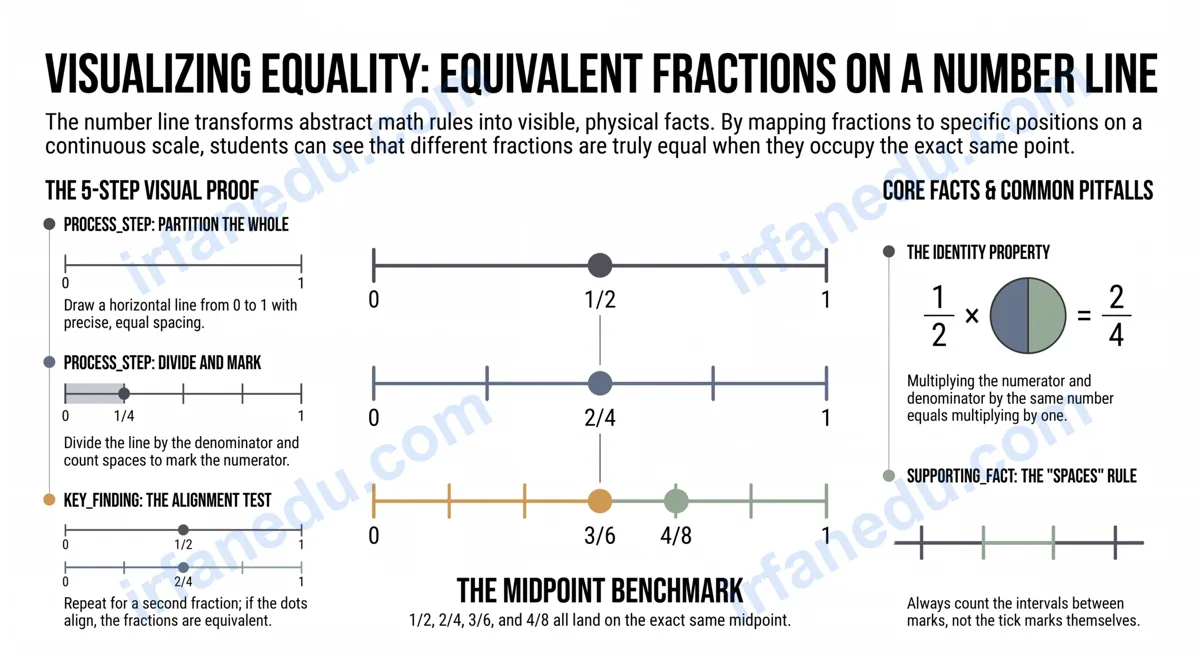
Equivalent fractions on a number line are fractions that point to the exact same location between (or beyond) 0 and 1, even though their numerators and denominators are different. Seeing them land on the same point is the clearest proof that fractions like 1/2, 2/4, and 3/6 are genuinely equal — not just “kind of similar.”
In this guide, you will get clear step-by-step instructions, three fully worked visual examples, a comparison table, a CSS-only number-line diagram, a quiz, and — most importantly — the one insight that most textbooks miss entirely. By the end, you will be able to draw equivalent fractions on a number line confidently and explain why the method works, not just how.
- 🎯 Understand what equivalent fractions are and why they matter
- 📏 Use a number line to prove two fractions are equivalent
- 🔢 Follow a 5-step method to find any equivalent fraction visually
- ⚠️ Avoid the three most common mistakes students make
- 🌍 See real-world situations where this skill is used every day
⚡ TL;DR – Quick Summary
- 🔵 Equivalent fractions name the same point on a number line.
- 🟠 Divide the line by the denominator; count up by the numerator.
- 🟢 Same position = same value, regardless of how the fraction looks.
- 🔴 The most common mistake: unequal spacing when dividing the line.
- 🟡 Works beyond 1 too — 3/2 and 6/4 land on the same point past 1.
- ⚪ Simplifying a fraction = finding the equivalent with the smallest denominator.
📊 Quick Facts at a Glance
| Fact | Detail |
|---|---|
| Definition | Fractions that represent the same point (same value) on a number line |
| Classic example | 1/2 = 2/4 = 3/6 = 4/8 (all at the midpoint between 0 and 1) |
| Key rule | Multiply or divide both numerator and denominator by the same non-zero number |
| Grade level | Typically introduced in Grade 3; reinforced in Grades 4–5 |
| Common curriculum standard | CCSS Math 3.NF.A.3 — Explain equivalence using visual fraction models |
| Why it matters | Foundation for adding fractions, comparing fractions, and ratio reasoning |
| Biggest misconception | Thinking a larger denominator always means a larger fraction |
🍕 What Are Equivalent Fractions?
Equivalent fractions are two or more fractions that represent the same quantity. The word “equivalent” means “equal in value,” not “identical in appearance.” So 1/2 and 3/6 look different but mean the same thing — half of a whole.
The rule is simple: if you multiply (or divide) both the numerator and the denominator of a fraction by the same non-zero number, you get an equivalent fraction.
1/2 × (2/2) = 2/4 ✔
1/2 × (3/3) = 3/6 ✔
1/2 × (4/4) = 4/8 ✔
All of these are equivalent to 1/2.
Notice you are multiplying by a form of 1 (since 2/2 = 1, 3/3 = 1, etc.). Multiplying by 1 never changes a number’s value — it only changes how you write it. That is the mathematical reason equivalent fractions are truly equal.
In my experience teaching fractions to students from Grade 3 through Grade 6, the biggest barrier is not the calculation — it is the belief. Students can memorize “multiply top and bottom” in five minutes. But they often do not believe it. They think the fraction somehow got “bigger” because the numbers got bigger. The number line destroys that misconception instantly. When a student draws 1/2 and 2/4 on the same line and sees them land on the same dot, the rule stops being a trick to memorize and becomes a fact they witnessed themselves. That is why I always start here.
📏 Why Is the Number Line the Best Way to See Equivalent Fractions?
The number line is the best visual model for equivalent fractions because it shows value as position — and position cannot lie. Unlike a pie chart (where a student might argue “but the slices look different sizes”), the number line has one axis and one truth: two fractions are equal if and only if they land on the same point.
Here is a comparison of the three most common visual models:
| Visual Model | Strengths | Weaknesses | Best For |
|---|---|---|---|
| 🔵 Number Line | Shows value as position; easy to compare multiple fractions at once | Requires careful equal spacing | Proving equivalence; ordering fractions |
| 🟠 Area Model (pie/rectangle) | Intuitive for “parts of a whole” | Hard to draw accurately; misleading if shapes differ | Introducing the concept of fractions |
| 🟢 Set Model (groups of objects) | Connects fractions to real counting | Does not show continuous value well | Fractions of a group (e.g., 2 out of 4 apples) |
The number line wins for equivalence because it maps fractions to a single continuous scale. When two fractions share a point on that scale, their equality is geometric, not just algebraic.
🪜 How to Find Equivalent Fractions on a Number Line (Step-by-Step)
Follow these five steps every time and you will never get it wrong. I use this exact sequence with my students on their first day of the topic.
- Draw a straight horizontal line. Mark 0 on the left end and 1 on the right end. Make sure the line is long enough to divide clearly — at least 10 cm on paper.
- Divide the line by the first fraction’s denominator. For 1/2, split the line into 2 equal parts. Label each tick mark: 0, 1/2, 1.
- Mark the first fraction. Count from 0 the number of parts equal to the numerator. For 1/2, count 1 part from 0 and place a dot. Label it “1/2.”
- Divide the same line (or a parallel one) by the second fraction’s denominator. For 2/4, add 4 equal divisions. Label: 0, 1/4, 2/4, 3/4, 1.
- Mark the second fraction and compare. For 2/4, count 2 parts from 0. Place a dot. If it aligns exactly with the 1/2 dot, the fractions are equivalent.
🖼 Visual: Number Line Proof That 1/2 = 2/4 = 3/6
HALVES (÷2):
0─────────────────1/2─────────────────1
|                  ▲                  |

QUARTERS (÷4):
0────────1/4────2/4────3/4────────────1
                 ▲
                 (same point as 1/2)

SIXTHS (÷6):
0──1/6──2/6──3/6──4/6──5/6──────────1
              ▲
              (same point as 1/2 and 2/4)

  ✅ 1/2 = 2/4 = 3/6 — all three arrows point to the SAME location.
✏️ Worked Examples: Three Pairs You Should Know
These three examples cover the most common equivalent fraction pairs tested in Grades 3–5. Work through each one yourself before reading my solution.
Example 1: Show that 1/3 = 2/6
Step 2: Divide into 3 equal parts. Mark 1/3 (the first tick after 0).
Step 3: Now divide the same line into 6 equal parts. Mark 2/6 (the second tick after 0).
Result: 1/3 and 2/6 land on the same point — exactly one-third of the way from 0 to 1. ✅
Why? 1/3 × (2/2) = 2/6. You doubled both numbers, so the position stays the same.
Example 2: Show that 2/3 = 4/6
Step 2: Divide the line into 6 equal parts. Mark 4/6 (four-sixths of the way).
Result: Both dots land at the same point, two-thirds of the way along the line. ✅
Why? 2/3 × (2/2) = 4/6. Same logic — multiply top and bottom by 2.
Example 3: Show that 3/4 = 6/8
Step 2: Divide the line into 8 equal parts. Mark 6/8 (six-eighths of the way).
Result: 3/4 and 6/8 share the same position — three-quarters of the way from 0 to 1. ✅
Why? 3/4 × (2/2) = 6/8. Doubling both numbers never changes the fraction’s value.
⚠️ Common Mistakes Students Make (and How to Fix Them)
After reviewing hundreds of student worksheets, I have identified the three mistakes that appear most often. Knowing them in advance saves a lot of frustration.
| ❌ Mistake | ✅ Correct Approach | Why It Matters |
|---|---|---|
| Drawing unequal tick marks (spacing by eye) | Measure with a ruler; divide the total length mathematically | Unequal spacing makes equivalent fractions appear to land in different places |
| Counting the tick marks instead of the spaces | Count the spaces (intervals), not the lines | A line divided into 4 parts has 3 interior ticks but 4 spaces — confusing these shifts every fraction |
| Thinking a bigger denominator means a bigger fraction | Compare positions on the number line, not the size of the numbers | 1/2 is larger than 1/4, even though 4 > 2 — the number line makes this obvious |
🔭 What About Equivalent Fractions Beyond 1?
Equivalent fractions are not limited to the space between 0 and 1. The same principle applies anywhere on the number line, including fractions greater than 1 (called improper fractions).
For example, 3/2 and 6/4 are equivalent. On a number line from 0 to 2, both land at the same point halfway between 1 and 2.
🖼 Visual: Equivalent Improper Fractions 3/2 = 6/4
HALVES (÷2), from 0 to 2:
0──────────1/2──────────1──────────3/2──────────2
                                    ▲

QUARTERS (÷4), from 0 to 2:
0──1/4──2/4──3/4──1──5/4──6/4──7/4──2
                          ▲
                    (same point as 3/2)

  ✅ 3/2 = 6/4 — both arrows point to the same location between 1 and 2.
This matters because students often assume the number line trick “only works between 0 and 1.” It works everywhere. The rule is the same: divide by the denominator, count up by the numerator.
In my experience, most Grade 3–4 lessons stop at fractions between 0 and 1. That is fine for an introduction, but it accidentally teaches students that fractions “live” only in that zone. When improper fractions appear in Grade 5, students are confused. I always spend five minutes extending the number line past 1 in my very first lesson on equivalence. It costs almost no extra time and prevents a major conceptual gap later. If you are a parent helping at home, try this: after your child masters 1/2 = 2/4 between 0 and 1, ask them, “Where do you think 3/2 and 6/4 land?” Watch them figure it out themselves.
🌍 Real-World Uses: Why This Skill Actually Matters
Equivalent fractions are not just a school exercise. They appear in everyday life more often than most people realize.
- 🍳 Cooking: A recipe calls for 1/2 cup of sugar. You only have a 1/4-cup measure. You need to know that 1/2 = 2/4, so you fill the 1/4 cup twice.
- 📐 Measurement: A carpenter measures a board as 3/4 of a foot. A colleague’s ruler shows 6/8. They are the same length — equivalent fractions confirm the measurement is correct.
- 💰 Money: A half-dollar coin (1/2 of a dollar) equals two quarters (2/4 of a dollar). The number line maps perfectly to a dollar scale.
- 🏃 Sports: A runner completes 2/4 of a race. A commentator says they are “halfway done.” Both descriptions are correct — 2/4 = 1/2.
- 🗺️ Maps and scales: Map scales use equivalent ratios (a form of equivalent fractions) to relate distances on paper to real distances on the ground.
Understanding equivalent fractions also unlocks the next big skill: adding and subtracting fractions with different denominators. You cannot add 1/2 + 1/3 without first finding a common denominator — which is exactly the process of creating equivalent fractions.
💡 Unique Insight: What Most Guides Get Wrong About “Equivalent” Fractions
Most textbooks and online guides teach equivalent fractions as a procedure: “multiply top and bottom by the same number.” That is correct, but it misses the deeper geometric truth.
Here is what I have never seen explained clearly elsewhere: dividing a number line into more parts does not change the length of the line — it only changes the size of each part. When you go from halves to quarters, each part is half as long, so you need twice as many parts to reach the same position. That is exactly why 1/2 = 2/4: you need twice as many quarter-steps as half-steps to walk the same distance from 0.
This “walking distance” framing is powerful because it explains why the rule works, not just that it works. In my experience, students who understand this geometric reason almost never confuse equivalent fractions with adding fractions (a very common error where students add numerators AND denominators: 1/2 + 1/2 = 2/4 — wrong!). The number line makes it obvious that 1/2 + 1/2 must land at 1, not at 2/4.
Takeaway: Teach the number line as a “walking distance” model, not just a comparison tool. It prevents the addition-confusion error before it starts.
🧠 Quick Quiz: Test Your Understanding
1. Which fraction is equivalent to 1/2 on a number line?
2. On a number line divided into 6 equal parts, where does 2/6 land?
3. A student divides a number line into 8 equal parts and marks 4/8. Which fraction is equivalent?
🏋️ Practice Problems (Click to Reveal the Answer)
Problem 1: Is 2/5 equivalent to 4/10? Use a number line to explain.
Problem 2: Find two fractions equivalent to 3/4 and mark all three on a number line.
Problem 3: A number line from 0 to 1 is divided into 6 equal parts. A dot is placed at the 4th tick mark. Write this as a fraction in simplest form.
Problem 4 (Challenge): Show that 5/2 and 10/4 are equivalent on a number line from 0 to 3.
❓ Frequently Asked Questions
What are equivalent fractions on a number line?
How do you show equivalent fractions on a number line?
Why do equivalent fractions land on the same point?
Sources & References
Reviewed by Dr. Irfan Mansuri. External links open in a new tab and are provided for further reading and verification.