
Number Line with Integers: How It Works, How to Use It
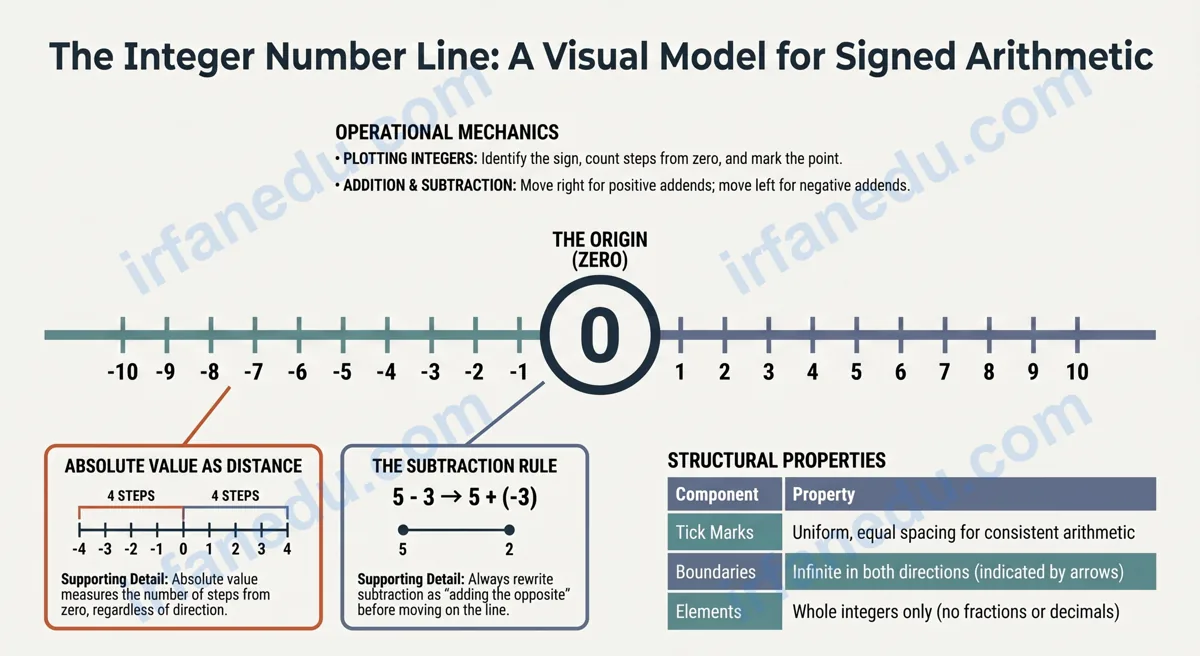
A number line with integers is a straight horizontal line on which every whole number occupies a fixed, equally spaced point. Zero sits at the center. Positive integers extend to the right; negative integers extend to the left. The line is infinite in both directions and serves as the visual foundation for ordering, comparing, and performing arithmetic on signed whole numbers.
If you have ever wondered why −3 is considered “greater than” −8, or why subtracting a negative number makes a value go up instead of down, the number line is the tool that makes both facts instantly obvious. In my experience teaching middle school math, students who build a strong mental picture of the integer number line almost never confuse the rules for signed arithmetic — because they can see what is happening.
This guide starts with the mechanism — exactly how the number line is built and why — before moving to applications. By the end, you will be able to plot any integer, compare two integers, and perform addition and subtraction using the number line with confidence.
- Understand the structure and direction rules of the integer number line.
- Plot any integer accurately and explain its position relative to zero.
- Order a set of integers from least to greatest (and vice versa).
- Add and subtract integers using directional movement on the line.
- Interpret absolute value as distance from zero.
TL;DR – Quick Summary
- A number line places every integer at an equally spaced point on a horizontal line.
- Zero is the center; negatives go left, positives go right.
- The further right an integer is, the greater its value.
- Adding a positive integer means moving right; adding a negative means moving left.
- Absolute value = distance from zero, always non-negative.
- Subtraction is rewritten as adding the opposite before using the line.
What Is a Number Line with Integers?
A number line with integers is a visual representation of the set of all whole numbers — including zero, all positive counting numbers (1, 2, 3…), and all negative whole numbers (−1, −2, −3…) — arranged in order on a straight line. Each integer corresponds to exactly one point, and the spacing between consecutive integers is always equal.
The line carries two key properties that make it mathematically precise. First, it has a fixed origin: zero. Second, it has a defined positive direction: right. Those two facts alone determine where every integer must go.
| Property | Detail |
|---|---|
| Set of numbers shown | All integers: {…, −3, −2, −1, 0, 1, 2, 3, …} |
| Origin (center point) | Zero (0) |
| Positive direction | Right (arrow points right) |
| Negative direction | Left (arrow points left) |
| Spacing between integers | Equal (uniform scale) |
| Length | Infinite in both directions |
| Integers include | Whole numbers only — no fractions or decimals at tick marks |
The Anatomy: How the Structure Works
The number line’s structure is built from four components: the line itself, the origin, the tick marks, and the directional arrows. Understanding each component explains why the rules of signed arithmetic work the way they do.
1. The Line
A straight horizontal line represents the continuum of integers. Horizontal is a convention, not a requirement — vertical number lines exist too (thermometers, for example) — but horizontal is standard in most curricula.
2. The Origin (Zero)
Zero is the reference point. It divides the line into two halves. Its position is not arbitrary: every other integer’s location is defined by its distance and direction from zero.
3. The Tick Marks
Each tick mark represents one integer. The distance between any two consecutive tick marks is identical — this is what makes the scale uniform and arithmetic consistent. If the spacing were uneven, moving “3 steps right” would not reliably mean adding 3.
4. The Directional Arrows
Arrows at both ends signal that the line continues forever. The right arrow indicates increasing values; the left arrow indicates decreasing values.
 <----+----+----+----+----+----+----+----+----+----+----+----+----+----+----+----+----+----+----+----+---->
     -10  -9   -8   -7   -6   -5   -4   -3   -2   -1    0    1    2    3    4    5    6    7    8    9   10

      NEGATIVE SIDE            |           POSITIVE SIDE
      (values decrease left)   |           (values increase right)
                            ORIGIN (0)

  Distance from 0 to -6 = 6 units  |  Distance from 0 to 6 = 6 units
  Absolute value: |-6| = 6         |  Absolute value: |6| = 6
In my experience teaching this concept, the single most effective thing I do is ask students to build the number line themselves — not copy one from a textbook. When you physically place each tick mark at equal intervals and label zero first, you internalize why the structure works. Copying a pre-drawn line skips the reasoning and leaves students memorizing rules instead of understanding them.
How to Plot Integers on a Number Line
Plotting an integer means finding its exact point on the number line. The process takes three steps and works for any integer, no matter how large or how negative.
- Identify the sign. A positive integer (or zero) goes to the right of or at the origin. A negative integer goes to the left.
- Count the absolute value. Count that many tick marks from zero in the correct direction.
- Mark the point. Place a dot at that tick mark and label it.
- −4: go left 4 from zero → mark at the 4th tick to the left
- 0: mark at the origin
- 2: go right 2 from zero → mark at the 2nd tick to the right
- −7: go left 7 from zero → mark at the 7th tick to the left
- 5: go right 5 from zero → mark at the 5th tick to the right
Reading the marked points from left to right gives the order: −7, −4, 0, 2, 5.
Notice that plotting automatically sorts the integers. That is not a coincidence — it is one of the number line’s most useful properties for students.
How to Order and Compare Integers
On a number line, the integer further to the right is always the greater value. This single rule handles every comparison, including comparisons between two negative numbers.
Most students handle positive-vs-positive and positive-vs-negative comparisons without trouble. The confusion almost always appears with two negative integers. Here is the precise reasoning:
On the number line, −3 sits to the right of −8. Therefore −3 > −8.
Intuitive check: a temperature of −3°C is warmer (greater) than −8°C. A bank account at −3 dollars is closer to zero debt than −8 dollars.
| Comparison | Position on Line | Result | Why |
|---|---|---|---|
| 5 vs 2 | 5 is right of 2 | 5 > 2 | Positive, further right |
| −1 vs −6 | −1 is right of −6 | −1 > −6 | Less negative = further right |
| 0 vs −4 | 0 is right of −4 | 0 > −4 | Zero is greater than any negative |
| −3 vs 3 | 3 is right of −3 | 3 > −3 | Positive is always greater than negative |
| −10 vs −2 | −2 is right of −10 | −2 > −10 | Closer to zero on the negative side |
How to Add and Subtract Integers on a Number Line
Adding and subtracting integers on a number line reduces every operation to a direction and a distance. There are no rules to memorize — only movement to follow.
Addition Rule
- Start at the first integer on the number line.
- If the second integer is positive, move right by that many steps.
- If the second integer is negative, move left by that many steps (use the absolute value for the count).
- The integer you land on is the answer.
Start at 3. The second integer is −5 (negative), so move left 5 steps: 3 → 2 → 1 → 0 → −1 → −2. Land on −2. Answer: −2.
Start at −4. The second integer is 6 (positive), so move right 6 steps: −4 → −3 → −2 → −1 → 0 → 1 → 2. Land on 2. Answer: 2.
Subtraction Rule
Subtraction is always rewritten as adding the opposite before using the number line. The rule: a − b = a + (−b).
- Rewrite the subtraction as addition of the opposite integer.
- Apply the addition rule above.
Rewrite: 2 + (−6). Start at 2, move left 6 steps: 2 → 1 → 0 → −1 → −2 → −3 → −4. Answer: −4.
Rewrite: −3 + 5. Start at −3, move right 5 steps: −3 → −2 → −1 → 0 → 1 → 2. Answer: 2.
This is the result that surprises students most: subtracting a negative number moves you to the right (increases the value). The number line makes it visual and obvious.
 Start                                   Land
   |                                       |
   v                                       v
<--+----+----+----+----+----+----+----+----+----+-->
  -4   -3   -2   -1    0    1    2    3    4    5

         <--- Move LEFT 5 steps from 3 --->

  Step 1: 3 → 2
  Step 2: 2 → 1
  Step 3: 1 → 0
  Step 4: 0 → -1
  Step 5: -1 → -2   ✓  Answer = -2
What Is Absolute Value and How Does the Number Line Show It?
Absolute value is the distance between an integer and zero on the number line, measured in steps. Distance is always non-negative, so the absolute value of any integer is always zero or positive.
The notation is: |n| = distance of n from zero.
- |7| = 7 (7 is 7 steps to the right of zero)
- |−7| = 7 (−7 is 7 steps to the left of zero)
- |0| = 0 (zero is at the origin — no distance)
Absolute value also lets you calculate the distance between any two integers on the number line without worrying about which is larger: distance = |a − b|.
|−3 − 4| = |−7| = 7. There are 7 units between −3 and 4 on the number line.
What Are the Most Common Mistakes Students Make with Integer Number Lines?
In my experience reviewing student work, four mistakes appear repeatedly. Each one has a clear fix.
Mistake 1: Unequal Spacing
Wrong: Drawing tick marks at irregular intervals, so −2 and −3 are closer together than 0 and 1.
Right: Use a ruler or count grid squares to keep all intervals identical. Unequal spacing makes every operation inaccurate.
Mistake 2: Treating Larger Absolute Value as Greater
Wrong: Writing −9 > −2 because “9 is bigger than 2.”
Right: On the number line, −2 is to the right of −9, so −2 > −9. Always check position, not magnitude.
Mistake 3: Moving in the Wrong Direction for Negative Addends
Wrong: For 5 + (−3), moving right 3 steps to get 8.
Right: A negative addend always means move left. 5 + (−3) → start at 5, move left 3 → land on 2.
Mistake 4: Forgetting to Rewrite Subtraction Before Using the Line
Wrong: Treating 4 − (−2) as “start at 4, move left 2” to get 2.
Right: Rewrite first: 4 − (−2) = 4 + 2. Start at 4, move right 2 → land on 6.
Mistake 4 is the one that costs students the most points on tests. The phrase “subtracting a negative” sounds abstract, but on the number line it is concrete: you flip direction. I always tell students to write the rewritten form (a + (−b) or a + b) on the page before touching the number line — that one habit eliminates the error almost entirely.
Where Do You See Integer Number Lines in Real Life?
Integer number lines are not just a classroom tool. They model real situations where values fall below zero.
- Temperature: A thermometer is a vertical number line. −10°C is 10 units below zero; 15°C is 15 units above. The difference between them is |15 − (−10)| = 25 degrees.
- Sea level and elevation: Altitude above sea level is positive; below sea level (ocean trenches, below-sea-level cities) is negative. The Dead Sea shore sits at roughly −430 meters.
- Finance: A bank balance of −$50 means you owe $50. Adding a $120 deposit: −50 + 120 = 70. The number line models this exactly.
- Time: Years BCE are negative integers on a historical timeline; years CE are positive. The distance between 200 BCE and 400 CE is |−200 − 400| = 600 years.
- Coordinate geometry: The x-axis and y-axis in a coordinate plane are both integer number lines intersecting at the origin (0, 0).
Most introductory guides teach the number line purely as a plotting tool and then switch to abstract rules for arithmetic. The insight they miss: the number line is not just a visual aid — it is a physical model of the group structure of integers. Every rule (adding negatives moves left, subtracting a negative reverses direction) is a consequence of the line’s geometry, not an arbitrary convention. When students understand that the line encodes direction as sign and distance as magnitude, they can derive any signed-arithmetic rule themselves instead of memorizing it. In my experience, students who reach this understanding make far fewer sign errors on timed tests, because they are reasoning from a model rather than recalling a list of rules.
Quick Quiz: Test Your Understanding
Q1. On an integer number line, which value is greater: −6 or −2?
Q2. You start at −4 on a number line and add −3. Where do you land?
Q3. What is |−9| on the number line?
Practice Problems (Click to Reveal the Answer)
Problem 1: Plot −5, −1, 3, and −9 on a number line. List them from least to greatest.
On the number line, the order from left to right (least to greatest) is: −9, −5, −1, 3.
Check: −9 is furthest left → smallest. 3 is furthest right → largest.
Problem 2: Solve −2 + (−6) using the number line method.
Start at −2. The addend is −6 (negative), so move left 6 steps.
−2 → −3 → −4 → −5 → −6 → −7 → −8. Answer: −8.
Problem 3: Solve 1 − (−4) using the number line method.
Rewrite: 1 + 4 (subtracting a negative = adding a positive).
Start at 1, move right 4 steps: 1 → 2 → 3 → 4 → 5. Answer: 5.
Problem 4: What is the distance between −6 and 4 on the number line?
Distance = |−6 − 4| = |−10| = 10 units.
You can verify by counting tick marks from −6 to 4: that is 10 steps.
Problem 5: Order these integers from greatest to least: −12, 0, −1, 7, −7.
From right to left on the number line (greatest to least): 7, 0, −1, −7, −12.
Frequently Asked Questions
What is a number line with integers?
Where does zero go on a number line?
How do you add integers on a number line?
How do you subtract integers on a number line?
Which integer is greater — the one further right or further left?
What is the difference between absolute value and an integer’s position?
Can a number line show fractions and decimals too?
Key Takeaways
- A number line with integers places every whole number at an equally spaced point on a horizontal line, with zero at the center.
- Negative integers sit to the left of zero; positive integers sit to the right.
- The further right an integer is, the greater its value — this applies to negative integers too.
- Adding a positive integer means moving right; adding a negative integer means moving left.
- Subtraction is always rewritten as addition of the opposite (a − b = a + (−b)) before using the line.
- Absolute value is the distance from zero — always non-negative, regardless of the integer’s sign.
- The number line’s geometry explains every signed-arithmetic rule; no rule needs to be memor
Sources & References
Reviewed by Dr. Irfan Mansuri. External links open in a new tab and are provided for further reading and verification.