
Comparing Fractions Worksheet: Free Printable PDF + Full Lesson
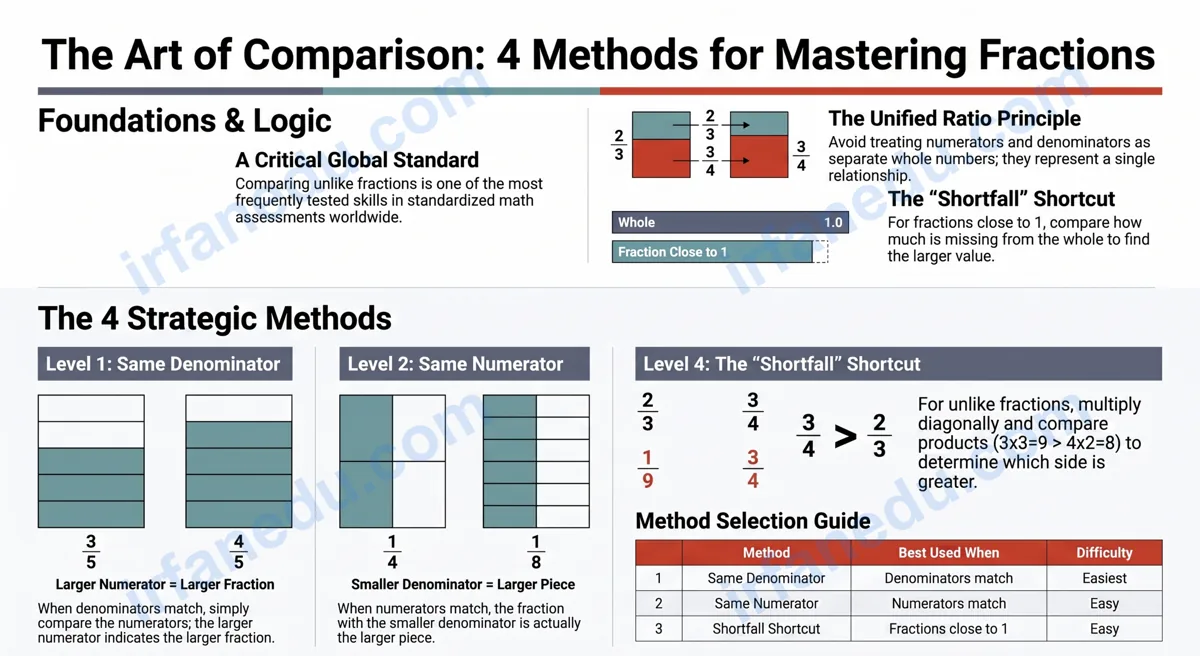
Comparing fractions is the skill of deciding which of two fractions is larger, smaller, or equal. Students in Grades 3 through 6 use four core methods: same-denominator comparison, same-numerator comparison, cross-multiplication, and decimal conversion. Mastering these methods builds the number sense needed for algebra, ratios, and proportional reasoning.
Most worksheet sites hand you a PDF and leave you to figure out the method yourself. That approach works fine if you already know what you are doing — but it fails the student who is stuck on why 5/6 is bigger than 7/8 (or is it?). On this page you get the full lesson first, then the printable practice sheet, so every problem you attempt is backed by a method you actually understand.
In my experience teaching fractions across multiple grade levels, the single biggest gap is not computation — it is knowing which method to reach for. This lesson fixes that directly.
- Learn all four comparison methods in order of difficulty
- See three fully worked examples with step-by-step reasoning
- Spot and correct the most common student errors
- Download or print a 10-problem worksheet with a full answer key
Free Printable PDF: 10 comparing-fractions problems, increasing difficulty, with a full answer key — ready to print or use on a tablet.
The PDF includes the answer key on a separate page. If the download link does not appear, the file is being processed — check back shortly.
TL;DR — Quick Summary
- Same denominators: compare numerators directly (5/8 > 3/8).
- Same numerators: larger denominator = smaller fraction (2/5 < 2/3).
- Unlike fractions: cross-multiply and compare the two products.
- Decimal check: divide numerator by denominator, compare decimals.
- Benchmark 1/2 shortcut: quickly screen fractions before full calculation.
- 10 practice problems (easy to hard) + answer key included below.
| Method | Best Used When | Difficulty | Example |
|---|---|---|---|
| Same denominator | Denominators already match | Easiest | 3/7 vs 5/7 |
| Same numerator | Numerators already match | Easy | 2/5 vs 2/9 |
| Benchmark (1/2) | Quick screening, mental math | Easy-Medium | 3/7 vs 5/9 |
| Cross-multiplication | Any unlike fractions | Medium | 3/4 vs 5/7 |
| Decimal conversion | Verification or calculator use | Medium | 7/11 vs 5/8 |
What Is Comparing Fractions — and Why Does It Matter?
Comparing fractions is the process of determining the relative size of two or more fractions using a mathematical relationship, not guesswork. A fraction represents a part of a whole, so comparing fractions is really asking: which part is bigger?
This skill matters far beyond the worksheet. Recipes use fractions (is 2/3 cup more than 3/4 cup?). Measurements use fractions (which bolt fits — 5/16 inch or 3/8 inch?). Probability uses fractions. Algebra uses rational expressions that are fractions in disguise. Students who cannot compare fractions fluently hit a wall in every one of these areas.
According to the Khan Academy Grade 4 fraction curriculum, comparing fractions with unlike denominators is one of the most frequently tested fraction skills in standardized assessments worldwide.
MY POV: In my experience, students who struggle with fractions almost always have the same root problem — they treat the numerator and denominator as two separate whole numbers instead of one unified ratio. Once I show them that 1/2 and 3/6 are the same-sized slice of pie, the comparison methods click into place within minutes. The visual fraction bar is not optional decoration; it is the conceptual anchor.
The 4 Methods for Comparing Fractions — From Easiest to Hardest
These four methods are ordered by difficulty. Start with the first method that applies to your pair of fractions — there is no reason to use cross-multiplication when the denominators already match.
Method 1 — Same Denominator (Easiest)
When two fractions share the same denominator, compare the numerators. The fraction with the larger numerator is greater.
- Confirm both denominators are identical.
- Compare the numerators as whole numbers.
- Write the correct symbol: >, <, or =.
Example: 5/8 vs 3/8. Both have denominator 8. Since 5 > 3, we get 5/8 > 3/8.
Method 2 — Same Numerator (Easy)
When two fractions share the same numerator, the fraction with the smaller denominator is greater. This is the method most students get backwards.
- Confirm both numerators are identical.
- Identify the smaller denominator.
- The fraction with the smaller denominator is the larger fraction.
Example: 2/5 vs 2/9. Same numerator (2). Since 5 < 9, we get 2/5 > 2/9. Think of it this way: 2 slices of a pie cut into 5 pieces is bigger than 2 slices of the same pie cut into 9 pieces.
Method 2 Visual — Same Numerator: 2/5 vs 2/9

  2/5  |####|####|    |    |    |   (2 out of 5 equal parts)
  2/9  |##|##|  |  |  |  |  |  |  | (2 out of 9 equal parts)

  Each # = one equal part of the whole.
  Clearly 2/5 shades MORE of the bar than 2/9.
  Conclusion: 2/5 > 2/9
Method 3 — Cross-Multiplication (Medium)
Cross-multiplication works for any two fractions with unlike denominators. It avoids finding the lowest common denominator, which makes it faster for most students.
- Write the two fractions side by side: a/b and c/d.
- Multiply the numerator of the first fraction by the denominator of the second: a × d. Write this product on the left.
- Multiply the numerator of the second fraction by the denominator of the first: c × b. Write this product on the right.
- Compare the two products. The side with the larger product holds the larger fraction.
Example: 3/4 vs 2/3. Left product: 3 × 3 = 9. Right product: 2 × 4 = 8. Since 9 > 8, we get 3/4 > 2/3.
Method 4 — Decimal Conversion (Medium, best as a check)
Divide each numerator by its denominator to convert to a decimal, then compare. This method is the most reliable verification tool, especially when cross-multiplication gives a close result.
- Divide: fraction 1 numerator ÷ denominator = decimal 1.
- Divide: fraction 2 numerator ÷ denominator = decimal 2.
- Compare the two decimals using standard place-value rules.
Example: 5/6 vs 7/8. 5 ÷ 6 ≈ 0.833. 7 ÷ 8 = 0.875. Since 0.875 > 0.833, we get 7/8 > 5/6.
3 Fully Worked Examples
These examples follow the progressive-difficulty backbone of the worksheet. Work through each one before attempting the practice problems.
Example 1 — Easy: 4/7 vs 3/7
Method: Same denominator.
Both fractions have denominator 7. Compare numerators: 4 vs 3. Since 4 > 3, the answer is 4/7 > 3/7.
No calculation needed beyond reading the numerators.
Example 2 — Medium: 2/3 vs 3/4
Method: Cross-multiplication.
Left product: 2 × 4 = 8. Right product: 3 × 3 = 9. Since 8 < 9, the left fraction is smaller. Answer: 2/3 < 3/4.
Decimal check: 2/3 ≈ 0.667, 3/4 = 0.75. Confirmed.
Example 3 — Hard: 11/12 vs 8/9
Method: Cross-multiplication (close fractions near 1).
Left product: 11 × 9 = 99. Right product: 8 × 12 = 96. Since 99 > 96, the left fraction is larger. Answer: 11/12 > 8/9.
Decimal check: 11/12 ≈ 0.9167, 8/9 ≈ 0.8889. Confirmed.
Note: Both fractions are close to 1. The “distance from 1” trick also works here: 11/12 is 1/12 away from 1, while 8/9 is 1/9 away from 1. Since 1/12 < 1/9, the fraction 11/12 is closer to 1 and therefore larger.
MY POV: Example 3 is the one that separates students who understand fractions from those who have only memorised steps. The “distance from 1” insight — that 11/12 is only 1/12 short of a whole, while 8/9 is 1/9 short — is a genuine mental-math shortcut I teach in every fraction unit. It is faster than cross-multiplication for fractions close to 1, and it builds real number sense. You will not find this tip in most worksheet PDFs.
Common Mistakes When Comparing Fractions
These are the errors I see most often in student work. Each one has a simple fix.
| Wrong Thinking | Correct Thinking |
|---|---|
| “3/7 > 3/5 because 7 > 5” | Same numerator rule: larger denominator = smaller fraction. 3/7 < 3/5. |
| Cross-multiplying but assigning products to the wrong side | Always write the product on the same side as the fraction whose numerator you used. |
| Comparing 5/6 and 7/8 by just looking at numerators (7 > 5) | You must account for the denominator. Use cross-multiplication or decimals. |
| Assuming a bigger numerator always means a bigger fraction | Only true when denominators are equal. 7/20 < 3/4 even though 7 > 3. |
| Rounding decimals too early (e.g. 0.83 vs 0.83 — looks equal) | Carry at least 3 decimal places. 5/6 = 0.8333 vs 7/9 = 0.7778 — clearly different. |
Unique Insight — What Most Fraction Guides Get Wrong
Most comparing-fractions resources teach cross-multiplication as the universal method and stop there. But cross-multiplication is actually the slowest reliable method in many cases. The insight most guides miss is this: for fractions close to 1, compare their “shortfall” instead. The shortfall of a fraction a/b is (b – a)/b — how far it is from 1. A smaller shortfall means a larger fraction. For 11/12 vs 8/9: shortfalls are 1/12 and 1/9. Since 1/12 < 1/9, we know 11/12 > 8/9 instantly, with no multiplication at all. This same logic applies to fractions close to any benchmark (0, 1/2, 1). Teaching benchmarks as a first-pass filter — not just a “nice trick” — cuts comparison time in half on timed tests.
On-Page Practice Worksheet — 10 Problems (Easy to Hard)
How to use this worksheet: work through each problem using the method that fits best. Check your answers with the key below. For extra practice, print the PDF version (link above and below).
- 1/2 ___ 1/3
- 2/4 ___ 1/2
- 3/5 ___ 2/5
- 4/7 ___ 3/7
- 2/3 ___ 3/4
- 5/6 ___ 7/8
- 3/8 ___ 2/5
- 7/10 ___ 3/4
- 5/9 ___ 4/7
- 11/12 ___ 8/9
Show Answer Key
- 1/2 > 1/3 (same numerator: 2 < 3, so 1/2 is larger)
- 2/4 = 1/2 (2/4 simplifies to 1/2)
- 3/5 > 2/5 (same denominator: 3 > 2)
- 4/7 > 3/7 (same denominator: 4 > 3)
- 2/3 < 3/4 (cross-multiply: 8 < 9)
- 5/6 < 7/8 (cross-multiply: 40 < 42; or decimals: 0.833 < 0.875)
- 3/8 < 2/5 (cross-multiply: 15 < 16)
- 7/10 < 3/4 (cross-multiply: 28 < 30; or decimals: 0.70 < 0.75)
- 5/9 < 4/7 (cross-multiply: 35 < 36)
- 11/12 > 8/9 (cross-multiply: 99 > 96; shortfall method: 1/12 < 1/9)
Want a print-ready version? Download the free PDF — includes all 10 problems and the answer key on a separate page.
Reveal-on-Click Practice Problems
Try each problem before revealing the solution.
Practice 1: Which is greater, 4/9 or 3/7?
Method: Cross-multiplication.
Left product: 4 × 7 = 28. Right product: 3 × 9 = 27. Since 28 > 27, the answer is 4/9 > 3/7.
This is a close pair — only cross-multiplication or decimals will catch it reliably.
Practice 2: Compare 5/8 and 7/12.
Method: Cross-multiplication.
Left product: 5 × 12 = 60. Right product: 7 × 8 = 56. Since 60 > 56, the answer is 5/8 > 7/12.
Decimal check: 5/8 = 0.625, 7/12 ≈ 0.583. Confirmed.
Practice 3: Order 1/2, 2/3, and 3/5 from least to greatest.
Method: Convert to decimals for a three-way comparison.
1/2 = 0.500, 2/3 ≈ 0.667, 3/5 = 0.600.
Order: 1/2 < 3/5 < 2/3.
Quick Quiz — Test Your Skills (3 Questions)
Q1. Which fraction is greater: 3/5 or 4/7?
Show Answer
3/5 is greater. Cross-multiply: 3×7 = 21 and 4×5 = 20. Since 21 > 20, we get 3/5 > 4/7. A very close pair — only 1 unit apart in the cross-products.
Q2. Which method is fastest for comparing 2/11 and 2/13?
Show Answer
Same-numerator rule. Both fractions have numerator 2. The smaller denominator (11) gives the larger fraction. So 2/11 > 2/13 — no calculation required.
Q3. True or False: 7/8 > 5/6.
Show Answer
True. Cross-multiply: 7×6 = 42 and 5×8 = 40. Since 42 > 40, we get 7/8 > 5/6. Shortfall method: 7/8 is 1/8 from 1; 5/6 is 1/6 from 1. Since 1/8 < 1/6, the fraction 7/8 is closer to 1 and therefore larger.