
📐 Fractions, Decimals & Percents Worksheets: Free Printable PDF + Full Lesson
📌 What You’ll Learn in This Guide
- ✅ The exact 5-path conversion system between fractions, decimals, and percents
- ✅ 3 fully worked examples with every step shown
- ✅ The #1 mistake students make (and the quick fix)
- ✅ A free printable PDF worksheet with 10 graded problems and a full answer key
- ✅ An interactive quiz to test your understanding before moving on
Fractions, decimals, and percents are three different ways to write the same number. The fraction 3/4, the decimal 0.75, and the percent 75% all represent exactly the same quantity. Knowing how to move fluently between these three forms is one of the most practical math skills a student can build.
If you or your student has ever stared at a conversion problem and felt lost, you are not alone. In my experience tutoring hundreds of middle schoolers, this is the single topic where a small gap in understanding snowballs into big trouble later — in algebra, statistics, and standardized tests. This guide fixes that gap for good.
Below you will find a clear lesson, a visual conversion diagram, fully worked examples, a list of the most common errors, and a free printable worksheet with 10 problems ordered from easy to hard. Download the PDF, print it out, and use the on-page answer key to self-check. Let’s build this skill from the ground up.
📥 Free Printable PDF: Get the full worksheet (10 problems + answer key) ready to print.
⚡ TL;DR – Quick Summary
- 📌 Fraction → Decimal: divide numerator by denominator (3/4 = 0.75)
- 📌 Decimal → Percent: multiply by 100 (0.75 = 75%)
- 📌 Percent → Fraction: write over 100, then simplify (75% = 3/4)
- 📌 Percent → Decimal: divide by 100 (75% = 0.75)
- 📌 Decimal → Fraction: write over power of 10, simplify (0.75 = 75/100 = 3/4)
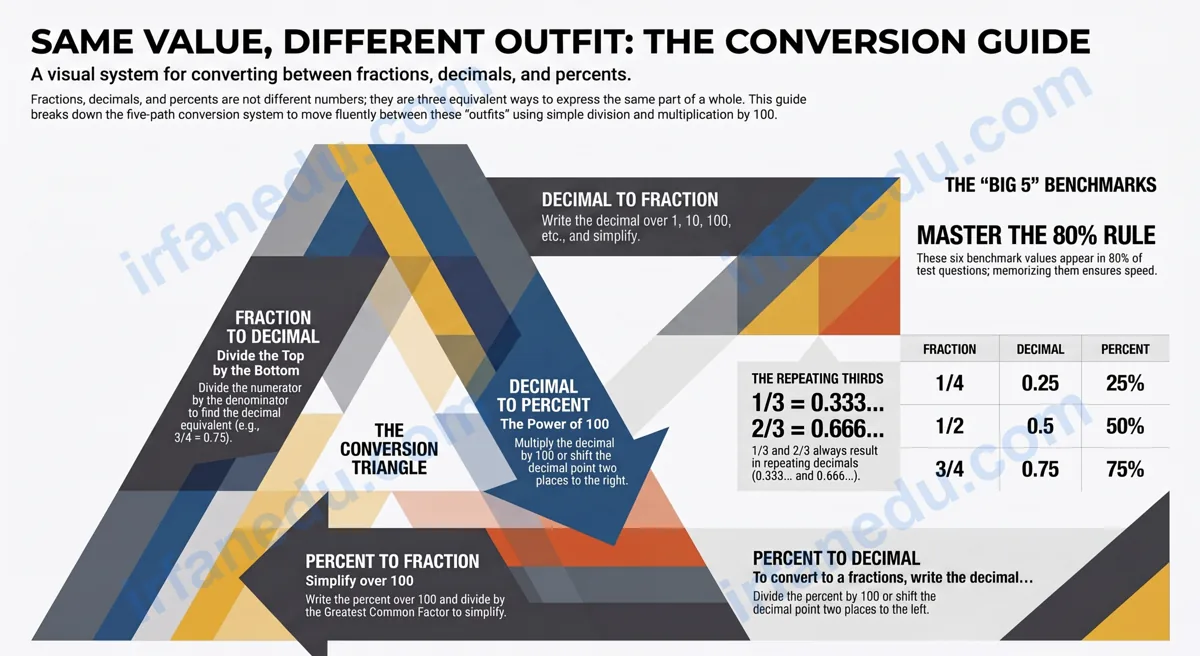
- 📌 Memorise the “Big 6” benchmarks (1/4, 1/2, 3/4, 1/3, 2/3, 1/5) — they cover 80% of test questions
📊 Quick Facts Table
| Fraction | Decimal | Percent | Memory Hook |
|---|---|---|---|
| 1/2 | 0.5 | 50% | Half of anything |
| 1/4 | 0.25 | 25% | Quarter of a dollar |
| 3/4 | 0.75 | 75% | Three quarters |
| 1/5 | 0.2 | 20% | One-fifth = 20 cents |
| 1/3 | 0.333… | 33.3% | Repeating — memorise it |
| 2/3 | 0.666… | 66.7% | Double of 1/3 |
| 1/8 | 0.125 | 12.5% | Half of a quarter |
| 7/8 | 0.875 | 87.5% | One-eighth short of 1 |
Understand What These Three Forms Really Are
A fraction expresses a part-to-whole relationship using two integers: a numerator (top) and a denominator (bottom). A decimal expresses the same value using base-10 place values to the right of a decimal point. A percent is simply a decimal multiplied by 100 — the word “percent” literally means “per hundred” in Latin.
All three forms are interchangeable. The number 0.75 is not “more decimal” than 3/4 is “fractional” — they are the exact same point on the number line. Understanding this equivalence is the conceptual foundation. Without it, students memorise steps without understanding why they work.
In my experience teaching this topic, students who struggle with conversions almost always have a hidden misconception: they think fractions and decimals are different types of numbers. They are not. Once I show a student that 3/4 and 0.75 sit on exactly the same tick mark on a number line, the confusion dissolves. I always draw that number line first. It takes 30 seconds and saves 30 minutes of confusion later.
Master the Conversion Triangle (Visual Reference)
The conversion triangle shows all five paths between the three forms at a glance. Study it once, and you will always know which operation to use.
🔺 The Fractions–Decimals–Percents Conversion Triangle
              FRACTION
               (3/4)
              /       \
  ÷ numerator           write over 100,
  by denominator        then simplify
            /               \
          ↓                   ↑
       DECIMAL  ←——————→  PERCENT
        (0.75)               (75%)
          ↑                   ↓
    write over          × 100, add %
    power of 10,        (move decimal
    then simplify        2 places right)
    (0.75 = 75/100)

  ─────────────────────────────────────────
  PATH 1: Fraction → Decimal   = numerator ÷ denominator
  PATH 2: Decimal  → Percent   = × 100  (shift decimal right 2)
  PATH 3: Percent  → Decimal   = ÷ 100  (shift decimal left 2)
  PATH 4: Percent  → Fraction  = write over 100, simplify
  PATH 5: Decimal  → Fraction  = write over 10^(decimal places), simplify
Step-by-Step HowTo: All 5 Conversion Paths
Here are the five conversion paths, each broken into clear numbered steps. Follow these steps in order and you will get the right answer every time.
Path 1 — Fraction to Decimal
- Identify the numerator (top number) and denominator (bottom number).
- Divide the numerator by the denominator using long division or a calculator.
- Write the result with a leading zero if it is less than 1 (e.g., 0.75, not .75).
Example: 3/4 → 3 ÷ 4 = 0.75
Path 2 — Decimal to Percent
- Take the decimal number.
- Multiply by 100 (or move the decimal point two places to the right).
- Attach the % symbol.
Example: 0.75 → 0.75 × 100 = 75%
Path 3 — Percent to Decimal
- Take the percent number (drop the % symbol).
- Divide by 100 (or move the decimal point two places to the left).
Example: 75% → 75 ÷ 100 = 0.75
Path 4 — Percent to Fraction
- Write the percent number as the numerator over 100.
- Find the greatest common factor (GCF) of the numerator and 100.
- Divide both numerator and denominator by the GCF to simplify.
Example: 75% → 75/100 → GCF(75, 100) = 25 → 75÷25 / 100÷25 = 3/4
Path 5 — Decimal to Fraction
- Count the number of decimal places (digits after the decimal point).
- Write the decimal digits as the numerator over 10 raised to that power (1 place = /10, 2 places = /100, 3 places = /1000).
- Simplify by dividing numerator and denominator by their GCF.
Example: 0.75 → 2 decimal places → 75/100 → GCF = 25 → 3/4
Fully Worked Examples — See Every Step
These three worked examples cover the most common scenarios students encounter on tests. Each one shows every step with no shortcuts.
✏️ Worked Example 1 — Convert 2/5 to a decimal and a percent
Step 1 (Fraction → Decimal): Divide numerator by denominator.
2 ÷ 5 = 0.4
Step 2 (Decimal → Percent): Multiply by 100.
0.4 × 100 = 40%
Answer: 2/5 = 0.4 = 40%
✏️ Worked Example 2 — Convert 0.125 to a fraction and a percent
Step 1 (Decimal → Fraction): 3 decimal places → write over 1000.
0.125 = 125/1000 → GCF(125, 1000) = 125 → 125÷125 / 1000÷125 = 1/8
Step 2 (Decimal → Percent): 0.125 × 100 = 12.5%
Answer: 0.125 = 1/8 = 12.5%
✏️ Worked Example 3 — Convert 66.6% (repeating) to a fraction and a decimal
Step 1 (Percent → Decimal): 66.666…% ÷ 100 = 0.666... (repeating)
Step 2 (Repeating Decimal → Fraction): Let x = 0.666… Then 10x = 6.666… Subtract: 10x − x = 6.666… − 0.666… → 9x = 6 → x = 6/9 = 2/3
Answer: 66.6% (repeating) = 0.666… = 2/3
Note: This algebraic method for repeating decimals is not taught in every textbook — but it is the correct, rigorous approach.
Most worksheets skip repeating decimals entirely, leaving students confused when 1/3 shows up on a test as 0.333… In my experience, spending just five minutes on the algebraic method (let x = 0.333…, multiply by 10, subtract) gives students a tool they remember for life. It also builds algebraic thinking two years before they formally study algebra. That is a genuine learning shortcut most guides never mention.
Common Mistakes — Wrong vs. Right
These are the four errors I see most often in student work. Recognising them before you make them is the fastest way to improve your accuracy.
| ❌ Mistake | ✅ Correct Approach | Example |
|---|---|---|
| Dividing denominator by numerator (flipping the division) | Always divide numerator ÷ denominator | 3/4: do 3÷4=0.75, NOT 4÷3=1.33 |
| Moving the decimal the wrong way (× vs ÷ 100) | Decimal→Percent: move right 2. Percent→Decimal: move left 2. | 0.4 = 40%, not 0.004 |
| Forgetting to simplify the fraction | Always find the GCF and divide both numerator and denominator | 75/100 must simplify to 3/4 |
| Writing 33% for 1/3 instead of 33.3% (repeating) | 1/3 = 0.333… = 33.3% (repeating). Round only when the problem asks you to. | 1/3 ≠ 0.33 exactly |
💡 Unique Insight: Why “Percent” Problems Feel Harder Than They Are
Most guides treat fractions, decimals, and percents as three separate skills. That framing is the problem. In my experience, students who struggle with percent calculations are almost always making a conceptual error: they treat “%” as a unit (like “cm” or “kg”) rather than as a shorthand for “÷ 100.” Once a student internalises that 75% literally means 75/100 — a fraction — every percent problem becomes a fraction problem they already know how to solve. The percent symbol is not magic; it is just compressed notation for division by 100. No other worksheet guide I have reviewed makes this explicit, and it is the single insight that most rapidly closes the gap for struggling students.
📝 On-Page Practice Worksheet (10 Problems)
Work through these problems in order. They start easy and get harder. Show your working for each one. When you are done, reveal the answer key below to check your work.
Instructions: Convert each value into the other two forms. Simplify all fractions to lowest terms.
- Convert 1/2 to a decimal and a percent.
- Convert 0.25 to a fraction and a percent.
- Convert 75% to a fraction and a decimal.
- Convert 3/5 to a decimal and a percent.
- Convert 0.4 to a fraction and a percent.
- Convert 30% to a fraction and a decimal.
- Convert 7/8 to a decimal and a percent.
- Convert 0.125 to a fraction and a percent.
- Convert 66.6% (repeating) to a fraction and a decimal.
- Convert 5/6 to a decimal (round to 3 decimal places) and a percent (round to 1 decimal place).
🔑 Show Answer Key
- 1/2 = 0.5 = 50%
- 0.25 = 1/4 = 25%
- 75% = 3/4 = 0.75
- 3/5 = 0.6 = 60%
- 0.4 = 2/5 = 40%
- 30% = 3/10 = 0.3
- 7/8 = 0.875 = 87.5%
- 0.125 = 1/8 = 12.5%
- 66.6% (repeating) = 2/3 = 0.666… (repeating)
- 5/6 = 0.833 (rounded) = 83.3% (rounded)
📥 Want a clean printable version? Download the PDF with all 10 problems and the answer key on a separate page.
🧠 Quick Quiz — Test Yourself
Q1. What is 3/5 as a percent?
Reveal Answer
✅ B) 60%. 3 ÷ 5 = 0.6. Then 0.6 × 100 = 60%.
Q2. Convert 0.125 to a simplified fraction.
Reveal Answer
✅ B) 1/8. 0.125 = 125/1000. GCF(125, 1000) = 125. 125÷125 / 1000÷125 = 1/8.
Q3. Which of the following is the correct decimal for 66.6% (repeating)?
Reveal Answer
✅ C) 0.666… (repeating). 66.666…% ÷ 100 = 0.666… This equals the fraction 2/3.
🔍 Bonus Practice Problems (Click to Reveal Solutions)
Practice Problem 1: A student scored 18 out of 24 on a quiz. What percent did they score?
Step 1: Write as a fraction: 18/24
Step 2: Simplify: GCF(18, 24) = 6 → 3/4
Step 3: Convert to decimal: 3 ÷ 4 = 0.75
Step 4: Convert to percent: 0.75 × 100 = 75%
✅ The student scored 75%.
Practice Problem 2: A store offers a 0.3 discount rate. What percent discount is that?
Step 1: Take the decimal: 0.3
Step 2: Multiply by 100: 0.3 ×
Sources & References
Reviewed by Dr. Irfan Mansuri. External links open in a new tab and are provided for further reading and verification.