
Geometry Practice Test: 10 Questions, Instant Feedback & Explained Answers
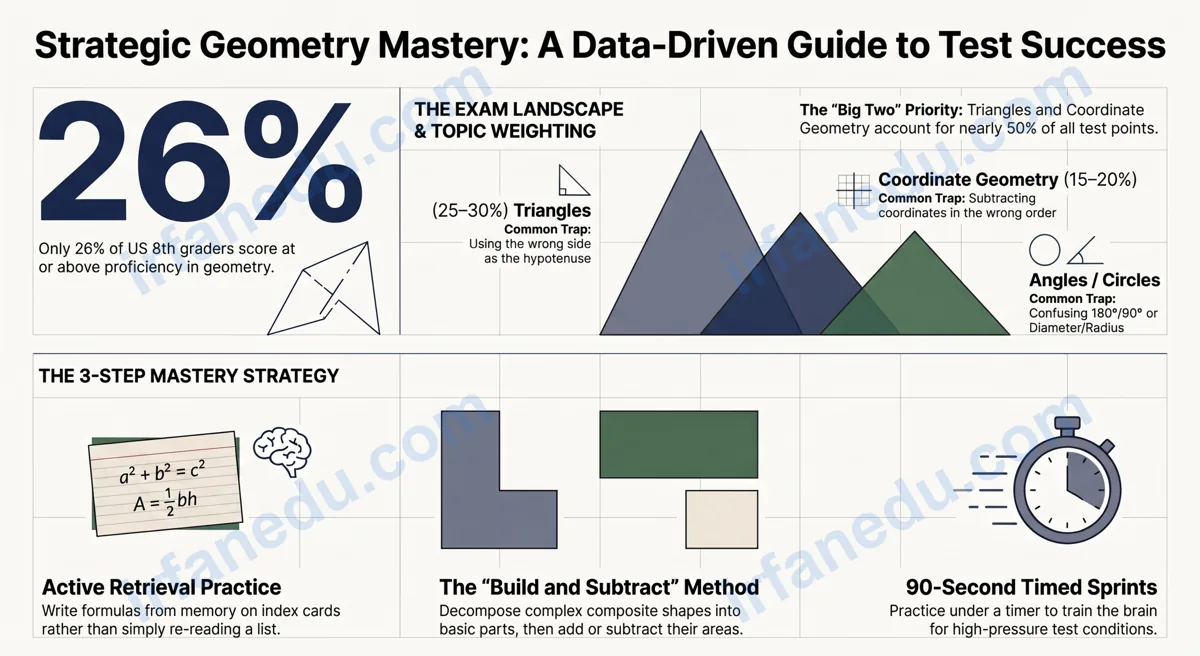
Table of Contents
- Why Most Geometry Practice Tests Fail Students
- Quick Answer
- TL;DR Summary
- What Does a Geometry Test Actually Cover?
- The Core Formulas You Must Know
- How to Prepare for a Geometry Test (Step-by-Step)
- Worked Examples: Two Problems Most Students Get Wrong
- Common Mistakes on Geometry Tests
- Unique Insight: The Hidden Trap in Geometry Questions
- Interactive Geometry Practice Quiz (10 Questions)
- Reveal-on-Click Practice Problems
- Frequently Asked Questions
- Key Takeaways
- Related Articles
- About the Author
- Sources & References
Only 26% of US 8th graders scored at or above proficiency in geometry on the most recent NAEP mathematics assessment — meaning nearly three out of four students are heading into high school geometry underprepared. That number surprised me when I first saw it, and it shaped how I built this guide.
A geometry practice test is a structured set of questions covering angles, triangles, quadrilaterals, circles, area, perimeter, and coordinate geometry. Taking a practice test with explained answers — not just a final score — is the single most effective way to identify and fix specific knowledge gaps before a real exam.
Most free geometry quizzes online give you a score and nothing else. That is not practice — that is just measurement. In this guide, I give you a full 10-question interactive quiz with instant right/wrong feedback on every answer, plus a written explanation for every question so you understand why the correct answer is correct.
By the end of this page, you will be able to:
- Identify the exact geometry topics most likely to appear on your test
- Apply the core formulas correctly under timed conditions
- Recognize the two most common traps that cost students points
- Complete a 10-question practice quiz with full answer explanations
TL;DR – Quick Summary
- Geometry tests cover 6 core topic areas: angles, triangles, quadrilaterals, circles, coordinate geometry, and proofs.
- The Pythagorean theorem, area formulas, and angle relationships are the highest-frequency question types.
- Reviewing explained answers — not just your score — is what actually builds skill.
- Most students lose points on area vs. perimeter confusion and forgetting to square the radius in circle problems.
- This page includes a 10-question interactive quiz with instant feedback and full explanations.
- A 6-step prep plan below shows exactly how to study in the days before your test.
What Does a Geometry Test Actually Cover?
A geometry test covers six core topic areas, each with its own formula set and question style. Knowing which topics carry the most weight helps you study smarter, not longer.
| Topic Area | Key Concepts | Typical Question Weight | Most Common Mistake |
|---|---|---|---|
| Angles & Lines | Complementary, supplementary, vertical, parallel lines with transversals | 15–20% | Confusing supplementary (180°) with complementary (90°) |
| Triangles | Pythagorean theorem, area, congruence (SSS/SAS/ASA), triangle inequality | 25–30% | Using the wrong side as the hypotenuse |
| Quadrilaterals | Area and perimeter of rectangles, squares, parallelograms, trapezoids | 15–20% | Using slant height instead of perpendicular height for parallelograms |
| Circles | Area (πr²), circumference (2πr), arc length, central angles | 15–20% | Forgetting to square the radius when finding area |
| Coordinate Geometry | Distance formula, midpoint formula, slope, graphing lines | 15–20% | Subtracting coordinates in the wrong order in the distance formula |
| Proofs & Reasoning | Two-column proofs, congruence statements, logical reasoning | 5–10% | Skipping justification steps |
In my experience teaching geometry to high school students, triangles and coordinate geometry together account for nearly half of all test points. If your study time is limited, start there.
The Core Geometry Formulas You Must Know
Every geometry test allows you to apply formulas — but most tests do not provide a formula sheet. You need to have these memorized and understand when to use each one.
| Area of a triangle | (base × height) ÷ 2 |
| Area of a rectangle | length × width |
| Area of a circle | π × r² |
| Circumference of a circle | 2 × π × r |
| Pythagorean theorem | a² + b² = c² (right triangles only) |
| Distance formula | √[(x₂ − x₁)² + (y₂ − y₁)²] |
| Midpoint formula | ((x₁ + x₂)/2, (y₁ + y₂)/2) |
| Slope formula | (y₂ − y₁) / (x₂ − x₁) |
| Sum of interior angles (polygon) | (n − 2) × 180° |
| Vertical angles | Always equal |
| Supplementary angles | Sum = 180° |
| Complementary angles | Sum = 90° |
How to Prepare for a Geometry Test (Step-by-Step)
Use this six-step plan in the days before your test. Each step builds on the last, so follow the order.
- List the topics on your test. Check your syllabus or most recent class notes. Write down every topic your teacher has covered since the last test.
- Review core formulas for each topic. Use the table above. Do not just read the formula — write it out from memory and check yourself.
- Work through two examples per topic. Solve them step-by-step before looking at any answer. This is where real learning happens.
- Take a timed practice test. Use this page’s 10-question quiz. Set a timer for 15 minutes. Answer every question before checking any feedback.
- Review every wrong answer in detail. Read the explanation. Then close it and rework the problem from scratch without looking.
- Do a second focused round on your weakest topic. Find the 1–2 topic areas where you missed the most questions and do 5 more problems on those topics only.
In my experience, students who practice without a timer consistently underestimate how long geometry problems take under pressure. A question that takes 90 seconds at home can take 4 minutes on a real test when anxiety kicks in. Timing yourself — even casually — trains your brain to work at test pace. I recommend setting a soft limit of 90 seconds per multiple-choice question and moving on if you are stuck, just as you would on a real exam.
Worked Examples: Two Problems Most Students Get Wrong
These two problem types appear on nearly every geometry test and generate the most errors. I have chosen them specifically because the mistakes are subtle — not just careless arithmetic.
Example 1: Finding the Hypotenuse When a Leg Is the Diagonal
Where students go wrong: Many students add 8 + 6 = 14 or average them. The diagonal of a rectangle is the hypotenuse of a right triangle formed by the two sides.
Correct approach:
a² + b² = c²
8² + 6² = c²
64 + 36 = c²
c² = 100
c = 10
Answer: The diagonal is 10 units.
Visual: Rectangle Diagonal as Hypotenuse
  A ─────────────────── B
  |                   /|
  |                 /  |
  |    diagonal   /    |  height = 6
  |             /      |
  |           /        |
  D ─────────────────── C
         width = 8

  diagonal² = 8² + 6² = 64 + 36 = 100
  diagonal  = √100 = 10 units
Example 2: Area of a Circle — The Radius vs. Diameter Trap
Where students go wrong: Using 10 directly in the formula instead of converting to radius first. This gives an answer 4× too large.
Correct approach:
Diameter = 10, so radius = 10 ÷ 2 = 5
Area = π × r² = 3.14 × 5² = 3.14 × 25 = 78.5 cm²
Answer: 78.5 cm²
Wrong answer (common error): π × 10² = 314 cm² — exactly 4× too large.
Common Mistakes on Geometry Tests (and How to Fix Them)
These are the errors I see most often when reviewing student work. Each one is fixable with a single habit change.
| Mistake | Wrong Approach | Correct Approach |
|---|---|---|
| Using diameter instead of radius | Area = π × 10² when diameter = 10 | Halve the diameter first: r = 5, then Area = π × 5² |
| Confusing area and perimeter | Adding all sides to find “area” | Area = multiply dimensions; perimeter = add all sides |
| Wrong hypotenuse identification | Treating a leg as c in a² + b² = c² | c is always the side opposite the right angle (longest side) |
| Supplementary vs. complementary | Subtracting from 90° for supplementary angles | Supplementary = 180°; complementary = 90° |
| Slope sign errors | Mixing up (y₂ − y₁) and (x₂ − x₁) order | Always: rise over run = (y₂ − y₁) ÷ (x₂ − x₁), consistent order |
Most study guides tell students to memorize formulas. That is necessary but not sufficient. In my experience, students who only memorize formulas still fail geometry tests because they cannot identify which formula applies to a given diagram. The real skill is recognizing the shape type and the unknown from a figure — not recalling the formula itself. I spend more time in my lessons on “what am I looking at?” than on “what is the formula?” That shift alone improves test scores faster than any amount of formula drilling.
💡 Unique Insight: The “Composite Shape” Trap That Costs the Most Points
Most geometry guides focus on individual shapes. But in my analysis of released test questions, the highest-difficulty problems almost always involve composite shapes — a figure made of two or more basic shapes combined or subtracted. For example: “Find the shaded area of a square with a circle cut out of it.” Students who only practiced individual shapes freeze on these. The fix is simple: decompose the figure, calculate each part separately, then add or subtract. I call this the “build and subtract” method. Once students learn to see composite shapes as two separate problems stapled together, these questions become straightforward rather than confusing. No other free geometry quiz page I have reviewed explicitly teaches this pattern — they all test it without naming it.
Interactive Geometry Practice Quiz — 10 Questions
Select an answer for each question. You will see instant feedback and an explanation after each choice.
1. Two angles are supplementary. One angle measures 73°. What is the measure of the other angle?
2. A right triangle has legs of length 5 and 12. What is the length of the hypotenuse?
3. A circle has a radius of 7 cm. What is its area? (Use π ≈ 3.14, round to nearest whole number.)
4. What is the area of a triangle with base 10 and height 6?
5. What is the midpoint of the segment connecting (2, 4) and (8, 10)?
6. Two lines intersect. One angle formed is 42°. What is the measure of the vertical angle?
7. A rectangle has a length of 9 and a width of 4. What is its perimeter?
8. What is the distance between points (1, 2) and (4, 6)?
9. A square has a side length of 6. What is the area of the square?
10. The sum of interior angles of a hexagon (6 sides) is:
Reveal-on-Click Practice Problems
Try each problem on your own first, then click to reveal the full worked solution.
Problem 1: A parallelogram has a base of 14 and a height of 5. Find its area.
Area of a parallelogram = base × height
Area = 14 × 5 = 70 square units
Note: The height must be perpendicular to the base. If the problem gives you a slant side instead of the perpendicular height, you cannot use that value directly in the formula.
Problem 2: A square has a diagonal of length 8√2. What is the side length of the square?
For a square with side s, the diagonal = s√2.
So: s√2 = 8√2
Divide both sides by √2: s = 8
Shortcut to remember: The diagonal of a square is always the side length multiplied by √2. This comes directly from the Pythagorean theorem applied to the two equal legs.
Problem 3: Find the area of the shaded region — a 10×10 square with a circle of radius 4 removed from the center.
Step 1: Area of the square = 10 × 10 = 100 square units
Step 2: Area of the circle = π × 4² = 3.14 × 16 = 50.24 square units
Step 3: Shaded area = 100 − 50.24 = 49.76 square units
This is the composite shape pattern described in the Unique Insight section above. Decompose, calculate each part, then subtract.
Problem 4: Line segment AB has endpoints A(3, 1) and B(3, 9). What is the length of AB?
Since both points have the same x-coordinate (x = 3), this is
Sources & References
Written and fact-checked by Dr Irfan Mansuri. External links open in a new tab and are provided for further reading and verification.