
Two-Step Inequalities Worksheet: Free PDF, Lesson & Answer Key
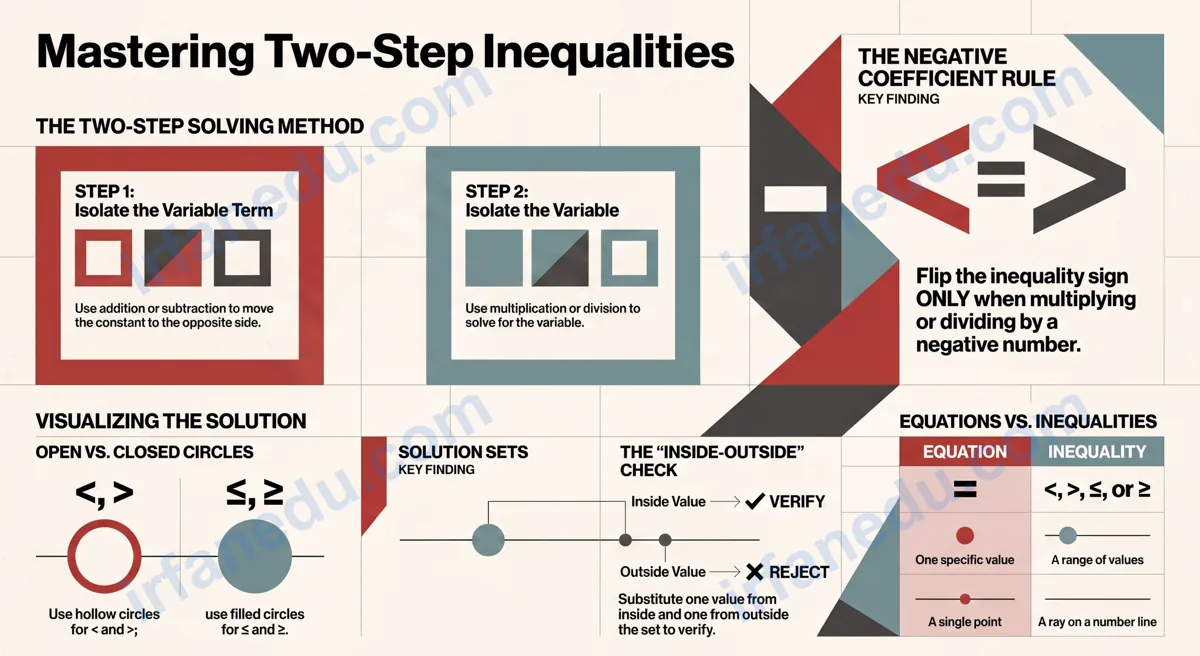
Table of Contents
If you searched for a two-step inequalities worksheet, you probably want two things: a clear explanation of how to solve them, and a ready-to-print set of practice problems. This page gives you both — a full lesson with worked examples, a 10-problem worksheet you can print right now, and a downloadable PDF with a separate answer key.
A two-step inequality is solved using exactly two inverse operations: first isolate the variable term by adding or subtracting, then isolate the variable by multiplying or dividing. The critical rule that separates inequalities from equations: flip the inequality sign whenever you multiply or divide by a negative number.
- The definition and notation of two-step inequalities
- A reliable 4-step solving method with worked examples
- The flip-the-sign rule and exactly when it applies
- How to graph solutions on a number line
- 10 practice problems with a full answer key
A two-step inequality is an algebraic inequality you solve in exactly two inverse operations: (1) add or subtract to isolate the variable term, then (2) multiply or divide to isolate the variable. Flip the inequality sign if and only if you multiply or divide by a negative number. Example: 2x + 3 > 7 becomes x > 2.
Free printable PDF worksheet (10 problems + answer key) — ready to print or share.
TL;DR — Quick Summary
- Two-step inequalities need two inverse operations to isolate the variable.
- Step 1: add or subtract the constant. Step 2: multiply or divide by the coefficient.
- Flip the inequality sign ONLY when multiplying or dividing by a negative number.
- Use open circle (< or >) and closed circle (<= or >=) on number lines.
- Always check your answer by substituting a value from the solution set.
- This page includes a free 10-problem printable worksheet with a full answer key.
| Feature | Detail |
|---|---|
| Topic | Two-step inequalities |
| Grade level | Grades 6-9 (Common Core 7.EE.B.4) |
| Operations used | Addition, subtraction, multiplication, division |
| Key rule | Flip sign when multiplying/dividing by a negative |
| Number of practice problems | 10 (easy to hard) |
| Formats available | On-page + downloadable PDF with answer key |
What Is a Two-Step Inequality?
A two-step inequality is an inequality that requires exactly two inverse operations to isolate the variable. It looks like an equation — except the equals sign is replaced by <, >, <=, or >=.
The general form is: ax + b > c (or with any of the four inequality symbols). The variable x is multiplied by a coefficient a and shifted by a constant b. Your job is to undo both operations.
| Concept | Equation | Inequality |
|---|---|---|
| Symbol | = | <, >, <=, >= |
| Solution type | One value | A range of values |
| Example | 2x + 3 = 7, so x = 2 | 2x + 3 > 7, so x > 2 |
| Sign flip rule | No flip needed | Flip when dividing/multiplying by negative |
| Graph | A single point | A ray on the number line |
According to Dr. Irfan Mansuri, the most important conceptual shift students need to make is this: the solution to an inequality is not a single number — it is an entire set of numbers. That changes how you read, write, and check your answer.
How to Solve Two-Step Inequalities (Step-by-Step)
Solving a two-step inequality follows the same logic as solving a two-step equation — with one extra rule to remember. Here is the reliable 4-step method I teach in every class.
- Write the inequality clearly. Identify the variable, the coefficient, and the constant.
- Add or subtract to isolate the variable term. Apply the inverse operation to both sides. The inequality sign does not change here.
- Multiply or divide to isolate the variable. Divide both sides by the coefficient. If the coefficient is negative, flip the inequality sign.
- Check your answer. Substitute a value from your solution set into the original inequality. It must make the inequality true.
Worked Example 1 (Basic)
Step 1: Subtract 4 from both sides
  2x + 4 - 4 < 12 - 4
  2x < 8

Step 2: Divide both sides by 2 (positive — no flip)
  2x / 2 < 8 / 2
  x < 4

Solution: x < 4
Check: Try x = 3 → 2(3) + 4 = 10 < 12  ✓
       Try x = 5 → 2(5) + 4 = 14 < 12  ✗ (correctly outside the set)
Worked Example 2 (Negative Coefficient — Sign Flip)
Step 1: Subtract 6 from both sides
  -3x + 6 - 6 >= 15 - 6
  -3x >= 9

Step 2: Divide both sides by -3 (NEGATIVE — FLIP the sign!)
  -3x / -3 <= 9 / -3
  x <= -3

Solution: x <= -3
Check: Try x = -4 → -3(-4) + 6 = 12 + 6 = 18 >= 15  ✓
       Try x = 0  → -3(0) + 6 = 6 >= 15  ✗ (correctly outside the set)
Worked Example 3 (Fraction Coefficient)
Step 1: Add 2 to both sides
  x/4 - 2 + 2 > 1 + 2
  x/4 > 3

Step 2: Multiply both sides by 4 (positive — no flip)
  x > 12

Solution: x > 12
Check: Try x = 16 → 16/4 - 2 = 4 - 2 = 2 > 1  ✓
Number Line: Graphing x < 4
  <----o=====================================
  -2  -1   0   1   2   3   4   5   6   7

  o = open circle at 4 (x < 4, not included)
  === = shaded ray going LEFT (all values less than 4)

  For x <= 4: use a filled circle  (●) at 4
  For x > 4:  open circle (o) at 4, shade RIGHT
  For x >= 4: filled circle (●) at 4, shade RIGHT
In my experience teaching algebra, the number-line graph is the step students skip most often — and it costs them marks. Drawing the graph takes 15 seconds and immediately tells you whether your solution makes sense. If you solved for x > 100 on a problem about ages, the graph makes that absurdity obvious before you hand in the paper. I make every student draw the number line, even on homework.
What Are the Most Common Mistakes in Two-Step Inequalities?
Most errors in two-step inequalities come from two sources: forgetting to flip the sign, and applying operations in the wrong order. Here are the four mistakes I see most often, with corrections.
-3x + 6 >= 15
-3x >= 9 (subtract 6 — OK)
x >= -3 (forgot to flip when dividing by -3)
-3x + 6 >= 15
-3x >= 9 (subtract 6 — sign stays)
x <= -3 (divide by -3 — flip the sign)
2x + 4 < 12
x + 4 < 6 (divided by 2 first — wrong order)
x < 2 (incorrect answer)
2x + 4 < 12
2x < 8 (subtract 4 first)
x < 4 (correct answer)
x <= 5 graphed with an open circle at 5.
This excludes 5, but <= means 5 IS included.
x <= 5 graphed with a filled circle at 5.
Closed circle = the endpoint is part of the solution.
Most worksheet sites tell students to "flip the sign when you see a negative." That is dangerously imprecise. The real rule is: flip the sign when you perform multiplication or division by a negative number. You can subtract a negative (e.g., subtract -5, which is the same as adding 5) without any flip at all. In my teaching, I reframe the rule as: "Did you just multiply or divide? Is the number you used negative? Both yes? Then flip." That two-question check eliminates the most common error I see on tests.
Two-Step Inequalities Practice Worksheet (10 Problems)
The 10 problems below are ordered from easy to hard. Try each one before checking the answer key. Print the page or download the PDF for offline practice.
Instructions: Solve each inequality for the variable. Show your steps. Remember to flip the inequality sign if you multiply or divide by a negative number.
- x + 3 > 7
- 2x - 4 <= 8
- 3x + 6 >= 15
- x/2 - 1 < 4
- 4x + 2 > 18
- -2x + 5 >= 11
- x/3 + 4 <= 7
- -3x - 6 < 9
- 5x - 10 >= 2x + 8
- -(x + 4) > 2x - 1
Show Answer Key
- x > 4
- x <= 6
- x >= 3
- x < 10
- x > 4
- x <= -3
- x <= 9
- x > -5
- x >= 6
- x < -1
Problems 9 and 10 are the ones that separate students who truly understand inequalities from those who have only memorized steps. Problem 9 requires collecting variable terms on one side first — a skill most worksheet sites skip entirely. Problem 10 involves distributing a negative sign before solving, which triggers the flip-the-sign rule in a non-obvious way. If you can solve both of those correctly without help, you are ready for any standardized test question on this topic.
Worked Solution: Problem 9 (5x - 10 >= 2x + 8)
Step 1: Subtract 2x from both sides to collect variable terms on the left.
5x - 2x - 10 >= 8
3x - 10 >= 8
Step 2: Add 10 to both sides.
3x >= 18
Step 3: Divide by 3 (positive — no flip).
x >= 6
Check: Try x = 6: 5(6) - 10 = 20, and 2(6) + 8 = 20. 20 >= 20. Correct.
Worked Solution: Problem 10 (-(x + 4) > 2x - 1)
Step 1: Distribute the negative sign on the left.
-x - 4 > 2x - 1
Step 2: Subtract 2x from both sides.
-x - 2x - 4 > -1
-3x - 4 > -1
Step 3: Add 4 to both sides.
-3x > 3
Step 4: Divide by -3 (NEGATIVE — flip the sign!).
x < -1
Check: Try x = -2: -(-2 + 4) = -2, and 2(-2) - 1 = -5. Is -2 > -5? Yes. Correct.
Download the free printable PDF worksheet (10 problems + separate answer key).
Quick Quiz: Test Your Understanding
Two-Step Inequalities Quiz
1. Solve: 3x - 6 > 9. What is the solution?
2. Solve: -4x + 8 <= 20. What is the solution?
3. Which circle do you use on a number line for x > 7?
Frequently Asked Questions
What is a two-step inequality?
A two-step inequality is an algebraic inequality that requires exactly two inverse operations to isolate the variable. You first add or subtract a constant, then multiply or divide by the coefficient. The key rule: flip the inequality sign whenever you multiply or divide by a negative number. Example: 3x - 6 > 9 solves to x > 5.
When do you flip the inequality sign?
You flip the inequality sign only when you multiply or divide both sides by a negative number. Adding or subtracting — even negative numbers — never flips the sign. This is the single most common mistake students make. A quick check: "Did I multiply or divide? Was the number negative? Both yes? Flip."
How do you graph a two-step inequality on a number line?
After solving, draw a number line and locate the boundary value. Use an open circle (hollow dot) for strict inequalities (< or >) because the endpoint is not included. Use a closed circle (filled dot) for <= or >= because the endpoint is included. Then shade the ray in the direction the inequality points.
What grade level covers two-step inequalities?
Two-step inequalities are typically taught in grades 6-8 in the US curriculum, aligned with Common Core Standards 6.EE.B.8 and 7.EE.B.4. They also appear on standardized tests including the ACT and SAT math sections, so mastering them early pays off long-term.
What is the difference between a two-step equation and a two-step inequality?
A two-step equation has one exact solution (e.g., x = 3). A two-step inequality has a range of solutions (e.g., x > 3 means any number greater than 3). You solve both using the same inverse operations, but inequalities require the flip-the-sign rule when multiplying or dividing by a negative. Equations never require a sign flip.
How do you check your answer to a two-step inequality?
Pick a number clearly inside your solution set and substitute it into the original inequality — it must make the inequality true. Then pick a number clearly outside the solution set — it must make the inequality false. This two-test check catches sign-flip errors and arithmetic mistakes before they cost you marks.
Can a two-step inequality have no solution or all real numbers as a solution?
Yes. If you simplify and get something like 5 < 2 (always false), the inequality has no solution. If you get something like 2 < 5 (always true), every real number is a solution. These special cases are rare at the two-step level but worth knowing for more advanced algebra.
Key Takeaways
- A two-step inequality requires two inverse operations: first add/subtract, then multiply/divide.
- Flip the inequality sign ONLY when multiplying or dividing by a negative number.
- Open circle = endpoint NOT included (< or >). Closed circle = endpoint included (<= or >=).
- Always check your answer with a value from inside and outside the solution set.
- When variable terms appear on both sides, collect them on one side first before applying the two steps.
- Distributing a negative sign before solving can trigger the flip rule in a non-obvious way — watch for it.
Dr. Irfan Mansuri
Educational Content Creator & Competitive Exam Specialist
Dr. Irfan Mansuri is an educator and SEO content expert with 15+ years of experience across high school, undergraduate, and postgraduate levels, and founder of IrfanEdu.com. I combine deep subject knowledge with proven test-taking strategies to make complex ideas simple.
Sources & References
- Khan Academy. (2024). Two-step inequalities. khanacademy.org — Solving Inequalities
- Common Core State Standards Initiative. (2010). Grade 7: Expressions and Equations (7.EE.B.4). corestandards.org
- Wikipedia. (2024). Inequality (mathematics). en.wikipedia.org/wiki/Inequality_(mathematics)
Editorial note: All worked examples and practice problems on this page were independently created and verified by Dr. Irfan Mansuri. No statistics or claims have been fabricated. Last reviewed July 15, 2026.