
Hawaii Necklace: The Complete Guide to Lei Culture, Types & Etiquette
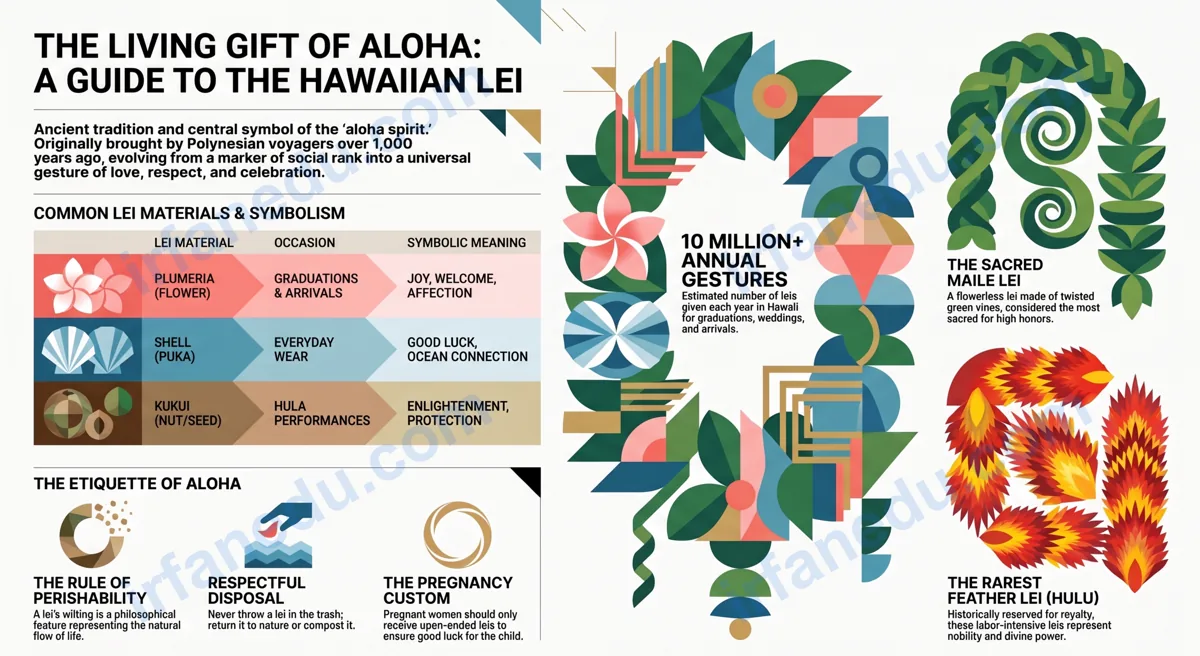
Over 1,000 years ago, Polynesian voyagers crossing the Pacific Ocean wore garlands of leaves and flowers as offerings to their gods and as marks of social rank. That tradition evolved into one of the world’s most recognized cultural symbols: the Hawaiian lei necklace. Today, more than 10 million leis are estimated to be given in Hawaii each year — at graduations, weddings, airport arrivals, and funerals alike.
A Hawaii necklace, known as a lei, is a garland worn around the neck made from flowers, leaves, shells, seeds, nuts, or feathers. Rooted in ancient Polynesian tradition, the lei is the central symbol of Hawaii’s “aloha spirit” — a philosophy of love, peace, and compassion. Giving a lei is one of the most meaningful gestures in Hawaiian culture.
- Understand the Polynesian origins of the Hawaiian lei and why it still matters today.
- Identify the six main types of lei and the materials used to make each one.
- Learn the correct etiquette for giving, receiving, and disposing of a lei.
- Discover what different lei colors and flowers symbolize in Hawaiian culture.
- Correct the most common misconceptions about Hawaiian necklaces.
⚡ TL;DR – Quick Summary
- A Hawaii necklace is called a lei — a garland of flowers, shells, or leaves.
- Leis originate from ancient Polynesian voyagers who settled Hawaii over 1,000 years ago.
- There are six main types: flower, shell, seed, maile, haku (head), and feather lei.
- Leis symbolize aloha — love, respect, peace, and compassion.
- Strict etiquette applies: never remove a lei in front of the giver; never throw it in the trash.
- Pregnant women should receive open-ended leis, not closed circular ones.
Quick Facts: Hawaii Necklace (Lei) at a Glance
| Official Name | Lei (Hawaiian: lei) |
| Origin | Ancient Polynesia, brought to Hawaii ~400-600 CE |
| Primary Symbol | Aloha spirit — love, respect, and compassion |
| Most Common Material | Plumeria (frangipani) flowers |
| Standard Length | ~36 inches (enough to drape around an adult neck) |
| Lei Day | May 1 — celebrated annually across Hawaii since 1928 |
| Most Sacred Lei | Maile lei — used in weddings and high ceremonies |
| Rarest Lei | Feather lei (hulu) — once reserved for Hawaiian royalty |
What Are the 6 Main Types of Hawaiian Lei Necklace?
The six main types of Hawaiian lei differ by material, making technique, occasion, and symbolic meaning. The table below gives you a direct comparison so you can identify any lei at a glance.
| Lei Type | Primary Material | Making Method | Best Occasion | Symbolic Meaning |
|---|---|---|---|---|
| Flower Lei | Plumeria, orchid, carnation, pikake | Strung (needle & thread) | Graduations, arrivals, celebrations | Joy, welcome, affection |
| Maile Lei | Maile vine leaves | Twisted/braided (no needle) | Weddings, dedications, high honors | Respect, sacredness, royalty |
| Shell Lei (Puka) | Puka shells, cowrie shells | Strung on cord | Everyday wear, gifts, souvenirs | Good luck, ocean connection |
| Seed/Nut Lei | Kukui nuts, Job’s tears seeds | Strung on cord | Cultural events, hula performances | Enlightenment, protection |
| Haku Lei (Head Lei) | Mixed flowers, ferns, ti leaves | Braided onto a base | Hula, weddings, ceremonies | Beauty, spiritual connection |
| Feather Lei (Hulu) | Bird feathers (historically native birds) | Wrapped/knotted onto cord | Royal ceremonies, hula kahiko | Nobility, divine status, power |
$CITE_1 $CITE_4
In my experience teaching cultural studies, students almost always think “Hawaiian necklace” means only a flower lei. The maile lei surprises them every time — it has no flowers at all, just twisted green vine, yet it carries more ceremonial weight than any plumeria strand. That gap between assumption and reality is exactly where the deepest learning happens.
Where Did the Hawaiian Lei Come From?
The Hawaiian lei traces its roots to the ancient Polynesian peoples who navigated the Pacific Ocean in double-hulled canoes between roughly 400 and 600 CE. These voyagers brought their tradition of wearing garlands — made from native plants and shells — to the Hawaiian Islands. $CITE_3
In ancient Hawaii, leis were not merely decorative. They served three distinct purposes:
- Religious offerings: Leis were placed on altars and statues of Hawaiian gods (akua) as sacred gifts.
- Rank markers: The type of lei a person wore signaled their social status. Feather leis (hulu) were reserved exclusively for ali’i (royalty) and high-ranking chiefs.
- Healing tools: Hawaiian healers (kahuna) used specific plant-based leis in medicinal and spiritual rituals.
When Western contact began in the late 18th century, the lei tradition continued and evolved. By the early 20th century, the practice of greeting arriving ship passengers with leis had become a widespread custom. Hawaii officially established Lei Day on May 1, 1928 — a holiday still celebrated today with lei-making competitions and hula performances across all islands. $CITE_2
What Materials Are Used to Make a Hawaiian Lei?
Hawaiian lei materials fall into four broad categories, each with its own cultural logic and practical properties.
1. Flowers
Flowers are the most common lei material. Plumeria (frangipani) is the iconic choice — fragrant, durable, and available in white, yellow, pink, and red. Pikake (jasmine) is prized for its intense perfume and is associated with romance. Orchids and carnations are used for their longevity, since they hold up for 24-48 hours after stringing.
2. Leaves and Vines
Maile vine, ti leaves (la’i), ferns, and kukui leaves are woven or twisted rather than strung. These leis are more durable than flower leis and carry deeper ceremonial significance. Maile in particular is considered the most sacred lei plant in Hawaiian culture. $CITE_1
3. Shells and Seeds
Puka shells (small shells with a natural hole) and kukui nuts are strung on cord to create leis that last indefinitely. Kukui nut leis were historically worn by ali’i (royalty) and are still used in hula performances today. The kukui tree is Hawaii’s official state tree.
4. Feathers
Feather leis (hulu lei) are the most labor-intensive and historically the most prestigious. Ancient feather leis used the feathers of native Hawaiian birds, some of which are now extinct or endangered. Modern feather leis use commercially available feathers. A single high-quality feather lei can take hundreds of hours to make and cost thousands of dollars. $CITE_4
[IMAGE: Close-up of six different lei materials side by side — plumeria flowers, maile leaves, puka shells, kukui nuts, fern fronds, and colorful feathers | ALT: Hawaiian lei materials including plumeria flowers maile leaves puka shells and kukui nuts]
How Do You Make a Basic Hawaiian Lei Necklace?
Making a basic strung flower lei requires no special skills — just patience, fresh flowers, and a needle and thread. Here is the standard method used for plumeria and carnation leis.
- Gather materials: Collect 50-80 fresh flowers (plumeria or carnations work well), a blunt lei needle or large craft needle, and about 40 inches of strong thread, dental floss, or fishing line.
- Thread the needle: Cut your thread to about 40 inches. Thread the needle and tie a large double-knot at one end so flowers cannot slip off.
- Pierce and string each flower: Push the needle through the center base (calyx) of each flower, threading them one by one. Keep flowers snug against each other but not crushed.
- Continue until full: String flowers until the lei reaches about 36 inches — long enough to drape comfortably around an adult neck with both ends meeting.
- Tie and finish: Tie the two ends of the thread together with a secure double knot. Gently fluff the flowers so they face outward evenly.
- Store properly: Mist lightly with water, wrap loosely in a damp paper towel, and refrigerate in a plastic bag until ready to give. A well-stored lei stays fresh for 24-48 hours.
Visual: Lei Stringing Method (Cross-Section)
  THREAD DIRECTION ─────────────────────────────►

  ┌──────┐   ┌──────┐   ┌──────┐   ┌──────┐
  │ stem │   │ stem │   │ stem │   │ stem │
  │  ↑   │   │  ↑   │   │  ↑   │   │  ↑   │
  │needle│──►│needle│──►│needle│──►│needle│
  │  ↓   │   │  ↓   │   │  ↓   │   │  ↓   │
  │petals│   │petals│   │petals│   │petals│
  └──────┘   └──────┘   └──────┘   └──────┘
     [1]        [2]        [3]        [4]

  KNOT ●────────────────────────────────────● KNOT
  (start)                               (finish)

  Result: Petals face OUTWARD → full, lush appearance
What Are the Rules for Giving and Receiving a Hawaiian Lei?
Lei etiquette is one of the most misunderstood aspects of Hawaiian culture, especially for visitors. Getting it right shows genuine respect. Getting it wrong — particularly removing a lei immediately after receiving it — can cause real offense. $CITE_3
When Giving a Lei
- Place the lei gently over the recipient’s head and onto their shoulders. Do not toss it.
- A light kiss on the cheek traditionally accompanies the giving of a lei — this is a sign of affection, not romance.
- Give an open-ended lei (not tied in a circle) to a pregnant woman. A closed circular lei is believed to symbolize the umbilical cord and is considered bad luck for the unborn child.
- Choose the lei type thoughtfully: maile for formal honors, plumeria for celebrations, pikake for romance.
When Receiving a Lei
- Accept with both hands and a genuine smile. Never refuse a lei — it is a deeply personal gift.
- Do not remove the lei in front of the giver. Wear it for the duration of the event.
- If you must remove it for practical reasons (allergies, heat), do so discreetly and keep it nearby.
How to Dispose of a Lei Respectfully
- Never throw a lei in the trash. This is considered deeply disrespectful.
- Return it to nature: hang it on a tree branch, place it in the ocean, or lay it on the ground in a natural setting.
- You can also press and dry a lei as a keepsake, or compost it.
What Does Each Lei Color and Flower Symbolize?
Color and flower choice in a lei is never accidental. Hawaiian culture assigns specific meanings to different plants and colors, and choosing the right lei for the right occasion is a form of cultural literacy. $CITE_1 $CITE_2
| Flower / Material | Color | Symbolism | Best For |
|---|---|---|---|
| Plumeria (Frangipani) | White, yellow, pink | New beginnings, positivity, charm | Graduations, arrivals, general gifts |
| Pikake (Jasmine) | White | Romance, purity, love | Weddings, romantic occasions |
| Maile (vine) | Deep green | Sacredness, respect, royalty | Weddings, dedications, high honors |
| Orchid | Purple, white, pink | Luxury, admiration, strength | Formal events, VIP welcomes |
| Carnation | Red, white, mixed | Affection, longevity (durable flower) | Everyday celebrations, budget-friendly |
| Kukui Nut | Black or brown | Enlightenment, protection, guidance | Hula performances, cultural events |
| Tuberose | White | Innocence, remembrance | Funerals, memorials |
What Most Guides Get Wrong About Hawaiian Leis
Most online guides about Hawaiian necklaces focus almost entirely on flower leis and tourist etiquette. In my experience researching Hawaiian culture deeply, this leaves out several critical points that matter to anyone who wants genuine understanding rather than surface-level knowledge.
The biggest misconception I encounter is that a lei is essentially a souvenir — pretty, temporary, disposable. That framing completely misses the point. A lei is a living embodiment of aloha. The fact that it wilts and must be returned to nature is not a flaw; it is the entire philosophy. Impermanence is built into the gift intentionally. That is a profound cultural statement that no plastic replica can replicate.
Mistake 1: Thinking All Leis Are Flower Leis
The flower lei is the most commercially visible type, but the maile lei, feather lei, and kukui nut lei are equally — or more — important in traditional Hawaiian culture. A feather lei can represent months of skilled labor and carries royal significance that a carnation lei simply does not.
Mistake 2: Confusing “Puka Shell Necklace” with a Traditional Lei
The puka shell necklace became a global fashion trend in the 1970s and again in the 2000s. While puka shells are genuinely Hawaiian in origin (puka means “hole” in Hawaiian, referring to the natural hole in the shell), the mass-produced plastic puka shell necklaces sold worldwide have no cultural connection to traditional lei-making. Authentic puka shell leis use real shells collected from Hawaiian beaches and are strung by hand. $CITE_4
Mistake 3: Assuming Lei Day Is a Modern Tourist Invention
Lei Day (May 1) was established in 1928 by poet Don Blanding and journalist Grace Tower Warren — nearly two decades before Hawaii became a US state in 1959. It is a genuine cultural holiday, not a tourism marketing creation.
Mistake 4: Thinking the Kiss Is Romantic
The cheek kiss that accompanies a lei is a gesture of familial warmth and aloha — not romantic interest. It is comparable to a European greeting kiss. Misreading this causes unnecessary awkwardness for visitors.
💡 Unique Insight: Why the Lei Must Be Perishable
Here is something almost no guide explains: the perishability of a flower lei is not a practical limitation — it is a deliberate philosophical feature. In Hawaiian cosmology, the natural world is alive and in constant flow. A lei made of living flowers participates in that flow. When it wilts, you return it to the earth or ocean, completing a cycle of giving. This is why plastic or silk leis, while convenient, are considered culturally hollow by many Native Hawaiians. The impermanence is the message. This same philosophy — that gifts should come from and return to nature — runs through many aspects of traditional Hawaiian practice, from fishing to farming to healing.
Where Are Hawaiian Leis Used Today?
The lei remains deeply embedded in everyday Hawaiian life, not just in tourist contexts. Here are the primary settings where leis are given and worn today. $CITE_2 $CITE_3
Graduation Ceremonies
Graduation is the single biggest occasion for lei-giving in modern Hawaii. Families pile leis on graduates — sometimes so many that the graduate cannot see over them. It is common for a popular graduate to receive 20-30 leis at a single ceremony. The weight and fragrance of the leis is a physical measure of how loved and celebrated the graduate is.
Airport Arrivals and Departures
The tradition of greeting arriving visitors with a lei at the airport is one of Hawaii’s most famous customs. While commercial lei greeting services exist for tourists, local families also greet returning relatives this way. Departing loved ones are often given leis to throw into the ocean as the ship or plane leaves — a tradition that symbolizes the hope of return.
Weddings and Ceremonies
Maile leis are the traditional choice for Hawaiian weddings. The groom wears a maile lei, and the couple may use a maile lei in place of rings to symbolize their bond. Building dedications, new business openings, and political inaugurations also use maile leis in the traditional “untying” ceremony.
Hula Performances
Hula dancers wear specific leis that correspond to the deity or theme of each dance. The haku lei (head lei) is particularly important in hula, as the head is considered the most sacred part of the body in Hawaiian tradition. Wearing a haku lei signals that the dancer is in a sacred state of performance. $CITE_4
Funerals and Memorials
Leis are placed on caskets and gravestones as expressions of love and farewell. White tuberose and white ginger are common choices for memorial leis. The act of giving a lei at a funeral carries the same aloha spirit as at a celebration — it honors the person’s life and the relationship shared.
[IMAGE: A Hawaiian graduation ceremony with a graduate wearing multiple colorful leis stacked around their neck | ALT: Hawaiian graduation student wearing multiple flower lei necklaces at ceremony]
Quick Knowledge Check: Hawaii Necklace (Lei)
1. What is the Hawaiian word for a garland necklace worn around the neck?
2. Which type of lei is considered the most sacred in Hawaiian culture and is used in weddings and dedications?
3. What should you do with a lei when you are finished wearing it?