
FTA ABS Test: What It Is, How It Works & What Results Mean 🔬
📋 Table of Contents
- My Personal Take: Why This Test Confuses Everyone
- Quick Answer
- TL;DR – Quick Summary
- Quick Facts Table
- What Is the FTA ABS Test?
- How Does the FTA ABS Test Work? (Step-by-Step)
- Visual: The FTA ABS Process at a Glance
- How Do You Interpret FTA ABS Test Results?
- FTA ABS vs RPR vs VDRL: What’s the Difference?
- How Accurate Is the FTA ABS Test?
- What Causes False Positives in the FTA ABS Test?
- Common Mistakes Students Make When Studying This Test
- 💡 Unique Insight
- Quick Quiz
- Practice Problems
- FAQ
- Key Takeaways
- Related Articles
- About the Author
- Sources & References
If I Could Teach You One Thing About This Test… 🎓
If I could teach you one thing about the FTA ABS test before you walk into your biology exam or sit with a confused family member holding a lab report, it’s this: the FTA ABS test is a confirmatory test, not a screening test — and that single distinction explains almost every question you’ll ever be asked about it.
In my experience teaching microbiology and health sciences, I see students lose marks not because they don’t know the test exists, but because they mix up its role in the diagnostic sequence. They write “the FTA ABS is used to screen for syphilis” when the correct answer is the opposite. This guide will make sure that never happens to you.
The FTA ABS test (Fluorescent Treponemal Antibody Absorption test) is a blood test that confirms syphilis by detecting antibodies specifically targeting Treponema pallidum, the bacterium that causes syphilis. It is ordered after a reactive non-treponemal screening test (RPR or VDRL) to rule out false positives. The test uses fluorescent-labeled antibodies and a UV microscope to identify the presence of treponemal antibodies in a patient’s serum.
- 🔬 Understand exactly what the FTA ABS test detects and why
- 🧪 Follow the step-by-step lab procedure with a visual diagram
- 📊 Interpret reactive, non-reactive, and borderline results correctly
- ⚖️ Compare FTA ABS with RPR, VDRL, and TPPA tests
- 🚫 Avoid the top misconceptions that cost students marks
- ✅ Apply your knowledge with a quiz and practice problems
⚡ TL;DR – Quick Summary
- 🔬 FTA ABS = Fluorescent Treponemal Antibody Absorption test for syphilis confirmation.
- 🧪 It detects antibodies against Treponema pallidum using fluorescent microscopy.
- ✅ Used to confirm a reactive RPR or VDRL screening test result.
- ⚠️ A reactive FTA ABS stays positive for life — it cannot monitor treatment success.
- 📊 Sensitivity: ~84–100% by stage; specificity: ~96–99%.
- 🚫 False positives are rare but occur in lupus, Lyme disease, and pregnancy.
Quick Facts: FTA ABS Test at a Glance 📋
| Feature | Detail |
|---|---|
| Full Name | Fluorescent Treponemal Antibody Absorption Test |
| Test Type | Treponemal (confirmatory) |
| Disease Detected | Syphilis (Treponema pallidum) |
| Specimen | Venous blood (serum) |
| Method | Indirect immunofluorescence |
| Sensitivity | ~84–100% (varies by stage) |
| Specificity | ~96–99% |
| Result After Treatment | Remains reactive (positive) for life |
| Used For | Confirmation, not screening |
| Ordered After | Reactive RPR or VDRL screening test |
What Is the FTA ABS Test? 🧬
The FTA ABS test is a laboratory blood test that detects antibodies specifically produced by the human immune system in response to Treponema pallidum — the spiral-shaped bacterium (spirochete) that causes syphilis. The test belongs to a category called treponemal tests, meaning it targets antibodies against the actual pathogen rather than indirect tissue-damage markers.
The name breaks down like this:
- Fluorescent — the test uses a fluorescent dye to make the reaction visible under UV light.
- Treponemal — it targets antibodies against Treponema pallidum specifically.
- Antibody — it detects the patient’s immune antibodies, not the bacteria itself.
- Absorption — before testing, the serum is treated with a sorbent to remove non-specific cross-reactive antibodies, improving specificity.
Syphilis diagnosis uses a two-test sequence. First, a non-treponemal screening test (RPR or VDRL) is run. If that comes back reactive, a treponemal confirmatory test like the FTA ABS is run to verify the result. This two-step approach balances cost, speed, and accuracy.
How Does the FTA ABS Test Work? (Step-by-Step) 🔬
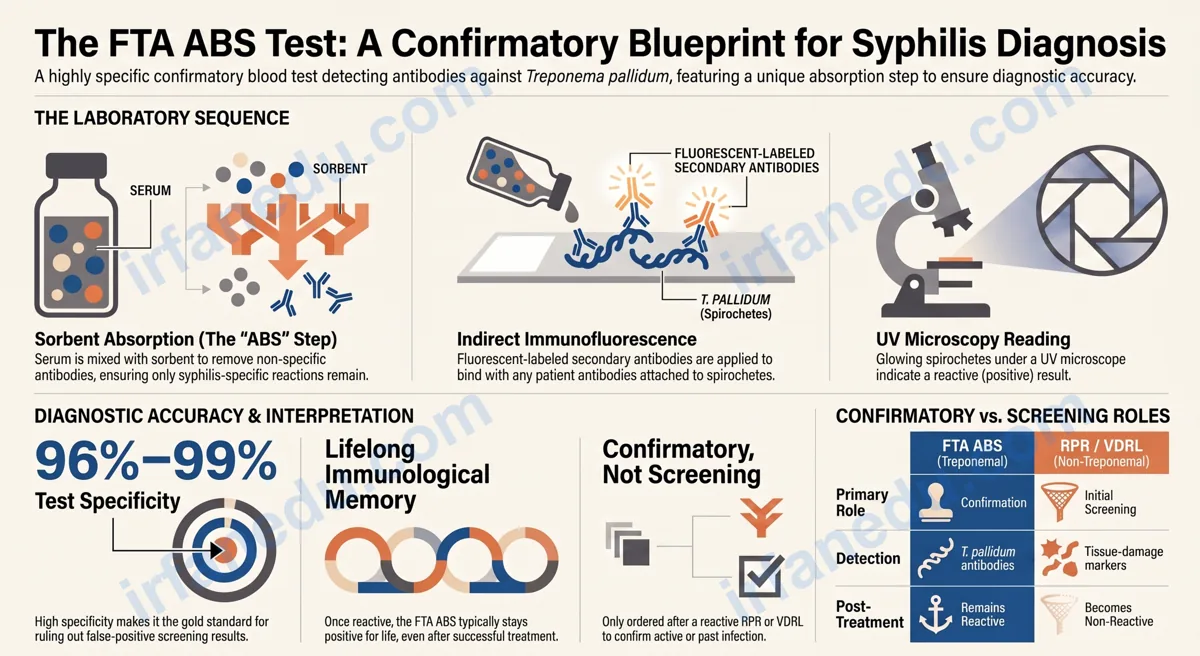
The FTA ABS test uses a technique called indirect immunofluorescence. Here is the exact procedure, step by step:
-
Blood Sample Collection: A small blood sample is drawn from a vein in the patient’s arm. The sample is centrifuged to separate the serum (the clear liquid portion) from blood cells.
-
Absorption Step (the “ABS” part): The patient’s serum is mixed with a sorbent — a preparation of non-pathogenic treponema antigens. This absorbs non-specific antibodies that could react with any spirochete, not just T. pallidum. This step is what makes the test specific to syphilis.
-
Slide Preparation: A glass slide is coated with killed, whole Treponema pallidum organisms (the Nichols strain). The absorbed patient serum is applied to this slide and incubated.
-
First Incubation: If the patient has syphilis antibodies, they bind to the T. pallidum organisms on the slide. The slide is then washed to remove unbound antibodies.
-
Fluorescent Antibody Application: A fluorescent-labeled anti-human immunoglobulin (secondary antibody) is applied to the slide. This secondary antibody binds to any human antibodies that are already attached to the spirochetes.
-
UV Microscopy Reading: The slide is examined under a fluorescence microscope. If the spirochetes glow (fluoresce), the test is reactive (positive). If there is no fluorescence, the test is non-reactive (negative).
Visual: The FTA ABS Process at a Glance 🖼️
🔬 FTA ABS Test — Process Flow Diagram
┌─────────────────────────────────────────────────────────────────┐
│                    FTA ABS TEST PROCEDURE                       │
├─────────────────────────────────────────────────────────────────┤
│                                                                 │
│  STEP 1: Blood Draw                                             │
│  ┌──────────┐                                                   │
│  │  Patient │──► Venous blood ──► Centrifuge ──► SERUM          │
│  └──────────┘                                                   │
│                                                                 │
│  STEP 2: Absorption (removes cross-reactive antibodies)         │
│  SERUM + SORBENT ──► Absorbed Serum (only T.pallidum Ab left)   │
│                                                                 │
│  STEP 3: Apply to Slide                                         │
│  ┌─────────────────────────────────────┐                        │
│  │  Slide coated with T. pallidum      │                        │
│  │  (killed organisms)                 │                        │
│  └─────────────────────────────────────┘                        │
│           ↓ add absorbed serum                                  │
│  Patient Ab binds to T. pallidum? ──► Wash ──► Step 4           │
│                                                                 │
│  STEP 4: Add Fluorescent Anti-Human Ab                          │
│  Fluorescent Ab binds to patient Ab on organisms                │
│                                                                 │
│  STEP 5: Read Under UV Microscope                               │
│                                                                 │
│  ✨ GLOWING spirochetes = REACTIVE (POSITIVE) ✨                 │
│  ○  No glow = NON-REACTIVE (NEGATIVE)                           │
│                                                                 │
└─────────────────────────────────────────────────────────────────┘
In my experience, students who draw this flow diagram once — even roughly on paper — remember the procedure far better than those who just read it. The absorption step is the hardest part to visualize, but once you see it as a “filter” that removes noise before the main test, it clicks immediately. I always tell my students: draw it, don’t just read it.
How Do You Interpret FTA ABS Test Results? 📊
FTA ABS results are reported in one of three ways: Reactive, Non-Reactive, or Borderline. Here is what each means:
| Result | What It Means | Next Step |
|---|---|---|
| Reactive (Positive) | Antibodies against T. pallidum detected. Confirms syphilis infection at some point in life. Stays positive even after treatment. | Clinical evaluation for stage; treat if active infection confirmed. |
| Non-Reactive (Negative) | No treponemal antibodies detected. Syphilis is unlikely (but very early primary syphilis can still be negative). | No further syphilis workup needed unless clinical suspicion is high. |
| Borderline | Weak fluorescence — inconclusive. May indicate very early infection or a non-specific reaction. | Repeat test in 1–2 weeks or use an alternative treponemal test (TPPA). |
FTA ABS vs RPR vs VDRL: What’s the Difference? ⚖️
Understanding the difference between treponemal and non-treponemal tests is the most-tested concept in syphilis serology. Here is a clear side-by-side comparison:
| Feature | FTA ABS | RPR | VDRL |
|---|---|---|---|
| Test Type | Treponemal (confirmatory) | Non-treponemal (screening) | Non-treponemal (screening) |
| What It Detects | Antibodies to T. pallidum | Cardiolipin/lipoidal antibodies | Cardiolipin/lipoidal antibodies |
| Sensitivity (Primary) | ~84% | ~86% | ~78% |
| Sensitivity (Secondary) | ~100% | ~100% | ~100% |
| Specificity | ~96–99% | ~98% (lower in some conditions) | ~98% |
| False Positive Rate | Low (~1–2%) | Higher (up to 10% in some populations) | Higher |
| Stays Positive After Treatment? | Yes (lifelong) | No — titers fall | No — titers fall |
| Used For | Confirmation | Screening + treatment monitoring | Screening + CSF testing |
| Quantitative? | No | Yes (titers) | Yes (titers) |
Interpretation: The reactive FTA ABS confirms this is a true positive for syphilis (not a false positive RPR). The RPR titer of 1:16 suggests active infection. After treatment with penicillin, the RPR titer should fall (e.g., to 1:2 or non-reactive within 6–12 months), confirming treatment success. The FTA ABS will remain reactive for life — that is expected and does not mean treatment failed.
How Accurate Is the FTA ABS Test? 🎯
The FTA ABS test is one of the most accurate confirmatory tests for syphilis, but its accuracy varies by disease stage. Here is what the data shows:
- Primary syphilis: Sensitivity ~84–86%. Some early infections are missed because antibody levels are still low.
- Secondary syphilis: Sensitivity approaches 100%. The immune response is at its peak.
- Latent syphilis: Sensitivity ~96–99%. Very reliable.
- Tertiary syphilis: Sensitivity ~96%. Still highly reliable.
- Specificity: ~96–99% across all stages. False positives are rare.
The test is considered the gold-standard treponemal confirmatory test, though newer automated assays (like the TPPA and chemiluminescence immunoassays) are increasingly used in high-volume labs because they are easier to standardize and read.
Most textbooks present the FTA ABS as near-perfect, but the ~84% sensitivity in primary syphilis is a real clinical gap. In my experience reviewing microbiology curricula, this nuance is almost never taught at the high school level — yet it appears in nursing board exams and pre-med assessments. If you know that the test can miss very early primary syphilis, you already know more than most students who just memorize “FTA ABS = confirmatory test.”
The practical implication: a negative FTA ABS in a patient with a fresh chancre does not rule out syphilis. Repeat testing in 2–4 weeks is warranted.
What Causes False Positives in the FTA ABS Test? 🚨
False positives in the FTA ABS test are uncommon (roughly 1–2% of cases) but they do occur. Knowing the causes is important for both exams and real-world clinical reasoning.
| Condition | Why It Can Cause a False Positive |
|---|---|
| Systemic Lupus Erythematosus (SLE) | Autoantibodies in lupus can cross-react with treponemal antigens. |
| Lyme Disease | Caused by Borrelia burgdorferi, another spirochete — antibodies can cross-react. |
| Pregnancy | Altered immune response can occasionally produce non-specific reactivity. |
| Other Spirochetal Infections | Yaws, pinta, and bejel (caused by related treponemes) produce reactive results — these are true positives for the organism, not false positives technically, but they are not syphilis. |
| Viral Infections (e.g., EBV, HIV) | Polyclonal B-cell activation can produce non-specific antibodies. |
| Elderly Patients | Age-related immune changes can occasionally produce borderline results. |
Common Mistakes Students Make When Studying This Test ❌➡️✅
After reviewing hundreds of student answers on this topic, I have identified the most frequent errors. Here is a wrong-vs-right breakdown:
| ❌ Common Mistake | ✅ The Correct Understanding |
|---|---|
| “FTA ABS is a screening test for syphilis.” | FTA ABS is a confirmatory test. RPR and VDRL are the screening tests. |
| “A negative FTA ABS rules out syphilis completely.” | In very early primary syphilis, FTA ABS can be negative. Repeat testing may be needed. |
| “If FTA ABS is still positive after treatment, the treatment failed.” | FTA ABS stays reactive for life after infection — this is expected and normal, not a sign of treatment failure. |
| “FTA ABS can tell you what stage of syphilis the patient is in.” | FTA ABS only confirms past or present infection. Staging requires clinical evaluation and RPR titers. |
| “The ‘absorption’ step removes syphilis antibodies to reduce false positives.” | The absorption step removes non-specific cross-reactive antibodies, not syphilis-specific antibodies. It improves specificity. |
| “FTA ABS is the same as VDRL.” | They are completely different: VDRL detects cardiolipin antibodies (non-treponemal); FTA ABS detects treponemal antibodies. |
💡 Unique Insight: The “Serofast” Paradox — Why a Positive Result After Treatment Is Actually Good News
Most guides stop at “FTA ABS stays positive for life” without explaining why — and this creates genuine confusion for students and patients alike. Here is the non-obvious point almost no introductory resource explains clearly:
The lifelong reactivity of the FTA ABS test is not a flaw — it is a feature of immunological memory. Once your immune system produces IgG antibodies against T. pallidum, memory B-cells persist indefinitely. Antibiotic treatment eliminates the live bacteria but cannot erase immunological memory. This is the same reason you remain immune to chickenpox after recovery.
The clinical implication most guides miss: in a patient with a known history of treated syphilis who presents with a new reactive RPR, the FTA ABS result is useless for distinguishing re-infection from the old treated infection. Clinicians must rely on the RPR titer change (a four-fold rise, e.g., 1:4 to 1:16, suggests re-infection or treatment failure) — not the FTA ABS. Students who understand this distinction score in the top percentile on clinical reasoning questions.
🧠 Quick Quiz: Test Your FTA ABS Knowledge
Q1. A patient has a reactive RPR. The next step is to order:
Show Answer
Q2. A patient was treated for syphilis 5 years ago. Their FTA ABS is still reactive today. This means:
Show Answer
Q3. The “absorption” step in the FTA ABS test is performed to:
Show Answer
Practice Problems: Apply What You Know 📝
Practice Problem 1: Interpreting a Lab Report
Scenario: A 22-year-old college student presents with a painless genital ulcer. Lab results: RPR = Reactive (1:8), FTA ABS = Reactive.
Question: What do these results indicate? What is the next clinical step?
Answer: Both tests reactive confirms syphilis infection. The painless ulcer (chancre) and RPR titer of 1:8 are consistent with primary syphilis. The FTA ABS confirms this is a true positive (not a false positive RPR). The next step is treatment with benzathine penicillin G and partner notification. After treatment, monitor RPR titers — they should fall by at least four-fold within 6–12 months. The FTA ABS will remain reactive for life.
Practice Problem 2: The False Positive Scenario
Scenario: A 35-year-old woman with known systemic lupus erythematosus (SLE) has a reactive RPR at 1:2. FTA ABS is borderline.
Question: How do you interpret this? What should the clinician do?
Answer: SLE is a known cause of false-positive non-treponemal tests (RPR/VDRL). The borderline FTA ABS is inconclusive. This presentation is most consistent with a biological false positive RPR related to her lupus. The clinician should: (1) repeat the FTA ABS in 2 weeks, (2) consider an alternative treponemal test (TPPA), and (3) correlate with clinical history and symptoms. A low RPR titer (1:2) in a lupus patient with no symptoms or exposure history makes true syphilis less likely.
Practice Problem 3: Monitoring Treatment
Scenario: A patient was treated for secondary syphilis 8 months ago. Follow-up labs: RPR = 1:2 (was 1:32 at diagnosis), FTA ABS = Reactive.
Question: Is treatment working? What does the FTA ABS result mean here?
Answer: Yes, treatment is working. The RPR titer dropped from 1:32 to 1:2 — a four-fold drop (actually a 16-fold drop) confirms adequate treatment response. The reactive FTA ABS is expected and normal — it stays positive for life and does not mean treatment failed. The FTA ABS should not be used to monitor treatment; only the RPR titer is used for that purpose.
Frequently Asked Questions About the FTA ABS Test ❓
What does FTA ABS stand for?
Sources & References
Written and fact-checked by Dr Irfan Mansuri. External links open in a new tab and are provided for further reading and verification.