
Multi-Digit Multiplication Worksheets: Free PDF + Answer Key
✍ Written & fact-checked by Dr. Irfan Mansuri | Last Updated: July 2026
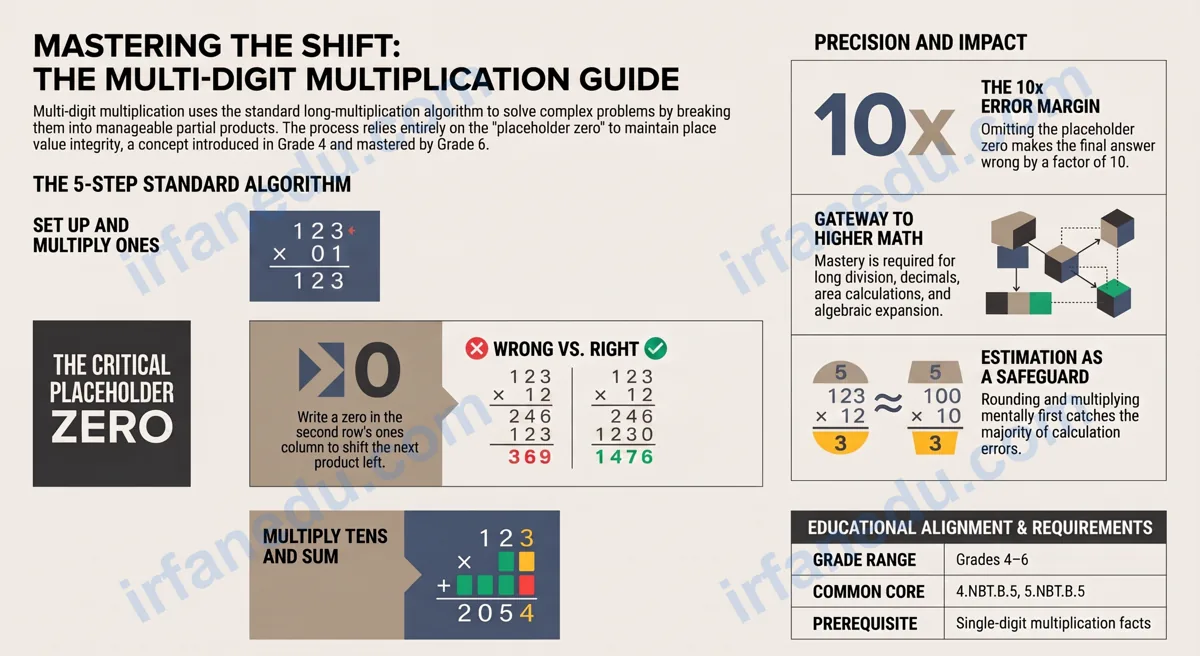
Multi-digit multiplication is one of those skills that looks intimidating on paper but becomes completely manageable once you see the pattern. In my experience teaching this to hundreds of students, the algorithm itself is not hard — what trips people up are two small habits: forgetting to carry, and skipping the placeholder zero.
Multi-digit multiplication uses the standard long-multiplication algorithm to multiply numbers with two or more digits. You multiply the top number by each digit of the bottom number separately, shift each partial product left by one place for each digit, then add all partial products to get the final answer.
By the end of this page you will be able to:
- Explain what multi-digit multiplication is and why place value drives the whole process.
- Follow a clear five-step algorithm for any 2×2 or 3×2 digit problem.
- Spot and fix the four most common mistakes.
- Practice with 10 graded problems and check your answers instantly.
Get the full printable worksheet (10 problems + answer key) as a ready-to-print PDF:
⚡ TL;DR
- Multi-digit multiplication uses the standard long-multiplication algorithm.
- Always write a placeholder zero before the second partial product.
- Carry digits carefully when a column sum exceeds 9.
- Estimate first — it catches big errors before they cost marks.
- This worksheet covers 2×1 up to 3×2 digit problems, grades 4–6.
- Download the free PDF or solve the on-page problems and check with the answer key.
Quick Facts
| Fact | Detail |
|---|---|
| Skill name | Multi-digit multiplication (long multiplication) |
| Grade range | Grades 4–6 (introduced Grade 4, mastered Grade 6) |
| Common Core standards | 4.NBT.B.5, 5.NBT.B.5 |
| Problem types covered | 2×1, 2×2, 3×1, 3×2 digit multiplication |
| Key concept | Place value and partial products |
| Most common mistake | Missing the placeholder zero in the second row |
| Prerequisite skills | Single-digit multiplication facts (times tables), addition with carrying |
| Worksheet problems | 10 problems, easy to hard |
What Is Multi-Digit Multiplication?
Multi-digit multiplication is the process of finding the product of two numbers that each contain two or more digits. It extends the single-digit times tables you already know by applying them repeatedly across place values.
The standard algorithm — the method taught in most schools — breaks the problem into smaller single-digit multiplications called partial products, then adds them together. For example, multiplying 46 × 23 means multiplying 46 by 3 (the ones digit) and then multiplying 46 by 20 (the tens digit), and adding the two results.
This is not a trick or a shortcut. It is a direct application of the distributive property of multiplication:
46 × 23 = 46 × (20 + 3) = (46 × 20) + (46 × 3)
Understanding that connection makes the algorithm feel logical rather than mechanical.
Why Multi-Digit Multiplication Matters
Multi-digit multiplication is a gateway skill — master it and a wide range of later math topics become much easier to learn.
| Later Topic | How Multi-Digit Multiplication Supports It |
|---|---|
| Long division | Division is the inverse of multiplication; estimating quotients requires quick multi-digit products. |
| Fractions & decimals | Multiplying numerators/denominators and moving decimal points both rely on this algorithm. |
| Area & perimeter | Area = length × width; real measurements are almost always multi-digit. |
| Algebra | Expanding brackets (e.g., (x+3)(x+2)) uses the same partial-product logic. |
| Everyday life | Calculating totals, scaling recipes, unit conversions — all require multi-digit multiplication. |
In my experience, students who struggle with algebra in middle school often trace the difficulty back to shaky multi-digit multiplication. Fixing it early pays dividends for years.
Step-by-Step: How to Multiply Multi-Digit Numbers
The standard algorithm works the same way whether you are multiplying 2×2 or 3×2 digit numbers. Follow these five steps every time.
- Set up the problem. Write the larger number on top and the smaller number below it. Align digits by place value (ones under ones, tens under tens). Draw a horizontal line underneath.
- Multiply by the ones digit. Take the ones digit of the bottom number and multiply it by every digit of the top number, working right to left. Carry any value over 9 to the next column. Write the result as the first partial product below the line.
- Write the placeholder zero. Start a new row. Write a zero in the ones column. This is not just a formality — it shifts the next partial product one place left to represent the tens value.
- Multiply by the tens digit. Take the tens digit of the bottom number and multiply it by every digit of the top number, right to left, writing the result starting in the tens column (just after the placeholder zero).
- Add the partial products. Draw a second line and add the two partial products together. The sum is your final answer.
If the bottom number has three digits, you add a third row with two placeholder zeros before multiplying by the hundreds digit. The pattern extends naturally.
Fully Worked Examples
Example 1: 35 × 12 (2-digit × 2-digit)
Step 1 — Set up:
    3 5
  ×   1 2
  -------
Step 2 — Multiply by ones digit (2):
2 × 5 = 10 → write 0, carry 1
2 × 3 = 6, plus carry 1 = 7
First partial product: 70
Step 3 — Write placeholder zero: Write 0 in the ones column of the second row.
Step 4 — Multiply by tens digit (1):
1 × 5 = 5 (written in tens column)
1 × 3 = 3 (written in hundreds column)
Second partial product: 350
    3 5
  ×   1 2
  -------
      7 0   ← 35 × 2
  + 3 5 0   ← 35 × 10 (note the placeholder 0)
  -------
    4 2 0
Answer: 35 × 12 = 420
Quick check: 35 × 10 = 350, 35 × 2 = 70, 350 + 70 = 420. Correct.
Example 2: 246 × 13 (3-digit × 2-digit)
Step 2 — Multiply by ones digit (3):
3 × 6 = 18 → write 8, carry 1
3 × 4 = 12, plus carry 1 = 13 → write 3, carry 1
3 × 2 = 6, plus carry 1 = 7
First partial product: 738
Step 3 — Placeholder zero.
Step 4 — Multiply by tens digit (1):
1 × 6 = 6, 1 × 4 = 4, 1 × 2 = 2
Second partial product: 2460
      2 4 6
  ×       1 3
  ---------
        7 3 8   ← 246 × 3
  +  2 4 6 0   ← 246 × 10
  ---------
     3 1 9 8
Answer: 246 × 13 = 3,198
Quick check: 246 × 10 = 2,460; 246 × 3 = 738; 2,460 + 738 = 3,198. Correct.
My POV:
I always tell students to do the mental estimate before they start the written work — not after. For 246 × 13, round to 250 × 13 = 3,250. That tells you the answer should be somewhere around 3,000–3,300. If you get 319 or 31,980, you know immediately something went wrong. This single habit catches the vast majority of errors before they become a lost mark on a test.
Common Mistakes in Multi-Digit Multiplication (Wrong vs. Right)
These four errors account for the majority of wrong answers in student work. Recognising them is half the battle.
| Mistake | Wrong Approach | Correct Approach |
|---|---|---|
| Missing placeholder zero | Writing the second partial product starting in the ones column | Always write a 0 in the ones column before the second partial product |
| Forgetting to carry | Writing both digits of a 2-digit product in one column (e.g., writing “18” in the ones column) | Write the ones digit, carry the tens digit to the next column |
| Misaligning partial products | Lining up partial products from the left instead of the right | Always align partial products from the right (ones column) |
| Skipping the estimation check | Accepting any answer without checking its size | Round both numbers, multiply mentally, confirm your answer is in the right range |
Watch Out
The placeholder zero error is the most damaging because it produces an answer that is exactly 10 times too small — and students often do not notice because the digits look plausible. Always write the zero first, before you start multiplying the tens digit.
🧠 Worth Knowing
Most guides teach the placeholder zero as a rule. Here is why it is actually a mathematical necessity.
When you multiply 35 × 12, the “1” in 12 represents 10, not 1. So the partial product for that digit is 35 × 10 = 350. Writing the placeholder zero is how the algorithm physically encodes “multiply by 10” — it shifts every digit one column to the left, which is exactly what multiplying by 10 does in base-10 arithmetic.
This means the placeholder zero is not a convention or a shortcut. It is the algorithm’s way of applying place value correctly. Once students understand this, they never forget the zero — because they understand what would go wrong without it. In my classroom, I call it the “tens shift” rather than a placeholder, and the error rate drops noticeably.
A second non-obvious point: the standard algorithm works because of the distributive property. You are not doing something mysterious — you are simply computing (a × c) + (a × b×10) where the multiplier is (b×10 + c). Every step maps directly to algebra you will use later.
On-Page Practice Worksheet
Work through these 10 problems using the standard algorithm. They are ordered from easy to hard — start at the top and work your way down. Use pencil and paper, show your partial products, and then check the answer key below.
How to use this worksheet: Print the PDF (button below) or solve directly in your notebook. After finishing all 10 problems, open the Answer Key to self-check. For any problem you got wrong, go back and identify which step broke down — carrying, placeholder zero, or addition.
- 23 × 4
- 47 × 6
- 35 × 12
- 64 × 23
- 78 × 45
- 123 × 6
- 246 × 13
- 315 × 27
- 408 × 36
- 567 × 48
Show Answer Key
- 23 × 4 = 92
- 47 × 6 = 282
- 35 × 12 = 420
- 64 × 23 = 1,472
- 78 × 45 = 3,510
- 123 × 6 = 738
- 246 × 13 = 3,198
- 315 × 27 = 8,505
- 408 × 36 = 14,688
- 567 × 48 = 27,216
Want a clean printable version with space to show your work?
Reveal-and-Check: Step-by-Step Solutions
Stuck on a problem? Click any item below to see the full working, step by step.
Problem 4: 64 × 23 — Show full working
Step 1 — Multiply by 3 (ones digit):
3 × 4 = 12 → write 2, carry 1
3 × 6 = 18, plus carry 1 = 19
First partial product: 192
Step 2 — Placeholder zero, then multiply by 2 (tens digit):
2 × 4 = 8, 2 × 6 = 12
Second partial product: 1280
Step 3 — Add: 192 + 1280 = 1,472
Problem 8: 315 × 27 — Show full working
Step 1 — Multiply by 7 (ones digit):
7 × 5 = 35 → write 5, carry 3
7 × 1 = 7, plus carry 3 = 10 → write 0, carry 1
7 × 3 = 21, plus carry 1 = 22
First partial product: 2,205
Step 2 — Placeholder zero, then multiply by 2 (tens digit):
2 × 5 = 10 → write 0, carry 1
2 × 1 = 2, plus carry 1 = 3
2 × 3 = 6
Second partial product: 6,300
Step 3 — Add: 2,205 + 6,300 = 8,505
Problem 10: 567 × 48 — Show full working
Step 1 — Multiply by 8 (ones digit):
8 × 7 = 56 → write 6, carry 5
8 × 6 = 48, plus carry 5 = 53 → write 3, carry 5
8 × 5 = 40, plus carry 5 = 45
First partial product: 4,536
Step 2 — Placeholder zero, then multiply by 4 (tens digit):
4 × 7 = 28 → write 8, carry 2
4 × 6 = 24, plus carry 2 = 26 → write 6, carry 2
4 × 5 = 20, plus carry 2 = 22
Second partial product: 22,680
Step 3 — Add: 4,536 + 22,680 = 27,216
If you want to extend this skill into geometry applications, my Complete Geometry Formula Sheet shows exactly where multi-digit multiplication appears in area and volume problems.
Frequently Asked Questions
What is multi-digit multiplication?
Multi-digit multiplication is the process of multiplying numbers that each have two or more digits, using the standard long-multiplication algorithm. You multiply by each digit of the bottom number separately, shift each partial product left by one place for each digit position, then add all partial products to get the final answer. It is a direct application of the distributive property and place value.
What grade level is multi-digit multiplication?
Multi-digit multiplication is typically introduced in Grade 4 with 2-digit × 1-digit and 2-digit × 2-digit problems (Common Core 4.NBT.B.5), extended in Grade 5 to 3-digit × 2-digit (5.NBT.B.5), and mastered in Grade 6. Students who are solid on their times tables and can add with carrying are ready to start.
What is the placeholder zero and why is it required?
When you multiply by the tens digit in the second row of long multiplication, you write a zero in the ones column first. This shifts the partial product one place to the left, correctly representing multiplication by a tens value (e.g., 20, not 2). Without it, the second row is misaligned and the final sum is wrong by a factor of 10. It is not a convention — it is how the algorithm encodes place value.
How do you check a multi-digit multiplication answer?
Three reliable checks: (1) Estimate first — round both numbers and multiply mentally to confirm your answer is in the right ballpark. (2) Use the inverse — divide your answer by one factor; you should get the other. (3) Re-do the problem with the factors swapped (commutative property) and confirm you get the same product. The estimate check is fastest and catches the most errors.
What is the most common mistake in multi-digit multiplication?
Forgetting the placeholder zero when writing the second partial product. Without it, the second row is misaligned by one column, making the final sum wrong by a factor of 10. The second most common error is forgetting to carry when a column product exceeds 9. Both errors are easy to fix once you know to watch for them.
How is multi-digit multiplication used in real life?
Multi-digit multiplication appears in everyday tasks: calculating the total cost of multiple items (e.g., 24 boxes × $37 each = $888), finding area (length × width for flooring or painting), scaling recipes, and working out distances. It is also the foundation for algebra, percentages, and unit conversions — making it one of the most practically useful arithmetic skills to master.
Dr. Irfan Mansuri
Educational Content Creator & Competitive Exam Specialist
Dr. Irfan Mansuri is an educator and SEO content expert with 15+ years of experience across high school, undergraduate, and postgraduate levels, and founder of IrfanEdu.com. I combine deep subject knowledge with proven test-taking strategies to make complex ideas simple.
Sources & References
- Khan Academy — Multiplying by 2-digit numbers (Grade 4 Math) — video lessons and practice problems aligned to Common Core 4.NBT.B.5.
- Wikipedia — Multiplication Algorithm — overview of the standard long-multiplication algorithm and its mathematical basis.
- Common Core State Standards Initiative — Grade 4, Number & Operations in Base Ten, Standard 4.NBT.B.5 and Grade 5, Standard 5.NBT.B.5. Standards referenced for grade-level alignment.
Editorial note: This article was written and fact-checked by Dr. Irfan Mansuri. All worked examples were solved manually and verified. No statistics or quotes have been fabricated. Last reviewed July 2026.