
Rays in Math: Definition, Types, Notation & Examples That Actually Stick 📐
📋 Table of Contents
- Why Rays Are the Secret Backbone of Geometry
- Quick Answer: What Is a Ray?
- TL;DR – Quick Summary
- Quick Facts Table
- What Exactly Is a Ray in Math?
- How Do You Name a Ray Correctly?
- What Are the Types of Rays in Geometry?
- Ray vs. Line vs. Line Segment: What’s the Difference?
- How Do Rays Form Angles?
- Common Mistakes Students Make with Rays
- Real-World Examples of Rays
- Unique Insight: The Mistake Even Textbooks Make
- Quick Knowledge Check
- Practice Problems
- Frequently Asked Questions
- Key Takeaways
- Related Articles
- About the Author
- Sources & References
If I Could Teach You One Thing About Geometry, It Would Be Rays 🔦
If I could teach you one thing about geometry before anything else, it would be this: understand rays, and angles, lines, and even coordinate geometry start to make intuitive sense. I’ve watched students struggle with angle problems, parallel line proofs, and even basic protractor work — not because the concepts were hard, but because nobody took five minutes to make rays truly click.
In my 15+ years of teaching math, I’ve found that rays are the single most underestimated concept in early geometry. They’re introduced quickly, often reduced to “a line with one arrow,” and then students move on without really owning the idea. That shallow understanding costs them later — especially when they hit angle bisectors, opposite rays, and coordinate geometry.
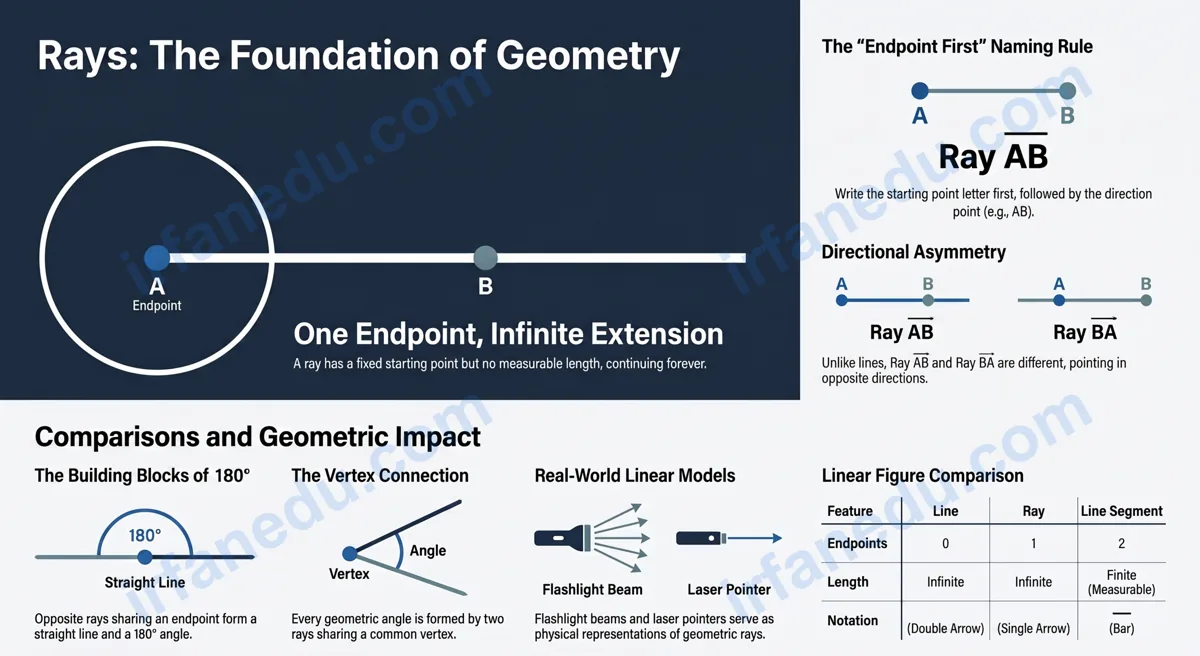
A ray in math is a geometric figure that starts at one fixed point (the endpoint) and extends infinitely in one direction. It has a definite beginning but no end. Rays are the building blocks of angles: every angle is formed by exactly two rays sharing a common endpoint called the vertex.
By the end of this guide, you’ll know exactly what a ray is, how to name one without making the classic notation mistake, how rays differ from lines and segments, and how to spot rays in the real world. I’ll also share a non-obvious insight that most geometry textbooks skip entirely.
- 🎯 Understand the precise definition of a ray and its properties
- ✏️ Name rays correctly using endpoint-first notation
- 🔀 Distinguish rays from lines, line segments, and opposite rays
- 📐 See how two rays form every angle you’ll ever measure
- 🌍 Connect rays to real-world situations and exam problems
A ray in math is a part of a line that has one fixed starting point called the endpoint and extends infinitely in one direction. You name a ray by writing the endpoint letter first, then any other point on the ray, with a right-pointing arrow on top — for example, ray AB starts at A and passes through B, going on forever. Rays are the sides of every angle.
⚡ TL;DR – Quick Summary
- 📍 A ray has one endpoint and extends infinitely in one direction.
- ✏️ Always write the endpoint first when naming a ray (ray AB ≠ ray BA).
- ↔️ Two rays sharing an endpoint in opposite directions form a straight line.
- 📐 Every angle is made of two rays meeting at a common vertex.
- 📏 A ray has no measurable length — it goes on forever.
- 🔦 Real-world rays: flashlight beams, laser pointers, sunlight reaching Earth.
| Property | Ray |
|---|---|
| Number of endpoints | 1 (the starting point) |
| Length | Infinite (cannot be measured) |
| Direction | One direction only |
| Symbol | → over two letters (e.g., AB with arrow) |
| Naming order | Endpoint first, then any other point on the ray |
| Forms what shape? | One side of an angle; two rays form a full angle |
| Related concepts | Line, line segment, angle, vertex, opposite rays |
| First introduced | Typically Grade 4–5 (US curriculum) |
What Exactly Is a Ray in Math? 📍
A ray is a straight geometric figure that begins at one specific point and continues in one direction without ever stopping. That starting point is called the endpoint — and it is the only bounded part of the ray.
Think of it this way: a ray is like a one-way road that starts at a town and goes on forever. The town is the endpoint. The road never loops back, never ends, and never splits.
Formally, in Euclidean geometry, a ray is defined as the set of all points that start at a given endpoint and extend through a second point, continuing infinitely beyond it. Every point between the endpoint and the second point is also on the ray — and so is every point beyond the second point in that same direction.
You are given three labeled points on a diagram: point P, point Q, and point R, where Q is between P and R on the same straight path.
Ray PQ starts at P, passes through Q, and continues through R and beyond — forever.
Ray QP starts at Q, goes back through P, and continues in the opposite direction — forever.
Key insight: Ray PQ and ray QP are NOT the same ray. They start at different endpoints and travel in opposite directions.
In my experience teaching this concept, the word “infinite” trips students up. They think a ray must look very long on paper. It doesn’t. On a diagram, a ray is drawn with a short arrow to show direction — but that arrow represents infinite extension. The drawing is just a representation, not the actual length.
I’ve tried half a dozen analogies for rays over the years — flashlights, arrows, number lines. The one that sticks best with students aged 10–14 is the one-way road starting at a city. The city is the endpoint (you can always return to it as a reference), and the road goes on in one direction forever. It makes the “endpoint first” naming rule feel natural: you always name a road by where it starts.
How Do You Name a Ray Correctly? ✏️
You name a ray by writing the endpoint first, then any other point on the ray, and placing a right-pointing arrow (→) on top of both letters. This is the one rule that students get wrong most often — and it matters because reversing the letters names a completely different ray.
- Identify the endpoint — the point where the ray starts. This is the bounded, fixed end.
- Identify a second point on the ray — any labeled point that lies on the ray in the direction it travels.
- Write the endpoint letter first — for example, if the endpoint is A and another point is B, write “AB.”
- Add the ray arrow symbol — place a right-pointing arrow on top: AB⃗. This distinguishes it from line AB (double arrow) or segment AB (bar on top).
- Verify the direction — the arrow always points from the endpoint toward the second point and beyond. Never reverse it.
In ray notation, the endpoint is always the first letter. A helpful memory trick: the endpoint is the “boss” — it always comes first. If you see ray MN, M is the boss (endpoint). If you see ray NM, N is the boss. They are two different rays on the same line, pointing in opposite directions.
  RAY AB  (starts at A, goes through B, extends forever →)

  A ●————————————————————————————————————→
       B
  |endpoint|        direction of travel →

  ─────────────────────────────────────────────────────
  RAY BA  (starts at B, goes through A, extends forever ←)

  ←————————————————————————————● B
                          A
  direction of travel ←        |endpoint|

  ─────────────────────────────────────────────────────
  OPPOSITE RAYS CA and CB  (C is the shared endpoint)

  ←——————————————● C ——————————————→
       A         |endpoint|         B

  Ray CA + Ray CB = a straight line (180°)
What Are the Types of Rays in Geometry? 🔀
Geometry recognizes a few important categories of rays based on their relationship to each other. Knowing these types helps you solve angle problems and line proofs much faster.
1. Opposite Rays
Opposite rays share the same endpoint and point in exactly opposite directions, forming a straight line. If points A, C, and B are collinear (on the same line) and C is between A and B, then ray CA and ray CB are opposite rays. Together they form a straight angle of 180°.
2. Collinear Rays
Two rays are collinear when they lie on the same straight line. Opposite rays are a special case of collinear rays. Two rays can be collinear without being opposite — for example, if they share an endpoint and point in the same direction, one is simply a subset of the other.
3. Angle-Forming Rays (Non-Collinear Rays)
When two rays share a common endpoint but point in different (non-opposite) directions, they form an angle. The shared endpoint is the vertex. The size of the angle depends on how far apart the rays are rotated. This is the most important type for exam problems.
4. Perpendicular Rays
Two rays are perpendicular if they form a 90° angle at their shared endpoint. For example, the positive x-axis and positive y-axis on a coordinate grid are perpendicular rays both starting at the origin.
On a diagram, point O is at the center. Four rays extend from O: ray OA (pointing right), ray OB (pointing up), ray OC (pointing left), ray OD (pointing down).
– Ray OA and ray OC are opposite rays (they form a straight horizontal line).
– Ray OB and ray OD are opposite rays (they form a straight vertical line).
– Ray OA and ray OB are perpendicular rays (they form a 90° angle).
– All four rays together form a “plus sign” shape — two full lines crossing at O.
Ray vs. Line vs. Line Segment: What’s the Difference? 📏
These three geometric figures are closely related but have critical differences. Students who mix them up lose easy marks on geometry tests.
| Feature | Line | Ray | Line Segment |
|---|---|---|---|
| Endpoints | 0 (none) | 1 (one fixed start) | 2 (both ends fixed) |
| Length | Infinite both ways | Infinite one way | Finite, measurable |
| Symbol on top | ↔ (double arrow) | → (single arrow) | — (bar/overline) |
| Can you measure it? | No | No | Yes |
| Named by | Any two points (order doesn’t matter) | Endpoint first, then any other point | Either endpoint first (order doesn’t matter) |
| Real-world analogy | Infinite straight road, both ways | Flashlight beam | A piece of string |
For a line, line AB = line BA (same line, order doesn’t matter).
For a line segment, segment AB = segment BA (same segment, order doesn’t matter).
For a ray, ray AB ≠ ray BA (DIFFERENT rays — they go in opposite directions!).
This asymmetry is the most tested concept about rays on standardized exams.
How Do Rays Form Angles? 📐
Every angle in geometry is formed by exactly two rays that share a common endpoint — and understanding this makes angle problems dramatically easier to solve.
The shared endpoint of the two rays is called the vertex of the angle. The two rays themselves are called the sides of the angle. When you name an angle, the vertex letter always goes in the middle.
Ray BA starts at vertex B and points toward A.
Ray BC starts at vertex B and points toward C.
These two rays share vertex B and form angle ABC (written ∠ABC).
The vertex B is in the middle of the name.
The measure of ∠ABC depends on how far apart rays BA and BC are rotated from each other.
If the rays point in the same direction → angle = 0°
If the rays are perpendicular → angle = 90°
If the rays are opposite rays → angle = 180° (straight angle)
Most teachers introduce angles by handing students a protractor. In my experience, that’s backwards. Students who first understand that an angle is simply two rays rotating apart from a shared point develop a far more flexible understanding. They can visualize why a 0° angle is two rays on top of each other, why 180° is a straight line, and why 360° brings you back to the start. The protractor then becomes a measurement tool for something they already understand conceptually — not a mysterious device they follow steps to use.
Common Mistakes Students Make with Rays ❌
These are the errors I see most often in student work — and each one costs marks on tests. Study this table carefully.
| ❌ Wrong | ✅ Right |
|---|---|
| Writing ray BA when the endpoint is A (endpoint not first) | Write ray AB — endpoint A always comes first |
| Thinking ray AB and ray BA are the same ray | They are opposite rays — different starting points, opposite directions |
| Saying a ray has a measurable length | A ray has infinite length — it cannot be measured |
| Drawing a ray with arrows on both ends | A ray has ONE arrow (the open end) and ONE dot (the endpoint) |
| Confusing the vertex of an angle with a ray’s endpoint | The vertex IS the shared endpoint of the two rays forming the angle |
| Assuming two rays always form an angle | Two rays form an angle only if they share the same endpoint (vertex) |
Real-World Examples of Rays 🌍
Rays aren’t just abstract geometry — they show up everywhere in the physical world. Connecting math to real life helps the concept stick, especially for visual learners.
- 🔦 Flashlight beam: The flashlight is the endpoint. Light travels outward in one direction indefinitely. This is the classic ray analogy.
- ☀️ Sunlight reaching Earth: Each ray of sunlight starts at the Sun (endpoint) and travels outward through space in one direction. The term “ray of light” in physics is literally borrowed from geometry.
- 🎯 Laser pointer: The laser source is the endpoint. The beam travels in one direction. In optics, light rays are modeled exactly as geometric rays.
- 🌅 Shadow edges: The edge of a shadow cast by a point light source forms a ray — starting at the tip of the object and extending outward.
- 📡 Radar signals: A radar dish sends out signals in specific directions — each signal path is modeled as a ray from the dish as the endpoint.
- 🗺️ Compass directions from a city: “Due north from Chicago” is a ray — it starts at Chicago and extends infinitely northward.
In my experience reviewing structural design problems, architects use rays constantly when planning sight lines. A security camera mounted at point C covers a “field of view” defined by two rays — ray CA and ray CB — forming the angle of coverage. The camera is the vertex (endpoint of both rays). The wider the angle between the rays, the larger the area covered. This is a direct real-world application of the angle-from-two-rays concept.
Most textbooks and websites (including some well-known ones) teach that a ray “starts at a point and goes on forever” — and then immediately show a diagram where the ray clearly has a visible end on the right side of the page. This creates a silent contradiction that confuses students: if it goes on forever, why does it stop on the diagram?
The fix is to explicitly teach that a ray diagram is a representation, not the object itself. The arrow at the open end is a symbol meaning “this continues without end.” The diagram is like a map — the map of a highway isn’t the highway. Once students understand this distinction, they stop second-guessing whether a ray “really” goes on forever, and they stop making the mistake of treating the drawn length as meaningful.
A second insight most guides miss: the number line is a real-world ray. The positive number line starting at 0 and going right is ray 0→∞. The negative number line starting at 0 and going left is ray 0→-∞. Together they form a line — exactly like opposite rays. This connection makes both number lines and rays click simultaneously for students who struggle with either concept.
🧠 Quick Knowledge Check — Test Yourself
3-Question Ray Quiz
Q1. Which of the following correctly names a ray with endpoint at point M passing through point N?
Show explanation
✅ B) Ray MN — The endpoint M must come first. Ray NM would be a different ray starting at N going through M in the opposite direction.
Q2. Two rays share the same endpoint and point in exactly opposite directions. What do they form?
Show explanation
✅ C) A straight line — Opposite rays share an endpoint and travel in opposite directions, forming a 180° straight angle, which is equivalent to a full line.
Q3. How many endpoints does a ray have?
Show explanation
✅ B) 1 — A ray has exactly one endpoint (its starting point). The other end extends infinitely and has no endpoint. A line has 0 endpoints; a segment has 2.
✏️ Practice Problems — Click to Reveal Answers
Problem 1: Points A, B, and C are collinear. B is between A and C. Name all the rays you can form using these three points.
You can form 4 rays:
1. Ray AB — starts at A, goes through B and continues through C and beyond.
2. Ray AC — starts at A, goes through C (same direction as ray AB, since B is between A and C — ray AC is actually the same ray as ray AB).
3. Ray BA — starts at B, goes through A and beyond (opposite direction).
4. Ray BC — starts at B, goes through C and beyond.
5. Ray CA — starts at C, goes through B and A and beyond.
6. Ray CB — starts at C, goes through B (same as ray CA since B is between A and C — ray CB is the same as ray CA).
Distinct rays: Ray AB (= Ray AC), Ray BA, Ray BC (= Ray BA reversed), Ray CA (= Ray CB).
Note: Ray BA and Ray BC are opposite rays sharing endpoint B.
Problem 2: Angle PQR measures 75°. Ray QP and ray QR are the sides of the angle. What is the vertex? Are ray QP and ray QR opposite rays? Explain.
The vertex is point Q — it is the shared endpoint of both rays.
Ray QP and ray QR are NOT opposite rays. Opposite rays must form a straight line (180°). Since angle PQR = 75°, the two rays are only 75° apart — not 180°. Opposite rays would require the angle between them to be exactly 180°.
Problem 3: On a coordinate plane, a ray starts at the origin (0, 0) and passes through the point (3, 4). Describe this ray and state whether it has a measurable length.
The ray starts at the origin (0, 0) as its endpoint and travels in the direction of the point (3, 4) — that is, up and to the right at a slope of 4/3.
The ray passes through (3, 4), (6, 8), (9, 12), and every point of the form (3t, 4t) for t ≥ 0.
It does NOT have a measurable length — it extends infinitely in the direction of (3, 4). The distance from the origin to (3, 4) is √(9+16) = √25 = 5 units, but that is the distance to a point ON the ray, not the length of the ray itself.
❓ Frequently Asked Questions About Rays in Math
What is a ray in math?
How do you name a ray correctly?
What is the difference between a ray and a line segment?
Can a ray go in two directions?
What are opposite rays in geometry?
What is a real-world example of a ray?
How are rays used to form angles?
✅ Key Takeaways
- 📍 A ray has exactly one endpoint and extends infinitely in one direction — it cannot be measured.
- ✏️ Naming rule: endpoint always comes first (ray AB ≠
Sources & References
Reviewed by Dr. Irfan Mansuri. External links open in a new tab and are provided for further reading and verification.