
Three-Digit Addition and Subtraction with Regrouping: Step-by-Step Guide + Free Worksheet
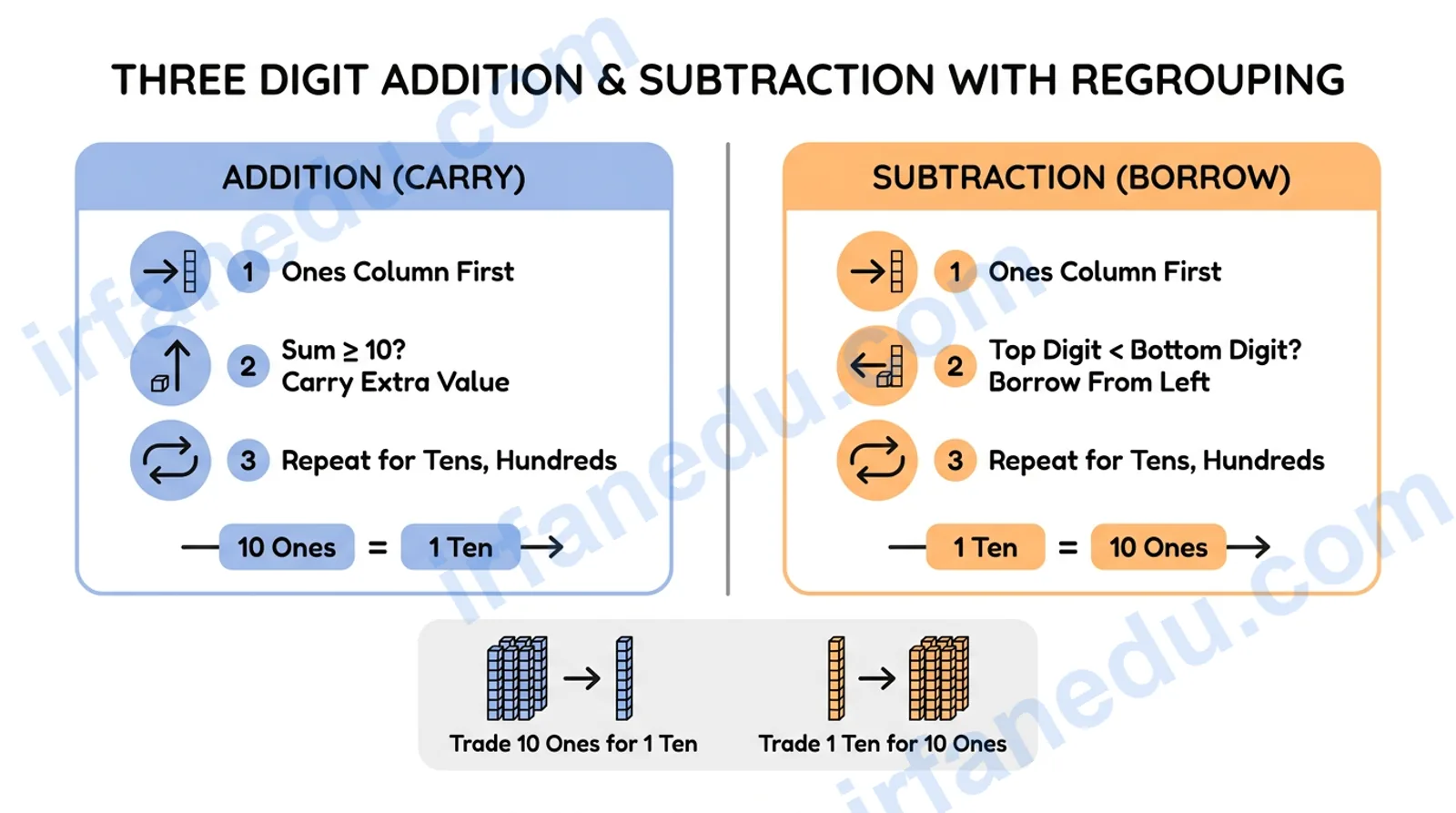
Key Terms Before You Start
This guide uses these four terms throughout. Read them once and every worked example will make sense immediately.
- Place Value
- The value of a digit based on its position. In 347, the 3 is in the hundreds place (worth 300), the 4 is in the tens place (worth 40), and the 7 is in the ones place (worth 7).
- Regroup
- To trade between place values. 10 ones = 1 ten; 10 tens = 1 hundred. Regrouping is the modern umbrella term for both carrying and borrowing.
- Carry (in addition)
- When a column’s sum reaches 10 or more, you carry the extra value to the next column on the left.
- Borrow (in subtraction)
- When a top digit is smaller than the bottom digit, you borrow 1 from the column to the left, converting it into 10 units in the current column.
Three-digit addition and subtraction with regrouping is the process of trading place values — carrying in addition and borrowing in subtraction — so you can compute accurately when digits in a column exceed 9 or fall below 0. It is the bridge between basic counting and multi-digit arithmetic, and it is the single most tested skill in Grade 2 and Grade 3 math.
If your child freezes the moment they see a problem like 523 − 268, or writes 11 in the ones column instead of carrying, this guide fixes that. I have taught this skill to hundreds of students, and I have noticed the same two or three misconceptions come up every single time. I will address each one directly.
- Understand what regrouping actually means (not just the steps)
- Follow a clear column-by-column method for both addition and subtraction
- Avoid the four most common regrouping errors
- Practice with 12 graded problems on the free printable worksheet
12 graded problems • Answer key included • Grades 2–3
📌 Quick Summary
- Regrouping = trading 10 ones for 1 ten (or 1 ten for 10 ones).
- Always work right to left: ones column first, then tens, then hundreds.
- In addition, carry when a column’s sum is 10 or more.
- In subtraction, borrow when the top digit is smaller than the bottom digit.
- Zeros in subtraction require borrowing from two columns at once.
- The free PDF worksheet below has 12 problems ordered easy to hard.
Quick Facts
| Fact | Detail |
|---|---|
| Skill name | Three-digit addition and subtraction with regrouping |
| Also called | Carrying (addition) / Borrowing (subtraction) |
| Grade level | Grade 2 – Grade 3 (ages 7–9) |
| Prerequisite | Place value (hundreds, tens, ones); two-digit regrouping |
| Max regroupings per problem | 2 (ones column + tens column) |
| Hardest sub-skill | Borrowing across a zero (e.g. 500 − 243) |
| Common error rate | Forgetting to add the carried 1 to the tens column |
Why Three-Digit Regrouping Matters
Regrouping is not a trick or a shortcut. It is the direct application of place value — the idea that our number system is built in groups of ten. Once a student truly understands why they carry or borrow (not just how), multi-digit multiplication, long division, and even algebra become far less intimidating.
In my experience teaching elementary math, students who skip the “why” and only memorize the steps hit a wall around Grade 4 when problems get longer. Spending an extra ten minutes on the place-value reasoning now saves hours of confusion later.
The biggest disservice a worksheet can do is present regrouping as a mechanical procedure with no explanation. When I see a student write “1” above the tens column without knowing it represents one group of ten, I stop and use physical base-ten blocks before touching the pencil. The algorithm is only as strong as the concept behind it.
How to Do Three-Digit Addition with Regrouping
Three-digit addition with regrouping follows a four-step column method. Work from right to left every time — ones, then tens, then hundreds.
- Write in columns. Stack the two numbers vertically. Align ones under ones, tens under tens, hundreds under hundreds. Draw vertical lines if it helps.
- Add the ones column. If the sum is 9 or less, write it below. If it is 10 or more, write only the ones digit below and write the tens digit (always 1) as a small number above the tens column.
- Add the tens column (including any carried 1). Same rule: if the sum is 10 or more, write the ones digit below and carry 1 to the hundreds.
- Add the hundreds column (including any carried 1). Write the full result. If it exceeds 9, your answer has four digits.
  H   T   O
      1   1   ← carried values
  3   4   7
+ 2   8   5
-----------
  6   3   2

Step 1 (Ones):  7 + 5 = 12  → write 2, carry 1 to tens
Step 2 (Tens):  4 + 8 + 1   = 13  → write 3, carry 1 to hundreds
Step 3 (Hund):  3 + 2 + 1   = 6   → write 6

Answer: 632
  H   T   O
  1   1       ← carried values
  7   5   6
+ 1   8   8
-----------
  9   4   4

Step 1 (Ones):  6 + 8 = 14  → write 4, carry 1
Step 2 (Tens):  5 + 8 + 1   = 14  → write 4, carry 1
Step 3 (Hund):  7 + 1 + 1   = 9   → write 9

Answer: 944
How to Do Three-Digit Subtraction with Regrouping
Three-digit subtraction with regrouping uses the same right-to-left column method, but instead of carrying forward, you borrow backward from the column to the left.
- Write in columns. Place the larger number on top. Align ones, tens, hundreds.
- Subtract the ones column. If the top digit is smaller than the bottom digit, borrow 1 from the tens column. Cross out the tens digit, write one less above it, and add 10 to the ones digit. Now subtract.
- Subtract the tens column (using the reduced tens digit if you borrowed). If the top tens digit is now smaller than the bottom, borrow from the hundreds column the same way.
- Subtract the hundreds column (using the reduced hundreds digit if you borrowed). Write the result.
  H   T   O
  6  13  11   ← after borrowing
  7   4   1
- 3   5   6
-----------
  3   8   5

Step 1 (Ones):  1 < 6 → borrow from tens: tens becomes 3, ones becomes 11
                11 - 6 = 5
Step 2 (Tens):  3 < 5 → borrow from hundreds: hundreds becomes 6, tens becomes 13
                13 - 5 = 8
Step 3 (Hund):  6 - 3 = 3

Answer: 385
  H   T   O
  4   9  10   ← after borrowing chain
  5   0   0
- 2   4   3
-----------
  2   5   7

Step 1 (Ones):  0 < 3 → need to borrow from tens, but tens = 0
                So borrow from hundreds first:
                  hundreds 5 → 4; tens 0 → 10
                Now borrow from tens for ones:
                  tens 10 → 9; ones 0 → 10
                10 - 3 = 7
Step 2 (Tens):  9 - 4 = 5
Step 3 (Hund):  4 - 2 = 2

Answer: 257
The zero case trips up most students. The key insight: you cannot borrow from 0, so you move one column further left first, then borrow back.
Common Mistakes and How to Fix Them
These four errors account for the vast majority of wrong answers I see on regrouping worksheets. Recognising them is half the battle.
A student adds 4 + 8 = 12 in the tens column, writes 2, carries 1 — then adds the next column without including that carried 1.
Fix: Always circle or box the carried digit before moving on. Make it visible.
For 41 − 6 in the ones column, a student writes 5 (because 6 − 1 = 5) instead of borrowing to get 11 − 6 = 5. Wait — the answer is the same here, but in 43 − 6 they would write 3 instead of the correct 7. This "flip and subtract" error is extremely common.
Fix: Always ask "Is the top digit bigger?" before subtracting. If not, borrow first.
A student borrows 10 for the ones column but forgets to reduce the tens digit by 1, so the tens column still shows the original number.
Fix: Cross out the tens digit immediately and write the new (reduced) value above it before doing anything else.
Writing numbers without a grid causes digits to drift. A 3 in the tens column gets added to a 7 in the ones column.
Fix: Use graph paper or draw three vertical lines (H | T | O) before writing any digits.
Carrying vs. Borrowing: Side-by-Side Comparison
Carrying and borrowing are mirror images of each other. This table shows exactly how they differ and where they are the same.
| Feature | Carrying (Addition) | Borrowing (Subtraction) |
|---|---|---|
| When it happens | Column sum is 10 or more | Top digit is smaller than bottom digit |
| Direction of trade | Current column gives 1 to the LEFT column | Current column takes 1 from the LEFT column |
| Effect on left column | Left column increases by 1 | Left column decreases by 1 |
| Effect on current column | Reduces sum by 10 (write remainder) | Increases top digit by 10 |
| Max times per 3-digit problem | 2 (ones and tens) | 2 (ones and tens) |
| Tricky special case | Sum of hundreds > 9 (4-digit answer) | Borrowing across a 0 in the tens column |
| Modern term | Regrouping | Regrouping |
Regrouping does not change the value of the number — it only changes how it is written.
Most guides present regrouping as a mechanical step ("carry the 1") without ever saying this. But here is the non-obvious truth: when you carry a 1 from the ones column to the tens column, you are not adding anything to the problem. You are just rewriting 12 ones as 1 ten and 2 ones. The total is identical.
Why does this matter? Because students who understand this never make the "flip and subtract" error (Mistake 2 above). They know that borrowing 1 ten and converting it to 10 ones does not shrink the number — it just re-expresses it. A student who sees 500 − 243 and panics at the zeros is really just afraid of renaming 5 hundreds as 4 hundreds + 10 tens + 0 ones. Once they see it as renaming, not losing, the anxiety disappears.
In my experience: Drawing a place-value chart and physically crossing out and rewriting digits (rather than just writing a small carried number) eliminates this confusion in one session for most students.
I have seen parents drill regrouping with flashcards for weeks and still watch their child fail a test. The problem is almost never practice volume — it is almost always the zero-borrowing case. If your child can do 741 − 356 correctly but gets 500 − 243 wrong, do not give them more random problems. Give them ten problems that all have a zero in the tens place. That targeted repetition fixes the specific gap in about 20 minutes.
Practice Worksheet: Three-Digit Addition and Subtraction with Regrouping
Use the column method for every problem. Show your carrying or borrowing above each column. Problems are ordered from easy to challenging.
How to use this worksheet: Print the PDF (button below) or solve the problems directly on paper. After finishing, expand the Answer Key to self-check. Aim for 10/12 correct before moving on.
- 346 + 275 = ______
- 518 + 364 = ______
- 427 + 395 = ______
- 653 − 218 = ______
- 741 − 356 = ______
- 500 − 243 = ______
- 384 + 467 = ______
- 602 − 375 = ______
- 756 + 188 = ______
- 900 − 647 = ______
- 473 + 359 = ______
- 801 − 566 = ______
Show Answer Key
- 346 + 275 = 621
- 518 + 364 = 882
- 427 + 395 = 822
- 653 − 218 = 435
- 741 − 356 = 385
- 500 − 243 = 257
- 384 + 467 = 851
- 602 − 375 = 227
- 756 + 188 = 944
- 900 − 647 = 253
- 473 + 359 = 832
- 801 − 566 = 235
Print-ready • 12 problems • Grades 2–3 • Answer key on page 2
Reveal-and-Solve Practice Problems
Try each problem on paper first, then click to see the full worked solution.
Problem A: 463 + 278 = ?
Tens: 6 + 7 + 1 = 14 → write 4, carry 1
Hundreds: 4 + 2 + 1 = 7
Answer: 741
Problem B: 832 − 457 = ?
Tens: 2 < 5 → borrow from hundreds: hundreds becomes 7, tens becomes 12. 12 − 5 = 7
Hundreds: 7 − 4 = 3
Answer: 375
Problem C: 700 − 364 = ?
Tens: 9 − 6 = 3
Hundreds: 6 −
Sources & References
Written and fact-checked by Dr Irfan Mansuri. External links open in a new tab and are provided for further reading and verification.