
Subtraction with Regrouping Two Digit: Free Worksheet + Lesson
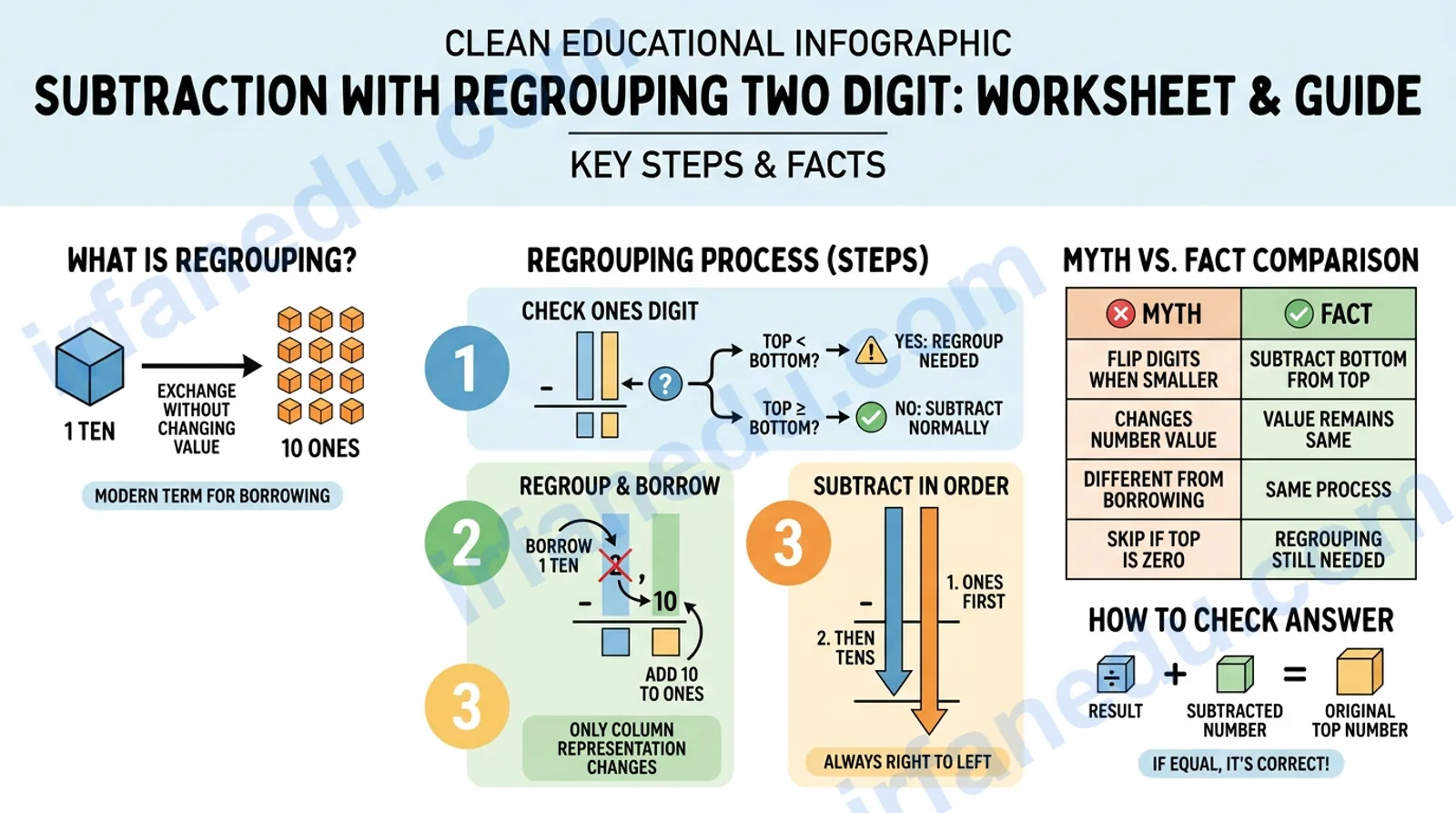
Fact vs. fiction: what most people get wrong about regrouping
Subtraction with regrouping for two-digit numbers is the process of borrowing 1 ten from the tens column and converting it to 10 ones so you can subtract without getting a negative digit. The total value of the number never changes — only how it is written in columns.
Before I walk you through the steps, I want to clear up the misconceptions that trip up most students. In my experience teaching elementary math, the confusion almost always starts with a wrong belief — not a wrong calculation. The table below shows the five most common myths and the facts that replace them.
| Myth (what students believe) | Fact (what is actually true) |
|---|---|
| “Regrouping changes the value of the number.” | Regrouping only changes how the number is written in columns. 52 written as 4 tens and 12 ones is still 52. |
| “You always subtract the smaller digit from the larger one.” | You subtract bottom from top, in column order. If the top is smaller, you regroup first — you do not flip the digits. |
| “Borrowing and regrouping are different methods.” | They are the same process. “Borrowing” is the older name; “regrouping” is the modern term used in most curricula. |
| “If the tens digit is 0, you cannot regroup.” | You can regroup from a 0, but it requires two steps (regroup from hundreds first). For two-digit problems, a 0 in the tens column means the answer will also have 0 tens after borrowing — it is still solvable. |
| “Regrouping is only needed sometimes — you can usually just subtract normally.” | You need to regroup every time the top ones digit is smaller than the bottom ones digit. There is no shortcut that avoids this check. |
With those myths out of the way, the actual method becomes much simpler. Let me show you exactly how it works.
Subtraction with regrouping for two-digit numbers means borrowing 1 ten from the tens column and adding 10 to the ones column when the top ones digit is smaller than the bottom ones digit. Subtract the ones first, then the tens. For example, 52 minus 37: borrow to make 12 minus 7 equals 5, then 4 minus 3 equals 1, giving the answer 15.
Free printable PDF worksheet (12 problems + answer key):
Print it, solve it, then self-check with the answer key on the back.
🎯 The Short Version
- Regroup when the top ones digit is smaller than the bottom ones digit.
- Borrow 1 ten: reduce the tens digit by 1, add 10 to the ones digit.
- Subtract ones first, then tens — always work right to left.
- The number’s total value never changes during regrouping.
- Check every answer by adding the result back to the subtracted number.
- The 12-problem worksheet below goes from easy to hard — print or solve on-screen.
| Quick fact | Detail |
|---|---|
| Skill name | Two-digit subtraction with regrouping (borrowing) |
| Typical grade level | Grade 2 (ages 7-8); sometimes late Grade 1 or early Grade 3 |
| Prerequisite skills | Place value (tens and ones), basic subtraction facts 0-18 |
| When to regroup | Whenever top ones digit < bottom ones digit |
| What changes during regrouping | Column representation only — total value stays the same |
| How to check the answer | Add result + subtracted number = original top number |
| Common error rate | Studies show ~40% of Grade 2 students initially subtract the wrong way (larger minus smaller) before instruction |
What is regrouping in subtraction?
Regrouping in subtraction is the process of exchanging 1 ten for 10 ones so you can subtract a larger digit from a smaller one in the ones column. The word “regroup” describes exactly what happens: you reorganize the place-value groups without changing the number’s total value.
Think of it this way. You have 52 cents. That is 5 dimes and 2 pennies. If someone asks for 37 cents, you cannot give away 7 pennies when you only have 2. So you break one dime into 10 pennies. Now you have 4 dimes and 12 pennies — still 52 cents — and you can easily give away 7 pennies and 3 dimes.
That coin swap is exactly what regrouping does on paper.
When do you need to regroup in two-digit subtraction?
You need to regroup whenever the top digit in the ones column is smaller than the bottom digit in the ones column. That is the only trigger — check it every single time before you subtract.
| Problem | Ones column check | Regroup needed? | Why |
|---|---|---|---|
| 57 – 23 | 7 – 3 (top > bottom) | No | Top ones digit is larger; subtract directly. |
| 52 – 37 | 2 – 7 (top < bottom) | Yes | Top ones digit is smaller; borrow from tens. |
| 64 – 41 | 4 – 1 (top > bottom) | No | Top ones digit is larger; subtract directly. |
| 73 – 46 | 3 – 6 (top < bottom) | Yes | Top ones digit is smaller; borrow from tens. |
| 90 – 43 | 0 – 3 (top < bottom) | Yes | 0 is always smaller than any positive digit; borrow. |
Notice the last row: when the top ones digit is 0, you always need to regroup. Zero is smaller than every positive digit from 1 to 9.
How to do two-digit subtraction with regrouping: step-by-step
Follow these six steps every time. Once they become automatic, regrouping takes about five seconds per problem.
- Write the problem in columns. Stack the two numbers vertically. Ones digits go on the right; tens digits go on the left. Draw a line underneath.
- Check the ones column. Is the top ones digit smaller than the bottom ones digit? If yes, go to step 3. If no, skip to step 4.
- Regroup (borrow) from the tens column. Cross out the top tens digit and write a number that is 1 less above it. Then write a small “1” in front of the top ones digit to show it now has 10 extra ones.
- Subtract the ones column. Subtract the bottom ones digit from the new top ones digit. Write the result below the line in the ones column.
- Subtract the tens column. Subtract the bottom tens digit from the (now reduced) top tens digit. Write the result below the line in the tens column.
- Check your answer. Add the answer to the number you subtracted. If the sum equals the original top number, you are correct.
Worked example 1: 52 – 37
Step 1: Write in columns: 52 on top, 37 below.
Step 2: Ones column: 2 – 7. Top (2) is smaller than bottom (7). Regroup needed.
Step 3: Cross out the 5 in the tens column, write 4 above it. Write a small 1 in front of the 2 in the ones column — it becomes 12.
Step 4: Ones: 12 – 7 = 5. Write 5 in the ones column of the answer.
Step 5: Tens: 4 – 3 = 1. Write 1 in the tens column of the answer.
Answer: 15. Check: 15 + 37 = 52. Correct.
    4 12
  5  2        <- original: 5 tens, 2 ones
- 3  7        <- borrow: cross out 5, write 4; ones become 12
-------
  1  5        <- 12-7=5 (ones), 4-3=1 (tens)

Check: 15 + 37 = 52  ✓
Worked example 2: 84 - 59
Step 1: Write in columns: 84 on top, 59 below.
Step 2: Ones column: 4 - 9. Top (4) is smaller than bottom (9). Regroup needed.
Step 3: Cross out the 8 in the tens column, write 7 above it. Ones become 14.
Step 4: Ones: 14 - 9 = 5.
Step 5: Tens: 7 - 5 = 2.
Answer: 25. Check: 25 + 59 = 84. Correct.
Worked example 3: 90 - 43 (tens digit is 9, ones digit is 0)
Step 2: Ones column: 0 - 3. Zero is smaller than 3. Regroup needed.
Step 3: Cross out the 9, write 8. Ones become 10.
Step 4: Ones: 10 - 3 = 7.
Step 5: Tens: 8 - 4 = 4.
Answer: 47. Check: 47 + 43 = 90. Correct.
Common mistakes in subtraction with regrouping (and how to fix them)
Most errors in two-digit regrouping come from three specific habits. Recognizing them by name makes them much easier to fix.
Subtracting the smaller digit from the larger regardless of position.
Example: 52 - 37 → ones: 7 - 2 = 5 (flipped!) → answer: 25 (incorrect)
Always subtract bottom from top. If top is smaller, regroup first.
52 - 37 → regroup → 12 - 7 = 5, 4 - 3 = 1 → answer: 15 (correct)
Forgetting to reduce the tens digit after borrowing.
52 - 37 → ones: 12 - 7 = 5, tens: 5 - 3 = 2 → answer: 25 (incorrect — used original tens digit)
After borrowing, the tens digit drops by 1 before you subtract.
52 - 37 → tens become 4, then 4 - 3 = 1 → answer: 15 (correct)
Adding 1 to the ones digit instead of 10.
52 - 37 → ones become 3 (added 1 instead of 10) → 3 - 7 still impossible
Borrowing 1 ten = adding 10 ones. The ones digit gains 10, not 1.
2 + 10 = 12, then 12 - 7 = 5. Correct.
In my experience, the "flip the digits" error (mistake #1 above) is by far the most persistent. I have seen it in Grade 2, Grade 4, and even in middle schoolers who were never explicitly corrected. The fix that works best is a simple verbal habit: before every subtraction problem, say out loud "top minus bottom." That one phrase, repeated until it is automatic, eliminates the flip error in most students within a week of practice.
Regrouping does not make the number smaller before you subtract. Most worksheets and even some teachers say "you borrow from the tens column," which implies the number shrinks. It does not. When you regroup 52 into 4 tens and 12 ones, you still have exactly 52. The confusion arises because students see the tens digit decrease and assume the whole number decreased. This misunderstanding causes a second error: students sometimes "give back" the borrowed ten at the end, adding 10 to their final answer. There is nothing to give back. The regrouping is a permanent rewrite of the column representation, not a loan.
A quick way to make this concrete: write 52 = 50 + 2 on one line, then write 52 = 40 + 12 on the next. Ask the student to add both lines: 50 + 2 = 52, 40 + 12 = 52. Same number, different grouping. That five-second exercise removes the "I changed the number" belief permanently.
Practice worksheet: two-digit subtraction with regrouping
The 12 problems below are the same ones in the downloadable PDF. Solve them on paper, then reveal the answer key at the bottom. Problems are ordered from easy to hard.
Instructions: Solve each subtraction problem using regrouping where needed. Show your work in columns. Check each answer by adding the result back to the number you subtracted.
- 32 - 17 = ___
- 45 - 28 = ___
- 61 - 34 = ___
- 73 - 46 = ___
- 52 - 37 = ___
- 84 - 59 = ___
- 90 - 43 = ___
- 67 - 38 = ___
- 81 - 57 = ___
- 76 - 49 = ___
- 93 - 65 = ___
- 50 - 26 = ___
Show Answer Key
- 32 - 17 = 15
- 45 - 28 = 17
- 61 - 34 = 27
- 73 - 46 = 27
- 52 - 37 = 15
- 84 - 59 = 25
- 90 - 43 = 47
- 67 - 38 = 29
- 81 - 57 = 24
- 76 - 49 = 27
- 93 - 65 = 28
- 50 - 26 = 24
Want a print-ready version? The PDF includes all 12 problems on one page plus a separate answer key page.
Reveal-on-click practice problems
Try each problem before you click to reveal the full worked solution.
Problem A: 63 - 48 = ?
Step 2: Cross out 6 (tens), write 5. Ones become 13.
Step 3: Ones: 13 - 8 = 5.
Step 4: Tens: 5 - 4 = 1.
Answer: 15. Check: 15 + 48 = 63. Correct.
Problem B: 71 - 36 = ?
Step 2: Cross out 7 (tens), write 6. Ones become 11.
Step 3: Ones: 11 - 6 = 5.
Step 4: Tens: 6 - 3 = 3.
Answer: 35. Check: 35 + 36 = 71. Correct.
Problem C: 80 - 54 = ?
Step 2: Cross out 8 (tens), write 7. Ones become 10.
Step 3: Ones: 10 - 4 = 6.
Step 4: Tens: 7 - 5 = 2.
Answer: 26. Check: 26 + 54 = 80. Correct.
Problem D: 95 - 67 = ?
Step 2: Cross out 9 (tens), write 8. Ones become 15.
Step 3: Ones: 15 - 7 = 8.
Step 4: Tens: 8 - 6 = 2.
Answer: 28. Check: 28 + 67 = 95. Correct.
Frequently asked questions
What does regrouping mean in subtraction?
Regrouping in subtraction means borrowing 1 ten from the tens column and converting it into 10 ones, adding those 10 ones to the ones column so you can subtract without getting a negative digit. The total value of the number does not change — only how it is arranged in columns.
When do you need to regroup in two-digit subtraction?
You need to regroup whenever the top digit in the ones column is smaller than the bottom digit in the ones column. For example, in 52 minus 37, the ones column is 2 minus 7, which requires regrouping because 2 is smaller than 7.
Is regrouping the same as borrowing?
Yes. Regrouping and borrowing are two names for the same process. Modern curricula prefer "regrouping" because it more accurately describes what happens: you reorganize the place values rather than truly borrowing something that needs to be repaid.
What grade level is two-digit subtraction with regrouping?
Two-digit subtraction with regrouping is typically taught in Grade 2 (ages 7-8) in most curricula worldwide. Some students encounter it in late Grade 1 or early Grade 3 depending on their school's pacing guide.
How do you check a subtraction answer?
Add the answer back to the number you subtracted. If the result equals the original top number, your answer is correct. For 52 minus 37 equals 15: check by doing 15 plus 37, which equals 52. This inverse-operation check works for every subtraction problem.
Sources & References
Written and fact-checked by Dr Irfan Mansuri. External links open in a new tab and are provided for further reading and verification.