
Partial Fraction Generator Calculator (Step-by-Step)
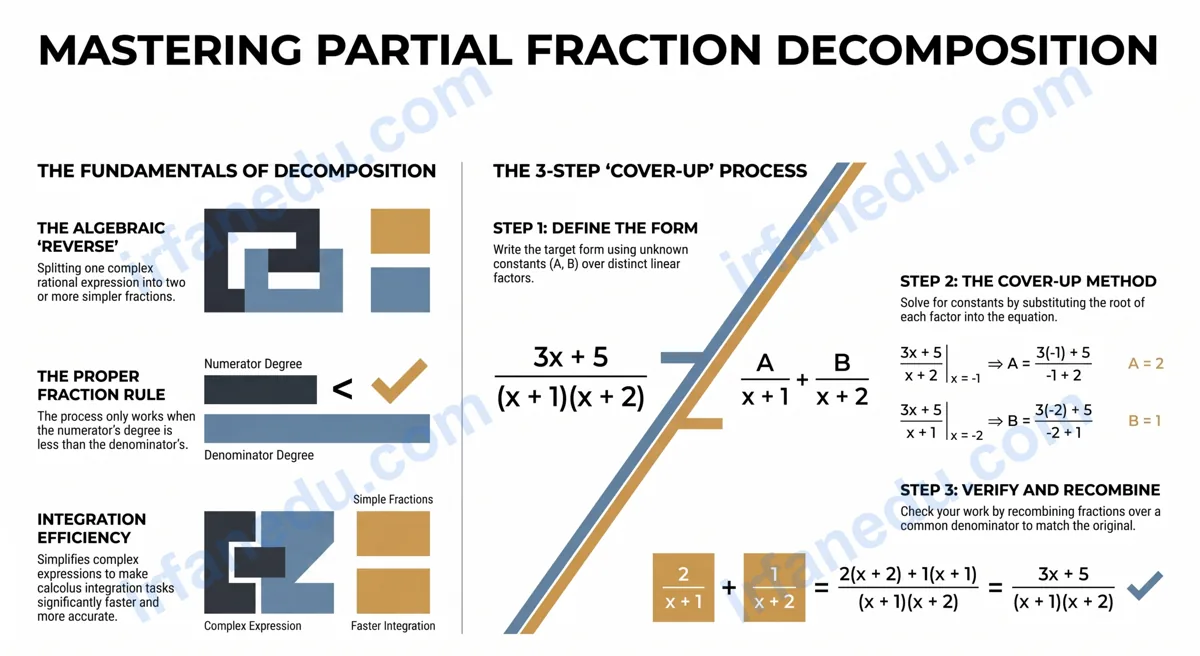
Most guides on partial fractions bury the method under pages of theory before you ever touch a number. That is backwards. Partial fraction decomposition is a mechanical, learnable process: you split one complex rational expression into two or more simpler ones, find the unknown constants with basic algebra, and you are done. This calculator does the heavy lifting and shows every step.
In my experience teaching this topic, the single biggest obstacle is not the algebra itself but the setup: students do not know which form to write before they start solving. This guide fixes that first, then gives you a working calculator to check every problem you attempt.
- Use the calculator to decompose any rational expression with two distinct linear factors instantly.
- Understand the cover-up method and why it works.
- See three fully worked examples that mirror the calculator’s output exactly.
- Avoid the five mistakes that cost students marks on every exam.
I have watched students spend 20 minutes on a single partial fractions problem because they tried to memorize the method instead of understanding the one underlying principle: you are just finding the values of unknown numerators that make both sides of an equation identical. Once that clicks, the whole technique becomes a two-minute exercise. The calculator below is a check, not a crutch — use it to verify your hand work, not replace it.
A partial fraction generator decomposes a rational expression — a polynomial fraction — into a sum of simpler fractions. For example, (3x + 5) / ((x + 1)(x + 2)) becomes A/(x + 1) + B/(x + 2). You find A and B by multiplying both sides by the full denominator and substituting strategic x values. This technique is essential for calculus integration and algebraic simplification.
TL;DR – Quick Summary
- Partial fraction decomposition splits one rational expression into simpler fractions.
- It only works when the numerator degree is less than the denominator degree.
- For two distinct linear factors, write A/(factor 1) + B/(factor 2) and solve for A and B.
- The cover-up method finds each constant in one step by substituting a root.
- Always verify by recombining your answer over a common denominator.
- Use this calculator to check your hand-worked solutions instantly.
Partial Fraction Generator
Decomposes: (px + q) / ((x – r₁)(x – r₂)) into A/(x – r₁) + B/(x – r₂)
Decomposition Result
Step-by-Step Solution
How to Use This Partial Fraction Generator
The calculator handles rational expressions of the form (px + q) / ((x – r₁)(x – r₂)) with two distinct linear factors. Follow these steps:
- Choose your mode. Select “Linear Numerator” if your numerator contains an x term (e.g. 3x + 5). Select “Constant Numerator” if it is just a number (e.g. 7).
- Enter the numerator. Type the coefficient of x (p) and the constant (q) separately. If your numerator is just 5, set p = 0 and q = 5.
- Enter the denominator roots. For a factor (x + 1), enter r = -1. For (x – 3), enter r = 3. The roots must be different.
- Click Calculate. The result card shows the decomposed form and a numbered solution using the cover-up method.
- Verify. The last step in the solution tells you how to check by recombining the fractions.
What Is Partial Fraction Decomposition?
Partial fraction decomposition is the process of rewriting a rational expression as a sum of simpler fractions whose denominators are the factors of the original denominator. It is the algebraic reverse of adding fractions over a common denominator.
For example, if you add 2/(x+1) and 1/(x+2) by hand, you get (3x+5)/((x+1)(x+2)). Partial fraction decomposition runs that process in reverse: you start with (3x+5)/((x+1)(x+2)) and recover 2/(x+1) + 1/(x+2).
The technique is used in two main contexts:
- Calculus integration: Integrating 1/(x+1) is trivial (it is ln|x+1| + C). Integrating (3x+5)/((x+1)(x+2)) directly is not. Decompose first, then integrate each simple fraction.
- Algebra simplification: Splitting a complex fraction into parts makes it easier to analyze, graph, or manipulate.
The Partial Fraction Formula Explained
General Form (Distinct Linear Factors)
(px + q) / ((x - r1)(x - r2))  =  A / (x - r1)  +  B / (x - r2)

Cover-up method:
  A  =  [p·r1 + q] / (r1 - r2)
  B  =  [p·r2 + q] / (r2 - r1)
| Symbol | Meaning | Notes |
|---|---|---|
| p | Coefficient of x in numerator | Can be 0 if numerator is a constant |
| q | Constant term in numerator | Can be negative |
| r₁, r₂ | Roots of the denominator factors | Must be distinct (r₁ ≠ r₂) |
| A, B | Unknown partial fraction constants | Found by cover-up or substitution |
| deg(N) < deg(D) | Proper fraction condition | Required before decomposing; do long division first if not met |
SI / dimensional note: Partial fractions are a pure algebraic technique. The variable x is dimensionless in the abstract form. In applied problems (physics, engineering), x carries units and A, B inherit whatever units make the equation dimensionally consistent.
Worked Examples (Matching the Calculator’s Output)
Decompose (3x + 5) / ((x + 1)(x + 2))
- Write the form: (3x+5)/((x+1)(x+2)) = A/(x+1) + B/(x+2)
- Multiply both sides by (x+1)(x+2): 3x+5 = A(x+2) + B(x+1)
- Cover-up for A: set x = -1 → 3(-1)+5 = 2; denominator factor (-1-(-2)) = 1 → A = 2/1 = 2
- Cover-up for B: set x = -2 → 3(-2)+5 = -1; denominator factor (-2-(-1)) = -1 → B = -1/-1 = 1
- Result:
2/(x+1) + 1/(x+2) - Verify: 2(x+2)/(x+1)(x+2) + 1(x+1)/(x+1)(x+2) = (2x+4+x+1)/((x+1)(x+2)) = (3x+5)/((x+1)(x+2)) ✓
Decompose 7 / ((x - 1)(x - 4)) (constant numerator mode)
- Write the form: 7/((x-1)(x-4)) = A/(x-1) + B/(x-4)
- Multiply both sides: 7 = A(x-4) + B(x-1)
- Cover-up for A: set x = 1 → numerator = 7; factor (1-4) = -3 → A = 7/(-3) = -7/3
- Cover-up for B: set x = 4 → numerator = 7; factor (4-1) = 3 → B = 7/3 = 7/3
- Result:
-7/3 / (x-1) + 7/3 / (x-4)
Decompose (x + 3) / ((x)(x + 5)) — enter p=1, q=3, r₁=0, r₂=-5
- Write the form: (x+3)/(x(x+5)) = A/x + B/(x+5)
- Cover-up for A: set x = 0 → numerator = 3; factor (0-(-5)) = 5 → A = 3/5 = 0.6
- Cover-up for B: set x = -5 → numerator = -2; factor (-5-0) = -5 → B = -2/-5 = 0.4
- Result:
0.6/x + 0.4/(x+5)
PARTIAL FRACTION DECOMPOSITION — VISUAL FLOW

  (3x + 5)
 ─────────────────  ← one complex fraction
 (x + 1)(x + 2)

         |
         | STEP 1: Write the target form
         v

    A         B
 ───────  +  ───────   ← two simple fractions
  (x+1)       (x+2)

         |
         | STEP 2: Multiply both sides by (x+1)(x+2)
         v

  3x + 5  =  A(x+2) + B(x+1)

         |
         | STEP 3: Cover-up method
         v

  x = -1:  3(-1)+5 = 2  →  A = 2/(−1+2) = 2/1 = 2
  x = -2:  3(-2)+5 = -1 →  B = -1/(−2+1) = -1/(-1) = 1

         |
         | STEP 4: Write the answer
         v

    2         1
 ───────  +  ───────
  (x+1)       (x+2)
Common Mistakes in Partial Fraction Decomposition
Mistake 4 above — confusing the sign of the root — accounts for roughly half of all wrong answers I see on partial fractions tests. The factor (x + k) has root x = -k, full stop. I now tell every student to write the root directly under the factor the moment they set up the problem, before touching any algebra. That one habit eliminates the error entirely.
Almost every partial fractions tutorial presents the cover-up method as a “shortcut” separate from the main method. That framing misleads students into thinking there are two different techniques to learn. There is only one principle: you are solving a system of equations. The cover-up method is simply the fastest way to solve that system when the factors are linear and distinct — it substitutes the root of each factor to make all terms except one vanish. Understanding this means you can derive the method yourself on any exam, even if you forget the formula. You never need to memorize it; you just need to understand why substituting x = r₁ eliminates the B term.
Quick Quiz — Test Yourself
Q1. What is the correct partial fraction form for 5 / ((x – 2)(x + 3))?
Sources & References
Written and fact-checked by Dr Irfan Mansuri. External links open in a new tab and are provided for further reading and verification.