
Simplifying Radical Expressions Solver: 7 Rules, Worked Examples & Free Worksheet
✍ Written & fact-checked by Dr. Irfan Mansuri | Last Updated: July 2026
A radical expression is any expression that contains a square root, cube root, or higher-order root symbol. Simplifying a radical expression means rewriting it in its most reduced form — no perfect-square factors hiding under the root sign, no radicals stranded in a denominator, and no unnecessary complexity. Once you learn the seven core rules, every radical problem becomes a pattern-matching exercise.
Here is what you will learn in this guide:
- 📌 What a radical expression is and why simplifying matters
- 📌 The 7 rules that cover every simplification case you will meet
- 📌 Fully worked examples for each rule, including variables and cube roots
- 📌 The most common mistakes students make — and exactly how to avoid them
- 📌 A free printable worksheet (12 problems, answer key included) to lock in the skill
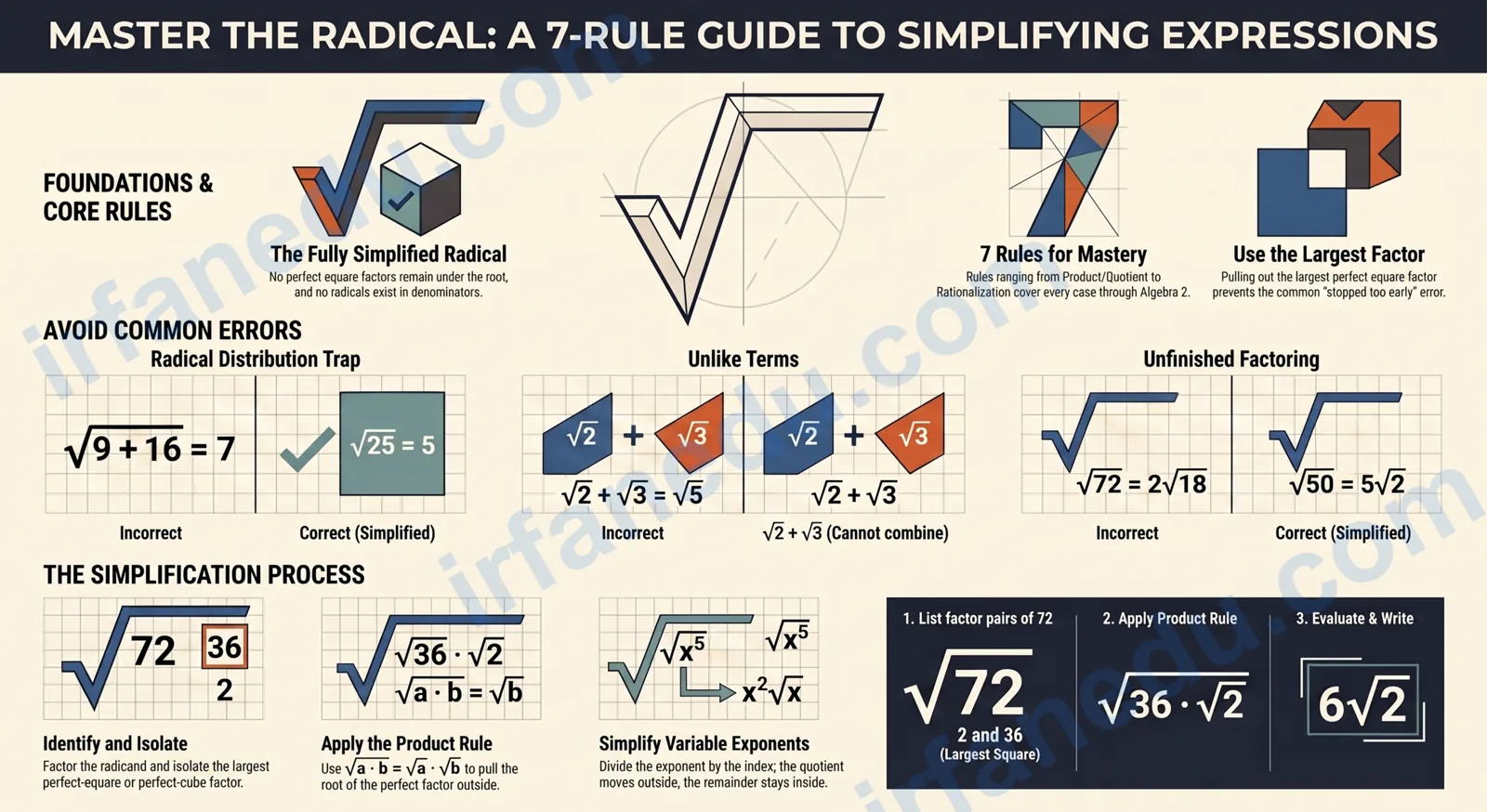
sqrt(72) = sqrt(36 × 2) = 6√2. Apply the product rule, quotient rule, and rationalize any denominator to reach fully simplified form.
🖨️ Free Printable Worksheet — 12 Problems + Answer Key
Print it, practise every rule, then self-check with the answer key at the end.
🎯 The Short Version
- A radical is simplified when no perfect-square factors remain under the sign.
- The Product Rule (
√(a·b) = √a · √b) is the engine of every simplification. - Variables simplify by dividing their exponent by the radical’s index.
- Rationalize any denominator that contains a radical.
- Like radicals (same radicand) can be added or subtracted like terms.
- Cube roots follow the same logic — just look for perfect-cube factors instead.
| Fact | Detail |
|---|---|
| Skill name | Simplifying radical expressions |
| Grade level | Grades 8–11 (Pre-Algebra through Algebra 2) |
| Core operation | Factor radicand → extract perfect powers → multiply coefficients |
| Key rules | Product Rule, Quotient Rule, Rationalization, Like Radicals |
| Common index values | 2 (square root), 3 (cube root), n (nth root) |
| Prerequisite skills | Prime factorization, exponent rules, fraction arithmetic |
| Typical test contexts | Algebra 1, Algebra 2, SAT/ACT Math, state standardized tests |
What Is a Radical Expression?
A radical expression is any mathematical expression containing a root symbol (√). The number or expression inside the root symbol is called the radicand. The small number written above the root symbol is the index — for a square root, the index is 2 (usually omitted by convention); for a cube root, it is 3.
A radical expression is considered fully simplified when all three of these conditions are true:
- The radicand has no perfect-square (or perfect-nth-power) factors other than 1.
- No fraction appears under the radical sign.
- No radical appears in the denominator of a fraction.
For example, √18 is NOT simplified because 18 = 9 × 2, and 9 is a perfect square. The simplified form is 3√2.
In my experience teaching algebra, the single biggest reason students struggle with radicals is that they try to memorize answers instead of learning the underlying pattern: find the perfect-square factor, pull it out, done. Once that pattern clicks, even intimidating expressions like √(200x⁵y²) feel manageable. Every rule below is just a variation of that same idea.
The 7 Rules for Simplifying Radical Expressions
These seven rules cover every case you will encounter through Algebra 2. I have ordered them from the most foundational to the most advanced.
Rule 1 — The Product Rule: √(a · b) = √a · √b
The product rule lets you split a radicand into two separate radicals. Use it to isolate the perfect-square factor from the non-perfect-square remainder.
Example: √50 = √(25 · 2) = √25 · √2 = 5√2
Key point: Always look for the largest perfect-square factor. Pulling out a smaller one (e.g., √(4 · 12.5)) just creates more work.
Rule 2 — The Quotient Rule: √(a/b) = √a / √b
The quotient rule lets you split a fraction under a radical into two separate radicals — one for the numerator and one for the denominator.
Example: √(25/9) = √25 / √9 = 5/3
Restriction: Both a and b must be non-negative, and b ≠ 0.
Rule 3 — Rationalize the Denominator
A radical in the denominator is not considered simplified. Multiply the top and bottom of the fraction by the radical in the denominator to clear it.
Example: 5/√3 = (5 · √3)/(√3 · √3) = 5√3/3
For binomial denominators like 1/(2 + √3), multiply by the conjugate (2 - √3) to use the difference-of-squares identity.
Rule 4 — Simplifying Radicals with Variables
For a variable under a square root, divide the exponent by 2. The quotient goes outside; the remainder stays inside.
Formula: √(x^n) = x^(n÷2) · √(x^(n mod 2))
Example: √(x^5) = √(x^4 · x) = x^2 · √x
Example: √(y^6) = y^3 (no remainder, so nothing stays inside)
Rule 5 — Adding and Subtracting Like Radicals
You can only add or subtract radicals with the same index AND the same radicand. Simplify each radical first, then combine like terms.
Example: √12 + √27 = 2√3 + 3√3 = 5√3
Cannot combine: √2 + √3 — different radicands, so this is already in simplest form.
Rule 6 — Multiplying Radical Expressions
Multiply coefficients together and radicands together, then simplify the result.
Formula: a√b · c√d = (a·c)√(b·d)
Example: 3√2 · 4√6 = 12√12 = 12 · 2√3 = 24√3
Rule 7 — Cube Roots and Higher-Index Radicals
For cube roots (index = 3), look for perfect-cube factors (8, 27, 64, 125). For variables, divide the exponent by 3.
Example: ∛54 = ∛(27 · 2) = 3∛2
Variable example: ∛(x^7) = x^2 · ∛(x) (7 ÷ 3 = 2 remainder 1)
Visual Step-by-Step: Solving √(72) from Start to Finish
Here is the full simplification process laid out visually so you can see every decision point at a glance.
  SIMPLIFY: sqrt(72)
  ─────────────────────────────────────────────────────
  Step 1 │ List factor pairs of 72:
         │   1×72,  2×36,  3×24,  4×18,  6×12,  8×9
         │
  Step 2 │ Identify the LARGEST perfect-square factor:
         │   36 is a perfect square  (6² = 36)  ✓
         │
  Step 3 │ Apply the Product Rule:
         │   sqrt(72) = sqrt(36 × 2)
         │            = sqrt(36) × sqrt(2)
         │
  Step 4 │ Evaluate the perfect-square root:
         │   sqrt(36) = 6
         │
  Step 5 │ Write the simplified form:
         │   sqrt(72) = 6√2  ✓
  ─────────────────────────────────────────────────────
  CHECK: (6√2)² = 36 × 2 = 72  ✓
Fully Worked Examples (Step by Step)
These three examples cover the most common question types. Work through each one before attempting the worksheet.
✅ Example 1 — Numeric Radicand: Simplify 3√12
Step 1: Factor 12 → largest perfect-square factor is 4 (4 × 3 = 12).
Step 2: 3√12 = 3 · √(4 · 3) = 3 · √4 · √3 = 3 · 2 · √3
Step 3: Multiply coefficients: 3 · 2 = 6
Answer: 6√3
Check: (6√3)² = 36 · 3 = 108 = (3)² · 12 ✓
✅ Example 2 — Variable Radicand: Simplify √(x⁴y³)
Step 1: Separate variables: √(x⁴) · √(y³)
Step 2: √(x⁴) = x² (exponent 4 ÷ 2 = 2, remainder 0 → nothing stays inside)
Step 3: √(y³) = √(y² · y) = y · √y (exponent 3 ÷ 2 = 1 remainder 1)
Answer: x²y√y
✅ Example 3 — Rationalize the Denominator: Simplify 5/√5
Step 1: Multiply numerator and denominator by √5:
5/√5 = (5 · √5)/(√5 · √5) = 5√5/5
Step 2: Simplify the coefficient: 5√5 / 5 = √5
Answer: √5
🔑 The Part Most Guides Miss
The “largest perfect-square factor” shortcut is not just faster — it prevents a hidden error. Most guides tell you to pull out ANY perfect-square factor, then keep going. In practice, students who pull out a small factor (say, 4 from 72 instead of 36) often stop too early and submit 2√18 as their final answer — which is wrong because 18 still contains the perfect-square factor 9.
The fix: always ask “Is there a larger perfect-square factor I missed?” before writing your answer. A quick prime-factor tree guarantees you find the largest one every time: 72 = 2³ × 3² → group pairs → 2 × 3 = 6 outside, 2 inside → 6√2. The prime-factor-tree method is the one I teach first in my classes because it eliminates the “stopped too early” mistake entirely.
A second non-obvious point: rationalizing the denominator is not just cosmetic. When you add fractions with radical denominators, a non-rationalized form makes finding a common denominator nearly impossible. Rationalizing first always makes the arithmetic cleaner downstream.
Common Mistakes — Wrong vs. Right
These are the four errors I see most often. Recognizing them in your own work is half the battle.
| Mistake | ❌ Wrong | ✅ Right | Why It Matters |
|---|---|---|---|
| Stopping at a small perfect-square factor | √72 = 2√18 | √72 = 6√2 | 18 still has a perfect-square factor (9). Always use the LARGEST factor. |
| Adding unlike radicals | √2 + √3 = √5 | √2 + √3 (already simplified) | Radicals only combine when the radicand is identical. Different radicands = unlike terms. |
| Leaving a radical in the denominator | 4/√2 (final answer) | 4/√2 = 2√2 | Standard form requires a rationalized denominator. Multiply top and bottom by √2. |
| Mishandling variable exponents | √(x⁵) = x²√x² (wrong exponent inside) | √(x⁵) = x²√x | Divide exponent by 2: quotient (2) goes out, remainder (1) stays in. The inside exponent is the remainder, not the quotient. |
The “√(a+b) = √a + √b” mistake is so common that I call it the Radical Distribution Trap. Students who have just learned the distributive property try to apply it to square roots. The cleanest way to kill this habit is to test it with numbers: √(9+16) = 5, not 7. One counterexample and the misconception usually disappears for good.
Practice Worksheet — 12 Problems (Simplify Each Radical)
Work through these problems in order — they progress from straightforward numeric radicals to variables, operations, and cube roots. Print the PDF for a clean copy, or solve directly in your notebook.
Instructions: Simplify each radical expression completely. Show every step. Check your answers with the key below.
- √50
- √72
- √98
- 3√12
- √200
- 2√45
- √(x⁴ · y³)
- √18 + √8
- 5 / √5
- ∛54
- √75 − √27
- (2√3)(4√6)
Show Answer Key
- 5√2
- 6√2
- 7√2
- 6√3
- 10√2
- 6√5
- x²y√y
- 5√2
- √5
- 3∛2
- 2√3
- 24√2
📥 Download the Free Printable PDF Worksheet (with Answer Key)
Clean, print-ready format — great for classroom use or independent study.
Quick Check Quiz — Test Yourself
🧠 3-Question Radical Quiz
Q1. What is the simplified form of √98?
Reveal Answer
✅ B) 7√2. 98 = 49 × 2, and √49 = 7, so √98 = 7√2. Option C is not simplified (49 is a perfect square still under the root).
Q2. Simplify: √18 + √8
Reveal Answer
✅ C) 5√2. √18 = 3√2 and √8 = 2√2. Since both have the same radicand, 3√2 + 2√2 = 5√2. Option A is the classic “add under the radical” trap.
Q3. Which expression has a radical in the denominator that still needs rationalizing?
Reveal Answer
✅ B) 7/√7. The denominator contains √7. Rationalize: (7 · √7)/(√7 · √7) = 7√7/7 = √7. Options A and D are already rationalized.
Reveal-on-Click Practice Problems
Try each one yourself first, then click to see the full worked solution.
Problem A: Simplify √(200)
Step 1: Find the largest perfect-square factor of 200. Factor pairs: 100 × 2. Since 100 = 10², use 100.
Step 2: √200 = √(100 × 2) = √100 · √2 = 10√2
Answer: 10√2
Problem B: Simplify (2√3)(4√6)
Step 1: Multiply coefficients: 2 × 4 = 8.
Step 2: Multiply radicands: √3 · √6 = √18.
Step 3: Simplify √18: √18 = √(9 × 2) = 3√2.
Step 4: Combine: 8 × 3√2 = 24√2.
Answer: 24√2
Problem C: Simplify √75 − √27
Step 1: Simplify √75: √(25 × 3) = 5√3.
Step 2: Simplify √27: √(9 × 3) = 3√3.
Step 3: Subtract like radicals: 5√3 − 3√3 = 2√3.
Answer: 2√3
Frequently Asked Questions
What does it mean to simplify a radical expression?
Simplifying a radical expression means rewriting it so no perfect-square (or perfect-nth-power) factors remain under the radical sign, no fractions appear under the radical, and no radicals appear in the denominator. The result is the most reduced equivalent form. For example, √18 simplifies to 3√2 because 18 = 9 × 2 and √9 = 3.
What is the product rule for radicals and how do I use it?
The product rule states that √(a × b) = √a × √b for any non-negative values a and b. You use it to split a radicand into a perfect-square part and a non-perfect-square remainder. Pull the perfect-square root outside the radical and leave the remainder inside. It is the core operation behind almost every simplification.
How do you simplify radicals with variables like √(x⁵)?
Divide the variable’s exponent by the radical’s index (2 for a square root). The quotient becomes the outside exponent; the remainder becomes the inside exponent. For √(x⁵): 5 ÷ 2 = 2 remainder 1, so √(x⁵) = x² · √x. If the remainder is 0, nothing stays inside the radical.
What is rationalizing the denominator and why is it required?
Rationalizing the denominator means eliminating any radical from the bottom of a fraction. Multiply both
Sources & References
Written and fact-checked by Dr Irfan Mansuri. External links open in a new tab and are provided for further reading and verification.