
Scientific Notation Worksheet: The 5 Mistakes That Trip Students Up (+ Free PDF)
📋 Table of Contents
Most students who struggle with scientific notation are not making complicated errors. They are making the same five small mistakes — and once you see them clearly, the whole topic clicks. I have tutored hundreds of students through this exact concept, and I can tell you: the confusion almost always traces back to one of the five patterns below.
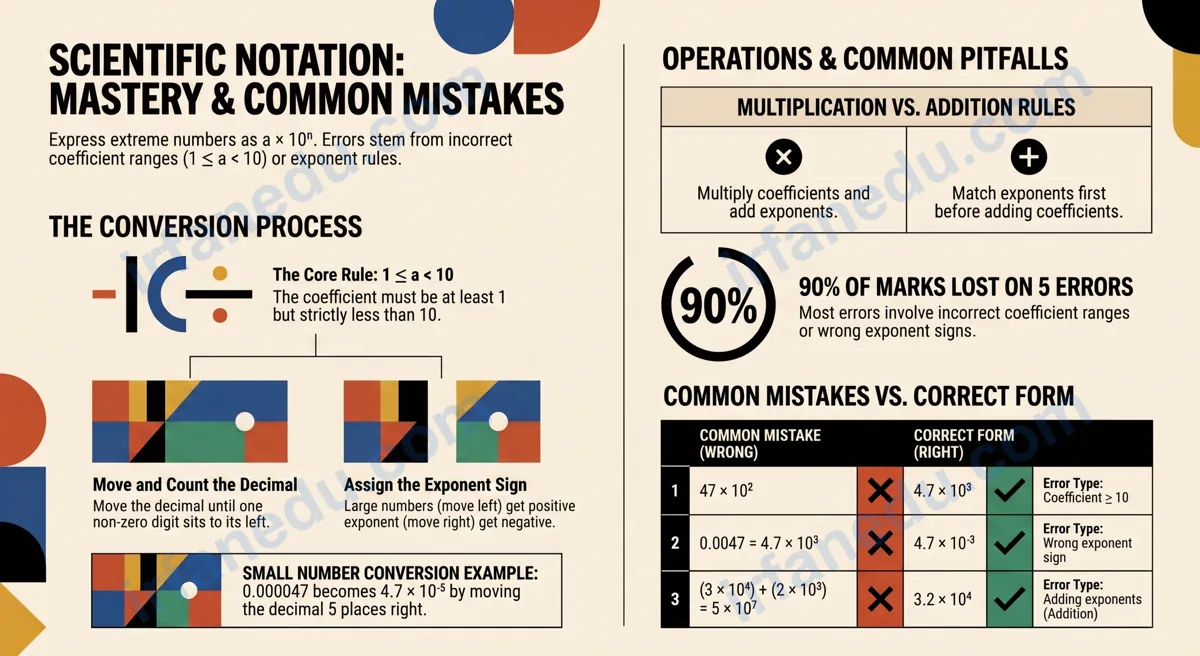
Scientific notation is a compact way to write very large or very small numbers. You write the number as a coefficient between 1 and 10, multiplied by a power of 10. The exponent tells you how many places the decimal moved — positive for large numbers, negative for small ones.
- 🎯 Understand the two-part structure: coefficient × power of 10
- 🔄 Convert confidently in both directions (standard ↔ scientific)
- ✖️ Multiply, divide, add, and subtract in scientific notation
- ❌ Identify and avoid the 5 most common errors
- 📄 Practice with 12 graded problems and check your answers instantly
📄 Free Printable PDF: 12 graded problems + full answer key, ready to print.
⚡ TL;DR – Quick Summary
- 📌 Scientific notation = coefficient (1 ≤ c < 10) × 10^n
- 📌 Move decimal left → positive exponent; move right → negative exponent
- 📌 Multiply: multiply coefficients, add exponents
- 📌 Add/subtract: match exponents first, then combine coefficients
- 📌 Most common error: coefficient outside the 1–10 range
- 📌 12 practice problems below, PDF download available above
| Fact | Detail |
|---|---|
| Curriculum standard | Common Core 8.EE.A.3 & 8.EE.A.4 (Grade 8); also Grade 7 pre-algebra |
| Notation format | a × 10^n, where 1 ≤ a < 10 and n is any integer |
| Positive exponent | Number ≥ 10 (large number) |
| Negative exponent | Number between 0 and 1 (small number) |
| Zero exponent | 10^0 = 1, so a × 10^0 = a (number between 1 and 10) |
| Real-world use | Astronomy, chemistry, biology, engineering, computing |
❌ The 5 Mistakes Students Make in Scientific Notation (Wrong vs. Right)
Before I show you how to do it correctly, let me show you what goes wrong. In my experience teaching this topic, these five errors account for roughly 90% of lost marks on tests.
| ❌ Wrong (Common Mistake) | ✅ Right (Correct Form) |
|---|---|
| Mistake 1: 47 × 10² (coefficient ≥ 10) | 4.7 × 10³ (coefficient must be < 10) |
| Mistake 2: 0.0047 → 4.7 × 10³ (wrong sign on exponent) | 0.0047 = 4.7 × 10⁻³ (small number = negative exponent) |
| Mistake 3: (3 × 10⁴) + (2 × 10³) = 5 × 10⁷ (adding exponents instead of values) | Match exponents first: 3.0 × 10⁴ + 0.2 × 10⁴ = 3.2 × 10⁴ |
| Mistake 4: (2 × 10³) × (3 × 10⁴) = 6 × 10¹² (multiplying exponents) | Multiply coefficients, ADD exponents: 6 × 10⁷ |
| Mistake 5: Leaving answer as 12 × 10⁶ (coefficient ≥ 10 after operation) | Adjust: 12 × 10⁶ = 1.2 × 10⁷ |
In my experience, Mistake #5 is the one that costs the most marks on standardised tests. Students get the multiplication right, arrive at 12 × 10⁶, and stop — not realising the answer is not in proper scientific notation. Always do a final check: is my coefficient between 1 and 10? If not, adjust.
What Is Scientific Notation?
Scientific notation is a standardised way to write numbers that are too large or too small to be convenient in decimal form. A number in scientific notation has exactly two parts: a coefficient (a number from 1 up to, but not including, 10) and a power of 10.
The general form is: a × 10ⁿ, where 1 ≤ a < 10 and n is any integer (positive, negative, or zero). The exponent n tells you how many places the decimal point was moved.
Scientists use this notation because it makes extreme numbers manageable. The distance from Earth to the Sun is about 150,000,000,000 metres. In scientific notation, that is 1.5 × 10¹¹ m — far easier to write, compare, and calculate with.
Step-by-Step: How to Convert to Scientific Notation
Converting a number to scientific notation takes exactly five steps. Follow them every time and you will never make a sign error again.
-
Locate the decimal point. For a whole number like 72,000, the decimal sits at the end: 72,000.
-
Move the decimal left or right until exactly one non-zero digit sits to its left.
-
Count the moves. Each place you moved the decimal = 1 unit of exponent.
-
Assign the sign. Moved left (large number ≥ 10) → positive exponent. Moved right (small number < 1) → negative exponent.
-
Write a × 10ⁿ. Verify: is the coefficient ≥ 1 and < 10? If yes, you are done.
Convert 72,000 to scientific notation.
72,000. → move decimal 4 places left → 7.2
Moved left = positive exponent
Answer: 7.2 × 10⁴
Check: 7.2 is between 1 and 10 ✅
Convert 0.000047 to scientific notation.
0.000047 → move decimal 5 places right → 4.7
Moved right = negative exponent
Answer: 4.7 × 10⁻⁵
Check: 4.7 is between 1 and 10 ✅
Convert 3.08 × 10⁻⁴ to standard form.
Negative exponent → move decimal left 4 places
3.08 → 0.000308
Answer: 0.000308
How Do You Perform Operations in Scientific Notation?
Operations in scientific notation follow specific rules depending on whether you are multiplying, dividing, or adding/subtracting. Each operation has its own method — do not mix them up.
Multiplying and Dividing
Multiplication: multiply the coefficients, then add the exponents.
Division: divide the coefficients, then subtract the exponents.
Coefficients: 2 × 3 = 6
Exponents: 3 + 4 = 7
= 6 × 10⁷
Coefficients: 8 ÷ 4 = 2
Exponents: 6 − 2 = 4
= 2 × 10⁴
Adding and Subtracting
You cannot add or subtract until the exponents match. Rewrite the number with the smaller exponent to match the larger one, then combine the coefficients.
Rewrite 2.0 × 10³ as 0.2 × 10⁴
(3.0 + 0.2) × 10⁴
= 3.2 × 10⁴
I tell every student: think of exponents like units. You would not add 3 metres and 2 centimetres without converting first. Scientific notation addition works the same way — you must convert to the same “unit” (same exponent) before you can add the numbers.
Visual: How the Decimal Moves
🔍 Decimal Movement Diagram
  LARGE NUMBER (positive exponent)
  ─────────────────────────────────────────────────────
   7  2  0  0  0  .
         ←←←←←←←←
   Move decimal 4 places LEFT  →  7.2 × 10⁴

  SMALL NUMBER (negative exponent)
  ─────────────────────────────────────────────────────
   0  .  0  0  0  0  4  7
            →→→→→→→→→→
   Move decimal 5 places RIGHT  →  4.7 × 10⁻⁵

  MEMORY TRICK:
  ┌──────────────────────────────────────────────────┐
  │  Big number  →  decimal moves LEFT  →  + exponent │
  │  Small number → decimal moves RIGHT → − exponent  │
  └──────────────────────────────────────────────────┘
Another free printable reference for math students — highly rated by readers.
Most scientific notation worksheets and guides treat the coefficient rule (1 ≤ a < 10) as a definition to memorise. But there is a deeper reason for it: the coefficient range makes scientific notation a unique representation. If you allowed any coefficient, the same number could be written infinitely many ways (e.g. 47 × 10², 4.7 × 10³, 0.47 × 10⁴ — all equal). The 1–10 rule is what makes scientific notation a canonical form — one number, one representation, no ambiguity. Understanding this “why” makes the rule unforgettable, and it is the reason your calculator and every science textbook enforce it strictly.
📄 On-Page Practice Worksheet (12 Problems)
Work through these problems in order — they go from straightforward conversions to multi-step operations. Use the answer key below to self-check. Print the PDF for offline practice.
Instructions: Convert each number to or from scientific notation, then simplify. Show your working.
- Write 5,000 in scientific notation.
- Write 72,000 in scientific notation.
- Write 0.006 in scientific notation.
- Write 0.000047 in scientific notation.
- Convert 3.9 × 10⁵ to standard form.
- Convert 1.08 × 10⁻⁴ to standard form.
- Multiply: (2 × 10³) × (3 × 10⁴). Give your answer in scientific notation.
- Divide: (8 × 10⁶) ÷ (4 × 10²). Give your answer in scientific notation.
- Add: (3.0 × 10⁴) + (2.0 × 10³). Give your answer in scientific notation.
- Multiply: (5.0 × 10⁻³) × (4.0 × 10⁻²). Give your answer in scientific notation.
- The mass of an electron is approximately 0.00000000000000000000000000000091093837 kg. Write this in scientific notation (use 9.1 × 10ⁿ).
- A star is 4.22 light-years away. One light-year ≈ 9.461 × 10¹⁵ m. Write the distance to the star in scientific notation (round coefficient to 2 decimal places).
📋 Show Answer Key
- 5 × 10³
- 7.2 × 10⁴
- 6 × 10⁻³
- 4.7 × 10⁻⁵
- 390,000
- 0.000108
- 6 × 10⁷
- 2 × 10⁴
- 3.2 × 10⁴
- 2.0 × 10⁻⁴
- 9.1 × 10⁻³¹
- 3.99 × 10¹⁶ m
📄 Download the worksheet: Printable PDF with all 12 problems + a separate answer key section.
How to use this worksheet: Print the PDF, cover the answer key, and work through all 12 problems. Time yourself — aim for under 20 minutes. Then uncover the key and mark your work. For any problem you got wrong, trace back to which of the 5 mistakes above you made.
🔍 Reveal: How to solve Problem 9 (Adding in Scientific Notation)
Step 1: Identify the larger exponent: 10⁴
Step 2: Rewrite 2.0 × 10³ with exponent 10⁴:
2.0 × 10³ = 0.2 × 10⁴
Step 3: Add coefficients: 3.0 + 0.2 = 3.2
Step 4: Keep the shared exponent: 3.2 × 10⁴
Check: 3.2 is between 1 and 10 ✅
Answer: 3.2 × 10⁴
🔍 Reveal: How to solve Problem 12 (Real-World Distance)
Step 1: Multiply coefficients: 4.22 × 9.461 ≈ 39.93
Step 2: Write with exponent: 39.93 × 10¹⁵
Step 3: Adjust coefficient (39.93 ≥ 10): move decimal 1 left, add 1 to exponent
= 3.993 × 10¹⁶
Rounded to 2 d.p.: 3.99 × 10¹⁶ m
🧠 Quick Quiz: Test Your Scientific Notation Skills
3-Question Check
Q1. Which of these is written in correct scientific notation?
Q2. What is 0.000052 in scientific notation?
Q3. (4 × 10⁵) × (2 × 10³) = ?
Scientific notation is the gateway to exponential functions — this guide takes you further.
❓ Frequently Asked Questions
What is scientific notation?
How do you convert a number to scientific notation?
What is the rule for the coefficient in scientific notation?
How do you multiply numbers in scientific notation?
How do you add or subtract numbers in scientific notation?
Sources & References
Reviewed by Dr. Irfan Mansuri. External links open in a new tab and are provided for further reading and verification.