
3-Digit Multiplication Worksheets: Free Printable PDF with Answer Key
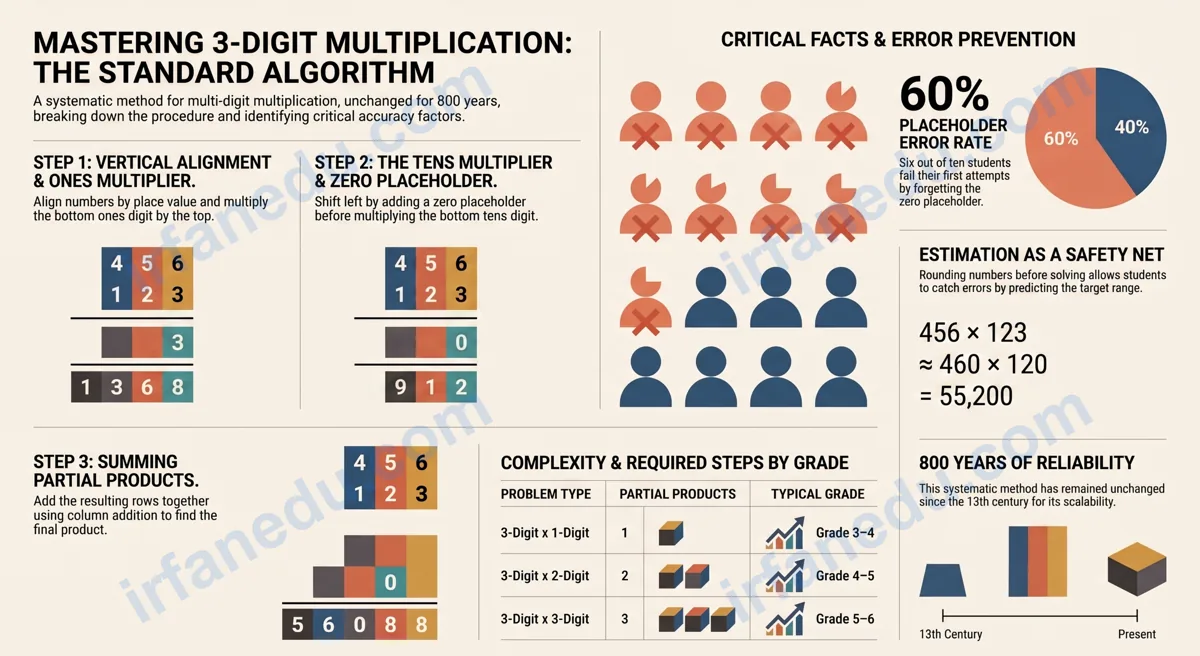
Multi-digit multiplication is one of those skills that shows up everywhere — splitting a restaurant bill, estimating a road trip cost, or scaling a recipe. The foundation of all of it is the same procedure students first meet in Grade 3 or 4: the standard column algorithm.
3-digit multiplication worksheets give students structured, graded practice multiplying three-digit numbers by one- or two-digit numbers using the standard algorithm. They build place-value fluency, reinforce regrouping (carrying), and prepare students for long multiplication and algebra. Most worksheets suit Grade 3–5 and progress from simple problems like 312 x 2 to harder ones like 487 x 63.
- Understand what the standard algorithm actually does at each step.
- Follow a clear 4-step method with two fully worked examples.
- Spot and fix the four most common errors students make.
- Complete 10 graded practice problems and check your work with the answer key.
- Download a free printable PDF to use offline or in class.
3-digit multiplication worksheets give students graded practice multiplying a three-digit number by a one- or two-digit number using the standard algorithm. They build place-value understanding and fluency in carrying (regrouping). Most worksheets suit Grade 3–5 learners and progress from simple facts (e.g. 312 x 2) to harder regrouping problems (e.g. 487 x 63).
Free Printable PDF: Download the full 3-digit multiplication worksheet with answer key — ready to print and use today.
- 3-digit multiplication uses the standard column algorithm with regrouping.
- 3 x 1-digit: one partial product; 3 x 2-digit: two partial products, then add them.
- The most common error is forgetting the zero placeholder on the second row.
- Estimation is the fastest way to check any answer before moving on.
- This page includes a free 10-problem worksheet and a collapsible answer key.
- Download the PDF for a print-ready version with a separate answer key section.
| Feature | Detail |
|---|---|
| Grade level | Grade 3–5 (ages 8–11) |
| Skill type | Standard algorithm, place value, regrouping |
| Problem types | 3-digit x 1-digit; 3-digit x 2-digit |
| Max partial products | 2 (for 3-digit x 2-digit) |
| Prerequisite skills | Times tables (1–9), 2-digit multiplication, place value to hundreds |
| Common standard | CCSS 4.NBT.B.5 (multiply multi-digit whole numbers) |
| Worksheet problems (this page) | 10, ordered easy to hard |
| Answer key | Included (collapsible on-page + PDF) |
Where This Method Comes From
The column multiplication algorithm most students learn today traces back to medieval Islamic mathematicians, particularly the work documented in Al-Khwarizmi’s 9th-century text Al-Kitab al-mukhtasar fi hisab al-jabr wal-muqabala. The place-value system that makes it work — the idea that a digit’s value depends on its position — came to Europe through Arabic scholarship and was formalized in print by Fibonacci in his 1202 work Liber Abaci.
By the 15th century, European merchants were using vertical column arithmetic for trade calculations. The “standard algorithm” as taught in schools today is essentially that same method, refined for pencil-and-paper use. It has survived for over 800 years because it is systematic, reliable, and scales to any number of digits without requiring new rules.
Modern curricula (including the US Common Core standard 4.NBT.B.5) formalize this as the expected method for Grade 4, though many students encounter 3-digit problems in Grade 3 as an extension of 2-digit work.
What Is 3-Digit Multiplication?
3-digit multiplication means multiplying a three-digit number (100–999) by another number — typically a 1-digit or 2-digit multiplier at this level. The result is called the product.
The standard algorithm breaks the multiplication into manageable column-by-column steps, using place value to keep each digit in its correct position. It relies on two skills students already have: single-digit times tables and regrouping (carrying) from addition.
| Type | Example | Partial Products | Typical Grade |
|---|---|---|---|
| 3-digit x 1-digit | 324 x 7 | 1 | Grade 3–4 |
| 3-digit x 2-digit | 456 x 23 | 2 (add them) | Grade 4–5 |
| 3-digit x 3-digit | 312 x 214 | 3 (add them) | Grade 5–6 |
Why Does 3-Digit Multiplication Matter Beyond the Classroom?
Fluency with multi-digit multiplication is a genuine life skill. A student who can multiply 3-digit numbers confidently can estimate a grocery total, calculate the area of a room, or figure out how many minutes are in a week — without reaching for a calculator every time.
In my experience teaching this skill across multiple grade levels, students who struggle with algebra in middle school almost always have a gap in multiplication fluency, not in abstract reasoning. The algorithm is the bridge between arithmetic and algebra: it teaches the discipline of working column by column, tracking partial results, and combining them — exactly what polynomial multiplication requires years later.
How to Multiply 3-Digit Numbers: Step-by-Step
The standard algorithm for 3-digit multiplication follows four clear steps. Master these and every problem on this worksheet becomes straightforward.
- Set up vertically. Write the 3-digit number on top and the multiplier below it. Align by place value (ones under ones, tens under tens). Draw a horizontal line underneath.
- Multiply by the ones digit. Starting from the right, multiply the bottom ones digit by each digit of the top number. If a product exceeds 9, write the ones digit and carry the tens digit above the next column. This gives your first partial product.
- Multiply by the tens digit (2-digit multiplier only). Move to the bottom tens digit. Multiply it by each top digit the same way. Write this second partial product on the next line, but shift it one place to the left — or write a zero placeholder in the ones column first. This shift reflects that you are multiplying by tens, not ones.
- Add the partial products. Add the two rows together using standard column addition. The sum is your final answer.
Fully Worked Examples
Example 1: 324 x 7 (3-digit x 1-digit)
    3  2  4
  x       7
  ---------
  Step 1: 7 x 4 = 28  → write 8, carry 2
  Step 2: 7 x 2 = 14, + 2 carry = 16 → write 6, carry 1
  Step 3: 7 x 3 = 21, + 1 carry = 22 → write 22

  Answer:  2  2  6  8
Example 2: 456 x 23 (3-digit x 2-digit)
       4  5  6
    x     2  3
    ----------
    Step A: multiply by 3 (ones digit)
      3 x 6 = 18 → write 8, carry 1
      3 x 5 = 15, + 1 = 16 → write 6, carry 1
      3 x 4 = 12, + 1 = 13 → write 13
    Partial product 1:  1  3  6  8

    Step B: multiply by 2 (tens digit) — shift left 1
      2 x 6 = 12 → write 2, carry 1
      2 x 5 = 10, + 1 = 11 → write 1, carry 1
      2 x 4 =  8, + 1 =  9 → write 9
    Partial product 2:  9  1  2  0  (note the 0 placeholder)

    Step C: add partial products
        1  3  6  8
    +   9  1  2  0
    -----------
       1  0  4  8  8

  Answer: 10,488
Common Mistakes — and How to Fix Them
| Mistake | What it looks like | The fix |
|---|---|---|
| Forgetting the zero placeholder | Second partial product written starting at the ones column instead of the tens column | Always write a 0 in the ones column of the second row before multiplying by the tens digit |
| Dropping a carry digit | Carry written above the wrong column or erased too soon | Write carry digits small but clearly; cross them out only after you have used them |
| Misaligning columns | Digits written without grid lines, causing addition errors | Use squared paper or draw a vertical line between each place-value column |
| Multiplying the carry instead of adding it | Student multiplies the carry digit by the next top digit instead of adding it after | Reinforce the order: multiply first, then add the carry — never multiply the carry |
What Most Guides Get Wrong About Teaching This Skill
Most worksheet sites teach the standard algorithm as a sequence of mechanical steps and move on. What they miss is that the algorithm is secretly doing the distributive property. When you compute 456 x 23, you are really computing (456 x 3) + (456 x 20). Writing it out as partial products — 1,368 + 9,120 = 10,488 — makes this visible. Students who understand this connection make far fewer placeholder errors, because they know why the second row shifts left: it represents tens, not ones. Teaching the partial-products method alongside the standard algorithm for even two or three problems produces measurably better retention. This is not a new idea in math education research, but it is almost universally skipped on free worksheet sites in favour of pure drill.
On-Page Practice Worksheet
Work through these 10 problems in order. Show your working using the standard algorithm. Problems 1–5 use a 1-digit multiplier; problems 6–7 add harder regrouping; problems 8–10 use a 2-digit multiplier. Use the Answer Key below to self-check when you are done.
How to use this worksheet: Print the PDF (button below) for a clean paper copy, or work directly in a notebook. Complete all problems before checking the answer key — self-checking after each problem reduces the learning benefit.
- 213 x 3 = ___________
- 312 x 2 = ___________
- 421 x 4 = ___________
- 234 x 5 = ___________
- 362 x 7 = ___________
- 487 x 6 = ___________
- 509 x 8 = ___________
- 324 x 12 = ___________
- 456 x 23 = ___________
- 487 x 63 = ___________
Show Answer Key
- 213 x 3 = 639
- 312 x 2 = 624
- 421 x 4 = 1,684
- 234 x 5 = 1,170
- 362 x 7 = 2,534
- 487 x 6 = 2,922
- 509 x 8 = 4,072
- 324 x 12 = 3,888
- 456 x 23 = 10,488
- 487 x 63 = 30,681
Want a print-ready copy? Download the free PDF — includes the same 10 problems plus a separate Answer Key section, formatted for A4 and US Letter paper.
Explore More Math Resources on IrfanEdu
Quick Quiz: Test Your Understanding
3 Questions — Reveal the Answer When Ready
Question 1: What is 213 x 3?
3 x 3 = 9; 3 x 1 = 3; 3 x 2 = 6. No carrying needed. Product: 639.
Question 2: When multiplying 456 x 23, why do you write a zero before starting the second partial product row?
The 2 in 23 represents 20 (tens), not 2 (ones). Shifting the row one place left — by writing a 0 in the ones column first — keeps place values correctly aligned before you add.
Question 3: Estimate 487 x 63. Is the exact answer closer to 30,000 or 3,000?
Round: 500 x 60 = 30,000. The exact answer is 30,681 — very close to the estimate. If a student got 3,068, the missing zero placeholder is the likely cause.
Frequently Asked Questions
What grade level are 3-digit multiplication worksheets for?
What is the standard algorithm for 3-digit multiplication?
What does regrouping (carrying) mean in multiplication?
How is 3-digit by 2-digit multiplication different from 3-digit by 1-digit?
Why do students put a zero when multiplying by the tens digit?
How can I check a 3-digit multiplication answer?
What prerequisite skills do students need before attempting these worksheets?
Are these worksheets aligned to Common Core standards?
- 3-digit multiplication uses the standard column algorithm with regrouping (carrying).
- 3-digit x 1-digit produces one partial product; 3-digit x 2-digit produces two partial products that you add together.
- The zero placeholder on the second row is not optional — it keeps place values aligned.
- Always estimate before solving; a quick mental check catches most errors before they become wrong answers.
- Understanding why the algorithm works (distributive property) reduces errors more than extra drill alone.
- The 10 problems in this worksheet progress from easy (no regrouping) to hard (2-digit multiplier with full carrying).
Related Articles
- Khan Academy — Multiplying by 2-Digit Numbers (Grade 4 Math). Khan Academy’s video lessons on multi-digit multiplication align with CCSS 4.NBT.B.5 and provide interactive practice complementary to this worksheet.
- National Governors Association Center for Best Practices & Council of Chief State School Officers — Common Core State Standards: Grade 4 Number & Operations in Base Ten (4.NBT). The authoritative source for the US curriculum standard this worksheet addresses.
-
Wikipedia — Multiplication Algorithm. Background on the history and variants of the standard multiplication algorithm, including its origins in medieval