
Main Idea and Details Graphic Organizer: The Complete Student Guide
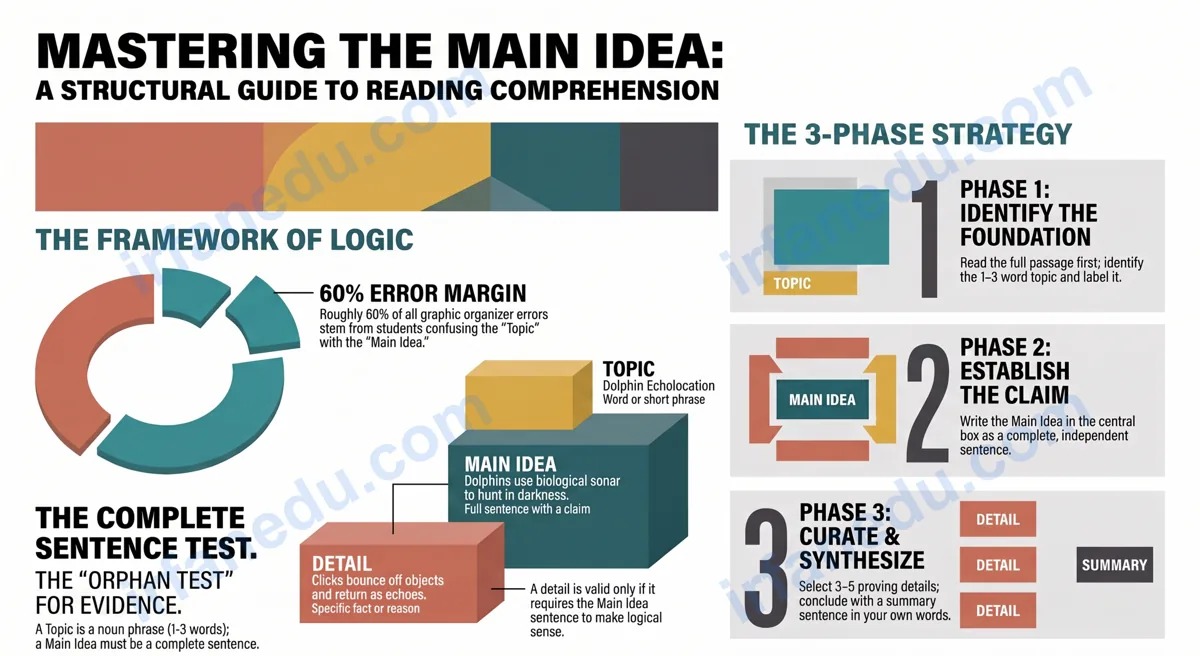
A main idea and details graphic organizer is a structured visual chart that separates a text’s central point from the specific facts and examples that support it. Students write the main idea in one box and list 3-5 supporting details in connected boxes, turning an abstract reading skill into a concrete, checkable task.
Most students struggle with reading comprehension not because the text is too hard, but because nobody gave them a clear system for separating the central point from the background noise. In my experience teaching reading strategies across multiple grade levels, the graphic organizer is the single most reliable fix for that problem. But it only works if students understand what actually belongs in each box.
This guide gives you a complete, example-led walkthrough. You will get a visual template, a fully worked example, the most common mistakes (with corrections), and a myth-busting table right at the top because the myths are where most confusion starts.
- Understand what a main idea and details graphic organizer is and why it works
- Distinguish main idea from topic and from supporting details
- Fill in any graphic organizer correctly using a 6-step process
- Avoid the four most common student errors
- Apply the organizer to both fiction and nonfiction texts
⚡ TL;DR – Quick Summary
- The main idea is a complete sentence stating the author’s central point about a topic.
- Supporting details are facts, examples, or reasons that directly prove the main idea.
- The graphic organizer has one main idea box and 3-5 detail boxes connected by lines.
- The “complete sentence test” instantly separates main idea from topic.
- Every detail must pass the “does this prove my main idea?” check before it goes in a box.
- The organizer works for both fiction (theme + evidence) and nonfiction (claim + support).
| Feature | Detail |
|---|---|
| Grade Range | Grades 2-8 (adaptable for high school) |
| Subject Areas | ELA, Science, Social Studies, any text-based subject |
| Standard Alignment | Common Core ELA RI.2.2, RI.3.2, RI.4.2, RI.5.2, RI.6.2 |
| Typical Box Count | 1 main idea box + 3-5 detail boxes |
| Time to Complete | 5-15 minutes per passage |
| Works For | Nonfiction, fiction (theme), textbook chapters, articles |
Fact vs. Fiction: 5 Common Myths About Main Idea Organizers
Before anything else, here are the five beliefs that cause the most confusion. Check which ones you have heard before.
| Fiction (What Students Believe) | Fact (What Is Actually True) |
|---|---|
| The main idea is the topic of the passage. | The topic is a word or phrase. The main idea is a complete sentence making a claim about that topic. |
| The first sentence of a paragraph is always the main idea. | The main idea can appear at the start, middle, or end of a passage. It can also be implied and never stated directly. |
| Any interesting fact from the text is a supporting detail. | A supporting detail must directly prove or explain the main idea. An interesting but unrelated fact is a distractor. |
| You need to fill every detail box, even if the passage only has two clear details. | Quality beats quantity. Two strong, accurate details are better than five weak or irrelevant ones. |
| Graphic organizers are only for younger students. | Professional researchers, journalists, and academics use structured note-taking tools that are functionally identical to graphic organizers. |
What Is a Main Idea and Details Graphic Organizer?
A main idea and details graphic organizer is a visual reading tool with a central box for the main idea and connected boxes for supporting details. It makes the invisible structure of a text visible on paper.
The organizer does two jobs at once. First, it forces students to compress a whole passage into one precise sentence. Second, it forces them to identify only the details that actually support that sentence, not just any detail they found interesting. Both skills are hard to practice without a visual scaffold.
The standard layout looks like a hub-and-spoke diagram: one large box in the center or at the top, with three to five smaller boxes branching out from it. Some versions add a summary box at the bottom where students write a one-sentence synthesis of everything.
What Is the Difference Between Main Idea and Topic?
The topic names what the text is about; the main idea states what the author says about that topic. This is the single most important distinction in all of reading comprehension instruction.
Here is the clearest way to see the difference:
| Concept | Definition | Example | Test |
|---|---|---|---|
| Topic | A word or short phrase naming the subject | Dolphins | Can you say it in 1-3 words? |
| Main Idea | A complete sentence stating the author’s central claim | Dolphins use echolocation to hunt and navigate in dark water. | Is it a full sentence with a subject and verb? |
| Supporting Detail | A specific fact, example, or reason that proves the main idea | Dolphins emit clicking sounds that bounce off objects and return as echoes. | Does it directly prove the main idea sentence? |
The “complete sentence test” is the fastest diagnostic tool I know. If a student’s main idea box contains only a noun phrase like “ocean animals” or “the rainforest,” it is the topic, not the main idea. Prompt them to add a verb and a claim.
► MY POV: I have seen this confusion in students from Grade 3 all the way through college. The root cause is that most reading worksheets ask “What is this passage about?” — and that question produces a topic answer. The better question is “What is the most important thing the author wants you to know?” That phrasing reliably produces a main idea answer. I changed this one question in my classroom and watched accuracy improve within a single lesson.
How Do You Fill In a Main Idea Graphic Organizer Step by Step?
Fill in a main idea graphic organizer by reading the full passage first, identifying the topic, writing the main idea as a complete sentence, then finding and testing each supporting detail. Follow these six steps in order.
- Read the full passage once without stopping. Resist the urge to highlight anything on the first read. Get a feel for the whole text before you analyze any part of it.
- Identify the topic. Ask: what one word or short phrase names what this text is about? Write it above the organizer as a label, not inside any box.
- Write the main idea in the central box. Ask: what is the most important point the author makes about the topic? Write a complete sentence. If you cannot write a complete sentence, you have not found the main idea yet.
- Re-read and highlight candidate details. Go back through the passage and highlight sentences that seem to prove or explain your main idea sentence.
- Test each detail before writing it in a box. Ask: “Does this sentence help prove my main idea?” If yes, write it in a detail box. If no, leave it out.
- Write a summary sentence at the bottom (optional but recommended). Combine the main idea and the two or three strongest details into one or two sentences in your own words. This is the synthesis step that turns comprehension into retention.
Passage topic: Bees
Student’s first attempt at main idea: “Bees” — Wrong. That is the topic.
After prompting: “Bees are essential pollinators that help plants reproduce.” — Correct. Full sentence, clear claim.
Detail 1: “Bees transfer pollen between flowers as they collect nectar.” — Passes the test. Directly supports the claim.
Detail 2: “Honey tastes sweet.” — Fails the test. Interesting, but does not prove bees are essential pollinators.
Visual Template: See the Graphic Organizer Structure at a Glance
The diagram below shows the standard main idea and details graphic organizer layout. The main idea sits at the top, and each detail box connects to it with a line.
Main Idea & Details Graphic Organizer — Standard Layout
  +--------------------------------------------------+
  |                    TOPIC                         |
  |            (word or short phrase)                |
  +--------------------------------------------------+

           +--------------------------------+
           |          MAIN IDEA             |
           |  (complete sentence — author's |
           |      central claim)            |
           +--------------------------------+
                  |        |        |
         +--------+  +-----+--+  +-+-------+
         |DETAIL 1|  |DETAIL 2|  |DETAIL 3 |
         |        |  |        |  |         |
         | Fact,  |  | Fact,  |  | Fact,   |
         | example|  | example|  | example |
         | or     |  | or     |  | or      |
         | reason |  | reason |  | reason  |
         +--------+  +--------+  +---------+

  +--------------------------------------------------+
  |                   SUMMARY                        |
  |  (main idea + strongest details, own words)      |
  +--------------------------------------------------+
[IMAGE: Colorful printable main idea and details graphic organizer with four detail boxes | ALT: printable main idea and supporting details graphic organizer template for elementary students]
Worked Example: Dolphins and Echolocation
Here is a complete, filled-in graphic organizer using a short informational passage. This is the kind of worked example most guides skip — so read it carefully.
Dolphins are remarkable hunters that rely on a biological sonar system called echolocation. They produce rapid clicking sounds through their nasal passages. These clicks travel through the water, hit an object, and bounce back to the dolphin as echoes. By interpreting the echoes, a dolphin can determine the size, shape, distance, and even the texture of an object. This ability allows dolphins to hunt fish in complete darkness or in murky water where vision is useless. Scientists have found that dolphins can detect an object the size of a golf ball from 70 meters away using echolocation alone.
| Box | Content | Why It Belongs Here |
|---|---|---|
| Topic | Dolphin echolocation | Names the subject in a short phrase |
| Main Idea | Dolphins use echolocation — a biological sonar system — to hunt and navigate with remarkable precision. | Full sentence; states the author’s central claim about the topic |
| Detail 1 | Dolphins produce clicking sounds that bounce off objects and return as echoes. | Explains the mechanism — directly supports “how” they use echolocation |
| Detail 2 | Echoes tell dolphins the size, shape, distance, and texture of an object. | Explains the precision — directly supports “remarkable precision” |
| Detail 3 | Dolphins can hunt in complete darkness where vision is useless. | Shows the real-world value — directly supports “hunt and navigate” |
| Detail 4 | Dolphins can detect a golf-ball-sized object from 70 meters away. | Specific data point that proves “remarkable precision” |
| Summary | Dolphins use echolocation to hunt and navigate by sending out clicks, interpreting the returning echoes, and detecting objects with extraordinary accuracy — even in total darkness. | Synthesizes main idea + strongest details in student’s own words |
What Types of Graphic Organizers Exist for Main Idea and Details?
Several graphic organizer formats serve the main idea and details skill. The best choice depends on the grade level, the length of the text, and whether the text has one central idea or several.
| Type | Layout | Best For | Grade Range |
|---|---|---|---|
| Basic Hub-and-Spoke | 1 center box + 3-4 outer boxes | Short passages, first introduction to the skill | Grades 2-4 |
| Top-Down Tree | Main idea at top, details below in a row | Informational texts with a clear thesis statement | Grades 3-6 |
| Layered (Main + Sub-details) | Main idea → 3 details → 2 sub-details each | Longer texts, multi-paragraph articles | Grades 5-8 |
| Paragraph-by-Paragraph | One organizer per paragraph, then a summary organizer | Textbook chapters, research articles | Grades 6-8+ |
| Fiction Adaptation (Theme Map) | Theme sentence at top + story events as details | Short stories, novels, fables | Grades 3-7 |
► MY POV: In my experience, teachers often jump straight to the layered organizer because it looks more rigorous. But if students have not mastered the basic hub-and-spoke version first, the layered version just multiplies their confusion. I always start with the simplest format and add complexity only after students can fill in the basic version correctly three times in a row. That threshold matters — three correct attempts builds genuine automaticity, not just lucky guessing.
What Are the Most Common Mistakes Students Make With Graphic Organizers?
The four most common mistakes are writing the topic instead of the main idea, including unrelated interesting facts as details, copying sentences verbatim instead of paraphrasing, and leaving detail boxes blank rather than admitting uncertainty.
| Mistake | What It Looks Like | The Fix |
|---|---|---|
| Topic in the main idea box | Main idea box says “Rainforests” | Apply the complete sentence test. Add a verb and a claim: “Rainforests produce 20% of the world’s oxygen.” |
| Interesting but irrelevant details | Detail box says “Some frogs are poisonous” in a passage about deforestation | Apply the “does this prove my main idea?” test. If no, remove it. |
| Verbatim copying | Student copies entire sentences word-for-word from the text | Require students to close the book and write details from memory, then check. Paraphrasing proves understanding. |
| Forced details | Student fills all five boxes even when the passage only supports three | Teach that an empty box is not a failure — it is an honest assessment. Quality beats quantity. |
💡 Unique Insight: The “Interesting Fact” Trap Is a Cognitive Bias, Not Just a Skill Gap
Most teachers treat the “interesting but irrelevant detail” mistake as a reading skill problem. In my experience, it is actually a cognitive bias problem called the vividness effect — students remember and prefer emotionally vivid or surprising information, even when it is logically irrelevant to the main point.
The practical fix is not just to tell students “check if the detail supports the main idea.” That instruction alone rarely works because the vivid detail feels relevant. The fix that actually works is to make students write the main idea sentence first, then read each candidate detail aloud and ask: “If I removed the main idea sentence, would this detail still make sense on its own?” If yes, it is probably a distractor. If no — if the detail only makes sense in the context of the main idea — it is a genuine supporting detail.
This “orphan test” is not in any standard curriculum guide I have seen, but it consistently outperforms the standard “does it support the main idea?” prompt in classroom practice.
Quick Quiz: Test Your Understanding
1. A student writes “Ocean Animals” in the main idea box of their graphic organizer. What is wrong?
2. A passage is about the importance of sleep for teenagers. Which of these is a supporting detail?
3. Where can the main idea of a passage appear?
Select an answer to reveal the explanation.
Practice Problems: Try These Yourself
Read each mini-passage and decide what belongs in the main idea box and the detail boxes. Then click to reveal the answer.
Practice 1: The Water Cycle (Grade 4 level)
Passage: Water moves continuously through the environment in a process called the water cycle. The sun heats surface water in oceans, lakes, and rivers, causing it to evaporate into water vapor. The vapor rises, cools, and condenses into clouds. Eventually, the water falls back to Earth as precipitation — rain, snow, or sleet. This cycle repeats endlessly and distributes fresh water across the planet.
Topic: The water cycle
Main Idea: Water moves continuously through the environment in a repeating cycle that distributes fresh water across the planet.
Detail 1: The sun heats surface water, causing it to evaporate into vapor.
Detail 2: Vapor rises, cools, and condenses into clouds.
Detail 3: Water falls back to Earth as precipitation (rain, snow, or sleet).
Summary: The water cycle is a continuous process where water evaporates, forms clouds, and falls as precipitation, distributing fresh water around the planet.
Practice 2: Identify the Distractor Detail (Grade 5 level)
Main Idea: Regular physical exercise improves mental health in teenagers.
Which of these four details belongs in the organizer? Which is the distractor?
- Exercise releases endorphins, which reduce feelings of anxiety and depression.
- Teenagers who exercise regularly report better sleep quality and mood.
- Some teenagers prefer team sports while others prefer individual activities.
- A 30-minute walk can reduce stress hormone levels for up to 2 hours.
Answer: Details 1, 2, and 4 belong in the organizer — they all directly prove that exercise improves mental health. Detail 3 is the distractor: it is about exercise preferences, not about mental health benefits. It is interesting but irrelevant to the main idea.
Practice 3: Write the Main Idea Sentence (Grade 6 level)
Topic: Plastic pollution in oceans
Details given:
- Over 8 million tons of plastic enter the ocean every year.
- Plastic breaks into microplastics that fish mistake for food.
- Microplastics have been found in human blood and tissue.
- Plastic pollution harms more than 700 marine species.
Your task: Write a main idea sentence that all four details support.
Sample answer: “Plastic pollution in the ocean poses a severe and growing threat to marine life, ecosystems, and ultimately human health.” (All four details prove this claim.)
Note: There is no single “correct” sentence — any complete sentence that all four details support is valid. The test is: can you draw a logical line from each detail to your sentence?
Frequently Asked Questions
What is a main idea and details graphic organizer?
Sources & References
Written and fact-checked by Dr Irfan Mansuri. External links open in a new tab and are provided for further reading and verification.