
🟢 Which Fraction Is Equal To? The Complete Student Guide
🙋 3 Quick Questions — Let Me Answer Them Right Now
Before we go deep, let me answer the three questions students ask me most often about fraction equality. These short answers are the backbone of everything on this page.
A: 2/4, 3/6, 4/8, 5/10 — and infinitely more. Multiply the top and bottom of 1/2 by any whole number and you get an equal fraction.
A: Cross-multiply. If a/b = c/d, then a × d must equal b × c. If those two products match, the fractions are equal.
A: 3/4. Divide both 6 and 8 by their GCF (which is 2): 6÷2 = 3, 8÷2 = 4.
Now that you have the quick answers, let me show you why they work — with visuals, step-by-step methods, and the one insight most fraction guides completely miss.
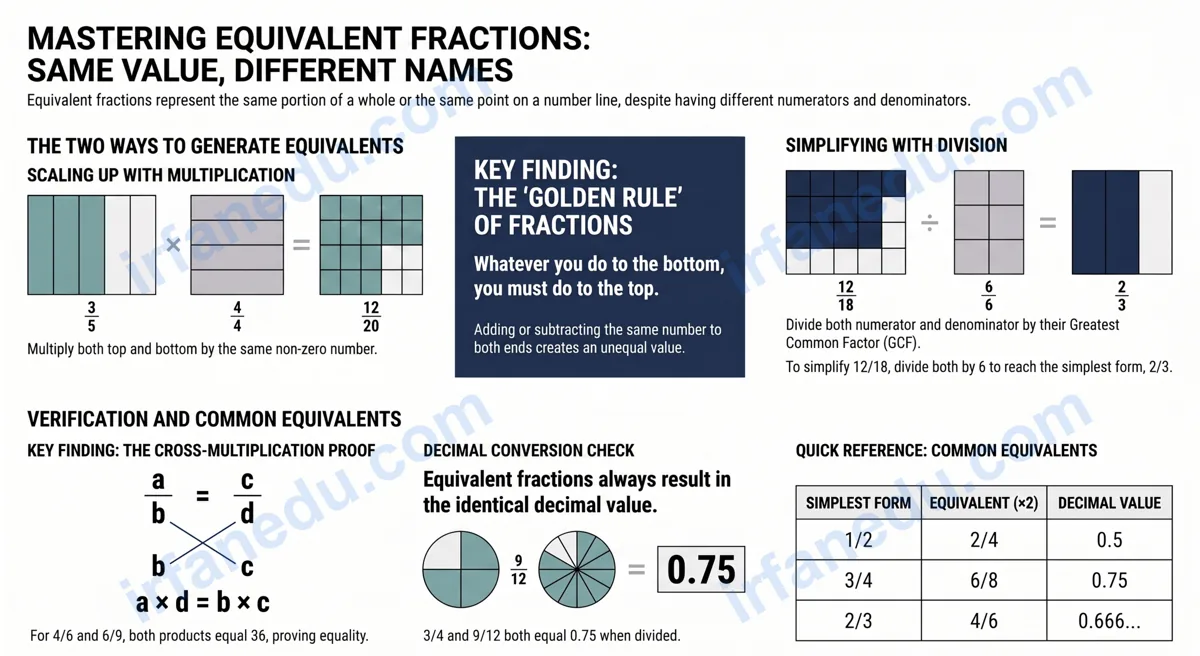
A fraction is equal to another fraction when both represent the same portion of a whole. You find an equivalent fraction by multiplying or dividing both the numerator and denominator by the same non-zero number. The value of the fraction stays identical — only the way it looks changes.
- 🎯 Understand what makes two fractions equal
- 🔢 Use multiplication and division to generate equivalent fractions
- ✅ Verify equality with cross-multiplication in seconds
- 📉 Simplify any fraction to its lowest terms
- 🌍 Recognise equivalent fractions in real-world contexts
⚡ TL;DR – Quick Summary
- ✅ Equivalent fractions represent the same value with different numbers.
- ✅ Multiply or divide top and bottom by the same number to find one.
- ✅ Cross-multiply to verify: a/b = c/d when a×d = b×c.
- ✅ Simplest form = divide both by their Greatest Common Factor (GCF).
- ✅ 1/2 = 2/4 = 3/6; 3/4 = 6/8 = 9/12; 2/3 = 4/6 = 6/9.
- ✅ Real-world uses: cooking, money, time, maps, and test scores.
| Concept | Definition / Rule | Example |
|---|---|---|
| Equivalent Fraction | Same value, different numerator/denominator | 1/2 = 4/8 |
| How to create one | Multiply or divide top & bottom by same number | 3/5 × 2/2 = 6/10 |
| How to verify | Cross-multiply; products must be equal | 1×4 = 2×2 ✓ |
| Simplest form | Divide both by GCF | 8/12 ÷ 4/4 = 2/3 |
| Decimal check | Both fractions give the same decimal | 1/4 = 0.25 = 2/8 |
🟢 What Are Equivalent Fractions?
Equivalent fractions are fractions that name the same point on the number line, even though their numerators and denominators look different. Think of a pizza cut into 2 equal slices — eating 1 slice means eating 1/2. Now imagine the same pizza cut into 4 slices — eating 2 slices is still exactly half the pizza. So 1/2 = 2/4.
The key rule: the ratio between numerator and denominator stays constant. When you multiply or divide both parts of a fraction by the same non-zero number, you scale the fraction up or down without changing its value.
🖼️ Visual: Fraction Bars for 1/2, 2/4, 4/8
 1/2  |████████████████████|                    |
      |-------- 1/2 --------|-------- 1/2 --------|

 2/4  |██████████|          |██████████|          |
      |-- 1/4 --|-- 1/4 --|-- 1/4 --|-- 1/4 --|

 4/8  |█████|     |█████|     |     |     |     |
      |-1/8-|-1/8-|-1/8-|-1/8-|-1/8-|-1/8-|-1/8-|-1/8-|

 ➜ Shaded area is IDENTICAL in all three rows = they are EQUAL
According to Khan Academy’s equivalent fractions guide, the concept of fraction equality is foundational for all fraction operations — addition, subtraction, comparison, and ratio work all depend on it.
🔢 How Do You Find a Fraction Equal to Another? (Step-by-Step)
Finding an equivalent fraction takes exactly two steps: pick a multiplier, then apply it to both the numerator and denominator. Here is the full method:
-
Write the original fraction. Identify the numerator (top) and denominator (bottom). Example: start with 3/5.
-
Choose a non-zero multiplier. Pick any whole number — 2, 3, 4, 10, 100. Let’s pick 4.
-
Multiply BOTH numerator and denominator by that number. 3 × 4 = 12; 5 × 4 = 20. Result: 12/20.
-
Verify with cross-multiplication. 3 × 20 = 60 and 5 × 12 = 60. Equal products confirm 3/5 = 12/20. ✅
-
To simplify instead of scale up, divide both by their GCF. GCF(12, 20) = 4. So 12 ÷ 4 = 3, 20 ÷ 4 = 5 — back to 3/5.
In my experience teaching fractions to hundreds of middle-school students, the single biggest confusion is thinking you can multiply only the numerator to make a “bigger” fraction. Students write 1/2 → 3/2 and think they have an equivalent fraction. They don’t — they’ve tripled the value. I always say: “Whatever you do to the bottom, you must do to the top. No exceptions.” That one sentence fixes about 80% of fraction errors I see.
✅ How Do You Check If Two Fractions Are Equal?
Cross-multiplication is the fastest, most reliable way to check if two fractions are equal. It works for any two fractions, no matter how large or complex the numbers are.
The rule: For fractions a/b and c/d, they are equal if and only if a × d = b × c.
Cross-multiply: 4 × 9 = 36 and 6 × 6 = 36.
36 = 36 ✅ — Yes, 4/6 = 6/9. (Both simplify to 2/3.)
Cross-multiply: 3 × 11 = 33 and 7 × 5 = 35.
33 ≠ 35 ❌ — No, 3/7 ≠ 5/11.
A second method is the decimal conversion check: divide numerator by denominator for each fraction. If the decimals match, the fractions are equal. For example, 3/4 = 0.75 and 9/12 = 0.75, so they are equal.
📊 Common Equivalent Fractions Table
This table shows the most commonly tested equivalent fractions. Each row lists fractions that all equal the same value. Use it as a quick reference for homework, tests, and mental math.
| Simplest Form | × 2 | × 3 | × 4 | × 5 | × 10 | Decimal |
|---|---|---|---|---|---|---|
| 1/2 | 2/4 | 3/6 | 4/8 | 5/10 | 10/20 | 0.5 |
| 1/3 | 2/6 | 3/9 | 4/12 | 5/15 | 10/30 | 0.333… |
| 2/3 | 4/6 | 6/9 | 8/12 | 10/15 | 20/30 | 0.666… |
| 1/4 | 2/8 | 3/12 | 4/16 | 5/20 | 10/40 | 0.25 |
| 3/4 | 6/8 | 9/12 | 12/16 | 15/20 | 30/40 | 0.75 |
| 1/5 | 2/10 | 3/15 | 4/20 | 5/25 | 10/50 | 0.2 |
| 2/5 | 4/10 | 6/15 | 8/20 | 10/25 | 20/50 | 0.4 |
| 3/5 | 6/10 | 9/15 | 12/20 | 15/25 | 30/50 | 0.6 |
| 1/6 | 2/12 | 3/18 | 4/24 | 5/30 | 10/60 | 0.1666… |
| 5/6 | 10/12 | 15/18 | 20/24 | 25/30 | 50/60 | 0.8333… |
💡 Tip: The decimal column is your fastest verification tool. If two fractions convert to the same decimal, they are equal — no algebra needed.
🧮 Worked Examples: Which Fraction Is Equal To?
Let me walk through six real worked examples — the kind you will see on standardized tests and homework. I have deliberately chosen examples that cover the most common question formats.
Example A: Which fraction is equal to 2/5 with denominator 20?
Step 2: Multiply numerator by the same: 2 × 4 = 8.
Answer: 8/20
Verify: 2 × 20 = 40 and 5 × 8 = 40. ✅
Example B: Which fraction is equal to 12/18 in simplest form?
Step 2: Divide both: 12 ÷ 6 = 2; 18 ÷ 6 = 3.
Answer: 2/3
Verify: 12 × 3 = 36 and 18 × 2 = 36. ✅
Example C: Are 5/8 and 15/24 equal?
120 = 120 ✅ — Yes, 5/8 = 15/24.
Example D: Which fraction is equal to 3/4 with numerator 9?
Step 2: Multiply denominator by same: 4 × 3 = 12.
Answer: 9/12
Example E: Which fraction equal to 1/3 has a denominator of 100?
Conclusion: There is NO fraction with denominator exactly 100 that equals 1/3 exactly. The closest is 33/99 (which equals 1/3) or the decimal approximation 33.33…/100. This is a common trap question on tests.
Example F (Mini Case Study): Test Question Format
My method — simplify 4/6 first: GCF(4,6) = 2. 4/6 = 2/3.
Now simplify each option:
A) 2/4 = 1/2 ❌
B) 6/9 = 2/3 ✅
C) 8/10 = 4/5 ❌
D) 3/4 = 3/4 ❌
Answer: B) 6/9
In my experience, Example F is exactly the type of question where students waste the most time. They try to cross-multiply all four options one by one. The faster strategy — which I teach in every fraction lesson — is to simplify the given fraction first, then simplify each option. You reduce four cross-multiplications to four quick simplifications. On a timed test, that speed difference is significant.
⚠️ Common Mistakes Students Make with Equal Fractions
After reviewing hundreds of student worksheets, I have identified the five mistakes that appear most often. Each one has a clear fix.
| ❌ Wrong Thinking | ✅ Correct Approach |
|---|---|
| Multiplying only the numerator: 1/2 → 3/2 | Multiply BOTH: 1×3 / 2×3 = 3/6 |
| Adding the same number: 1/2 → (1+3)/(2+3) = 4/5 | Multiply (or divide), never add or subtract |
| Thinking 2/3 and 3/2 are equivalent | 2/3 ≈ 0.667; 3/2 = 1.5 — completely different values |
| Assuming bigger numbers = bigger fraction: 6/8 > 3/4 | 6/8 = 3/4 = 0.75 — same value, different notation |
| Forgetting to simplify before comparing | Always simplify to lowest terms first for easy comparison |
🌍 Where Do Equal Fractions Show Up in Real Life?
Equivalent fractions are not just a classroom concept. You use them every day — often without realising it. Here are four concrete, globally-applicable examples.
🍕 1. Cooking and Recipes
A recipe calls for 3/4 cup of sugar. You only have a 1/4 cup measure. You need to fill it 3 times — because 3 × (1/4) = 3/4. You just used equivalent fractions to scale a measurement.
💰 2. Money and Percentages
50% is equal to 1/2, which equals 5/10, which equals 50/100. When a store says “50% off,” it means the same as “half price.” Percentages are equivalent fractions with denominator 100.
🗺️ 3. Maps and Scale
A map scale of 1/100,000 means 1 cm on the map equals 100,000 cm (1 km) in reality. Scaling up the map means creating an equivalent fraction with a larger denominator.
📊 4. Test Scores
Scoring 18 out of 24 on a quiz is the same as 3/4, which is 75%. Teachers convert scores to equivalent fractions over 100 to assign percentages. Knowing that 18/24 = 3/4 = 75/100 lets you instantly understand your performance.
💡 Unique Insight: The Mistake Khan Academy Doesn’t Warn You About
Most fraction guides — including many popular ones — teach you to generate equivalent fractions and verify them, but they skip a critical edge case: what happens when the denominator is zero?
Division by zero is undefined in mathematics. So 0/0 is NOT a valid fraction, and you cannot say 0/0 = 1/2 just because 0 × 2 = 1 × 0. Any cross-multiplication involving zero denominators is meaningless. Students who memorise the cross-multiply rule without understanding this exception get caught on trick questions.
The second insight most guides miss: equivalent fractions are an infinite set, not a finite list. For any fraction a/b, there are infinitely many equivalent fractions — one for every non-zero integer multiplier. When a test asks “which fraction is equal to,” it is always asking you to identify ONE member of that infinite set, not THE only one.
In my teaching, I frame this as: “Every fraction has a family — infinitely large, all looking different, all meaning the same thing.” That mental model makes the concept stick far better than a rule alone.
🧠 Quick Quiz: Which Fraction Is Equal To?
Answer each question, then click “Show Answer” to check.
Q1: Which fraction is equal to 2/3?
Show Answer
✅ B) 4/6. Multiply both numerator and denominator of 2/3 by 2: 2×2=4, 3×2=6. Cross-check: 2×6=12