
Integrated Physics and Chemistry: The Complete Guide Students Actually Need
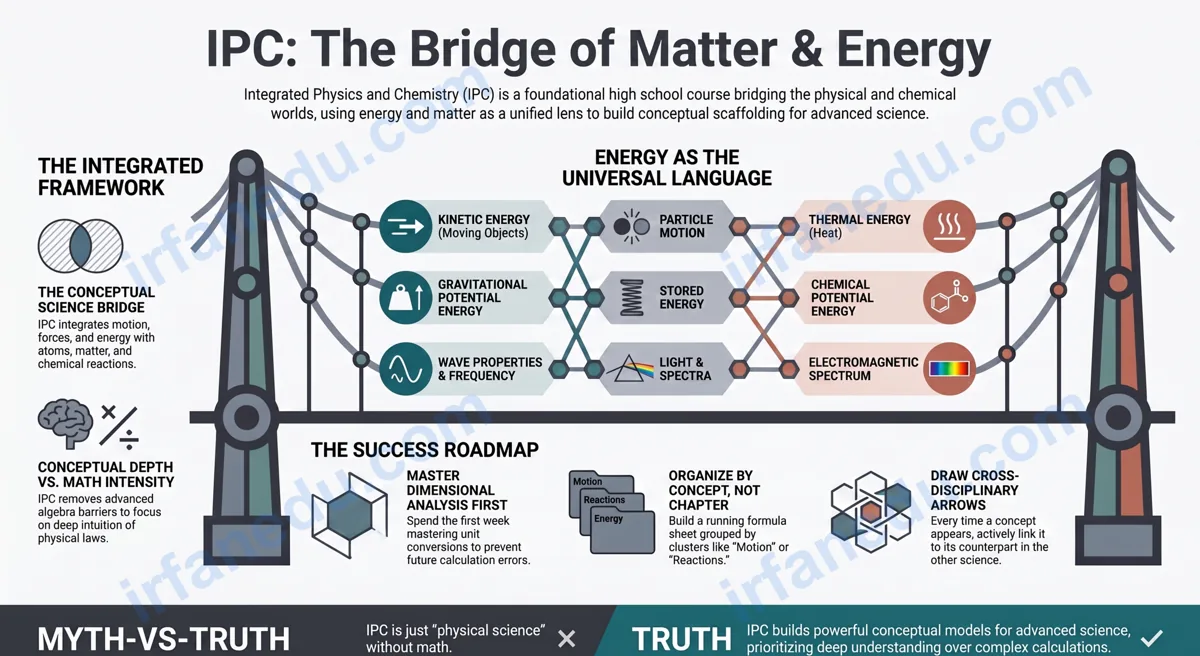
You’ve probably been told that Integrated Physics and Chemistry is just a “watered-down” science class for students who can’t handle real physics or chemistry. That’s wrong — and believing it is one of the fastest ways to walk into IPC unprepared and underperform.
IPC is a strategically designed foundational course. It builds the conceptual and mathematical scaffolding that makes every science course after it easier. Students who take IPC seriously arrive in 11th-grade chemistry or physics with a genuine advantage. Students who dismiss it as easy often struggle with the same concepts again, just at a harder level.
Integrated Physics and Chemistry (IPC) is a high school science course that teaches the core principles of both physics and chemistry together. It covers motion, forces, energy, matter, atomic structure, and chemical reactions — giving students a unified understanding of how the physical world works before they specialize in either subject.
- Understand what IPC actually covers and why it matters
- Bust the most damaging myths students believe about the course
- See physics and chemistry concepts side by side with worked examples
- Get a proven step-by-step strategy to succeed in IPC
- Walk away with a clear picture of how IPC connects to future science courses
Integrated Physics and Chemistry (IPC) is a high school science course that teaches foundational physics and chemistry concepts together in one class. It covers motion, forces, energy, matter, atoms, and chemical reactions. IPC is typically taken in 9th or 10th grade before separate physics or chemistry courses, and it is designed to show students how the two sciences connect in the real world.
TL;DR – Quick Summary
- IPC combines physics and chemistry into one foundational high school course.
- It is NOT a dumbed-down course — it builds skills every science course needs.
- Core topics: motion, forces, energy, matter, atoms, reactions, waves.
- Physics and chemistry share more concepts than most textbooks admit.
- The hidden skill IPC teaches is dimensional analysis — the most transferable science skill.
- Students who treat IPC seriously gain a measurable advantage in later science courses.
| Quick Fact | Detail |
|---|---|
| Full Name | Integrated Physics and Chemistry |
| Common Abbreviation | IPC |
| Typical Grade Level | 9th or 10th grade |
| Credit Type | Science elective or physical science requirement |
| Math Requirement | Basic algebra (no calculus needed) |
| Key Physics Topics | Motion, forces, energy, waves |
| Key Chemistry Topics | Matter, atoms, periodic table, reactions |
| Who Benefits Most | Students building science foundations before AP/honors courses |
Myth 1: “IPC Is Just an Easy Filler Course” — Here’s the Truth
The idea that IPC is a throwaway class for students who “aren’t science people” is one of the most persistent and damaging myths in high school science education. It causes students to under-prepare, parents to under-support, and teachers to fight an uphill battle against low expectations from day one.
The truth: IPC is a conceptual-depth course, not a math-intensity course. That distinction matters. Traditional physics courses are hard because of calculus or advanced algebra. Traditional chemistry courses are hard because of stoichiometry and molar calculations. IPC removes those barriers intentionally — not to make the science easier, but to make the underlying concepts accessible to students who are still building their math skills.
The concepts themselves are not trivial. Newton’s three laws of motion, conservation of energy, atomic structure, and the nature of chemical bonds are the same ideas that appear in AP Physics and AP Chemistry. IPC just teaches them without the mathematical overhead. That is a pedagogical choice, not a quality reduction.
Myth 2: “Physics and Chemistry Are Completely Separate Subjects” — Here’s the Truth
Physics and chemistry are not two separate kingdoms of science. They share a common border — and that border is where some of the most important science happens. IPC is built on this truth.
Consider thermal energy. In physics, you study it as a form of energy that transfers between objects at different temperatures. In chemistry, you study it as the energy released or absorbed during a chemical reaction (exothermic vs. endothermic). Same phenomenon, two lenses. IPC teaches you to see both at once.
The same overlap appears in states of matter (physics: kinetic molecular theory; chemistry: phase changes and intermolecular forces), waves (physics: wave properties; chemistry: electromagnetic spectrum and atomic emission spectra), and atomic structure (physics: subatomic particles and charge; chemistry: electron configuration and bonding).
In my experience teaching both physics and chemistry at the high school level, the students who struggle most in advanced courses are not the ones who found the math hard — they are the ones who never built a mental model of what matter and energy actually are. IPC, done right, builds exactly that model. I have seen students who took IPC seriously outperform students who skipped it and went straight to honors chemistry, purely because they had a richer intuition for what was happening at the atomic level.
What Is Integrated Physics and Chemistry, Really?
Integrated Physics and Chemistry is a high school physical science course that treats physics and chemistry as two perspectives on the same underlying reality: the behavior of matter and energy. Rather than teaching them as separate subjects with separate textbooks and separate teachers, IPC weaves them together so students see the connections naturally.
The course is most common in the United States, particularly in Texas (where it is part of the official TEKS science curriculum), but similar integrated physical science courses exist in school systems worldwide under different names. The core content — matter, energy, forces, and atomic structure — is universal.
IPC is typically a one-year course taken in 9th or 10th grade. It satisfies a physical science requirement and often serves as a prerequisite for separate chemistry and physics courses in later years. Some students take it as their only physical science course; others use it as a launching pad for AP or honors science in 11th and 12th grade.
What Topics Does IPC Actually Cover?
A standard IPC course covers six major topic clusters. Each one draws on both physics and chemistry principles, which is what makes the course genuinely integrated rather than just two half-courses stitched together.
1. Matter and Its Properties
This is where chemistry dominates. Students learn the difference between physical and chemical properties, physical and chemical changes, and the three states of matter (solid, liquid, gas). The physics connection comes through kinetic molecular theory — the idea that temperature is a measure of the average kinetic energy of particles.
2. Atomic Structure and the Periodic Table
Students learn the structure of atoms (protons, neutrons, electrons), how elements are organized on the periodic table, and how atomic number and mass number relate. This is foundational chemistry. The physics connection: subatomic particles carry charge, and the behavior of charged particles explains chemical bonding and electrical phenomena.
3. Motion and Forces
This is where physics dominates. Students study speed, velocity, acceleration, and Newton’s three laws of motion. The chemistry connection is subtler but real: forces between atoms (intermolecular forces) determine whether a substance is a solid, liquid, or gas at a given temperature.
4. Energy
Energy is the topic where IPC’s integration is most visible. Students study kinetic energy, potential energy, thermal energy, and the law of conservation of energy — all from physics. They then apply the same energy concepts to chemical reactions: exothermic reactions release energy, endothermic reactions absorb it. Same principle, two contexts.
5. Waves, Sound, and Light
Wave properties (wavelength, frequency, amplitude, speed) come from physics. The electromagnetic spectrum and the connection between light and atomic structure (why atoms emit specific colors of light) come from chemistry. IPC covers both.
6. Chemical Reactions
Students learn to identify and balance simple chemical equations, recognize types of reactions (synthesis, decomposition, single and double replacement, combustion), and understand conservation of mass. This is pure chemistry — but the energy changes in reactions tie directly back to the physics energy unit.
Wrong vs. Right: The IPC Misconceptions That Cost Students Marks
Most IPC errors are not calculation mistakes — they are conceptual misunderstandings that students carry from everyday language into science class. Here is a direct wrong-vs-right breakdown of the most common ones.
| WRONG (What Students Believe) | RIGHT (What the Science Says) |
|---|---|
| Heat and temperature are the same thing. | Temperature measures average kinetic energy of particles. Heat is the transfer of thermal energy between objects. A small hot object can have a higher temperature but less total heat than a large warm object. |
| A heavier object always falls faster than a lighter one. | In the absence of air resistance, all objects fall at the same rate regardless of mass (9.8 m/s² on Earth). This is one of Galileo’s most important findings and a core IPC concept. |
| Burning destroys matter — the ash weighs less, so mass is lost. | Mass is conserved in chemical reactions (Law of Conservation of Mass). Burning releases gases (CO₂, water vapor) that escape into the air. The total mass of products equals the total mass of reactants. |
| Atoms are the smallest possible particles of matter. | Atoms are made of subatomic particles: protons, neutrons, and electrons. Protons and neutrons are themselves made of quarks. For IPC, the proton/neutron/electron model is the working model, but atoms are not the smallest things. |
| An object in motion needs a constant force to keep moving. | Newton’s First Law states that an object in motion stays in motion unless acted on by an unbalanced force. No force is needed to maintain constant velocity. Force is needed to change velocity (accelerate or decelerate). |
| Chemical changes are always dramatic (explosions, color changes). | Many chemical changes are quiet and slow — iron rusting, food digesting, a battery discharging. The defining feature of a chemical change is that new substances with different properties are formed, not that it looks dramatic. |
| The periodic table is just a memorization chart. | The periodic table is a predictive tool. An element’s position tells you its electron configuration, typical charge, reactivity, and the types of bonds it forms. Understanding the table’s structure is more valuable than memorizing it. |
Worked Examples: Physics and Chemistry Side by Side
The best way to see what IPC integration actually looks like is through worked examples that show the same underlying principle appearing in both physics and chemistry contexts.
Physics context: A 2 kg ball is held 5 meters above the ground. Its gravitational potential energy is PE = mgh = 2 × 9.8 × 5 = 98 Joules. When released, all 98 J converts to kinetic energy just before it hits the ground (ignoring air resistance).
Chemistry context: When methane (CH₄) burns in oxygen, the chemical potential energy stored in the bonds is released as thermal energy and light. The total energy of the system is conserved — energy stored in bonds becomes heat and light. Same law, different system.
IPC connection: In both cases, energy changes form but the total amount stays constant. This is the Law of Conservation of Energy — one of the most powerful ideas in all of science.
Physics context: Kinetic energy (KE = ½mv²) describes the energy of a moving object. At the particle level, temperature is a measure of the average kinetic energy of particles in a substance.
Chemistry context: Water is a solid (ice) when particle kinetic energy is low, a liquid when it is moderate, and a gas (steam) when it is high. Adding heat increases kinetic energy until particles have enough energy to overcome intermolecular forces and change state.
IPC connection: Phase changes are kinetic energy changes. The physics formula and the chemistry observation describe the same physical reality.
  PHYSICS SIDE                    CHEMISTRY SIDE
  ─────────────────────────────────────────────────────
  Kinetic Energy (KE)  ◄──────►  Thermal Energy / Heat
  (moving objects)                (particle motion)

  Gravitational PE     ◄──────►  Chemical Potential Energy
  (height × mass × g)             (energy stored in bonds)

  Wave Energy          ◄──────►  Electromagnetic Spectrum
  (frequency, wavelength)         (light, UV, IR, atomic spectra)

  Conservation of      ◄──────►  Conservation of Mass
  Energy (physics)                + Energy in Reactions

  ─────────────────────────────────────────────────────
  SHARED CORE IDEA: Energy changes form, but is never
  created or destroyed (First Law of Thermodynamics).
One thing I have noticed across hundreds of IPC students: the ones who struggle most are not struggling with physics or chemistry specifically — they are struggling with unit analysis (dimensional analysis). They can understand the concept but they set up the calculation wrong because they are not tracking units. In my experience, spending one full week at the start of IPC doing nothing but unit conversion practice — before any formulas — produces measurably better results for the rest of the year. No textbook I have seen front-loads this skill the way it deserves.
How Do You Actually Succeed in IPC?
Succeeding in IPC requires a different study approach than most students use for history or English. Science is cumulative — each unit builds on the last — so falling behind in week three makes week seven genuinely harder. Here is a step-by-step approach that works.
- Build a concept map before each unit. Before you read a single page, sketch what you already know about the topic. Connect it to everyday experience. This activates prior knowledge and gives new information a place to land.
- Master unit conversions in the first two weeks. Practice converting meters to centimeters, grams to kilograms, and Joules to calories before any formulas appear. Conversion errors cause the majority of lost marks in IPC.
- Solve one complete worked example per formula. For every new equation, work through one full numerical problem showing every step, including units at each stage. Do not just read the example — write it out yourself.
- Actively look for physics-chemistry bridges. Every time a chemistry concept appears, ask: “Where did I see this in physics?” Every time a physics concept appears, ask: “How does this show up in chemical reactions?” This habit doubles your retention.
- Maintain a running formula sheet organized by topic cluster. Do not organize it by chapter. Organize it by concept: Motion, Energy, Matter, Reactions. This is how IPC exams actually test you — by concept, not by chapter order.
Most IPC study guides treat the course as “half physics + half chemistry.” That framing is wrong, and it leads to a fragmented study approach. The real structure of IPC is energy and matter, viewed from two angles. Every single topic in the course is either about what matter is made of (chemistry’s domain) or how matter and energy behave and interact (physics’ domain). When you study IPC through that lens — matter and energy, not physics and chemistry — the connections between topics become obvious, the formula sheet shrinks because you see which formulas are actually the same idea in different notation, and exam questions that seem to mix topics suddenly make sense. No textbook I have reviewed frames it this way, but it is the most accurate description of what IPC actually is.
Quick Quiz: Test Your IPC Knowledge
IPC Concept Check (3 Questions)
1. A student heats a piece of iron and it glows red. This is an example of:
Show Answer
2. Which of the following best describes Newton’s First Law of Motion?
Show Answer
3. When wood burns, the ash left behind weighs less than the original wood. This means:
Show Answer
Practice Problems
Problem 1: Calculate the kinetic energy of a 3 kg object moving at 4 m/s. (Click for solution)
Formula: KE = ½ × m × v²
KE = ½ × 3 kg × (4 m/s)²
KE = ½ × 3 × 16
KE = 24 Joules
IPC connection: This same 24 J of kinetic energy could be converted to thermal energy (heat) when the object stops — the same energy that drives temperature changes studied in the chemistry unit.
Problem 2: Balance this chemical equation: H₂ + O₂ → H₂O. (Click for solution)
Unbalanced: H₂ + O₂ → H₂O
Count atoms: Left: 2H, 2O. Right: 2H, 1O. Oxygen is unbalanced.
Step 1: Place a 2 in front of H₂O: H₂ + O₂ → 2H₂O
Step 2: Now left has 2H, right has 4H. Place a 2 in front of H₂: 2H₂ + O₂ → 2H₂O
Check: Left: 4H, 2O. Right: 4H, 2O. Balanced.
IPC connection: Conservation of mass in chemistry is the same principle as conservation of matter in physics. Atoms are not created or destroyed — they are rearranged.
Problem 3: A ball is dropped from a height of 10 m. What is its speed just before it hits the ground? (Click for solution)
Use conservation of energy: PE at top = KE at bottom
mgh = ½mv²
gh = ½v² (mass cancels)
v² = 2gh = 2 × 9.8 × 10 = 196
v = √196 = 14 m/s
IPC connection: Notice that mass cancelled out — this is why all objects fall at the same speed regardless of mass (in the absence of air resistance), a result that surprises most students.
Frequently Asked Questions About IPC
What is integrated physics and chemistry (IPC)?
Is IPC harder than regular chemistry or physics?
What grade level is IPC typically taken?
Does IPC count as a science credit for college admission?
How is IPC different from Earth Science or Biology?
What is the best way to study for IPC?
Sources & References
Written and fact-checked by Dr Irfan Mansuri. External links open in a new tab and are provided for further reading and verification.