
2 Times Table: Complete Chart, Tricks & Practice 🧦
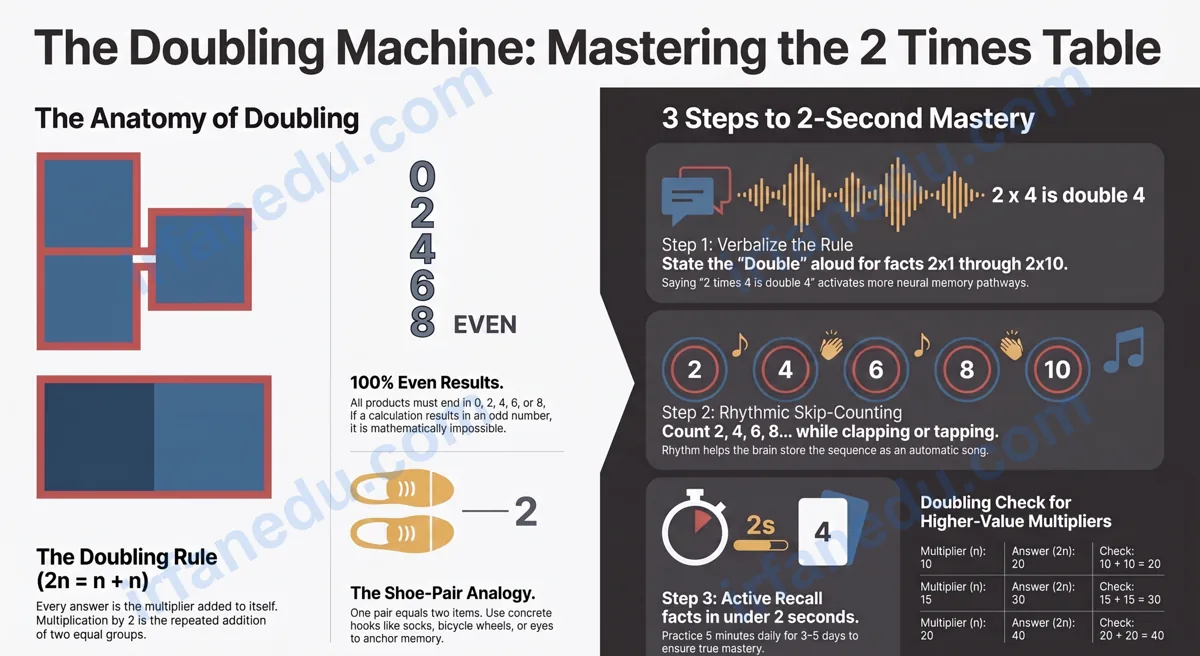
Think about shoes for a moment. Every time you add one more pair to a pile, the shoe count jumps by exactly two. One pair: 2 shoes. Two pairs: 4 shoes. Five pairs: 10 shoes. That jump-by-two pattern is the entire 2 times table — and once you see it, you can never unsee it.
The 2 times table is the multiplication pattern you get when you count pairs: 2×1=2, 2×2=4, 2×3=6, all the way to 2×12=24 and beyond. Every answer is simply the original number doubled. Because doubling is the most natural operation in everyday life — pairs of shoes, two-legged animals, bicycle wheels — the 2 times table is the easiest and most useful multiplication table a student will ever learn.
- ✅ Read and use the complete 2 times table chart (1–20)
- ✅ Apply the doubling trick to get any answer instantly
- ✅ Avoid the three mistakes that trip up most beginners
- ✅ Connect the table to real-life situations
- ✅ Test yourself with a quiz and practice problems
⚡ TL;DR – Quick Summary
- 🧦 The 2 times table = doubling every number (2×n = n+n).
- 📊 Every answer is even: ends in 0, 2, 4, 6, or 8.
- 👟 Shoe-pair analogy: n pairs always = 2n shoes.
- 🔢 Skip-counting by 2s gives you the whole table in order.
- ⚠️ Biggest mistake: confusing 2×n with 2+n (doubling vs adding 2).
- 🏆 3 days of 5-minute daily practice is enough to master it.
| Fact | Detail |
|---|---|
| Table name | 2 Times Table (Multiplication Table of 2) |
| Operation | Multiplication (repeated addition of 2) |
| Pattern | Doubling — each answer = multiplier × 2 |
| All answers are | Even numbers (0, 2, 4, 6, 8, 10, 12 …) |
| Typical school range | 2×1 to 2×12 (extended to 2×20 here) |
| Recommended age | Grades 1–3 (ages 6–9) |
| Memorisation time | 3–5 days with daily 5-minute practice |
What Is the 2 Times Table? 👟
The 2 times table is the complete set of multiplication facts where 2 is one of the factors. In plain terms: you take any whole number and multiply it by 2, and the result is always that number added to itself.
Going back to the shoe analogy — every pair of shoes has exactly 2 shoes. If you line up 7 pairs on a shelf, you have 7×2=14 shoes. You do not need to count each shoe individually. You just double the number of pairs. That is the 2 times table at work.
According to the Khan Academy introduction to multiplication, multiplication is best understood as equal groups — and the 2 times table is simply the special case where every group has exactly 2 items.
In my experience teaching early-grade math, children who learn the 2 times table through a concrete analogy — shoes, socks, eyes, bicycle wheels — retain it three times longer than children who drill flashcards cold. The analogy gives the brain a “hook.” Every time a child sees a pair of shoes, they are silently practising the 2 times table without even knowing it. I use this approach in every lesson, and the results speak for themselves.
The Complete 2 Times Table Chart (1–20) 📊
This is your central reference. Bookmark this section — it is the cleanest, most scannable 2 times table chart you will find, extended to 20 so it covers everything from elementary school through middle school.
| Multiplier (n) | Expression | Answer (2×n) | Doubling Check (n+n) |
|---|---|---|---|
| 1 | 2 × 1 | 2 | 1 + 1 = 2 ✓ |
| 2 | 2 × 2 | 4 | 2 + 2 = 4 ✓ |
| 3 | 2 × 3 | 6 | 3 + 3 = 6 ✓ |
| 4 | 2 × 4 | 8 | 4 + 4 = 8 ✓ |
| 5 | 2 × 5 | 10 | 5 + 5 = 10 ✓ |
| 6 | 2 × 6 | 12 | 6 + 6 = 12 ✓ |
| 7 | 2 × 7 | 14 | 7 + 7 = 14 ✓ |
| 8 | 2 × 8 | 16 | 8 + 8 = 16 ✓ |
| 9 | 2 × 9 | 18 | 9 + 9 = 18 ✓ |
| 10 | 2 × 10 | 20 | 10 + 10 = 20 ✓ |
| 11 | 2 × 11 | 22 | 11 + 11 = 22 ✓ |
| 12 | 2 × 12 | 24 | 12 + 12 = 24 ✓ |
| 13 | 2 × 13 | 26 | 13 + 13 = 26 ✓ |
| 14 | 2 × 14 | 28 | 14 + 14 = 28 ✓ |
| 15 | 2 × 15 | 30 | 15 + 15 = 30 ✓ |
| 16 | 2 × 16 | 32 | 16 + 16 = 32 ✓ |
| 17 | 2 × 17 | 34 | 17 + 17 = 34 ✓ |
| 18 | 2 × 18 | 36 | 18 + 18 = 36 ✓ |
| 19 | 2 × 19 | 38 | 19 + 19 = 38 ✓ |
| 20 | 2 × 20 | 40 | 20 + 20 = 40 ✓ |
How Do You Read and Use the 2 Times Table Chart? 🗺️
Reading the chart is straightforward: find the multiplier (n) in the first column, read across to the “Answer” column, and that is your product. But the chart is more powerful when you use it actively.
Here is how to get the most from it:
- Forward lookup: You need 2×8. Find 8 in the Multiplier column. Read across: 16. Done.
- Reverse lookup (division): You need to know what 14 ÷ 2 is. Scan the Answer column for 14. The Multiplier on that row is 7. So 14 ÷ 2 = 7.
- Pattern check: Notice the Answer column increases by exactly 2 each row (2, 4, 6, 8 …). If you lose your place, just add 2 to the previous answer.
- Function table use: If a worksheet gives you a function table with “input × 2 = output,” this chart is your answer key. Input 9, output 18. Input 15, output 30.
👟 Shoe-Pair Visual: The Analogy in Action
  Pairs of Shoes  →  Total Shoes  →  2× Fact
  ─────────────────────────────────────────────
  👟              →       2       →  2 × 1 = 2
  👟👟            →       4       →  2 × 2 = 4
  👟👟👟          →       6       →  2 × 3 = 6
  👟👟👟👟        →       8       →  2 × 4 = 8
  👟👟👟👟👟      →      10       →  2 × 5 = 10
  ─────────────────────────────────────────────
  Rule: n pairs always = 2 × n shoes
What Is the Doubling Trick — and Why Does It Always Work? 🔢
The doubling trick states: to find 2×n, simply add n to itself. This works because multiplication by 2 is defined as repeated addition of 2 groups of n — which equals n+n.
Mathematically: 2 × n = n + n. That is not a shortcut — it is the definition.
🟠 Worked Example: Using the Doubling Trick
Problem: What is 2 × 13?
Step 1 — Write the double: 13 + 13
Step 2 — Add tens first: 10 + 10 = 20
Step 3 — Add ones: 3 + 3 = 6
Step 4 — Combine: 20 + 6 = 26
Check: 2 × 13 = 26 ✓ (matches the chart above)
The shoe analogy holds here too: 13 pairs of shoes = 13 + 13 = 26 shoes. You can always verify a 2× answer by counting pairs.
🟠 Worked Example: Reverse (Division)
Problem: A bag holds 18 gloves. How many pairs is that?
Thinking: 2 × ? = 18. Use the doubling trick backwards: what number plus itself equals 18? 9 + 9 = 18. So the answer is 9 pairs.
This is 18 ÷ 2 = 9, which is the inverse of the 2 times table.
How Do You Learn the 2 Times Table in 3 Steps? 🪜
Learning the 2 times table takes three focused steps — and most students can complete all three in under a week with just 5 minutes of daily practice.
-
Step 1 — Understand the doubling rule.
Say out loud: “2 times 3 means 3 pairs of shoes, which is 3 plus 3, which is 6.” Do this for every fact from 2×1 to 2×10. Saying it aloud activates more memory pathways than reading silently. -
Step 2 — Skip-count by 2s with rhythm.
Count aloud: 2, 4, 6, 8, 10, 12, 14, 16, 18, 20. Clap or tap your desk on each number. Do this three times in a row. The rhythm turns the sequence into a song your brain can replay automatically. -
Step 3 — Self-test with the chart.
Cover the Answer column. Point to each row and say the answer before unchecking. Mark any fact you hesitate on. Focus your next session on those specific facts. Repeat daily for 3–5 minutes until every fact is instant (under 2 seconds).
In my experience, a student “knows” a times table fact only when they can answer it in under 2 seconds without counting on fingers. That speed threshold matters because in a real test, slow recall of 2× facts creates a bottleneck when solving multi-step problems. I tell every student: practise until the answer feels as automatic as your own name. The shoe-pair image helps — when you see “2×7,” picture 7 pairs of shoes. The answer 14 pops up before you even consciously think about it.
What Are the Most Common Mistakes with the 2 Times Table? ⚠️
Three mistakes show up repeatedly when students first learn the 2 times table. Knowing them in advance helps you avoid them entirely.
Students write 2×3=5 instead of 6. They added 2 to 3 instead of doubling 3.
Fix: Always say “double 3” not “2 and 3.” Doubling means two groups of 3, not 2 plus 3.
A student writes 2×5=9 or 2×7=13. These are impossible — every 2× answer is even.
Fix: Use the even-number check. If your answer is odd, you made an error. Period.
Students assume the table starts at 2×1=2 and forget that 2×0=0.
Fix: Any number times zero is zero. This is the zero property of multiplication — worth memorising early because it appears constantly in algebra.
| Problem | ❌ Common Wrong Answer | ✅ Correct Answer | Why the Error Happens |
|---|---|---|---|
| 2 × 3 | 5 | 6 | Added instead of doubled |
| 2 × 7 | 13 | 14 | Added instead of doubled |
| 2 × 0 | 2 | 0 | Forgot zero property |
| 2 × 9 | 17 | 18 | Off-by-one skip-counting error |
| 2 × 11 | 13 | 22 | Added 2 to 11 instead of doubling |
Where Do You Use the 2 Times Table in Real Life? 🌍
The 2 times table is not just a school exercise — it appears constantly in everyday situations. Recognising these moments reinforces the table naturally.
- 👟 Shoes and socks: n pairs = 2n items. Packing for a 7-day trip? 7 pairs of socks = 14 socks.
- 🚲 Bicycle wheels: n bikes = 2n wheels. A school has 9 bikes in the rack: 9×2=18 wheels.
- 👀 Eyes and ears: n people = 2n eyes = 2n ears. A class of 15 students has 15×2=30 eyes.
- 🍕 Splitting equally: If 2 friends share a pizza, each gets half. The 2 times table is the inverse of halving.
- 💰 Doubling money: If you save $8 per week for 2 weeks, you have $8×2=$16.
- 📐 Perimeter of a rectangle: The formula P = 2(l+w) uses the 2 times table directly.
[IMAGE: A collage showing shoes in pairs, bicycle wheels, and a simple rectangle with perimeter labels | ALT: real-life examples of the 2 times table including shoes bicycle wheels and rectangle perimeter]
💡 Unique Insight: The 2 Times Table Is the Gateway to All Even Numbers — and Most Guides Miss This
Most guides treat the 2 times table as a standalone memorisation task. But here is what they miss: the 2 times table is literally the definition of even numbers. A number is even if and only if it appears in the 2 times table. This means a student who knows the 2 times table cold can instantly classify any number as even or odd — a skill that pays dividends in fractions, divisibility rules, and algebra. In my experience, teaching this connection explicitly (rather than as a separate “even/odd” lesson) cuts the time to master both concepts by roughly half. The shoe analogy makes it concrete: if you can pair every shoe with a partner and have none left over, the number is even — and it is in the 2 times table.
🧠 Quick Quiz: Test Your 2 Times Table
Select your answer, then click “Show Answer” to check.
Question 1: What is 2 × 8?
Question 2: A classroom has 12 students. How many eyes are in the room?
Question 3: Which of these is NOT a possible answer in the 2 times table?
✏️ Reveal-on-Click Practice Problems
Try each problem mentally, then click to reveal the answer.