
DMV Permit Practice Test
On this page
What the permit test actually asks
A learner permit test is a multiple-choice paper on the written part of driving: what a sign means, who has the right of way, what a marking permits, how much room to leave, and the limits your state sets on speed, alcohol and equipment. It is not a test of car control — that is the road test that comes later.
The questions are drawn from your state handbook, so almost everything on it falls into one of a small number of subjects. Those subjects are the same in every state; only the numbers attached to them change. That is why the material below is split into a federal common core and five state-specific banks, rather than pretending one paper fits everywhere.
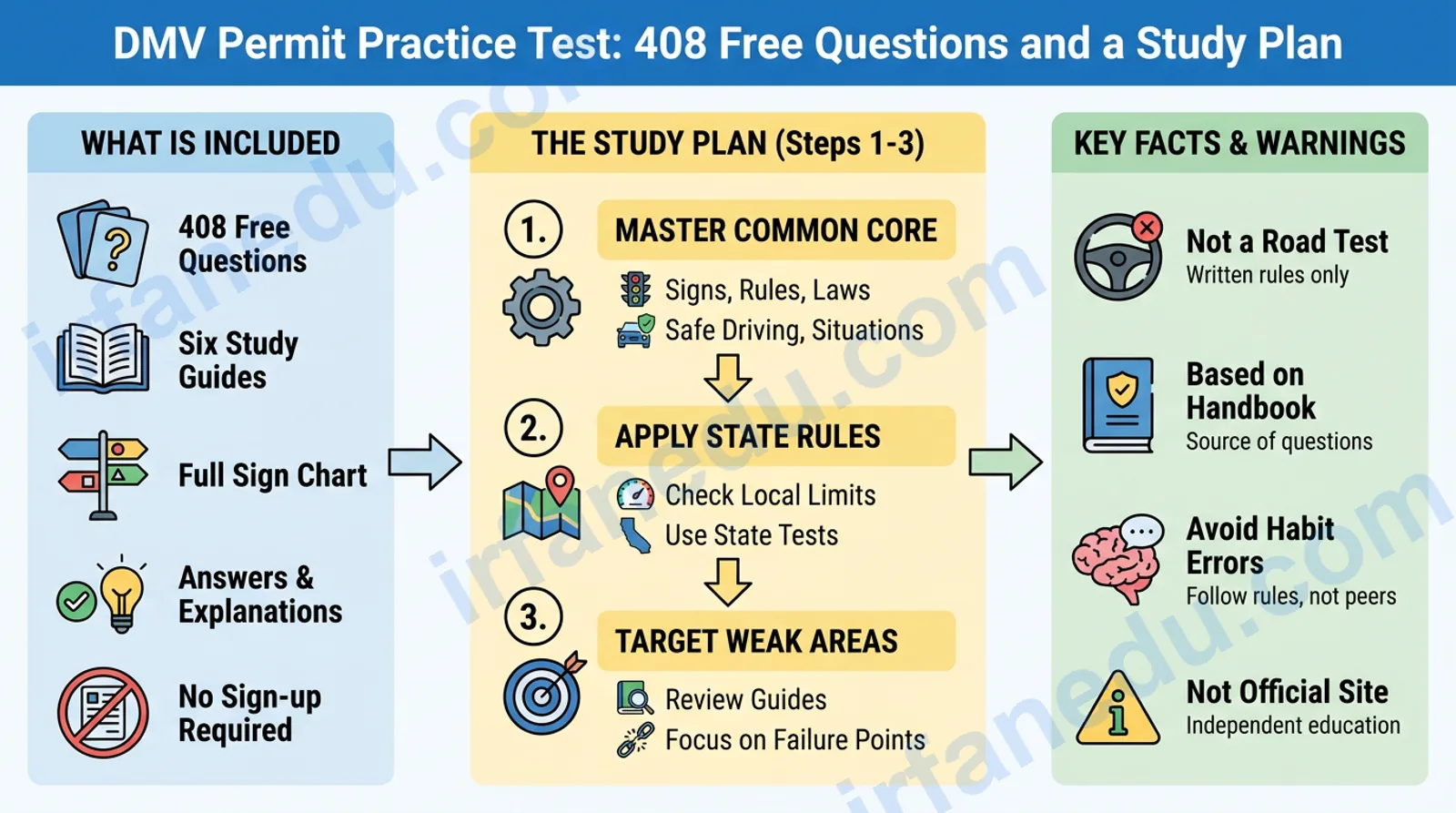
The most common way to fail is not ignorance of an obscure rule. It is answering from habit — what drivers around you actually do — rather than from the rule. Signs you have driven past for years and never had to name, and right-of-way situations you have always resolved by eye contact, are where the marks go. Both are worth practising as questions rather than just reading about.
Practice tests by state
Each of these is written to that state’s own rules, so the numbers are the ones its agency will test you on. If your state is not here, work through the subject tests below — the rules are the same, and check the limits against your handbook.
Practice tests by subject
The federal common core, split by what a question is about. No question appears on more than one of these, so working through all of them covers the set once rather than repeating it.
There is also a driving rules true or false quiz for the statements most learners have backwards.
The study guides
Read these first if a subject is new to you, or after a test if you got a run of questions wrong in one area. Each one ends with its own set of questions, and none of those questions appear on the practice tests.
What order to work through it in
If you have a week, this order costs about an hour a day and covers everything once:
| Day | What to do |
|---|---|
| 1 | Read the road signs guide and its sign chart end to end. Do not try to memorise it; learn the shapes and colours first, because they narrow every sign question before you read a word of it. |
| 2 | Both sign practice tests. Signs are the largest single block of questions and the fastest to fix. |
| 3 | Right of way guide, then the rules of the road test. This is the subject that punishes habit the most. |
| 4 | Traffic rules and safe driving guides, then the safe driving test. |
| 5 | Traffic laws, alcohol and parking. Short subjects, and the numbers in them are the ones your state sets, so read them beside your own handbook. |
| 6 | The diagram test and the true or false quiz. Both are about recognising a situation rather than reciting a rule. |
| 7 | Your state test. Anything you get wrong, go back to that subject’s guide rather than re-reading the question. |
Getting a question wrong and reading why is worth more than getting three right. The score at the top of each test is there to show you where to go back to, not to be beaten.
Where the marks actually go
Four patterns account for most wrong answers on a practice run, and none of them is about a rule being hard to understand:
- Answering from the road, not the handbook. Rolling stops, easing into a yield, and taking a gap because the other driver waved you through are all normal driving and all wrong on paper. When an option sounds like what people do, check it against what the rule says.
- Recognising a sign without being able to name what it requires. Knowing a diamond means a warning is not the same as knowing what the warning is, and the question asks the second one.
- Numbers with no anchor. Clearances, distances and limits are the only part of this that is pure memorisation, and they are also the part that differs by state. Learn yours from your own handbook and use the questions to test whether it stuck.
- Reading past the qualifier. “Unless”, “except”, “only when” and “must” versus “may” are doing the work in a lot of these stems. A question you get wrong after reading it twice is usually a question you read once.
Where these questions come from
Worth being direct about, because a lot of permit-test material online is not: none of these questions is taken from a real exam, and none of them was written by a language model. They come from an original, purpose-written question bank whose facts were checked against the federal MUTCD — the public-domain standard that defines what every sign shape and colour means — and against current state driver handbooks.
The sign artwork is drawn from the MUTCD specification rather than photographed or traced, which is why the signs here look clean and generic. A real sign in your town may carry different wording on the same shape and colour; the shape and the colour are the part that is standardised nationally, and they are the part the test is asking about.
Nothing on these pages is legal advice, and no practice test predicts a pass. What it can do is show you which subject you are weakest in while there is still time to read it again.