
Safe Driving Practice Test
What is in this test
Tap an option and the page marks it and opens the explanation. Nothing is timed and nothing is stored, so you can work through it in one sitting or come back to it. If you would rather not tap through, every answer is also listed in the answer key at the bottom.
| Subject | Questions |
|---|---|
| Safe driving | 21 |
Difficulty mix: 1 easy, 14 medium, 6 hard. The questions run easiest first.
The 21 questions
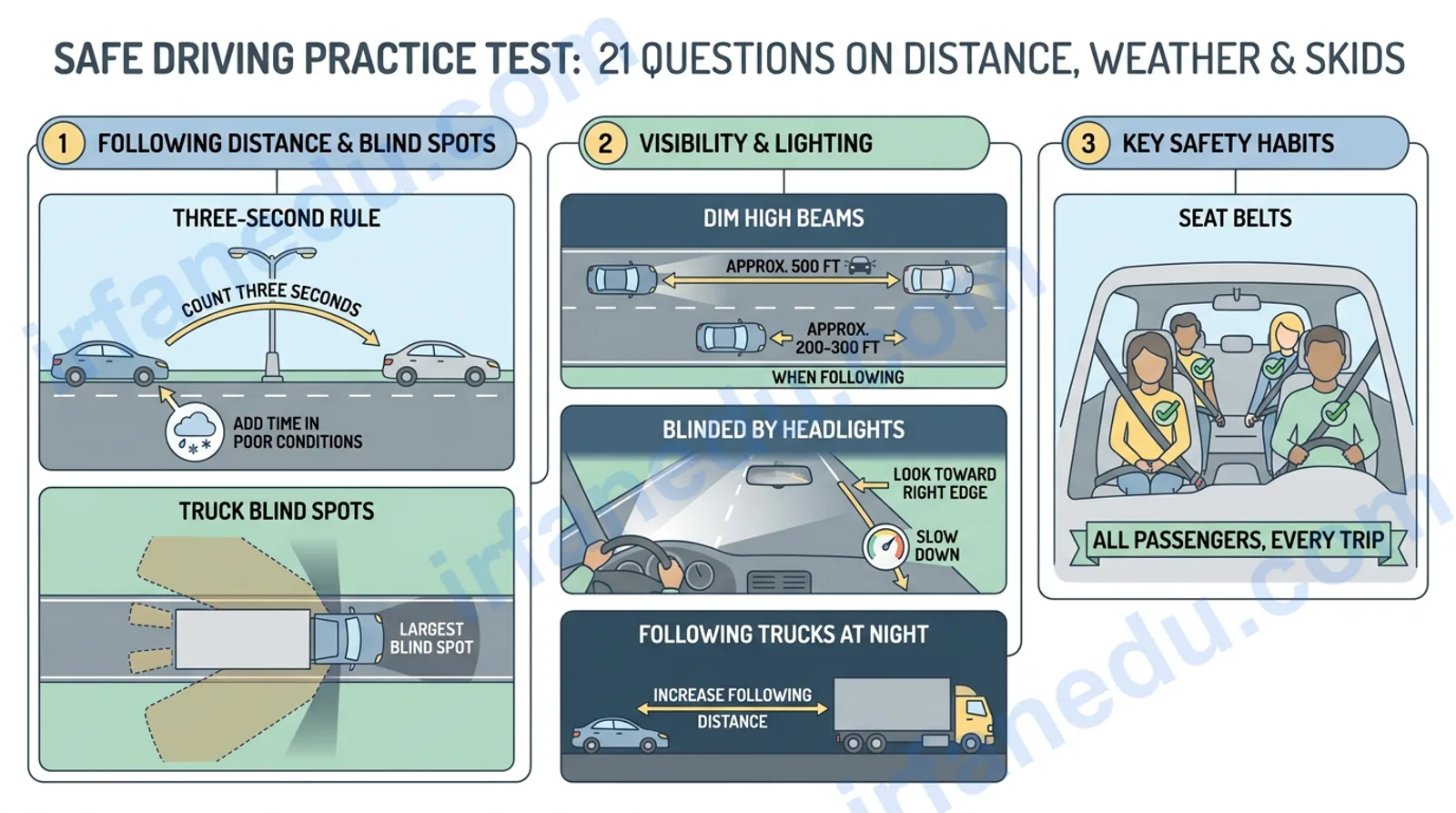
Seat belts should be worn:
Show the answer
Correct answer: C. By the driver and every passenger, on every trip
Most crashes happen close to home and at moderate speeds. An unbelted rear passenger also becomes a projectile that can injure or kill people in the front seats. The lap belt should sit low across the hips, not across the stomach.
When must you dim your high beams for an oncoming vehicle?
Show the answer
Correct answer: A. Generally within about 500 feet of an oncoming vehicle and 200 to 300 feet when following one
The usual rule is to switch to low beam within roughly 500 feet of an approaching vehicle and 200 to 300 feet when coming up behind one. Exact distances vary by state, but the principle is to never blind another driver.
You are blinded by the headlights of an oncoming car. You should:
Show the answer
Correct answer: B. Look toward the right edge of your lane and slow down
Shift your gaze to the right edge line and use it to hold your lane position until the vehicle has passed. Retaliating with your own high beams blinds both of you.
When following a large truck at night, you should:
Show the answer
Correct answer: C. Increase your following distance and use low beams
A truck blocks your view of the road ahead, so extra distance buys you sight lines and reaction time. High beams reflect off the trailer and the driver’s mirrors, dazzling them.
You are driving in strong crosswinds. You should:
Show the answer
Correct answer: B. Slow down and keep a firm grip on the wheel, especially near trucks and bridges
Gusts hit hardest at bridge openings, cuttings, and when a large vehicle passes. Reduce speed, hold the wheel with both hands, and be ready for a sudden push as you emerge from shelter.
You are the first to arrive at a crash where someone appears injured. You should:
Show the answer
Correct answer: B. Call 911, and avoid moving an injured person unless they face immediate danger such as fire
Moving someone with a possible spinal injury can cause permanent harm. Call for help, warn oncoming traffic, and only move a casualty when leaving them in place is more dangerous than moving them.
The safest way to handle a vehicle approaching you head-on in your lane is to:
Show the answer
Correct answer: D. Slow down, sound your horn, flash your lights, and steer to the right
Steer right, toward the shoulder. Moving left risks meeting the other driver as they correct back into their own lane. Slowing reduces the closing speed and gives you both more time.
Your engine stalls while you are driving. Your first priority is to:
Show the answer
Correct answer: C. Steer to the side of the road, using extra force because power steering and brake assistance are lost
With the engine off, steering and braking both take much more effort but still work. Get the vehicle off the roadway first, put on your hazard lights, then diagnose the problem.
You are driving into low sun and the glare makes it hard to see. You should:
Show the answer
Correct answer: B. Slow down, use the sun visor and clean windshield, and increase following distance
A dirty windshield turns low sun into a wall of scatter. Slowing down buys reaction time you no longer have visually, and extra distance protects you from what you cannot yet see.
You are driving and a bee enters the cabin. The safest response is to:
Show the answer
Correct answer: D. Keep both hands on the wheel, pull over safely, then deal with it
Distractions inside the cabin cause real crashes. Nothing inside the vehicle is urgent enough to take your hands off the wheel or your eyes off the road while moving.
Your headlights fail suddenly at night. You should:
Show the answer
Correct answer: C. Try the high beams and hazard lights, and pull off the road as soon as it is safe
High beams sometimes run on a separate circuit and may still work. Hazards make you visible while you slow and get completely off the traveled way.
You are following a motorcycle. Your following distance should be:
Show the answer
Correct answer: D. Longer than for a car, because motorcycles can stop quickly and are destabilized by road hazards
A motorcycle can stop in a shorter distance than your car and may swerve suddenly for gravel, grates, or a pothole. Three to four seconds gives you room for both.
Which is the safest way to carry a heavy load in a car?
Show the answer
Correct answer: A. Secured low and as far forward in the cargo area as possible
An unsecured load becomes a projectile in a crash and raises the center of gravity when stacked high. Keeping weight low and forward preserves handling and braking.
Your windshield fogs up quickly on a cold, rainy morning. The fastest fix is to:
Show the answer
Correct answer: D. Turn on the defroster with the air conditioning, and crack a window if needed
Air conditioning dries the air, so running it alongside the defroster clears the glass much faster than heat alone. Wiping by hand smears the screen and takes a hand off the wheel.
Before a long trip, the most useful safety check is:
Show the answer
Correct answer: A. Tires, including pressure and tread, plus lights, wipers, and fluid levels
Tires are the only contact with the road, and under-inflation causes heat build-up and blowouts at highway speed. Lights and wipers are what keep you visible and able to see.
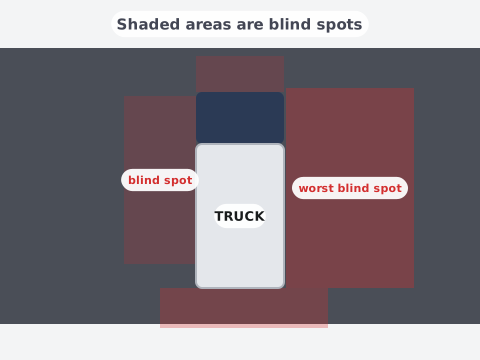
Where is the blind spot of a large truck the largest?
Show the answer
Correct answer: A. Along the right side and directly behind the trailer
A truck’s blind zones, often called no-zones, extend along both sides and well behind the trailer, with the right side by far the worst. A useful rule: if you cannot see the driver’s face in the truck’s mirror, they cannot see you.
You are approaching a curve. The safest technique is to:
Show the answer
Correct answer: D. Slow down before entering, then accelerate gently through the curve
Braking while turning asks the tires to do two things at once and can break traction. Do your slowing in a straight line before the bend, hold a steady line through it, and accelerate gently as it opens up.
You are driving at night on an unlit road. Your speed should be such that:
Show the answer
Correct answer: B. You can stop within the distance lit by your headlights
This is the outdriving your headlights rule. Low beams light roughly 150 to 200 feet ahead, which at highway speed is less than your total stopping distance, so night speeds on unlit roads should be lower than the posted limit.
Your vehicle’s rear wheels lose traction on a curve and the back begins to slide out. You should:
Show the answer
Correct answer: B. Ease off the accelerator and steer in the direction the rear is sliding
Steer where you want the front of the car to go, which means into the slide. Be ready for a gentle correction back as grip returns, or the vehicle can snap the other way.
The accelerator sticks while you are driving. Your first action should be to:
Show the answer
Correct answer: C. Shift to neutral, then brake and steer to a safe stop
Neutral disconnects the engine from the wheels while keeping power steering and brakes alive. Switching the engine off first can lock the steering and remove the assistance you need.
You are driving in heavy traffic and notice brake lights several vehicles ahead. You should:
Show the answer
Correct answer: D. Ease off the accelerator now and cover the brake
Looking through and beyond the vehicle in front is what turns a panic stop into a gentle one. Reacting to the traffic ahead rather than the bumper in front is the core defensive habit.
Answer key
Every answer in one place, in question order.
| No. | Ans | The correct option |
|---|---|---|
| 1 | C | By the driver and every passenger, on every trip |
| 2 | A | Generally within about 500 feet of an oncoming vehicle and 200 to 300 feet when following one |
| 3 | B | Look toward the right edge of your lane and slow down |
| 4 | C | Increase your following distance and use low beams |
| 5 | B | Slow down and keep a firm grip on the wheel, especially near trucks and bridges |
| 6 | B | Call 911, and avoid moving an injured person unless they face immediate danger such as fire |
| 7 | D | Slow down, sound your horn, flash your lights, and steer to the right |
| 8 | C | Steer to the side of the road, using extra force because power steering and brake assistance are lost |
| 9 | B | Slow down, use the sun visor and clean windshield, and increase following distance |
| 10 | D | Keep both hands on the wheel, pull over safely, then deal with it |
| 11 | C | Try the high beams and hazard lights, and pull off the road as soon as it is safe |
| 12 | D | Longer than for a car, because motorcycles can stop quickly and are destabilized by road hazards |
| 13 | A | Secured low and as far forward in the cargo area as possible |
| 14 | D | Turn on the defroster with the air conditioning, and crack a window if needed |
| 15 | A | Tires, including pressure and tread, plus lights, wipers, and fluid levels |
| 16 | A | Along the right side and directly behind the trailer |
| 17 | D | Slow down before entering, then accelerate gently through the curve |
| 18 | B | You can stop within the distance lit by your headlights |
| 19 | B | Ease off the accelerator and steer in the direction the rear is sliding |
| 20 | C | Shift to neutral, then brake and steer to a safe stop |
| 21 | D | Ease off the accelerator now and cover the brake |
More permit test practice
Everything on this site tagged DMV lives in the DMV category.
Sources