
Alcohol, Drugs and DUI Study Guide
On this page
Legal Limits
The numbers, and why they are lower than you think.
The thresholds
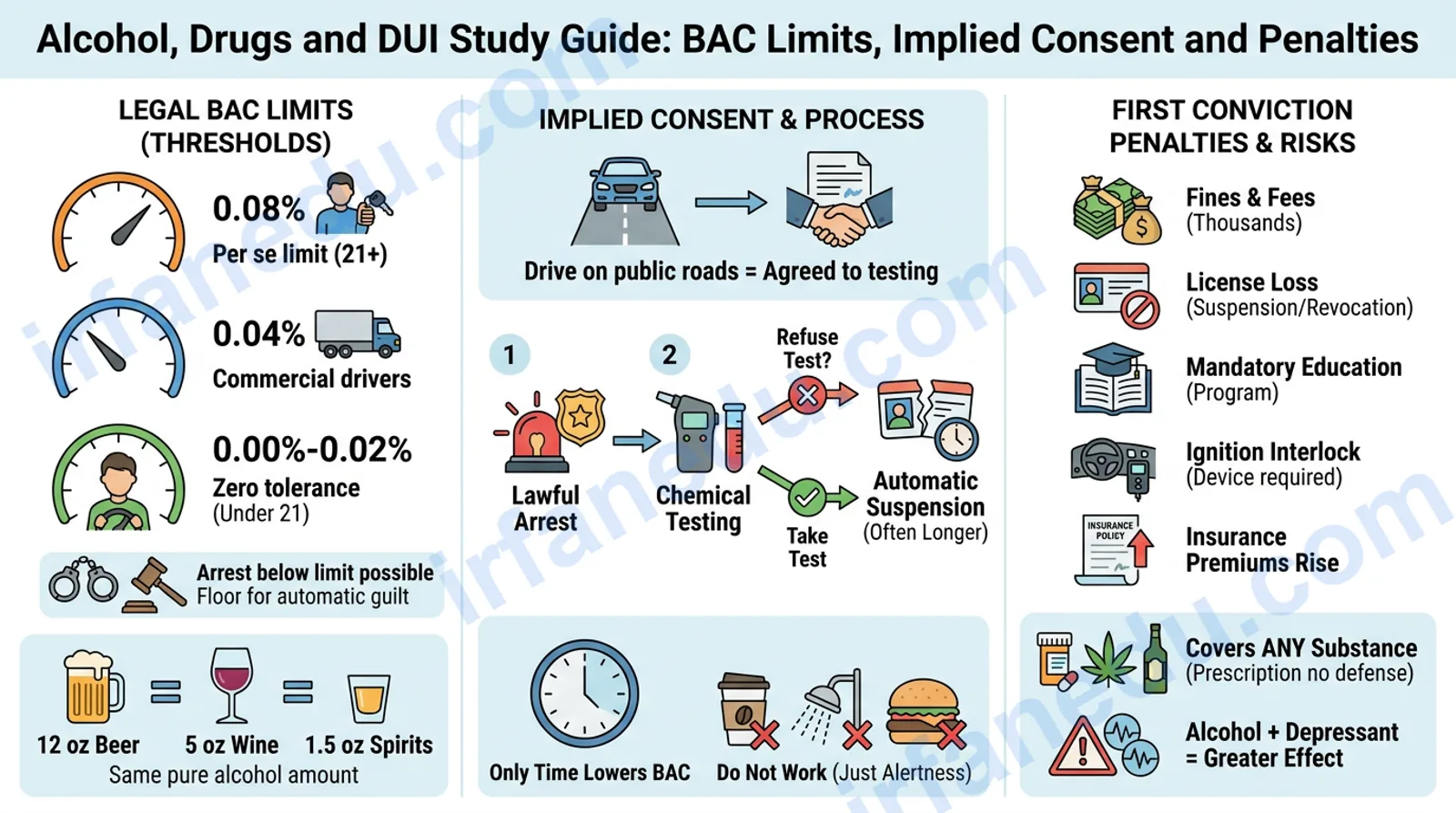
- 0.08%. The per se limit for drivers 21 and over in every state except Utah, which uses 0.05%.
- 0.04%. The federal limit for commercial drivers operating a commercial vehicle.
- 0.00% to 0.02%. Zero tolerance for drivers under 21. The exact trigger varies, and some states use any detectable amount.
You can be arrested below the limit if your driving is visibly impaired. The number is a floor for automatic guilt, not a safe allowance.
What a standard drink is
A 12 oz regular beer, a 5 oz glass of table wine, and a 1.5 oz shot of 80-proof spirits each contain about the same amount of pure alcohol. Switching drinks does not change how much you consume.
Implied Consent and Penalties
What happens after the traffic stop.
Implied consent
By driving on public roads you have already agreed to submit to chemical testing when lawfully arrested for impaired driving. Refusing normally brings an automatic license suspension, often longer than the penalty for failing the test, and the refusal itself can be used against you in court.
What a first conviction costs
- Fines and fees. Court costs, fines, and surcharges typically run into thousands of dollars.
- License loss. Suspension or revocation, often six months to a year.
- Education. A mandatory alcohol or drug education program at your own expense.
- Ignition interlock. A breath-testing device wired to the ignition, increasingly required even on a first offense.
- Insurance. Premiums rise sharply and stay elevated for years.
Other substances
Impaired driving law covers any substance. A valid prescription is not a defense, and legal availability of cannabis does not change the driving offense. Alcohol combined with another depressant produces an effect greater than either alone.
Check yourself
20 questions on what you have just read. Tap an option to see whether you were right.
In every US state, the blood alcohol concentration limit for a driver aged 21 or over is:
Show the answer
Correct answer: C. 0.08%
0.08% is the per se limit nationwide for drivers 21 and older, meaning you are legally impaired at that level regardless of how you feel. Utah is the exception with a stricter 0.05% limit. You can still be arrested below the limit if your driving is impaired.
Zero tolerance laws mean that a driver under 21 can be charged with a BAC as low as:
Show the answer
Correct answer: C. 0.01% to 0.02%, depending on the state
Every state has a zero tolerance law for drivers under 21, usually triggering at 0.01% or 0.02%. That is low enough that a single drink, or even some medicines, can put a young driver over the line.
The BAC limit for a driver holding a commercial driver’s license while operating a commercial vehicle is:
Show the answer
Correct answer: A. 0.04%
Federal rules set 0.04% for commercial drivers operating a commercial vehicle, half the limit for ordinary drivers, reflecting the greater damage a heavy vehicle can do.
Which of these will actually lower your blood alcohol concentration?
Show the answer
Correct answer: C. Time
The liver metabolizes alcohol at a roughly fixed rate of about one standard drink per hour, and nothing speeds it up. Coffee and cold water may make you feel more alert, which is dangerous because it disguises impairment without reducing it.
Which of these contains roughly the same amount of pure alcohol?
Show the answer
Correct answer: A. A 12 oz beer, a 5 oz glass of wine, and a 1.5 oz shot of spirits
One standard drink is about 0.6 fluid ounces of pure alcohol: a 12 oz regular beer, a 5 oz glass of table wine, or a 1.5 oz shot of 80-proof spirits. Switching drinks does not change how much alcohol you consume.
Implied consent means that by driving on public roads you have agreed to:
Show the answer
Correct answer: B. Submit to chemical testing for alcohol or drugs when lawfully arrested for impaired driving
Every state has an implied consent law. Refusing the test after a lawful arrest normally brings an automatic license suspension, often longer than the penalty for failing the test, and the refusal itself can be used against you in court.
Prescription and over-the-counter medicines:
Show the answer
Correct answer: D. Can impair driving, and you can be charged with impaired driving while taking them
Antihistamines, sleep aids, some painkillers, and many cold remedies cause drowsiness or slow reactions. Impaired driving laws cover any substance, and a valid prescription is not a defense. Read the label and ask a pharmacist.
An ignition interlock device is:
Show the answer
Correct answer: B. A breath testing device wired to the ignition that stops the engine starting if alcohol is detected
Courts and licensing agencies commonly order an interlock after an impaired driving conviction, and many states require one even for a first offense. The driver pays for installation and monitoring, and the device demands retests while driving.
Combining alcohol with another drug generally:
Show the answer
Correct answer: C. Produces an effect greater than either would cause alone
Alcohol and other depressants multiply each other’s effects rather than simply adding them. A dose of each that would be individually mild can together cause severe impairment or loss of consciousness.
Marijuana use before driving:
Show the answer
Correct answer: D. Impairs reaction time, judgment of distance, and coordination, and is treated as impaired driving
Legal availability does not change the driving offense. Cannabis slows reactions, distorts time and distance perception, and impairs lane keeping. Driving under its influence is prosecuted the same way as driving after drinking.
If you refuse a lawfully requested breath test, in most states you can expect:
Show the answer
Correct answer: B. An immediate administrative license suspension separate from any criminal case
The suspension for refusal is administrative and takes effect regardless of the criminal outcome. It is often longer than the suspension for failing the test, precisely to remove the incentive to refuse.
The first ability that alcohol impairs in a driver is:
Show the answer
Correct answer: A. Judgment and the ability to assess risk
Judgment goes first, before any obvious loss of physical control. That is why impaired drivers so often believe they are fine to drive: the very faculty needed to make that assessment is already compromised.
An open container of alcohol in the passenger compartment of a moving vehicle is:
Show the answer
Correct answer: A. Illegal in most states, for the driver and usually for passengers too
Open container laws prohibit any opened alcoholic beverage in the passenger area, whether or not anyone is drinking. Transport unsealed alcohol in the trunk or a locked compartment out of reach.
A driver under 21 convicted of a zero tolerance violation typically faces:
Show the answer
Correct answer: B. License suspension, fines, and often a required education program
Underage impaired driving usually brings an automatic suspension of a year or more, fines, mandatory alcohol education, and a record that raises insurance costs for years. Many states apply the suspension even before a court hearing.
The safest plan if you intend to drink is to:
Show the answer
Correct answer: D. Arrange a designated driver, a taxi, a rideshare, or public transport before you start drinking
Decide before the first drink, while your judgment is intact. Any plan made after drinking has begun is made by an impaired brain, which is exactly the faculty alcohol degrades first.
Factors that affect how alcohol raises your BAC include:
Show the answer
Correct answer: D. Body weight, how quickly you drink, and whether you have eaten
Body weight and composition, the rate of drinking, food in the stomach, sex, and some medications all change how fast BAC rises. Because these vary so much, no rule of thumb reliably keeps a person under the limit.
A driver says they feel fine after three drinks. The most likely explanation is:
Show the answer
Correct answer: C. Alcohol has already degraded the judgment needed to assess their own impairment
Judgement is the first faculty alcohol affects, before any obvious loss of coordination. Feeling fine is a symptom of impairment, not evidence against it.
Which statement about BAC and time is correct?
Show the answer
Correct answer: D. BAC can continue rising for a while after the last drink, as alcohol is still being absorbed
Absorption lags consumption, so someone who feels borderline when they get in the car can be over the limit twenty minutes later. Waiting a short while does not make it safe.
A passenger in your car is drinking from an open can. In most states:
Show the answer
Correct answer: B. The driver can be cited, because open containers in the passenger area are prohibited
Open container laws cover the whole passenger compartment and hold the driver responsible for the vehicle. Anything opened must travel in the trunk.
You are a designated driver and a friend offers you one drink. The correct answer is:
Show the answer
Correct answer: A. None, because you agreed to drive and any amount raises your BAC
Designated means zero, not moderate. For a driver under 21, a single drink can exceed a zero tolerance limit outright.
Answer key
Every answer in one place, in question order.
| No. | Ans | The correct option |
|---|---|---|
| 1 | C | 0.08% |
| 2 | C | 0.01% to 0.02%, depending on the state |
| 3 | A | 0.04% |
| 4 | C | Time |
| 5 | A | A 12 oz beer, a 5 oz glass of wine, and a 1.5 oz shot of spirits |
| 6 | B | Submit to chemical testing for alcohol or drugs when lawfully arrested for impaired driving |
| 7 | D | Can impair driving, and you can be charged with impaired driving while taking them |
| 8 | B | A breath testing device wired to the ignition that stops the engine starting if alcohol is detected |
| 9 | C | Produces an effect greater than either would cause alone |
| 10 | D | Impairs reaction time, judgment of distance, and coordination, and is treated as impaired driving |
| 11 | B | An immediate administrative license suspension separate from any criminal case |
| 12 | A | Judgment and the ability to assess risk |
| 13 | A | Illegal in most states, for the driver and usually for passengers too |
| 14 | B | License suspension, fines, and often a required education program |
| 15 | D | Arrange a designated driver, a taxi, a rideshare, or public transport before you start drinking |
| 16 | D | Body weight, how quickly you drink, and whether you have eaten |
| 17 | C | Alcohol has already degraded the judgment needed to assess their own impairment |
| 18 | D | BAC can continue rising for a while after the last drink, as alcohol is still being absorbed |
| 19 | B | The driver can be cited, because open containers in the passenger area are prohibited |
| 20 | A | None, because you agreed to drive and any amount raises your BAC |
More permit test practice
Everything on this site tagged DMV lives in the DMV category.
Sources