
Road to Emmaus Painting: The Complete Art History Guide
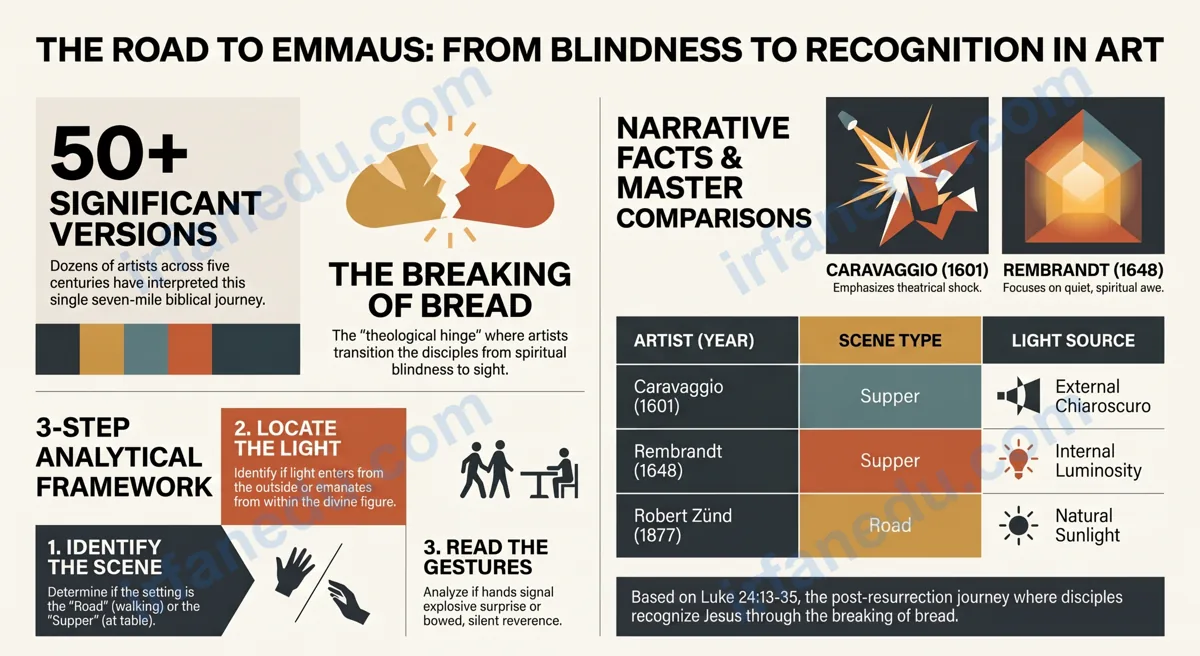
Table of Contents
- Fact vs. Fiction: Common Myths Corrected
- What Is the Road to Emmaus Painting?
- Quick Facts
- What Is the Biblical Source of This Scene?
- Which Artists Painted the Road to Emmaus?
- How Did Caravaggio Paint the Emmaus Scene?
- What Makes Rembrandt’s Emmaus Painting Unique?
- Artist Comparison Table
- What Are the Key Symbols in Emmaus Paintings?
- How to Analyze an Emmaus Painting Step by Step
- Unique Insight: The Blindness Paradox
- Quick Knowledge Quiz
- Practice Problems
- Frequently Asked Questions
- Key Takeaways
- Related Articles
- About the Author
- Sources & References
Fact vs. Fiction: Common Myths About the Road to Emmaus Painting
Before anything else, here are the most common misconceptions students and casual readers bring to this topic — corrected with the actual historical record.
| Fiction (What People Believe) | Fact (What the Record Shows) |
|---|---|
| There is one definitive “Road to Emmaus painting.” | Dozens of artists across five centuries painted this scene. No single work holds the title; Caravaggio and Rembrandt are simply the most studied. |
| Caravaggio painted the walking scene on the road. | Both of Caravaggio’s versions (1601 and 1606) show the supper — the meal at Emmaus — not the journey. The road itself is rarely depicted. |
| Robert Zünd’s 1877 painting is a medieval work. | Zünd was a 19th-century Swiss landscape painter. His Emmaus is a Romantic-era work, not medieval, and is notable for placing the figures inside a lush natural landscape. |
| The two disciples in the story are named apostles. | Luke 24 names only one disciple: Cleopas. The second is unnamed. Artists have depicted the second figure variously as male, female, or ambiguous. |
| Rembrandt painted only one Emmaus scene. | Rembrandt produced at least three Emmaus works: a 1629 grisaille sketch, a 1648 oil (Louvre), and several related drawings. The 1648 painting is the most celebrated. |
| The scene is set at night because of the dark backgrounds in Baroque paintings. | Luke 24:29 says “it is toward evening,” but the dark backgrounds in Baroque versions reflect the artistic technique of chiaroscuro, not necessarily a night setting. |
The Road to Emmaus is one of the most painted post-resurrection scenes in Western art — and also one of the most misunderstood. Students often encounter it in humanities, AP Art History, or religious studies classes without a clear framework for comparing versions or reading the symbolism.
The Road to Emmaus painting depicts the biblical account from Luke 24:13-35, in which two disciples walk with the risen Jesus without recognizing him, then recognize him at the breaking of bread. Caravaggio, Rembrandt, Robert Zünd, and dozens of other artists have painted this scene, each using light, gesture, and composition to explore themes of faith, recognition, and divine presence in ordinary moments.
In this guide, I walk you through the biblical source, the major artists and their techniques, the key symbols, and a step-by-step method for analyzing any Emmaus painting — whether you’re writing an essay, preparing for an exam, or simply curious about why this single story generated so much art.
- Understand the biblical narrative that inspired the paintings
- Compare Caravaggio, Rembrandt, Pontormo, and Robert Zünd
- Read the symbolic language of light, bread, and gesture
- Apply a structured analysis method to any version of the scene
⚡ TL;DR – Quick Summary
- The scene comes from Luke 24:13-35 — two disciples walk with an unrecognized risen Christ.
- Most famous paintings show the supper (recognition moment), not the road itself.
- Caravaggio (1601) uses theatrical drama; Rembrandt (1648) uses quiet spiritual light.
- Key symbols: bread, light source, pilgrim staff, gesture of the hands.
- Robert Zünd’s 1877 version is the most widely reproduced landscape treatment.
- Only one disciple (Cleopas) is named; the second’s identity is debated by scholars.
What Is the Road to Emmaus Painting?
The Road to Emmaus painting is any artwork depicting the post-resurrection story from the Gospel of Luke, chapter 24, verses 13 to 35. The story describes two disciples walking from Jerusalem to the village of Emmaus — a journey of about seven miles — when a stranger joins them. The stranger explains the scriptures to them, and they invite him to stay for a meal. At the table, when he breaks bread, they suddenly recognize him as the risen Jesus. He then vanishes.
The scene has fascinated artists for centuries because it presents a unique visual challenge: how do you paint a figure who is simultaneously present and unrecognized, ordinary and divine? The moment of recognition — a single gesture with a loaf of bread — became one of the most painted instants in Christian art.
The term “Road to Emmaus painting” is used loosely to cover both the journey scene (figures walking on a path) and the supper scene (figures at a table). In practice, the supper scene dominates art history. The walking scene is less common but appears in notable works by Robert Zünd and others.
| Biblical source | Luke 24:13-35 |
| Named disciple | Cleopas (the second is unnamed) |
| Distance to Emmaus | Approximately 7 miles (11 km) from Jerusalem |
| Most famous version | Caravaggio, Supper at Emmaus, 1601 (National Gallery, London) |
| Most reproduced landscape version | Robert Zünd, 1877 (Kunstmuseum Luzern) |
| Rembrandt’s key version | 1648 oil on panel (Louvre, Paris) |
| Central theological theme | Recognition of the risen Christ; Eucharist |
| Art movement coverage | Renaissance, Baroque, Mannerism, Romanticism, Realism |
What Is the Biblical Source of This Scene?
The Emmaus story comes exclusively from the Gospel of Luke (24:13-35) — it does not appear in Matthew, Mark, or John. This makes it one of the “Lukan exclusives,” a group of narratives unique to Luke’s gospel.
The story unfolds in three acts that map directly onto how artists structure their compositions:
- The Journey (verses 13-27): Two disciples leave Jerusalem, downcast after the crucifixion. A stranger joins them and walks alongside them. They do not recognize him. He explains the scriptures concerning the Messiah.
- The Invitation (verses 28-29): As they reach Emmaus, the stranger appears to be going further. The disciples urge him to stay: “Abide with us, for it is toward evening.” He agrees.
- The Recognition (verses 30-31): At the table, he takes bread, blesses it, breaks it, and gives it to them. “Their eyes were opened, and they recognized him; and he vanished out of their sight.”
The phrase “their eyes were opened” is the theological hinge of the story — and the visual hinge of every painting. Artists must communicate the transition from blindness to sight in a single frozen moment.
“When he was at table with them, he took the bread and blessed and broke it and gave it to them. And their eyes were opened, and they recognized him. And he vanished from their sight.”
Which Artists Painted the Road to Emmaus?
The Emmaus scene attracted painters across five centuries and multiple artistic movements. Each brought their own theological, cultural, and technical priorities to the same narrative.
The list below is not exhaustive — over 50 significant versions exist — but these are the artists whose works appear most frequently in art history curricula and museum collections.
- Jacopo Pontormo (c. 1525, Uffizi, Florence) — Mannerist; elongated figures, unnatural color palette, psychological tension.
- Caravaggio (1601, National Gallery, London; 1606, Brera, Milan) — Baroque; extreme chiaroscuro, theatrical gesture, everyday figures.
- Peter Paul Rubens (c. 1611, Prado, Madrid) — Baroque Flemish; monumental figures, rich color, dynamic movement.
- Rembrandt van Rijn (1629 sketch; 1648 oil, Louvre) — Dutch Golden Age; intimate light, psychological depth, spiritual stillness.
- Robert Zünd (1877, Kunstmuseum Luzern) — Swiss Realism/Romanticism; landscape-centered, figures small within nature, soft golden light.
- Eugene Burnand (1898) — French Realism; focuses on the walking scene, emotional urgency in the disciples’ faces.
In my experience teaching art history, students consistently underestimate how radical Caravaggio’s choice was in 1601. He painted the disciples as working-class men — rough hands, worn clothing — at a moment when most patrons expected idealized, aristocratic figures. That decision was not just stylistic; it was a theological statement about where the divine appears. Understanding that context transforms the painting from “dramatic composition” to “deliberate provocation.”
How Did Caravaggio Paint the Emmaus Scene?
Caravaggio’s 1601 Supper at Emmaus is the most analyzed version of this subject in Western art. It hangs in the National Gallery, London, and is considered a masterpiece of Baroque painting.
The composition places Christ at the center of a table, flanked by two disciples and an innkeeper. The moment depicted is the instant of recognition — Christ’s hand is extended over the bread in a gesture of blessing. The disciples react with explosive physical surprise: one flings his arms outward, the other grips the arms of his chair and leans forward.
Key technical features of the 1601 version:
- Chiaroscuro: A single light source from the upper left illuminates Christ’s face and the table while the background recedes into darkness.
- Foreshortening: The disciple on the right extends his arm directly toward the viewer, creating a sense of the scene breaking out of the canvas.
- Still life: A basket of fruit sits at the table’s edge, partly overhanging — a symbol of earthly abundance and, some scholars argue, the fragility of life (the fruit includes rotting pieces).
- Christ’s appearance: Unusually, Christ is beardless in the 1601 version — a departure from convention that may reflect Caravaggio’s interest in showing Christ as unrecognizable.
The 1606 version (Brera, Milan), painted after Caravaggio fled Rome following a killing, is markedly different. The palette is darker, the figures more subdued, and the emotional register shifts from theatrical shock to quiet grief. Art historians often read the 1606 version as a reflection of Caravaggio’s own fugitive state.
[IMAGE: Caravaggio’s 1601 Supper at Emmaus showing Christ blessing bread with two startled disciples | ALT: Caravaggio Supper at Emmaus 1601 National Gallery London chiaroscuro baroque painting]
  ┌─────────────────────────────────────────────┐
  │  LIGHT SOURCE (upper left)                  │
  │         ↓                                   │
  │  [Disciple A]  [CHRIST]  [Disciple B]       │
  │  arms flung    blessing  gripping chair     │
  │  outward       bread     leaning forward    │
  │                  ↑                          │
  │           [Innkeeper]                       │
  │           (standing,                        │
  │            unaware)                         │
  │                                             │
  │  [Fruit basket — edge of table]             │
  │  (overhanging → tension, fragility)         │
  │                                             │
  │  DARK BACKGROUND — figures emerge from void │
  └─────────────────────────────────────────────┘

  GESTURE AXIS: Disciple A's arm ←→ Disciple B's lean
  Both point toward CHRIST as the visual and
  theological center of the composition.
What Makes Rembrandt’s Emmaus Painting Unique?
Rembrandt’s 1648 Supper at Emmaus (Louvre, Paris) is the most celebrated of his several treatments of this subject, and it differs from Caravaggio’s version in almost every meaningful way.
Where Caravaggio gives you drama and shock, Rembrandt gives you silence and awe. Christ sits slightly apart from the table, bathed in a halo of warm golden light that seems to emanate from within rather than from an external source. The disciples are not flinging their arms; they are still, bowed, overwhelmed by a quiet recognition.
Technical features of the 1648 version:
- Internal luminosity: The light appears to come from Christ himself — a technique Rembrandt developed across his career to suggest divine presence without theatrical staging.
- Scale and space: Christ is placed against a large architectural niche, which dwarfs the human figures and emphasizes his transcendence.
- Restraint of gesture: The disciples’ hands are folded or resting; one has removed his hat in reverence. The emotional content is in posture, not movement.
- The servant figure: A small figure in the background, unaware of what is happening, reinforces the theme of ordinary life continuing alongside the miraculous.
When I compare the Caravaggio and Rembrandt versions side by side with students, the most productive question is not “which is better?” but “which moment is each artist painting?” Caravaggio paints the split second of recognition — the gasp. Rembrandt paints the second after — the settling into awe. Both are in Luke 24:31, but they are different frames of the same film. That distinction unlocks a much richer essay than simply describing what you see.
How Do the Major Emmaus Paintings Compare?
This comparison table covers the four most studied versions. Use it for essay preparation, exam revision, or direct comparison assignments.
| Artist / Year | Scene Depicted | Light Technique | Emotional Register | Key Symbol | Location |
|---|---|---|---|---|---|
| Caravaggio, 1601 | Supper (recognition) | External chiaroscuro (upper left) | Theatrical shock | Overhanging fruit basket | National Gallery, London |
| Caravaggio, 1606 | Supper (recognition) | Darker, more diffuse | Quiet grief | Subdued gestures | Brera, Milan |
| Rembrandt, 1648 | Supper (recognition) | Internal luminosity (from Christ) | Silent awe | Architectural niche behind Christ | Louvre, Paris |
| Pontormo, c.1525 | Supper (recognition) | Flat, unnatural Mannerist light | Psychological unease | Elongated figures, acid colors | Uffizi, Florence |
| Robert Zünd, 1877 | Road (journey) | Natural sunlight through trees | Peaceful, contemplative | Forest path, figures small in landscape | Kunstmuseum Luzern |
| Eugene Burnand, 1898 | Road (journey) | Dawn/dusk natural light | Urgent, emotional | Disciples’ expressive faces | Musée d’Orsay, Paris |
What Are the Key Symbols in Emmaus Paintings?
Emmaus paintings are dense with symbolic language. Each element on the canvas carries theological meaning that a trained viewer — or a student writing an analysis — should be able to read.
Bread
The broken bread is the central symbol of the entire scene. It refers simultaneously to the Eucharist (the Christian sacrament of communion) and to the act of recognition. In Luke 24:35, the disciples later describe the moment as “the breaking of bread” — the bread is not just food; it is the sign by which the divine is known.
Light
In virtually every Emmaus painting, the light source falls on or near Christ. In Baroque versions, this is achieved through chiaroscuro. In Rembrandt’s work, the light appears internal. In Zünd’s landscape, natural sunlight filters through trees to illuminate the path. Light = divine presence is the consistent symbolic equation.
The Pilgrim’s Staff and Scallop Shell
In some versions, Christ carries a pilgrim’s staff or wears a scallop shell — the traditional symbol of the pilgrim on the road to Santiago de Compostela. This is a visual pun: the disciples are walking to Emmaus, but Christ is the ultimate pilgrim, journeying through death and resurrection.
The Innkeeper
In Caravaggio’s 1601 version, an innkeeper stands at the table, unaware of what is happening. This figure represents the world that does not recognize the divine — a visual embodiment of the disciples’ own earlier blindness.
The Gesture of Blessing
Christ’s hand raised over the bread in a gesture of blessing is the compositional focal point in most supper versions. It echoes the liturgical gesture of the priest at the Eucharist, connecting the historical event to the ongoing ritual of the church.
How to Analyze an Emmaus Painting Step by Step
Whether you are writing an AP Art History essay, an IB Visual Arts commentary, or a college humanities paper, this five-step method works for any version of the Emmaus scene.
- Identify the scene: Is this the road (walking) or the supper (meal)? Look for a table, bread, and seated figures to confirm the supper. Walking figures on a path confirm the road.
- Locate the light source: Where does light enter the composition? Does it come from outside (chiaroscuro) or appear to come from within a figure? This almost always signals where the divine presence is located.
- Read the gestures: Examine the disciples’ hands, arms, and posture. Outward-flung arms signal shock (Caravaggio 1601). Bowed heads and folded hands signal reverence (Rembrandt 1648). Upright, walking postures signal the journey (Zünd).
- Identify symbolic objects: Look for bread, a pilgrim’s staff, a scallop shell, a fruit basket, or a lamp. Each carries specific theological meaning. Note what is present and what is absent compared to other versions.
- Place the work in its historical context: A Baroque painting uses drama and theatricality to engage a Counter-Reformation audience. A 19th-century landscape version reflects Romantic ideas about nature as a site of spiritual encounter. Context changes meaning.
Most guides to Emmaus paintings focus on the moment of recognition. But the more interesting art-historical question is: why did the artists spend so much effort on the moment of non-recognition?
In the 1601 Caravaggio, Christ’s beardless face is a deliberate choice — it makes him look like an ordinary young man. In Rembrandt’s 1629 sketch, Christ’s face is almost entirely in shadow. In Zünd’s 1877 landscape, the figure of Christ is so integrated into the natural setting that he is nearly invisible at first glance.
Each artist is not just painting the recognition. They are painting the conditions that made recognition impossible — and then showing how those conditions were overcome by a single act: the breaking of bread. The real subject of every Emmaus painting is not the miracle. It is the ordinary moment just before the miracle, and the question it poses to the viewer: would you have recognized him?
This is the “blindness paradox” — and it is almost never discussed in standard art history guides. Understanding it transforms your reading of every version of this scene.
Quick Knowledge Quiz
Test Your Understanding
1. In which gospel does the Road to Emmaus story appear?
Show Answer
2. What distinguishes Caravaggio’s 1601 version from his 1606 version of the Supper at Emmaus?
Show Answer
3. Which artist’s Emmaus painting is most notable for placing the figures within a natural landscape?
Sources & References
Reviewed by Dr. Irfan Mansuri. External links open in a new tab and are provided for further reading and verification.