
Is a URI Contagious? How Upper Respiratory Infections Spread
Key Terms — Read This First
- URI
- Upper Respiratory Infection — any infection of the nose, throat, sinuses, or larynx.
- Pathogen
- The germ causing the infection; for most URIs this is a virus (rhinovirus, coronavirus, RSV, influenza).
- Viral Shedding
- When an infected person releases live virus into the environment through breath, mucus, or touch.
- Droplet Transmission
- Spread via small liquid particles released by coughing, sneezing, or talking — typically travel up to 6 feet.
- Fomite
- A contaminated surface (doorknob, phone screen, keyboard) that carries live virus and can infect the next person who touches it.
- Incubation Period
- The time between exposure to the pathogen and the appearance of symptoms — typically 1-3 days for common URIs.
- Pre-symptomatic Spread
- Transmission that occurs before the infected person shows any symptoms.
Every school year, millions of students miss class because of a URI — a stuffy nose, scratchy throat, and that unmistakable foggy feeling. The first question parents and students ask is almost always the same: is this contagious, and how careful do I need to be?
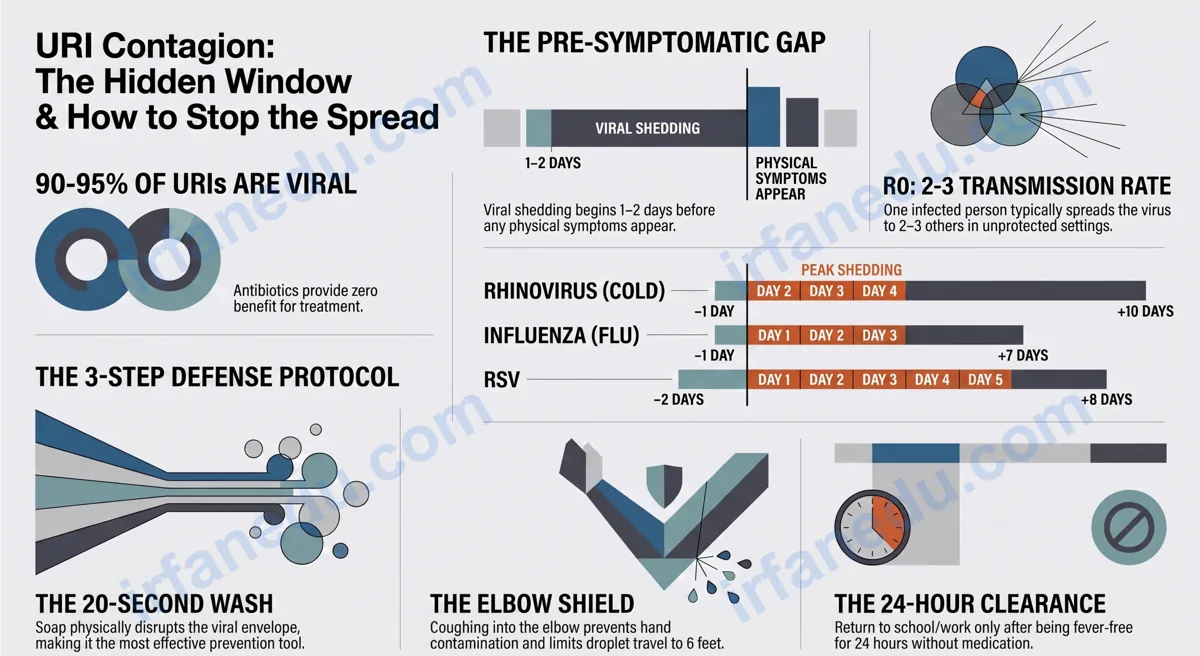
A URI (upper respiratory infection) is an infection of the nose, throat, sinuses, or larynx caused mainly by viruses. It is contagious from roughly 1-2 days before symptoms appear through 7-10 days after onset. It spreads through respiratory droplets, direct contact with an infected person, and touching contaminated surfaces then touching your face.
In this guide, I break down exactly how URIs spread, how long you stay contagious, what most people get wrong about transmission, and the specific steps that actually reduce spread — backed by CDC and WHO guidance. Whether you are a student wondering if you should go to school or a parent trying to protect the rest of the household, this is the clearest answer you will find.
- Define a URI and name the most common pathogens that cause it.
- Explain the three main transmission routes.
- State the contagious window and identify when risk is highest.
- Compare URI contagiousness with the cold, flu, and COVID-19.
- Apply a six-step protocol to stop a URI from spreading at home or school.
TL;DR — Quick Summary
- A URI is contagious — primarily through droplets, contact, and contaminated surfaces.
- Contagious window: 1-2 days before symptoms through 7-10 days after onset.
- Peak risk: first 2-3 days of symptoms (highest viral shedding).
- Most URIs are viral — antibiotics do not help and should not be used.
- Hand washing for 20 seconds is the single most effective prevention step.
- Students should stay home until fever-free for 24 hours without medication.
What Is a URI (Upper Respiratory Infection)?
A URI is any infectious illness affecting the upper part of the respiratory tract — the nose, throat (pharynx), sinuses, larynx (voice box), and trachea. It is the most common reason people visit a doctor worldwide.
The term “URI” is a medical umbrella. Under it sit several familiar conditions:
| Condition | Area Affected | Most Common Cause |
|---|---|---|
| Common Cold (Rhinitis) | Nose, throat | Rhinovirus (200+ strains) |
| Pharyngitis (Sore Throat) | Pharynx | Viral (most); Strep bacteria (some) |
| Sinusitis | Sinuses | Viral; sometimes bacterial secondary |
| Laryngitis | Larynx (voice box) | Viral |
| Croup | Larynx, trachea | Parainfluenza virus |
| Epiglottitis | Epiglottis | Bacterial (Haemophilus influenzae) |
The vast majority of URIs — roughly 90-95% — are caused by viruses. This single fact has enormous practical implications for treatment (antibiotics do not work) and for understanding how the infection spreads.
[IMAGE: Anatomy diagram of the upper respiratory tract labeling nose, sinuses, pharynx, larynx, and trachea | ALT: upper respiratory tract anatomy diagram showing URI-affected areas]
Is a URI Contagious?
Yes — a URI is contagious, and it spreads efficiently in close-contact settings like classrooms, households, and public transport. The degree of contagiousness depends on the specific pathogen, the infected person’s viral load, and environmental factors like indoor ventilation.
Rhinovirus, the most common URI pathogen, has a basic reproduction number (R0) of roughly 2-3 in unprotected populations — meaning one infected person can spread it to 2-3 others on average. That is lower than measles (R0 ~15) but higher than seasonal flu (R0 ~1.3), making URIs highly common but not catastrophically explosive.
In my experience working with school-age students, the biggest misconception I see is parents sending kids back to school the moment they “feel better” — often on day 3 or 4 — without realizing the child is still shedding virus and can infect half the class. Feeling better and being non-contagious are not the same thing. I always tell parents: the fever thermometer is your clearance test, not how energetic your child seems.
It is also important to know that a URI caused by a virus is not contagious in the same way as a bacterial infection. Viral URIs spread person-to-person; you cannot catch a viral URI from cold weather, wet hair, or air conditioning — those are myths that persist despite zero scientific support.
How Does a URI Spread? The Three Transmission Routes
A URI spreads through three well-documented routes: respiratory droplets, direct contact, and fomite (surface) contact. Understanding each route helps you target your prevention efforts precisely.
Route 1: Respiratory Droplets
When an infected person coughs, sneezes, or even talks loudly, they release droplets containing live virus. These droplets can travel up to 6 feet and land on the mucous membranes of a nearby person’s eyes, nose, or mouth. This is the primary route for most URI pathogens.
Route 2: Direct Contact
Shaking hands with an infected person, hugging them, or sharing utensils and cups transfers virus directly. The virus then enters your body when you touch your face — specifically your eyes, nose, or mouth.
Route 3: Fomite (Surface) Contact
Rhinovirus can survive on hard surfaces for up to 24 hours. Influenza A survives on stainless steel for up to 24 hours. When you touch a contaminated doorknob, keyboard, or phone and then touch your face, you complete the transmission chain.
  INFECTED PERSON
       |
  [Coughs / Sneezes / Talks]
       |
  +-----------+----------+
  |           |          |
DROPLETS   DIRECT    SURFACE
(air)      CONTACT   (fomite)
  |           |          |
  +-----+-----+----------+
        |
  [Lands on / Touched by]
        |
  SUSCEPTIBLE PERSON
  (touches eyes/nose/mouth)
        |
  VIRAL ENTRY -> URI begins
  (incubation: 1-3 days)
        |
  SYMPTOMS APPEAR
  (day 1-3 post-exposure)
How Long Is a URI Contagious?
The contagious window for a typical viral URI spans from about 1-2 days before symptoms appear until 7-10 days after symptom onset. The exact duration varies by pathogen.
| Pathogen | Incubation Period | Contagious Window | Peak Shedding |
|---|---|---|---|
| Rhinovirus (common cold) | 1-3 days | 1 day before to 7-10 days after onset | Days 2-4 of symptoms |
| Influenza A/B (flu) | 1-4 days | 1 day before to 5-7 days after onset | Days 1-3 of symptoms |
| RSV | 4-6 days | 1-2 days before to 8 days after onset | Days 1-5 of symptoms |
| Adenovirus | 2-14 days | Days of illness; can persist weeks | First week of illness |
| Parainfluenza | 2-6 days | 3-10 days after onset | Days 2-5 of symptoms |
For practical school and work decisions: most public health guidelines recommend staying home until you have been fever-free for at least 24 hours without fever-reducing medication, and until symptoms are clearly improving. This typically aligns with the end of peak viral shedding.
URI vs Cold vs Flu vs COVID-19: Contagiousness Compared
Students and parents often confuse these terms. Here is a direct comparison so you can make informed decisions about isolation and school attendance.
| Feature | Common Cold (URI) | Flu | COVID-19 |
|---|---|---|---|
| Main cause | Rhinovirus | Influenza A or B | SARS-CoV-2 |
| R0 (approx.) | 2-3 | 1.2-1.4 | 2-6+ (variant-dependent) |
| Incubation | 1-3 days | 1-4 days | 2-14 days (avg 5) |
| Contagious window | 1 day before to 10 days after | 1 day before to 7 days after | 2 days before to 10+ days after |
| Fever typical? | Rare / low-grade | Yes, often high | Common |
| Antibiotic useful? | No | No | No |
| Vaccine available? | No (too many strains) | Yes (annual) | Yes |
Who Is Most at Risk of Catching a URI?
Anyone can catch a URI, but certain groups face higher risk of both infection and serious complications. Knowing your risk profile helps you calibrate how careful to be.
- Young children (under 5): Immune systems still developing; average 6-8 URIs per year.
- School-age students: High-contact environments; 5-7 URIs per year on average.
- Adults over 65: Immune response weakens with age; higher risk of complications.
- Immunocompromised individuals: Those on chemotherapy, organ transplant recipients, or people with HIV face prolonged illness and higher complication risk.
- People with asthma or COPD: A URI can trigger severe exacerbations.
- Smokers: Damaged cilia in the airway reduce the body’s ability to clear pathogens.
- Crowded living or learning environments: Dormitories, classrooms, and public transport amplify all three transmission routes.
Children in group childcare settings catch URIs at roughly twice the rate of children cared for at home, according to data from the CDC. This is not a reason to avoid school — it is a reason to build strong hygiene habits early.
Common Mistakes That Make URIs Spread Faster
Most URI transmission is preventable — but only if you avoid the behaviors that accelerate spread. Here is a direct wrong-vs-right comparison.
| What People Do Wrong | What to Do Instead |
|---|---|
| Return to school/work as soon as fever breaks | Stay home until fever-free for 24 hours without medication |
| Cover cough with bare hand, then touch surfaces | Cough/sneeze into elbow or a tissue; discard tissue immediately |
| Rinse hands quickly under water without soap | Wash with soap for at least 20 seconds, including under nails |
| Share water bottles, utensils, or lip balm | Use personal items only during illness; label them clearly |
| Assume “no fever = not contagious” | Remember: viral shedding starts 1-2 days before symptoms |
| Take antibiotics to “get better faster” | Treat symptoms only; see a doctor if bacterial infection is suspected |
| Neglect high-touch surfaces at home | Disinfect doorknobs, phones, remotes, and keyboards daily |
The antibiotic mistake is the one that genuinely worries me most. I have spoken with hundreds of parents who believe a course of antibiotics will “clear up” a cold faster. It will not — and each unnecessary course contributes to antibiotic resistance, which the WHO calls one of the biggest threats to global health. If a doctor does not prescribe antibiotics for your child’s URI, that is the correct decision, not a missed opportunity.
How to Stop a URI from Spreading: Step-by-Step
These six steps are ranked by evidence strength — the first two provide the greatest reduction in transmission risk and should be your priority.
- Wash hands with soap for 20 seconds. Do this after coughing, sneezing, blowing your nose, touching shared surfaces, and before eating. Soap physically disrupts the viral envelope. Hand sanitizer (60%+ alcohol) works when soap is unavailable but is less effective against non-enveloped viruses like norovirus.
- Cover coughs and sneezes with your elbow, not your hand. Your elbow does not touch surfaces. A tissue is equally good — discard it immediately and wash hands. This single habit cuts droplet transmission dramatically.
- Disinfect high-touch surfaces daily. Focus on doorknobs, light switches, phones, keyboards, TV remotes, and bathroom faucets. Use an EPA-registered disinfectant or a diluted bleach solution (1 tablespoon bleach per quart of water).
- Stop touching your face. This is hard — the average person touches their face 23 times per hour — but it is the final barrier in all three transmission routes. Keeping hands busy (holding a pen, sitting on hands) can help break the habit.
- Stay home during peak contagiousness. The first 2-3 days of symptoms are when you shed the most virus. Staying home during this window protects classmates and colleagues far more than wearing a mask while symptomatic at school.
- Improve indoor ventilation. Open windows, use exhaust fans, or run a HEPA air purifier. Better air circulation dilutes airborne viral particles and reduces the concentration any one person inhales. This is especially important in classrooms and shared bedrooms.
When Should You See a Doctor for a URI?
Most URIs resolve on their own within 7-10 days without medical treatment. However, certain signs indicate a more serious infection or complication that needs professional evaluation.
- Fever above 103°F (39.4°C) or a fever lasting more than 3 days
- Difficulty breathing, wheezing, or shortness of breath
- Severe or worsening sore throat (possible strep — requires a swab test)
- Ear pain or sudden hearing loss
- Symptoms that improve then suddenly worsen (may signal secondary bacterial infection)
- Symptoms lasting more than 10-14 days without improvement
- Stiff neck, severe headache, or rash (these are not typical URI symptoms and need urgent evaluation)
Strep throat (Group A Streptococcus pharyngitis) is the most important bacterial URI to identify because it requires antibiotics to prevent rare but serious complications like rheumatic fever. A rapid strep test at a clinic gives results in minutes.
Most URI articles focus entirely on symptomatic spread and tell you to “stay home when sick.” That advice is necessary but insufficient. The real transmission gap is the pre-symptomatic window — the 1-2 days when you feel fine, go to school or work normally, shake hands, share a keyboard, and spread the virus to multiple people before anyone knows you are infected. This is why hand hygiene on healthy days matters just as much as isolation on sick days. A classroom where every student washes hands before lunch will have fewer URI outbreaks than one where only sick students stay home. The habit has to be universal and constant, not reactive. In my experience, schools that build structured hand-washing routines into the school day — not just reminders — see measurably lower absenteeism during cold season.
Quick Knowledge Check — URI Contagiousness
1. When does a person with a URI typically become contagious?
Show Answer
2. Which of the following is NOT a primary transmission route for a URI?
Show Answer
3. Why should you NOT take antibiotics for a typical URI?
Show Answer
Practice Problems — Apply What You Know
Scenario 1: Should Maya go to school on Thursday?
Scenario: Maya started feeling sick on Tuesday with a runny nose and mild sore throat. Her temperature was 100.8°F on Tuesday night. By Thursday morning her fever is gone and she feels “mostly fine.”
Answer: Maya should stay home on Thursday. Although her fever is gone, she has only been fever-free for roughly 12-18 hours — not the full 24 hours recommended before returning to school. She is also still in the early part of her contagious window (days 1-4 of symptoms are peak shedding). She should return Friday if she remains fever-free through Thursday night and symptoms are clearly improving.
Scenario 2: Carlos shook hands with a sick colleague. What should he do?
Scenario: Carlos shook hands with a colleague who later told him she has a URI. Carlos touched his nose about 10 minutes after the handshake.
Sources & References
Written and fact-checked by Dr Irfan Mansuri. External links open in a new tab and are provided for further reading and verification.