
Unit Circle Memorization Game: 5 Proven Methods to Master It Fast 🎯
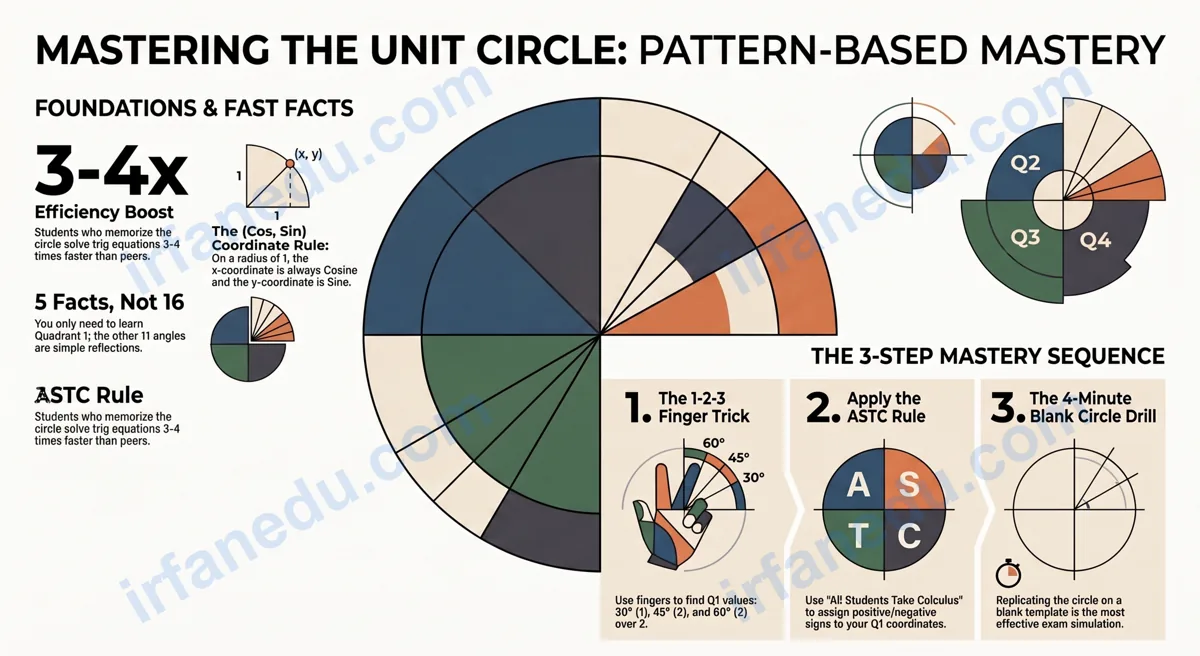
                      90° (π/2)
                    (0, 1)
                      |
   120° (2π/3)        |        60° (π/3)
  (-1/2, √3/2)        |       (1/2, √3/2)
                      |
  135° (3π/4)         |         45° (π/4)
  (-√2/2, √2/2)       |        (√2/2, √2/2)
                      |
  150° (5π/6)         |         30° (π/6)
  (-√3/2, 1/2)        |        (√3/2, 1/2)
                      |
180° (π) ─────────────+───────────── 0° / 360° (0 / 2π)
(-1, 0)               |               (1, 0)
                      |
  210° (7π/6)         |         330° (11π/6)
  (-√3/2, -1/2)       |        (√3/2, -1/2)
                      |
  225° (5π/4)         |         315° (7π/4)
  (-√2/2, -√2/2)      |        (√2/2, -√2/2)
                      |
  240° (4π/3)         |         300° (5π/3)
  (-1/2, -√3/2)       |        (1/2, -√3/2)
                      |
                    (0, -1)
                    270° (3π/2)

  QUADRANT SIGNS:  Q1 (+,+)  Q2 (-,+)  Q3 (-,-)  Q4 (+,-)
  ASTC RULE:       ALL       SINE      TAN       COS  (positive)
Look at that diagram. Every angle you will ever be tested on sits in one of four quadrants, and the coordinate signs follow a single rule. The unit circle is not a wall of random numbers — it is one pattern, repeated four times with a sign flip. Once you see that, memorizing it becomes a game rather than a chore.
A unit circle memorization game is any structured activity — flashcards, quizzes, songs, or interactive drills — that helps students encode the 16 standard angles (0° through 360°), their radian equivalents, and their (cos θ, sin θ) coordinates through active recall and pattern recognition. Games beat passive re-reading because they force retrieval, which is the mechanism that actually builds long-term memory.
- A clear explanation of what the unit circle is and why it matters
- 5 specific memorization games ranked by effectiveness
- The 1-2-3 finger trick and ASTC rule explained step by step
- 3 fully worked examples
- A free printable worksheet with 12 problems and a full answer key
📋 Table of Contents
- Quick Answer
- What Is the Unit Circle?
- Why Memorizing It Actually Matters
- Step-by-Step: The 1-2-3 Finger Trick + ASTC
- 5 Best Unit Circle Memorization Games
- 3 Fully Worked Examples
- Common Mistakes (Wrong vs. Right)
- 💡 Unique Insight
- On-Page Practice Worksheet
- Interactive Quiz
- FAQ
- Key Takeaways
- Sources & References
Download Free PDF Worksheet
⚡ TL;DR – Quick Summary
- 🎯 The unit circle has 16 key angles — master Q1 first, then mirror across quadrants.
- 🤚 The 1-2-3 finger trick gives you all Q1 sine/cosine values in seconds.
- 📐 ASTC tells you which trig functions are positive in each quadrant.
- 🎮 Games (flashcards, Spin-the-Wheel, song) beat passive re-reading every time.
- 📄 The free printable worksheet below has 12 graded problems with a full answer key.
- ⏱️ Most students can memorize the full circle in 2–3 focused 20-minute sessions.
| Fact | Detail |
|---|---|
| Total angles to know | 16 standard angles (0°–360°) |
| Radian families | π/6 family, π/4 family, π/3 family |
| Coordinate format | (cos θ, sin θ) — x is cosine, y is sine |
| Radius of unit circle | 1 (always) |
| ASTC quadrant rule | All / Sine / Tangent / Cosine positive |
| Typical course level | Pre-Calculus, Trigonometry, Calculus |
| Average memorization time | 2–3 sessions of 20 min each |
What Is the Unit Circle?
The unit circle is a circle with radius 1 centered at the origin of a coordinate plane. Every point on it has coordinates (cos θ, sin θ), where θ is the angle measured counterclockwise from the positive x-axis. That single definition is the foundation of all trigonometry.
Because the radius is always 1, the coordinates are clean fractions — no messy decimals. The x-coordinate of any point equals the cosine of the angle; the y-coordinate equals the sine. Tangent is simply sin divided by cos (y/x), so once you know the coordinates, you know all three primary trig functions automatically.
Why Memorizing the Unit Circle Actually Matters
Memorizing the unit circle is not busywork — it is the single highest-leverage skill in pre-calculus and calculus. Every trig identity, every derivative of a trig function, every integral involving sin or cos traces back to values you read off the unit circle.
In my experience teaching trigonometry, students who have the unit circle memorized solve trig equations 3–4 times faster than those who look values up. Speed matters on timed exams. But more than speed, fluency with the unit circle means you can focus mental energy on the actual problem rather than on retrieving basic facts.
I have seen students spend hours on trig identities and still fail tests — not because they did not understand the algebra, but because they kept second-guessing whether sin 150° is 1/2 or −1/2. The unit circle is the vocabulary of trigonometry. You would not try to read a novel while looking up every third word in a dictionary. Memorize the circle first; everything else gets easier automatically.
Step-by-Step: The 1-2-3 Finger Trick + ASTC Rule
This two-part system covers all 16 angles on the unit circle. Master these two tools and you will never need to memorize raw coordinates again — you will derive them on the fly.
Part 1 — The 1-2-3 Finger Trick (Q1 values)
-
Hold up 1 finger for 30°. Sine = √(1)/2 = 1/2. Cosine = √(3)/2 (reverse order). So the coordinate is (√3/2, 1/2).
-
Hold up 2 fingers for 45°. Sine = √(2)/2. Cosine = √(2)/2 (same — it is the diagonal). Coordinate: (√2/2, √2/2).
-
Hold up 3 fingers for 60°. Sine = √(3)/2. Cosine = √(1)/2 = 1/2. Coordinate: (1/2, √3/2).
-
Add the anchors. At 0°: (1, 0). At 90°: (0, 1). These are the axis intercepts — trivial to remember.
Part 2 — ASTC Quadrant Rule (signs for Q2, Q3, Q4)
Once you know Q1 coordinates, the other three quadrants are just sign changes. ASTC tells you which function is positive in each quadrant:
| Quadrant | Degrees | cos (x) sign | sin (y) sign | Positive function |
|---|---|---|---|---|
| Q1 | 0°–90° | + | + | All |
| Q2 | 90°–180° | − | + | Sine |
| Q3 | 180°–270° | − | − | Tangent |
| Q4 | 270°–360° | + | − | Cosine |
Memory phrase: “All Students Take Calculus” — first letter of each word = A, S, T, C.
-
Find the reference angle. The reference angle is the acute angle between the terminal side and the x-axis. Example: 150° has reference angle 30°.
-
Look up the Q1 coordinate for that reference angle. For 30°: (√3/2, 1/2).
-
Apply the ASTC sign. 150° is in Q2 — sine positive, cosine negative. So cos 150° = −√3/2, sin 150° = 1/2.
What Are the 5 Best Unit Circle Memorization Games?
The five games below are ranked by how well they build durable, test-ready recall. Each targets a different learning style, so mixing two or three of them produces the fastest results.
🎮 Game 1 — Flashcard Flip (Spaced Repetition)
Write each angle (degree or radian) on one side of a card and its coordinate on the other. Shuffle and flip. Mark cards you miss and return to them more often. This is spaced repetition — the most evidence-backed memorization technique in cognitive science.
Digital option: Create a free Quizlet set with all 16 angles. Quizlet’s “Learn” mode automatically applies spaced repetition. Most students who use this daily for 5 minutes reach full recall within one week.
🎵 Game 2 — The Unit Circle Song
Set the 16 angles and their coordinates to a familiar tune (many versions exist on YouTube). The rhythm and melody create an auditory memory hook that is surprisingly durable. In my experience, students who learn the song can recall values mid-exam just by humming the melody silently.
🎡 Game 3 — Spin the Wheel Quiz
Draw a blank unit circle (or print one). A partner spins a pencil at the center and calls out whichever angle it points to. You must give the radian measure and coordinate within 5 seconds. The time pressure mimics exam conditions and forces genuine recall rather than slow reconstruction.
✍️ Game 4 — Blank Circle Drill
Print a blank unit circle template. Set a timer for 4 minutes. Fill in as many angles and coordinates as you can from memory. Check against the answer key. Repeat daily, tracking how many you complete correctly. This is the single best exam simulation because it replicates exactly what a test asks you to do.
In my teaching, the Blank Circle Drill produces the most dramatic improvement in the shortest time. Students who do it for five consecutive days before a trig test consistently outperform those who spend the same time re-reading notes. The act of retrieving and writing — not reading — is what builds the memory trace. I recommend this as your primary game and use the others as warm-up variety.
🃏 Game 5 — Trig War (Card Game)
Two players each draw a card showing an angle. Both must state the sine of that angle. The player with the higher value keeps both cards (like the card game War). Ties go to whoever also correctly states the cosine. This game is competitive, social, and surprisingly effective — the emotional engagement of winning or losing deepens memory encoding.
3 Fully Worked Examples
Example 1 — Find sin(210°) and cos(210°)
Step 2: Find the reference angle. 210° − 180° = 30°.
Step 3: Q1 values for 30°: cos = √3/2, sin = 1/2.
Step 4: Apply ASTC. Q3: both cos and sin are negative.
Answer: cos(210°) = −√3/2, sin(210°) = −1/2. Coordinate: (−√3/2, −1/2).
Example 2 — Find tan(315°)
Step 2: Reference angle = 360° − 315° = 45°.
Step 3: Q1 values for 45°: cos = √2/2, sin = √2/2.
Step 4: Q4: cosine positive, sine negative → cos(315°) = √2/2, sin(315°) = −√2/2.
Step 5: tan = sin/cos = (−√2/2) / (√2/2) = −1.
Answer: tan(315°) = −1.
Example 3 — Convert 5π/6 to degrees and find its coordinates
Step 2: 150° is in Q2. Reference angle = 180° − 150° = 30°.
Step 3: Q1 values for 30°: cos = √3/2, sin = 1/2.
Step 4: Q2: cosine negative, sine positive.
Answer: cos(5π/6) = −√3/2, sin(5π/6) = 1/2. Coordinate: (−√3/2, 1/2).
Common Mistakes — Wrong vs. Right
Most unit circle guides teach all 16 angles as 16 separate facts to memorize. That is the wrong mental model. There are really only 5 facts to memorize (the Q1 values: 0°, 30°, 45°, 60°, 90°), plus 2 rules (ASTC for signs, reference-angle method for location). The other 11 angles are not memorized — they are derived in 3 seconds. Students who understand this distinction spend a fraction of the time and retain the information far longer, because they are encoding a system rather than a list. If your teacher or textbook presents the unit circle as 32 isolated values (16 cosines + 16 sines), push back — ask for the pattern, not the list.
🖊️ On-Page Practice Worksheet
Work through these 12 problems in order — they go from easy to challenging. Use the 1-2-3 finger trick and ASTC rule, not a calculator. Check your work with the answer key below.
How to use this worksheet: Print the PDF (button above or below) for a clean copy, or work directly on this page. After finishing, open the Answer Key to self-check. For each wrong answer, re-do the reference-angle steps from scratch before moving on.
- Convert 30° to radians.
- Convert 3π/4 to degrees.
- What is sin(60°)?
- What is cos(180°)?
- What is the (cos, sin) coordinate at 90°?
- What is tan(45°)?
- What is sin(210°)?
- What is cos(300°)?
- What is the (cos, sin) coordinate at 5π/6?
- What is tan(270°)?
- What is sin(315°)?
- What is cos(7π/6)?
📋 Show Answer Key
- π/6
- 135°
- √3/2
- −1
- (0, 1)
- 1
- −1/2
- 1/2
- (−√3/2, 1/2)
- Undefined
- −√2/2
- −√3/2
Download Free PDF (with Answer Key)
🧠 Quick Interactive Quiz
Test Yourself — 3 Questions
Q1. What is the (cos, sin) coordinate at 45°?
Reveal Answer
✅ (b) (√2/2, √2/2). At 45°, both cosine and sine equal √2/2 because the point lies on the diagonal of the unit square. Use the 1-2-3 trick: 2 fingers → √2/2 for both.
Q2. In which quadrant is cosine negative and sine also negative?
Reveal Answer
✅ (b) Quadrant 3. ASTC: in Q3, only Tangent is positive — both cosine (x) and sine (y) are negative. This covers angles from 180° to 270°.
Q3. What is tan(150°)?
Reveal Answer
✅ (b) −1/√3 (= −√3/3). Reference angle = 30°. Q2: sin positive, cos negative → sin(150°) = 1/2, cos(150°) = −√3/2. tan = (1/2)/(−√3/2) = −1/√3.
🔍 Reveal-on-Click Practice Problems
Practice 1: Find cos(240°) and sin(240°).
Written and fact-checked by Dr Irfan Mansuri. External links open in a new tab and are provided for further reading and verification.