
Major Medical Insurance: The Complete Guide You Actually Need
|
Last Updated: July 2026
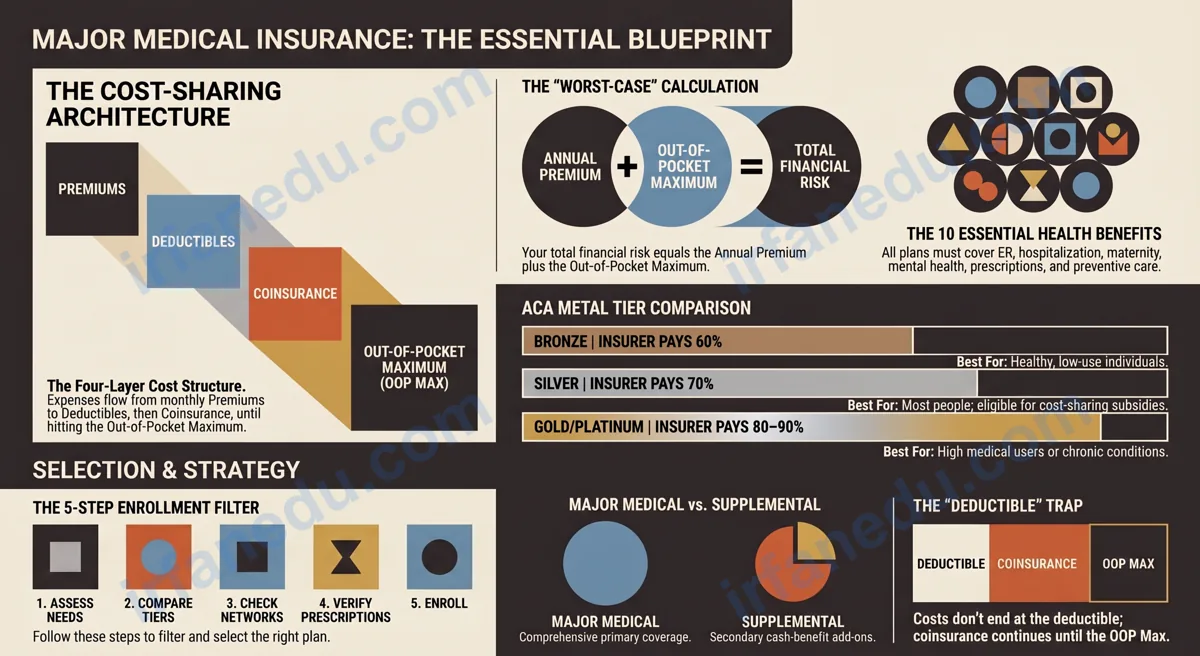
TL;DR – Quick Summary
- Major medical insurance is your primary, comprehensive health coverage — it pays for hospital stays, surgery, ER visits, and prescriptions.
- All ACA-compliant plans must cover ten essential health benefits and cannot reject you for pre-existing conditions.
- You share costs through four mechanisms: premium, deductible, copay/coinsurance, and out-of-pocket maximum.
- Plan tiers (Bronze to Platinum) trade lower premiums for higher out-of-pocket costs — pick based on expected use, not just price.
- Students under 26 can stay on a parent’s plan; others can use the ACA marketplace, employer plans, or school health plans.
- The single biggest mistake people make is confusing the deductible with the total out-of-pocket cost — they are not the same number.
Major medical insurance is the foundational health coverage that protects you from large, unpredictable medical costs. Unlike limited-benefit or supplemental plans, it covers both routine and catastrophic care. In the United States, ACA-compliant major medical plans are sold through employer benefits, the federal marketplace at healthcare.gov, or directly through insurers.
If you have ever stared at an insurance card wondering what “deductible,” “coinsurance,” and “out-of-pocket maximum” actually mean in real dollars — this guide is for you. I have spent years explaining health insurance to students and parents who were never taught this in school, and I want to change that.
- You will understand exactly what major medical insurance covers and what it does not.
- You will be able to calculate your real annual cost for any plan.
- You will know how to pick the right tier for your situation.
- You will avoid the three most expensive mistakes people make when choosing a plan.
What Is Major Medical Insurance?
Major medical insurance is a comprehensive health insurance policy designed to cover a wide range of medical expenses, from routine preventive care to major surgeries and extended hospital stays. It is the standard form of health insurance that most employed adults in the United States receive through their employer or purchase independently.
The term “major medical” distinguishes this type of plan from limited-benefit plans (which cap payouts at low dollar amounts) and supplemental insurance (which pays cash benefits on top of your primary coverage). A major medical plan is your first line of defense against health care costs.
Before the Affordable Care Act (ACA) became law in 2010, major medical plans varied enormously in what they covered. Some excluded mental health treatment. Others refused to cover people with pre-existing conditions like diabetes or asthma. The ACA standardized minimum requirements, which is why the term “ACA-compliant major medical plan” is now the benchmark.
Real-World Example
Suppose you break your leg in a soccer game. Without major medical insurance, you might face: $1,200 for the ER visit, $3,500 for surgery, $800 for follow-up appointments, and $600 for physical therapy — a total of $6,100. With a major medical plan that has a $1,500 deductible and 20% coinsurance, you pay $1,500 (deductible) plus 20% of the remaining $4,600 = $920. Your total out-of-pocket cost: $2,420 instead of $6,100.
What Does Major Medical Insurance Cover?
Every ACA-compliant major medical plan must cover ten essential health benefits — no exceptions. These are the minimum coverage categories required by federal law.
| # | Essential Health Benefit | What It Includes |
|---|---|---|
| 1 | Ambulatory (outpatient) care | Doctor visits, same-day procedures |
| 2 | Emergency services | ER visits, ambulance |
| 3 | Hospitalization | Inpatient surgery, overnight stays |
| 4 | Maternity & newborn care | Prenatal visits, labor, delivery |
| 5 | Mental health & substance use | Therapy, counseling, rehab |
| 6 | Prescription drugs | Formulary medications |
| 7 | Rehabilitative services | Physical therapy, occupational therapy |
| 8 | Laboratory services | Blood tests, imaging, pathology |
| 9 | Preventive & wellness care | Annual physicals, vaccines, screenings |
| 10 | Pediatric services | Dental and vision for children under 19 |
Preventive care services — like annual physicals, flu shots, and certain cancer screenings — are covered at no cost to you (no copay, no deductible) when you use an in-network provider. This is one of the most underused benefits in major medical plans.
How Does the Cost Structure Work?
Major medical insurance uses four cost-sharing mechanisms. Understanding all four — not just the premium — is essential to calculating your true annual cost.
Visual: The Four Cost Layers of Major Medical Insurance
YOUR ANNUAL HEALTH CARE COSTS
==============================================
LAYER 1 — PREMIUM
  You pay every month, whether or not you use care.
  Example: $350/month = $4,200/year

LAYER 2 — DEDUCTIBLE
  You pay 100% of covered costs until this is met.
  Example: $1,500 deductible
  |--- $0 --------- $1,500 ---|--- insurer kicks in --->

LAYER 3 — COINSURANCE / COPAY
  After deductible: you pay a % (coinsurance) or flat
  fee (copay) per service.
  Example: 20% coinsurance on a $2,000 bill = $400 you pay

LAYER 4 — OUT-OF-POCKET MAXIMUM
  The ceiling. Once reached, insurer pays 100%.
  2025 ACA limit: $9,450 individual / $18,900 family
  |--- deductible + coinsurance ---|--- $0 after max --->

TOTAL WORST-CASE ANNUAL COST =
  Premium ($4,200) + Out-of-Pocket Max ($9,450) = $13,650
==============================================
Worked Example: Calculating Your Real Annual Cost
Most people only look at the monthly premium. In my experience teaching financial literacy, this is the single most common mistake. Here is how to calculate the true cost of two plans side by side:
| Cost Component | Plan A (Bronze) | Plan B (Silver) |
|---|---|---|
| Monthly premium | $280 | $420 |
| Annual premium | $3,360 | $5,040 |
| Deductible | $6,000 | $2,500 |
| Coinsurance (after deductible) | 40% | 20% |
| Out-of-pocket maximum | $8,500 | $6,000 |
| Best case (no claims) | $3,360 | $5,040 |
| Worst case (max out-of-pocket) | $11,860 | $11,040 |
Plan A looks cheaper at first glance. But if you have a serious illness or injury, Plan B costs less overall. The break-even point is around $3,500 in medical claims. If you expect to use more than that, Plan B wins.
In my experience, most healthy young adults default to the cheapest premium without running this math. That works fine — until it doesn’t. A single ER visit, a broken bone, or a new diagnosis can flip the calculation entirely. I always tell students: spend 15 minutes with a spreadsheet before open enrollment closes. It is one of the highest-return uses of your time.
What Types of Major Medical Plans Exist?
Major medical plans come in two main dimensions: the metal tier (which determines cost-sharing) and the network type (which determines which doctors you can see).
Metal Tiers
| Tier | Insurer Pays | You Pay | Best For |
|---|---|---|---|
| Bronze | 60% | 40% | Healthy, low-use individuals |
| Silver | 70% | 30% | Most people; cost-sharing reductions available |
| Gold | 80% | 20% | Regular prescription users, chronic conditions |
| Platinum | 90% | 10% | High medical users, predictable heavy use |
There is also a Catastrophic tier available to people under 30 or those with a hardship exemption. It has very low premiums but a deductible equal to the out-of-pocket maximum — so it only kicks in for truly catastrophic events.
Network Types
- HMO (Health Maintenance Organization): You must use in-network providers and get referrals from a primary care physician (PCP) to see specialists. Lower premiums, less flexibility.
- PPO (Preferred Provider Organization): You can see any provider, but pay less for in-network care. No referral needed. Higher premiums.
- EPO (Exclusive Provider Organization): In-network only (like an HMO) but no referral required (like a PPO).
- HDHP (High-Deductible Health Plan): A plan with a deductible above the IRS threshold ($1,650 individual in 2025). Qualifies you to open a Health Savings Account (HSA).
How Do You Choose the Right Major Medical Plan?
Choosing a major medical plan is a five-step process. Follow these steps in order — skipping any one of them is how people end up with the wrong plan.
- Assess your health needs. List your regular prescriptions, expected doctor visits, and any planned procedures. Estimate how much medical care you realistically expect to use in the next 12 months.
- Understand the tiers. Compare Bronze, Silver, Gold, and Platinum by total annual cost (premium + expected out-of-pocket), not just the monthly premium.
- Check the provider network. Confirm your preferred doctors, specialists, and hospitals are in-network before enrolling. An out-of-network specialist can cost 3-5x more than an in-network one.
- Verify your prescriptions are covered. Each plan has a formulary (drug list). Check that your medications are on it and note which tier they fall under — Tier 1 drugs cost far less than Tier 4 specialty drugs.
- Enroll during your window. ACA open enrollment runs November 1 through January 15 for coverage starting the following year. Outside this window, you need a qualifying life event (job loss, marriage, birth of a child) to enroll.
Explore more practical life-skills and education topics.
Major Medical vs. Supplemental Insurance: What Is the Difference?
Major medical is your primary coverage; supplemental insurance is an add-on that pays cash benefits in specific situations. They serve different purposes and one cannot replace the other.
| Feature | Major Medical | Supplemental Insurance |
|---|---|---|
| Purpose | Primary comprehensive coverage | Cash benefit add-on |
| Pays | Directly to providers | Cash to you |
| Covers | Broad range of services | Specific events (accident, cancer, hospital stay) |
| Required? | Yes (for ACA compliance) | No — optional |
| Can replace major medical? | N/A | No |
| Examples | Blue Cross, Aetna, UnitedHealth | Aflac, Colonial Life, CHUBB |
Supplemental plans are legitimate and useful — they help cover the out-of-pocket costs that major medical leaves behind, like your deductible or lost income during recovery. But they are sold aggressively, and some people mistakenly buy only supplemental coverage thinking it replaces major medical. It does not.
I have seen students’ families get caught by this exact confusion. They bought a low-cost “health plan” that turned out to be a hospital indemnity policy paying $200/day — not a major medical plan. When a family member needed surgery, they faced a $40,000 bill with only $1,400 in supplemental benefits. Always verify that any plan you buy is ACA-compliant major medical before signing up.
How Can Students Get Major Medical Insurance?
Students have four main pathways to major medical coverage, and the right one depends on age, income, and enrollment status.
- Parent’s plan (under 26): The ACA requires all major medical plans to allow children to stay on a parent’s plan until age 26, regardless of student status, marital status, or financial dependence. This is often the cheapest option.
- Student Health Plan (SHP): Most colleges and universities offer a Student Health Plan through the school. These are ACA-compliant major medical plans. Costs vary widely — from $1,500 to $4,000 per year — but they are convenient and often include on-campus health center visits at low or no cost.
- ACA Marketplace: Any student can buy a plan at healthcare.gov during open enrollment. Students with low income may qualify for premium tax credits (subsidies) that significantly reduce monthly costs. Students earning under 138% of the federal poverty level may qualify for Medicaid.
- Medicaid: In states that expanded Medicaid under the ACA, individuals earning up to 138% of the federal poverty level ($20,783 for a single adult in 2025) qualify for free or very low-cost major medical coverage.
[IMAGE: Four pathways to student health insurance shown as a flowchart | ALT: student major medical insurance options flowchart showing parent plan, student health plan, ACA marketplace, and Medicaid]
What Are the Most Common Major Medical Insurance Mistakes?
These are the mistakes I see most often — and each one can cost hundreds or thousands of dollars.
| Mistake | What People Do Wrong | What to Do Instead |
|---|---|---|
| Choosing by premium alone | Pick the cheapest monthly premium without calculating total annual cost | Calculate premium + expected out-of-pocket for each plan |
| Ignoring the network | Enroll, then discover their doctor is out-of-network | Check the insurer’s provider directory before enrolling |
| Skipping preventive care | Avoid the doctor to save money, missing free screenings | Use free preventive care — it is already paid for in your premium |
| Confusing deductible with OOP max | Think they are done paying once the deductible is met | Understand that coinsurance continues until the OOP max is reached |
| Not checking the drug formulary | Enroll, then find a key medication is not covered | Look up every regular prescription in the plan’s formulary before enrolling |
Unique Insight: The Hidden Math Most Guides Get Wrong
Almost every guide on major medical insurance tells you to “compare premiums and deductibles.” That advice is incomplete and can lead you to the wrong plan. Here is what most guides miss:
Your deductible and your out-of-pocket maximum are not the same number. After you meet your deductible, you still pay coinsurance (typically 20-40%) on every covered service until you hit the out-of-pocket maximum. On a Bronze plan with a $6,000 deductible and 40% coinsurance, a $20,000 hospital bill works out like this: you pay $6,000 (deductible) + 40% of the remaining $14,000 = $5,600 in coinsurance — for a total of $11,600 before hitting the out-of-pocket maximum. Most people think they are protected once the deductible is met. They are not.
The correct comparison metric is: Annual Premium + Out-of-Pocket Maximum = Worst-Case Annual Cost. That single number, compared across plans, tells you the most you will ever pay in a bad year. Run this calculation for every plan you consider. It takes five minutes and it is the most important number in your insurance decision.
From math to science, IrfanEdu has reference guides for every subject.
Quick Knowledge Check
1. Which of the following is NOT one of the ACA’s ten essential health benefits?
Show Answer
2. On a Silver plan, the insurer pays approximately what percentage of covered costs?
Show Answer
3. What is the maximum age a child can stay on a parent’s major medical plan under the ACA?
Show Answer
Practice Problems: Apply What You Learned
Problem 1: Calculate the worst-case annual cost for this plan.
Given: Monthly premium = $310. Deductible = $3,000. Coinsurance = 30%. Out-of-pocket maximum = $7,000.
Solution:
Annual premium = $310 x 12 = $3,720.
Worst-case out-of-pocket = $7,000 (the OOP maximum — this is the most you pay in covered costs beyond the premium).
Worst-case annual cost = $3,720 + $7,000 = $10,720.
This is the maximum you would pay in any single plan year, no matter how large your medical bills are.
Problem 2: You have a $2,500 deductible and 20% coinsurance. Your surgery bill is $12,000. How much do you pay?
Step 1: You pay the deductible first: $2,500.
Step 2: Remaining bill = $12,000 – $2,500 = $9,500.
Step 3: You pay 20% coinsurance on the remaining amount: 20% x $9,500 = $1,900.
Total you pay = $2,500 + $1,900 = $4,400.
Your insurer pays the remaining $7,600 (assuming you have not yet hit your OOP maximum).
Problem 3: Should a healthy 24-year-old student choose Bronze or Silver?
Scenario: Bronze plan costs $180/month with a $6,500 deductible. Silver plan costs $310/month with a $2,000 deductible. The student expects minimal medical use (one annual physical, no prescriptions).
If no major claims occur: Bronze annual premium = $2,160. Silver annual premium = $3,720. Bronze saves $1,560/year.
Sources & References
Written and fact-checked by Dr Irfan Mansuri. External links open in a new tab and are provided for further reading and verification.