
Tertiary Insurance: What It Is, How It Works & Who Needs It
📋 Table of Contents
- Visual Overview: The Three Layers of Insurance
- What Is Tertiary Insurance?
- Quick Answer
- How Does Tertiary Insurance Work?
- Who Actually Has Tertiary Insurance?
- Coordination of Benefits: The Rules That Govern All Three Payers
- Worked Example: A Real $10,000 Hospital Bill
- How to File a Claim with Tertiary Insurance (Step-by-Step)
- Common Mistakes People Make with Multiple Insurance Plans
- Primary vs. Secondary vs. Tertiary Insurance: Side-by-Side
- 💡 Unique Insight
- Quick Knowledge Check
- Practice Problems
- Frequently Asked Questions
- Key Takeaways
- Related Articles
- About the Author
- Sources & References
🖼️ Visual Overview: The Three Layers of Insurance
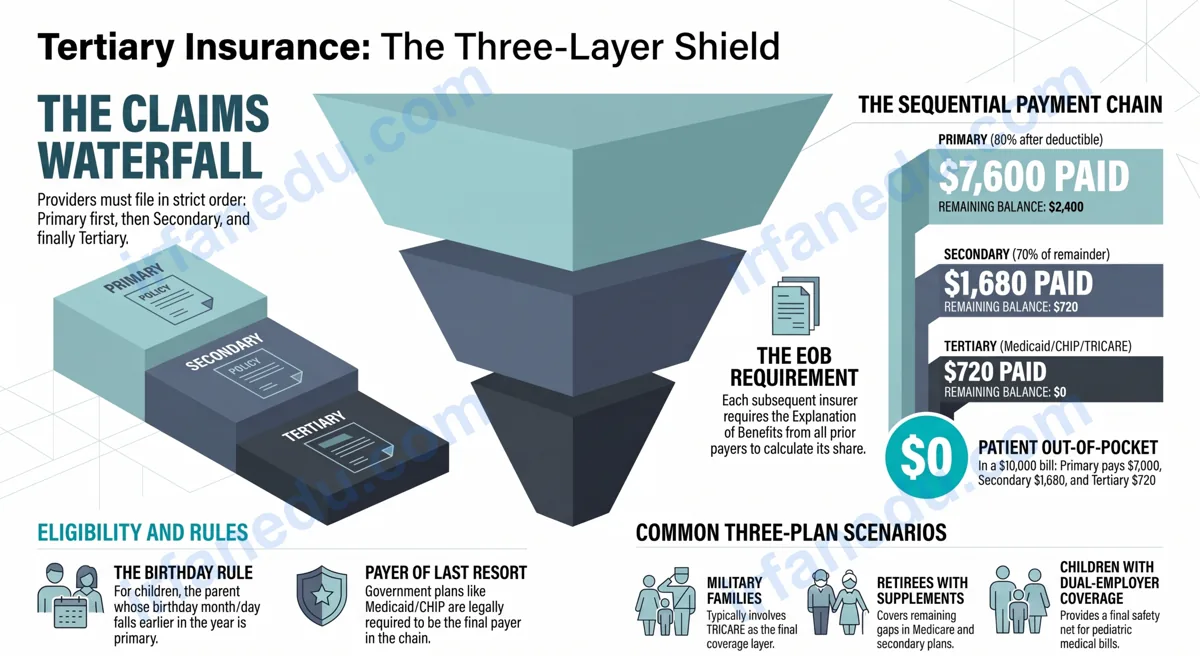
Picture a medical bill as a stack of blocks. The first insurer chips away the biggest piece. The second insurer handles most of what is left. The third insurer — your tertiary plan — catches the final remainder so it does not land in your pocket.
📊 How a $10,000 Bill Gets Paid Across Three Insurers
 ┌──────────────────────────────────────────────────────────┐
 │              TOTAL MEDICAL BILL: $10,000                 │
 └──────────────────────────────────────────────────────────┘
          │
          ▼
 ┌──────────────────────────────────────────────────────────┐
 │  🥇 PRIMARY INSURANCE  (e.g., Parent A's employer plan)  │
 │     Pays: $7,000  ░░░░░░░░░░░░░░░░░░░░░░░░░░░░░░░░░░░░  │
 │     Remaining: $3,000                                    │
 └──────────────────────────────────────────────────────────┘
          │
          ▼  (sends Explanation of Benefits to next payer)
 ┌──────────────────────────────────────────────────────────┐
 │  🥈 SECONDARY INSURANCE  (e.g., Parent B's employer plan)│
 │     Pays: $2,500  ░░░░░░░░░░░░░░░░░░░░░░░░░░░░░░        │
 │     Remaining: $500                                      │
 └──────────────────────────────────────────────────────────┘
          │
          ▼  (sends Explanation of Benefits to next payer)
 ┌──────────────────────────────────────────────────────────┐
 │  🥉 TERTIARY INSURANCE  (e.g., Medicaid / CHIP / TRICARE)│
 │     Pays: $500   ░░░░░░░░░░░░░░░░░░░░░░░░░░░░░░░░░░░░░░ │
 │     Remaining: $0 ✅                                     │
 └──────────────────────────────────────────────────────────┘
          │
          ▼
 ┌──────────────────────────────────────────────────────────┐
 │  👤 PATIENT OUT-OF-POCKET: $0                            │
 └──────────────────────────────────────────────────────────┘

 KEY:  ░ = dollars paid by that insurer
       Each payer sees the previous EOB before processing.
       Total paid ≤ actual bill (no profit from insurance).
That diagram captures the entire concept. The rest of this guide explains why each layer exists, who ends up with three plans, and how to actually use them without losing money to paperwork errors.
What Is Tertiary Insurance?
Tertiary insurance is a third health insurance plan that activates after both a primary and a secondary insurance plan have already processed and paid their portion of a medical claim. It covers whatever cost remains — such as a copay, deductible, or a service the first two plans do not fully cover. The word “tertiary” simply means “third in order.”
The term comes up most often in health insurance, but the same three-layer structure can appear in auto insurance and liability coverage. In everyday life, most people only deal with one or two insurance plans. Three-plan situations are less common, but they are far from rare — especially for children, military families, and retirees.
It is important to understand what tertiary insurance is not:
- It is not a replacement for primary insurance.
- It is not the same as a supplemental plan (though a supplemental plan can act as a tertiary payer).
- It does not pay more than the actual bill — insurers coordinate so the total never exceeds 100% of the cost.
⚡ TL;DR – Quick Summary
- 🥉 Tertiary insurance is the third payer after primary and secondary plans pay first.
- 📋 All three plans coordinate using Coordination of Benefits (COB) rules.
- 👶 Most common for children, military families, and retirees with multiple plans.
- 💰 Can reduce patient out-of-pocket costs to zero in ideal cases.
- 📄 You must submit an EOB from each prior payer before the next one processes your claim.
- 🚫 Total paid by all three plans cannot exceed the actual bill amount.
| Quick Facts: Tertiary Insurance | Detail |
|---|---|
| Also called | Third-party payer, third insurance, third-level coverage |
| Pays when | After primary AND secondary insurance have both processed the claim |
| Governed by | Coordination of Benefits (COB) rules (NAIC model regulations) |
| Most common for | Children on two parents’ plans + Medicaid/CHIP; military + civilian; Medicare + two supplements |
| Can exceed the bill? | No — total payout across all plans is capped at actual charges |
| Claim filing order | Primary → Secondary → Tertiary (each needs the previous EOB) |
| US regulatory body | State insurance commissioners; federal rules for Medicare/Medicaid |
How Does Tertiary Insurance Work?
Tertiary insurance works by sitting at the end of a sequential claims process called Coordination of Benefits (COB). Each insurer in the chain must know what the others paid before it calculates its own share.
Here is the exact sequence of events after you receive medical care:
- You receive care — your provider creates an itemized bill (the claim).
- Primary insurer processes the claim — it pays its contracted rate and issues an Explanation of Benefits (EOB) showing what it paid and what remains.
- Secondary insurer receives the claim + primary EOB — it calculates its share of the remaining balance and issues its own EOB.
- Tertiary insurer receives the claim + both EOBs — it reviews what is left and pays up to its plan limits.
- You receive a final bill — showing any patient responsibility after all three payers have settled.
The key rule is this: no combination of insurance payments can exceed the actual cost of the service. If your bill is $500 and your primary plan pays $500, the secondary and tertiary plans pay nothing — there is nothing left to pay. This prevents “profiting” from insurance.
Who Actually Has Tertiary Insurance?
Tertiary insurance is not something most people choose — it usually happens when life circumstances stack multiple coverage sources on top of each other.
🧒 Children with Two Working Parents + Government Coverage
This is the most common scenario. A child is listed on both parents’ employer-sponsored health plans. If the family also qualifies for Medicaid or CHIP (Children’s Health Insurance Program), that government program becomes the tertiary payer. The “birthday rule” typically determines which parent’s plan is primary (the parent whose birthday falls earlier in the calendar year).
🪖 Military Families with TRICARE + Civilian Coverage
Active-duty service members and their dependents have TRICARE. If a spouse also has employer coverage, TRICARE often acts as the secondary or tertiary payer, depending on the situation. Some families add a supplemental plan on top, creating a three-layer structure.
👴 Retirees with Medicare + Two Supplemental Plans
A retiree might have Medicare Part A and B (primary), a Medicare Supplement (Medigap) plan (secondary), and a retiree health plan from a former employer (tertiary). Each plan picks up a slice of costs that Medicare does not fully cover.
🏥 Workers’ Compensation + Personal Health + Employer Plan
In workplace injury cases, workers’ compensation is typically primary. A personal health plan and an employer group plan can layer behind it for any non-work-related portions of treatment.
In my experience, the students and parents I work with are almost always surprised to learn that a child can have three active insurance plans simultaneously. The confusion usually comes from thinking of insurance as a single card in your wallet. In reality, for a child whose parents both work and whose family qualifies for CHIP, three-plan coverage is completely normal — and it can mean the child pays nothing out of pocket for most medical visits. The system is genuinely useful once you understand the filing order.
Coordination of Benefits: The Rules That Govern All Three Payers
Coordination of Benefits (COB) is the set of rules that prevents you from collecting more money from insurance than you actually spent. Every US state follows guidelines based on the National Association of Insurance Commissioners (NAIC) model regulation.
The Core COB Principles
- Non-duplication: The total paid by all plans cannot exceed 100% of the actual bill.
- Order of benefit determination: Rules decide which plan is primary, secondary, and tertiary before any claims are paid.
- The birthday rule: For dependent children, the parent whose birthday (month and day only, not year) falls earlier in the calendar year has the primary plan.
- Active employment rule: A plan from current employment is primary over a plan from prior employment or a retiree plan.
- Medicare last: Medicare is almost always secondary or tertiary when other employer coverage exists for active workers.
Parent A’s birthday is March 15. Parent B’s birthday is August 22. Their child is on both plans. Parent A’s plan is primary (March comes before August). Parent B’s plan is secondary. If Medicaid also covers the child, Medicaid is tertiary.
COB rules also specify that each insurer must share information with the others. When you file a claim, you are required to disclose all other coverage. Failing to do so can result in a claim denial or repayment demand.
[IMAGE: Flowchart showing COB order-of-benefit determination rules | ALT: Coordination of benefits flowchart showing birthday rule and active employment rule for determining primary secondary and tertiary insurance order]
Worked Example: A Real $10,000 Hospital Bill
Let me walk through a concrete, numbers-based example so the mechanics become completely clear. This is an original worked case I built to show exactly how each layer calculates its payment — something most guides skip.
Her coverage:
- Primary: Mom’s employer PPO plan (80/20 after $500 deductible)
- Secondary: Dad’s employer HMO plan (pays 70% of remaining after primary)
- Tertiary: State Medicaid (pays remaining eligible balance)
| Step | Payer | Calculation | Amount Paid | Remaining Balance |
|---|---|---|---|---|
| 1 | Primary (Mom’s PPO) | Applies $500 deductible, then pays 80% of $9,500 | $7,600 | $2,400 |
| 2 | Secondary (Dad’s HMO) | Pays 70% of remaining $2,400 | $1,680 | $720 |
| 3 | Tertiary (Medicaid) | Pays eligible remaining balance | $720 | $0 |
| ✅ | Patient (Maya’s family) | All three plans have paid | $0 | $0 |
Notice that the total paid ($7,600 + $1,680 + $720 = $10,000) equals exactly the bill. No plan overpays. Maya’s family pays nothing out of pocket — a real financial benefit of understanding and using all three layers correctly.
How to File a Claim with Tertiary Insurance (Step-by-Step)
Filing with a tertiary insurer requires patience and paperwork, but the process is straightforward once you know the sequence.
- Collect all insurance cards before your appointment. Give all three cards to the provider’s front desk. Ask them to confirm they will bill all three plans in order.
- File with your primary insurer. Your provider usually does this automatically. Wait for the Explanation of Benefits (EOB) document — it arrives by mail or in your online account within 2–4 weeks.
- File with your secondary insurer. Attach a copy of the primary EOB to the claim. The secondary insurer needs to see what the first plan paid before it calculates its share.
- File with your tertiary insurer. Attach copies of both the primary and secondary EOBs. The tertiary insurer reviews the full payment history before processing.
- Review the final Explanation of Benefits. Confirm the patient responsibility shown matches what you expect. If any balance seems wrong, call the billing office before paying.
- Appeal if a plan denies the claim. Each insurer has an appeals process. A denial from one plan does not automatically mean the others will deny too.
Common Mistakes People Make with Multiple Insurance Plans
Most billing errors with tertiary insurance come from simple, avoidable mistakes. Here is a wrong-vs-right breakdown based on the most frequent issues I see.
| ❌ Common Mistake | ✅ What to Do Instead |
|---|---|
| Paying the bill before all three plans have processed it | Wait for all three EOBs before paying any patient balance |
| Not telling the provider about all three plans at check-in | Always present all insurance cards and confirm the billing office will file all three |
| Assuming the provider will automatically file with the tertiary plan | Follow up with the billing office after 4–6 weeks to confirm all three claims were filed |
| Filing with the tertiary insurer before getting both prior EOBs | File in strict order: primary → secondary → tertiary |
| Thinking tertiary insurance is optional or unnecessary | Enroll eligible dependents in all available plans — the coverage is usually free or low-cost |
| Confusing the birthday rule with the older-parent rule | The birthday rule uses the month and day only — the younger parent’s plan can be primary if their birthday is earlier in the year |
In my experience, the single most expensive mistake families make is paying a medical bill the moment it arrives — before confirming that all insurance plans have processed it. I have seen families pay hundreds of dollars that their tertiary insurer would have covered completely. The rule I always share: never pay a medical bill until you have an EOB from every insurer on file. A bill is not a final demand — it is a starting point for the insurance process.
Primary vs. Secondary vs. Tertiary Insurance: Side-by-Side
Understanding the difference between all three layers helps you know exactly what to expect from each plan and when each one activates.
| Feature | 🥇 Primary | 🥈 Secondary | 🥉 Tertiary |
|---|---|---|---|
| Order of payment | First | Second | Third |
| Processes claim based on | Original bill | Primary EOB + remaining balance | Both prior EOBs + remaining balance |
| Typical examples | Employer PPO/HMO, Marketplace plan | Spouse’s employer plan, Medicare Part B | Medicaid, CHIP, TRICARE, retiree plan |
| Can pay $0? | Rarely (deductibles apply) | Yes, if primary covered everything | Yes, if prior plans covered everything |
| Required to disclose other coverage? | Yes | Yes | Yes |
| Governed by COB rules? | Yes | Yes | Yes |
| Most people have this? | Yes | Sometimes | Less common |
Almost every article about tertiary insurance treats it as a passive “mop-up” layer that simply catches whatever falls through. That framing causes families to leave real money on the table.
Here is the non-obvious truth: Medicaid and CHIP, when they act as tertiary payers, are legally required to be the payer of last resort under federal law (42 CFR § 433.139). This means private insurers must pay first — but it also means that if you have a child eligible for Medicaid and you do not enroll them, you are voluntarily giving up a third-layer safety net that costs you nothing in premiums.
In my experience, many families earning moderate incomes do not realize their children qualify for CHIP even when the parents do not qualify for Medicaid themselves. A child covered by two private plans plus CHIP effectively has near-zero out-of-pocket exposure for covered services. The enrollment step takes about 20 minutes online. Most guides never mention this because they focus on explaining the concept rather than the actionable financial opportunity it represents.
🧠 Quick Knowledge Check (3 Questions)
1. Which document must you attach when filing with your secondary insurer?
2. Parent A’s birthday is June 10. Parent B’s birthday is February 3. Whose plan is primary for their child under the birthday rule?
3. A patient’s bill is $1,000. Primary pays $800, secondary pays $200. How much does the tertiary insurer pay?
🔍 Practice Problems — Reveal the Solution
Problem 1: Calculate what the tertiary insurer pays
Scenario: A hospital bill totals $5,000. The primary insurer pays $3,500. The secondary insurer pays $1,000. The tertiary insurer covers all remaining eligible balances.
Question: How much does the tertiary insurer pay? What does the patient owe?
Solution:
Remaining after primary: $5,000 − $3,500 = $1,500
Remaining after secondary: $1,500 − $1,000 = $500
Tertiary insurer pays: $500
Patient owes: $0
Problem 2: Apply the birthday rule
Scenario: Carlos and Diana both have employer health plans. Carlos’s birthday is September 5. Diana’s birthday is September 5 (same month and day, different year — Carlos is older). Their daughter Sofia is on both plans.
Question: Whose plan is primary for Sofia?
Solution: When two parents share the same birthday (month and day), the birthday rule is a tie. In this case, most COB guidelines default to the plan that has been in effect longer being primary. If both plans started at the same time, the plans negotiate directly. The year of birth does not determine primary status under the standard birthday rule.
Problem 3: Identify the correct filing order
Scenario: James has three insurance plans: his employer’s group plan, his spouse’s employer plan,
Sources & References
Written and fact-checked by Dr Irfan Mansuri. External links open in a new tab and are provided for further reading and verification.