
Trash Bin Sizes Calculator: Find the Right Bin & Bag Fast 🗑️
Most people pick a trash bin by eyeballing it in the store — then discover the bags they already own are either too small (they tear at the rim) or so large they bunch up uselessly at the bottom. The real fix takes 30 seconds: measure your bin’s height and diameter, plug the numbers into the calculator below, and the right bag size comes straight out. No guessing, no wasted bags.
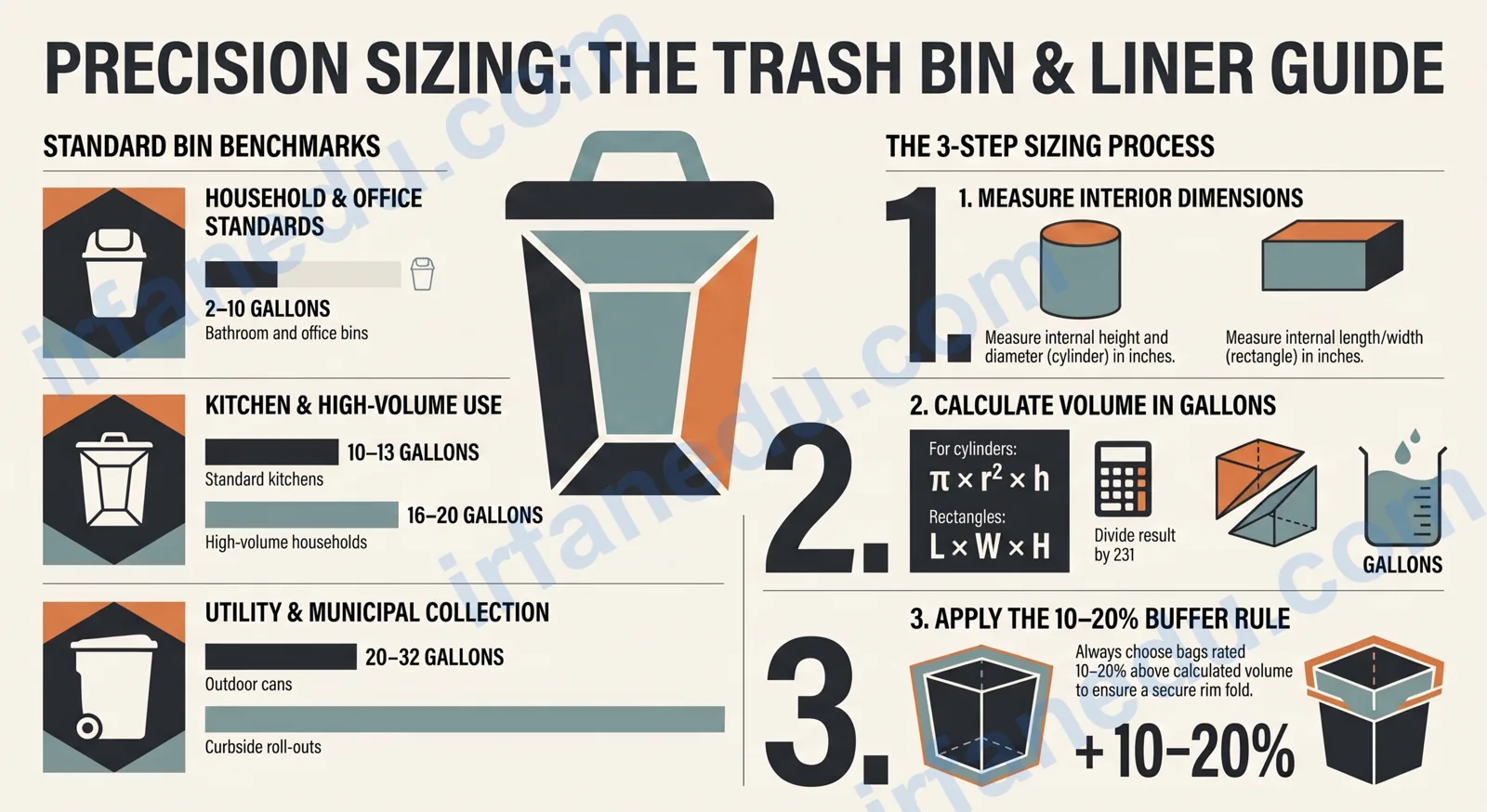
Use the calculator below to get your bin’s exact volume in gallons, then choose a garbage bag rated 10–20% above that volume so it folds securely over the rim. Scroll down for the formula, worked examples, and a wrong-vs-right size guide.
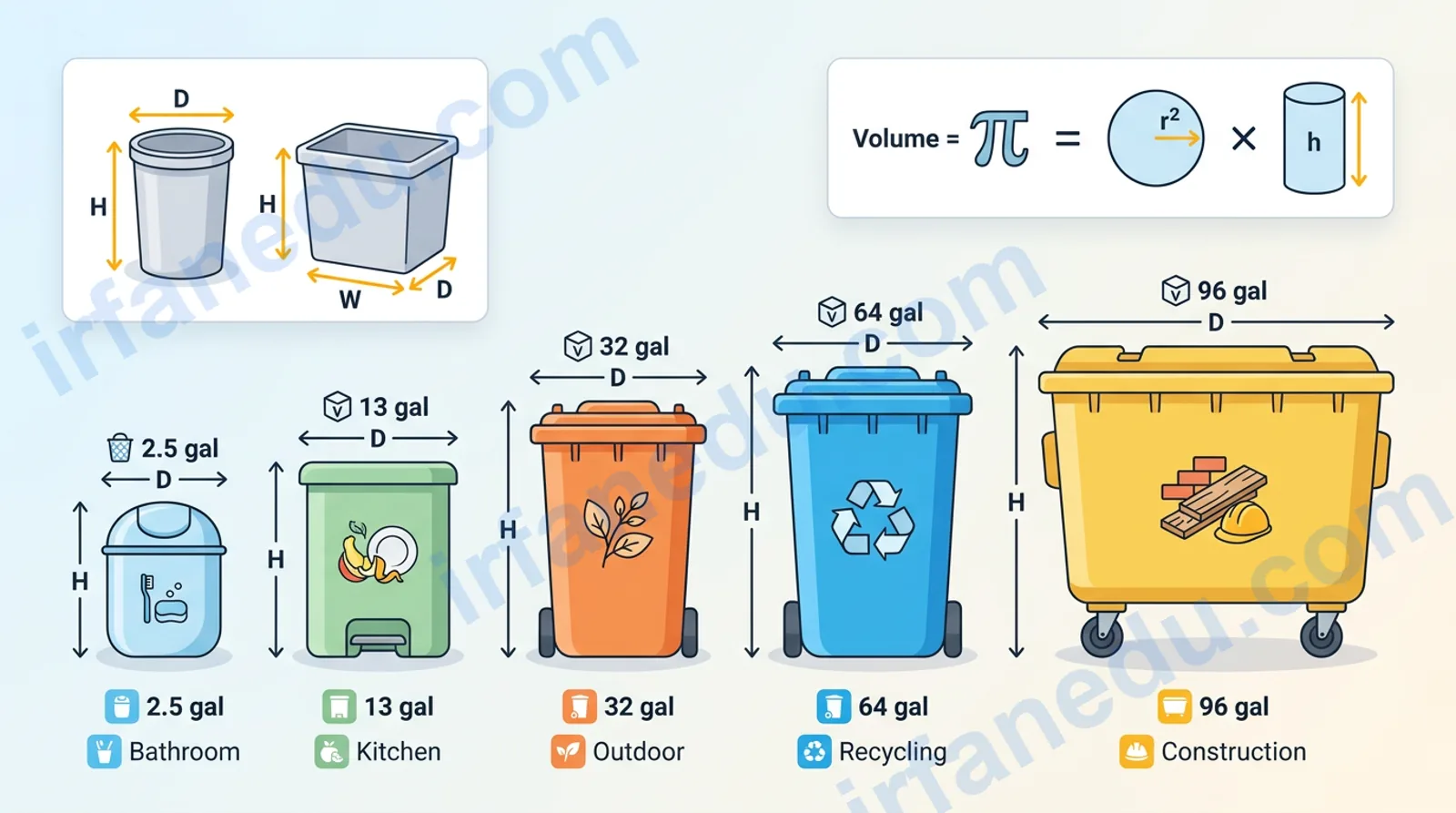
Trash bin sizes range from 2–4 gallons (bathroom), 10–13 gallons (kitchen), 20–32 gallons (outdoor), and 64–96 gallons (curbside roll-out). To find the right size, calculate your bin’s volume using V = π × r² × h (cylinder) or V = L × W × H (rectangle), divide by 231 to convert cubic inches to gallons, then pick a garbage bag rated 10–20% above that volume.
- 🗑️ Kitchen bins: 10–13 gal; bathrooms: 2–4 gal; outdoor: 20–32 gal; curbside: 64–96 gal.
- 📐 Volume formula: π × r² × h (cylinder) or L × W × H (rectangle) ÷ 231 = gallons.
- 🛍️ Always buy bags rated 10–20% larger than your bin’s volume — never the same size.
- ⚠️ Bin “gallon” labels are often the nominal capacity — actual interior volume can be 5–15% less.
- 🔢 Use the calculator below to get your exact volume and matching bag size in seconds.
Trash Bin Sizes Calculator
Find your bin volume & the right garbage bag size
Step-by-Step Solution
How to Use This Trash Bin Sizes Calculator
This calculator has three modes. Pick the one that matches what you already know:
- Cylindrical Bin: Measure your bin’s interior diameter and interior height. Enter both (inches or cm). Hit Calculate.
- Rectangular Bin: Measure interior length, width, and height. Enter all three. Hit Calculate.
- Weekly Volume → Bin Size: Enter how many bags you fill per week, your current bag size, and how often you empty the bin. The calculator tells you the minimum bin volume you need.
The result shows your bin’s volume in gallons and liters, the recommended garbage bag size, and a numbered step-by-step breakdown of the math.
What Are Standard Trash Bin Sizes?
Standard trash bin sizes are defined by their usable interior volume, measured in gallons (US) or liters. The most common sizes are grouped by use case.
| Use Case | Typical Size | Matching Bag Size | Notes |
|---|---|---|---|
| Bathroom / desktop | 2–4 gal (8–15 L) | 4 gal | Under-sink or countertop |
| Office / bedroom | 7–10 gal (26–38 L) | 8–10 gal | Slim profile bins |
| Kitchen (2–4 people) | 10–13 gal (38–49 L) | 13 gal | Most common household size |
| Kitchen (5+ people) | 16–20 gal (60–76 L) | 20 gal | High-volume households |
| Outdoor / garage | 20–32 gal (76–121 L) | 30–33 gal | Lidded cans |
| Curbside roll-out | 64–96 gal (242–363 L) | 65–95 gal | Municipal collection bins |
| Construction / dumpster | 10–40 cu yd | Contractor bags (42–55 gal) | Roll-off dumpsters |
The Formula: How Bin Volume Is Calculated
Bin volume depends on the bin’s shape. Two formulas cover nearly every household and outdoor bin.
Cylindrical bin: $$V = \pi \times r^2 \times h$$
Rectangular bin: $$V = L \times W \times H$$
To convert cubic inches to US gallons, divide by 231 (since 1 US gallon = 231 in³). To convert cubic centimeters to liters, divide by 1,000.
| Symbol | Meaning | SI / US Unit |
|---|---|---|
| V | Volume of the bin | in³ → ÷231 → US gal; cm³ → ÷1000 → L |
| r | Interior radius (= diameter ÷ 2) | inches or cm |
| h (or H) | Interior height | inches or cm |
| L | Interior length | inches or cm |
| W | Interior width | inches or cm |
| π | Pi (mathematical constant) | ≈ 3.14159 |
Always measure the interior dimensions — the wall thickness of thick plastic bins can reduce the usable volume by 5–10% compared to the exterior measurement.
Worked Examples That Match the Calculator’s Steps
Given: diameter = 12 in, height = 24 in
- r = 12 ÷ 2 = 6 in
- V = π × 6² × 24 = 3.14159 × 36 × 24 = 2,714.3 in³
- Gallons = 2,714.3 ÷ 231 = 11.75 gal
- Recommended bag: 13 gal (next standard size up, ~10% buffer)
Given: L = 18 in, W = 14 in, H = 28 in
- V = 18 × 14 × 28 = 7,056 in³
- Gallons = 7,056 ÷ 231 = 30.5 gal
- Recommended bag: 33 gal
Given: 2 bags/week × 13 gal bags, emptied every 7 days
- Weekly volume = 2 × 13 = 26 gal/week
- Daily volume = 26 ÷ 7 = 3.71 gal/day
- Volume for 7 days = 3.71 × 7 = 26 gal
- Add 15% buffer: 26 × 1.15 = 29.9 gal
- Recommended bin: 32 gal outdoor can
CYLINDRICAL BIN RECTANGULAR BIN
___ ┌─────────────┐
/ \ ← diameter │ L │
| | │ ┌───────┐ │
| | height (h) │W │ │ │
| | │ └───────┘ │
\___/ └─────────────┘
H (height)V = π × r² × h V = L × W × H
r = diameter ÷ 2 All in same units÷ 231 → US gallons ÷ 231 → US gallons
÷Sources & References
Written and fact-checked by Dr Irfan Mansuri. External links open in a new tab and are provided for further reading and verification.