
Illinois DMV Permit Practice Test
What is in this test
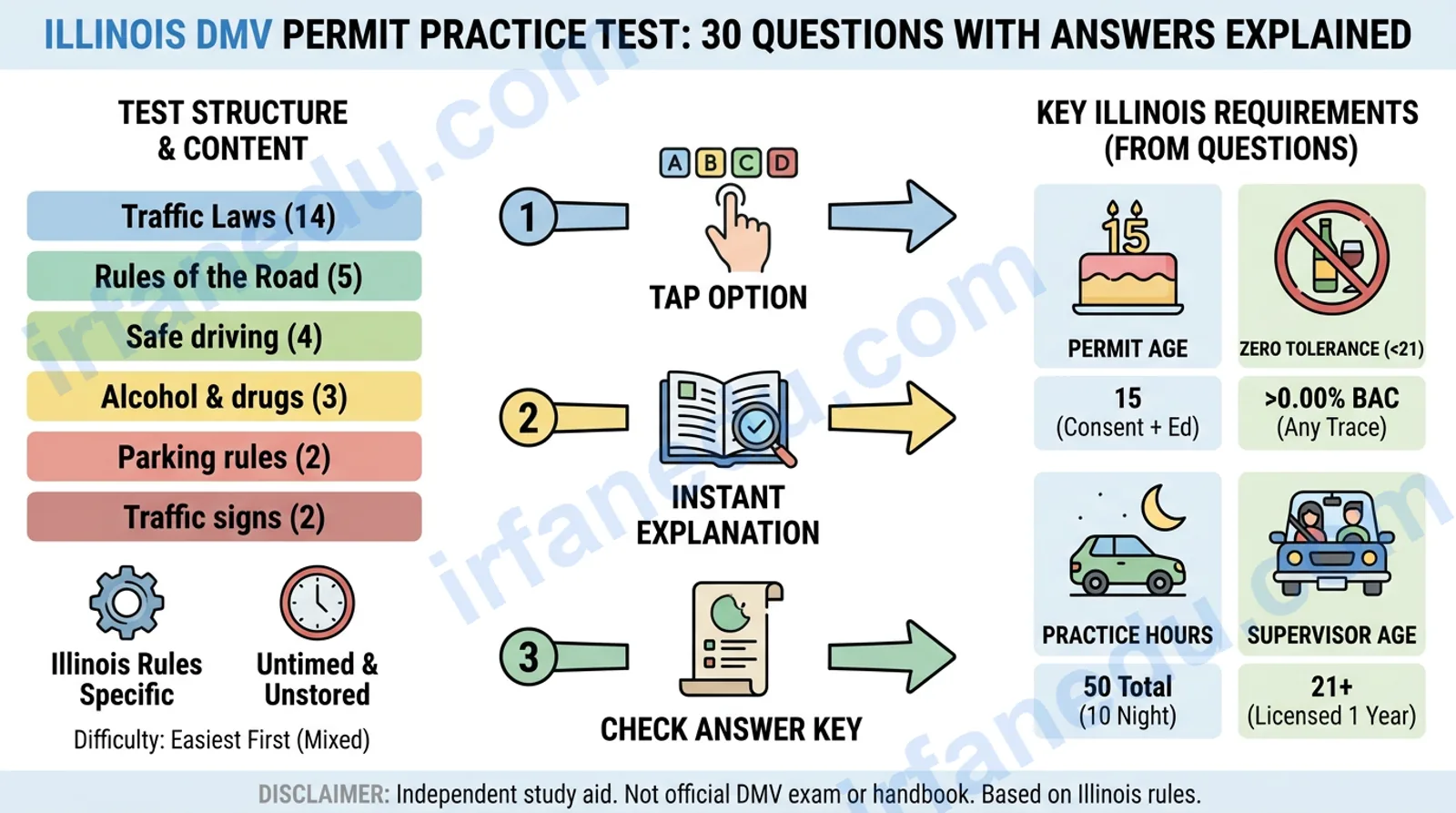
Tap an option and the page marks it and opens the explanation. Nothing is timed and nothing is stored, so you can work through it in one sitting or come back to it. If you would rather not tap through, every answer is also listed in the answer key at the bottom.
| Subject | Questions |
|---|---|
| Traffic laws | 14 |
| Rules of the road | 5 |
| Safe driving | 4 |
| Alcohol and drugs | 3 |
| Parking rules | 2 |
| Traffic signs | 2 |
Difficulty mix: 2 easy, 19 medium, 9 hard. The questions run easiest first.
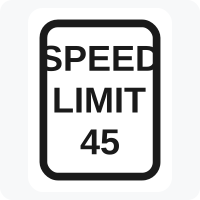
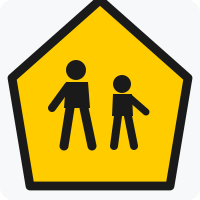
Signs come up on every state paper. These six account for more of them than any others:




The 30 questions
The minimum age to apply for an Illinois instruction permit is:
Show the answer
Correct answer: B. 15
Illinois issues an instruction permit at 15 with parental consent, provided the applicant is enrolled in an approved driver education course. The permit must be held for at least nine months before the driving test.
Under Illinois’s Zero Tolerance Law, a driver under 21 loses driving privileges for a first offense at a BAC of:
Show the answer
Correct answer: C. More than 0.00%, meaning any trace of alcohol
Illinois applies genuinely zero tolerance: any trace of alcohol in a driver under 21 brings a three-month suspension for a first offense, and refusing testing brings a six-month suspension.
An Illinois permit holder under 18 must complete how many hours of supervised practice driving?
Show the answer
Correct answer: B. 50 hours, including 10 at night
Fifty hours of certified practice, of which at least ten must be at night, is required before the driving test. A parent or guardian must certify the log, and the permit must be held for nine months.
An Illinois instruction permit holder must be accompanied by a licensed driver who is at least:
Show the answer
Correct answer: A. 21 years old
The supervising driver must be at least 21, hold a valid license for the class of vehicle, and have at least one year of driving experience. Permit holders may not drive unsupervised at any hour.
Unless otherwise posted, the Illinois speed limit in an urban district is:
Show the answer
Correct answer: B. 30 mph
Thirty miles per hour is the urban default, 15 mph in an alley, 20 mph in a school zone on school days, and 55 or 70 mph on rural highways depending on the road type unless posted differently.
In Illinois, a driver 21 or over who fails a chemical test at 0.08% or above faces a statutory summary suspension for a first offense of:
Show the answer
Correct answer: B. 6 months
A first failure brings a six-month statutory summary suspension, and a first refusal brings twelve months. The suspension is administrative and starts on the 46th day after notice, regardless of the criminal case.
In Illinois, when a school bus stops with red lights flashing on a two-lane road, drivers:
Show the answer
Correct answer: C. In both directions must stop
Traffic in both directions must stop on a two-lane road and remain stopped until the arm retracts. A first conviction for passing a stopped school bus brings a $300 fine and a three-month license suspension.
Scott’s Law, the Illinois Move Over law, requires you to:
Show the answer
Correct answer: A. Change lanes if possible, or reduce speed, when approaching a stopped emergency or maintenance vehicle with flashing lights
Scott’s Law is named for a Chicago firefighter killed at a crash scene. Violations bring heavy fines, and a violation causing injury or death can bring felony charges and license suspension.
Using a handheld mobile phone while driving in Illinois is:
Show the answer
Correct answer: A. Prohibited statewide, and drivers under 19 may not use a phone at all
Illinois requires hands-free operation for all drivers, and bans any wireless device use for drivers under 19 and in school and construction zones. A violation is a moving offense that goes on the record.
In Illinois, you may not park within how many feet of a fire hydrant?
Show the answer
Correct answer: B. 15 feet
Fifteen feet is the Illinois clearance, along with 20 feet from a crosswalk, 30 feet from a stop sign or signal, and 50 feet from a railroad crossing.
Illinois winters bring snow and ice. When driving on a snow-covered road you should:
Show the answer
Correct answer: A. Reduce speed, increase following distance, and make all steering and braking inputs gently
Traction on snow can be a fraction of that on dry pavement, so every input must be gentle. Never crowd a plow, which travels slowly, throws salt and snow, and has blades wider than the truck body.
Illinois child restraint law requires an appropriate child seat or booster for children under:
Show the answer
Correct answer: B. 8 years old
Children under 8 must be secured in an appropriate child restraint system, and children under 2 must ride rear-facing unless they exceed 40 pounds or 40 inches. Every child under 13 is safest in the rear seat.
In Illinois, a solid yellow line on your side of the center marking means:
Show the answer
Correct answer: D. You may not cross the line to pass
The line on your side governs your permission to pass. Solid means the sight distance ahead is inadequate for a safe overtake, so wait until a broken line appears on your side.
In Illinois, a right turn on red is:
Show the answer
Correct answer: D. Permitted after a complete stop and yielding, unless a sign prohibits it
Illinois permits right on red after a full stop unless a sign forbids it, and permits a left on red only from a one-way street onto another one-way street. Many Chicago intersections post NO TURN ON RED.
When approaching a railroad crossing in Illinois with gates coming down, you must:
Show the answer
Correct answer: A. Stop no closer than 15 feet from the nearest rail and wait until the gates rise and the lights stop
Stop between 15 and 50 feet from the nearest rail. Driving around a lowered gate is a serious offense and the reason for most crossing fatalities. A second train may follow immediately behind the first.
The Illinois knowledge test includes a section on identifying signs by:
Show the answer
Correct answer: A. Shape, color, and symbol, sometimes without any wording
Illinois devotes 15 of the 35 test questions to sign identification. Learn the shape and color conventions, because a sign obscured by snow or dirt is often identifiable by outline alone.
Illinois requires drivers to carry liability insurance and to show proof:
Show the answer
Correct answer: C. On request by a police officer, and when registering a vehicle
Driving without insurance in Illinois brings a minimum fine of $500 and a three-month registration suspension, rising to $1,000 for driving while the registration is suspended for that reason.
Illinois recommends a following distance in good conditions of at least:
Show the answer
Correct answer: D. Two seconds, increased in poor conditions
Two seconds is the stated minimum in good conditions. Add at least one second for each adverse factor such as rain, snow, night driving, or following a large vehicle.
Illinois requires headlights to be turned on:
Show the answer
Correct answer: D. From sunset to sunrise, when visibility is under 1,000 feet, and whenever wipers are in continuous use
The wipers-on, lights-on rule means headlights and tail lights must be on in rain, snow, or sleet. Daytime running lights alone do not satisfy it because the tail lights stay dark.
In Illinois, you must yield to a pedestrian:
Show the answer
Correct answer: B. In marked and unmarked crosswalks, and you must stop rather than merely slow
Illinois requires drivers to stop, not just yield, for pedestrians in a crosswalk. Never pass a vehicle stopped at a crosswalk, because it is likely stopped for someone you cannot see.
In an Illinois construction zone with workers present, traffic fines are:
Show the answer
Correct answer: A. Increased, with a minimum fine for speeding and license suspension for repeat offenses
Illinois sets a minimum $250 fine for a first speeding offense in a construction zone and $750 for a second, and two convictions bring a 90-day license suspension.
Illinois night-time driving restrictions for drivers under 18 apply, Sunday through Thursday, from:
Show the answer
Correct answer: D. 10 p.m. to 6 a.m.
The curfew runs from 10 p.m. to 6 a.m. Sunday through Thursday, and from 11 p.m. to 6 a.m. on Friday and Saturday. Some municipalities set stricter local curfews.
The Illinois speed limit in a school zone on a school day when children are present is:
Show the answer
Correct answer: B. 20 mph
Twenty miles per hour applies on school days between 7 a.m. and 4 p.m. when children are present. Fines are steep, and a second offense within two years can bring a license suspension.
In Illinois, you must report a crash to law enforcement when there is injury, death, or property damage exceeding:
Show the answer
Correct answer: C. $1,500
Illinois sets the threshold at $1,500 in damage, or $500 when any driver involved is uninsured. Any injury or death must be reported immediately regardless of damage.
At an Illinois intersection where a traffic signal is dark because of a power failure, you must:
Show the answer
Correct answer: C. Treat the intersection as a four-way stop
Every approach stops, then proceeds in arrival order. If two vehicles arrive together, the one on the left yields to the one on the right, and a left-turning driver yields to oncoming traffic.
In Illinois, a driver under 21 convicted of two or more moving violations within 24 months faces:
Show the answer
Correct answer: D. A license suspension of at least one month, increasing with the number of violations
Illinois suspends the license of a young driver convicted of two moving violations within a 24-month period, with the length depending on the offenses. Drivers under 18 also lose the ability to obtain a full license on schedule.
On an Illinois road with a two-way left-turn lane, you may:
Show the answer
Correct answer: A. Use it only to prepare for a left turn or to complete a left turn onto the roadway
Both directions share this lane, so traveling in it risks a head-on collision with a driver entering from the opposite way. Enter it shortly before the turn and leave it as soon as the turn is complete.
A first DUI conviction in Illinois brings a minimum license revocation of:
Show the answer
Correct answer: C. 1 year
A first DUI conviction revokes the license for at least one year, alongside fines up to $2,500, possible jail, and a mandatory alcohol evaluation. Revocation, unlike suspension, requires a formal hearing to regain driving privileges.
In Illinois, parking in a space reserved for people with disabilities without a valid placard brings:
Show the answer
Correct answer: C. A fine of several hundred dollars and possible towing
Illinois imposes a fine of $350 for a first offense, and the rule applies in private lots open to the public as well as on the street. Blocking the striped access aisle is treated the same way.
Your vehicle skids on an icy Illinois road and the rear begins to slide right. You should:
Show the answer
Correct answer: D. Ease off the accelerator and steer gently to the right, in the direction the rear is sliding
Steer where you want the front of the vehicle to go, which means steering into the slide. Do it smoothly, and be ready for a gentle counter-correction as grip returns and the rear swings back.
Answer key
Every answer in one place, in question order.
| No. | Ans | The correct option |
|---|---|---|
| 1 | B | 15 |
| 2 | C | More than 0.00%, meaning any trace of alcohol |
| 3 | B | 50 hours, including 10 at night |
| 4 | A | 21 years old |
| 5 | B | 30 mph |
| 6 | B | 6 months |
| 7 | C | In both directions must stop |
| 8 | A | Change lanes if possible, or reduce speed, when approaching a stopped emergency or maintenance vehicle with flashing lights |
| 9 | A | Prohibited statewide, and drivers under 19 may not use a phone at all |
| 10 | B | 15 feet |
| 11 | A | Reduce speed, increase following distance, and make all steering and braking inputs gently |
| 12 | B | 8 years old |
| 13 | D | You may not cross the line to pass |
| 14 | D | Permitted after a complete stop and yielding, unless a sign prohibits it |
| 15 | A | Stop no closer than 15 feet from the nearest rail and wait until the gates rise and the lights stop |
| 16 | A | Shape, color, and symbol, sometimes without any wording |
| 17 | C | On request by a police officer, and when registering a vehicle |
| 18 | D | Two seconds, increased in poor conditions |
| 19 | D | From sunset to sunrise, when visibility is under 1,000 feet, and whenever wipers are in continuous use |
| 20 | B | In marked and unmarked crosswalks, and you must stop rather than merely slow |
| 21 | A | Increased, with a minimum fine for speeding and license suspension for repeat offenses |
| 22 | D | 10 p.m. to 6 a.m. |
| 23 | B | 20 mph |
| 24 | C | $1,500 |
| 25 | C | Treat the intersection as a four-way stop |
| 26 | D | A license suspension of at least one month, increasing with the number of violations |
| 27 | A | Use it only to prepare for a left turn or to complete a left turn onto the roadway |
| 28 | C | 1 year |
| 29 | C | A fine of several hundred dollars and possible towing |
| 30 | D | Ease off the accelerator and steer gently to the right, in the direction the rear is sliding |
More permit test practice
Everything on this site tagged DMV lives in the DMV category.
Sources