
Driving Rules True or False Quiz
On this page
The 30 statements
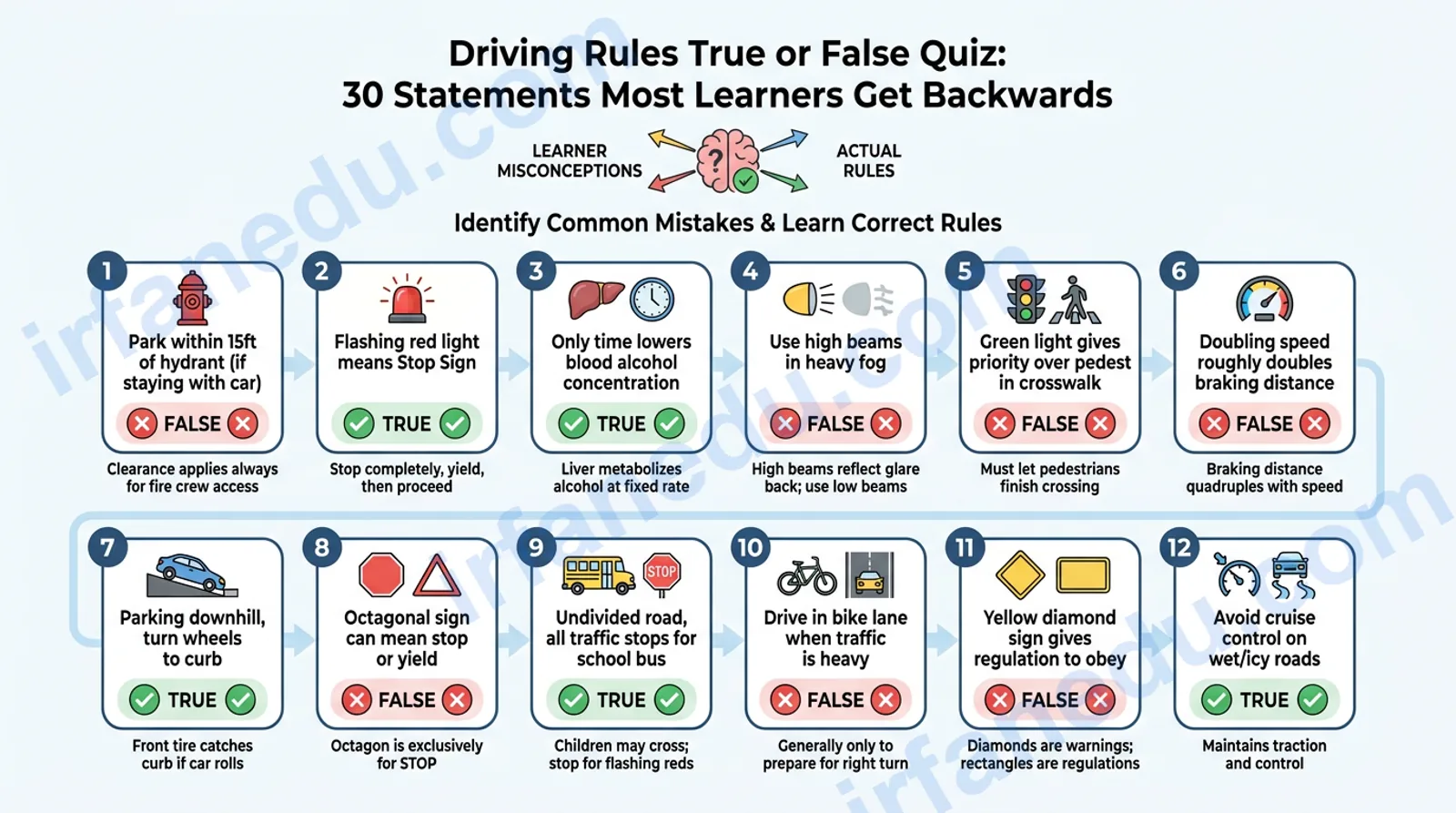
You may park within 15 feet of a fire hydrant if you stay with the vehicle.
Show the answer
False.
The clearance applies whether or not anyone is in the car. A fire crew needs room to reach the hydrant and run hose.
A flashing red traffic light means the same thing as a stop sign.
Show the answer
True.
Stop completely, yield to traffic and pedestrians, then proceed when the way is clear.
Only time can lower your blood alcohol concentration.
Show the answer
True.
The liver metabolizes alcohol at a roughly fixed rate. Coffee and cold showers change how alert you feel, not how impaired you are.
You should use high beam headlights in heavy fog.
Show the answer
False.
High beams reflect off fog droplets and bounce glare back at you. Low beams throw light under the fog.
A green traffic light gives you the right of way over pedestrians already in the crosswalk.
Show the answer
False.
Green permits movement but never overrides a pedestrian already crossing. You must let them finish.
Doubling your speed roughly doubles your braking distance.
Show the answer
False.
Braking distance grows with the square of speed, so doubling speed roughly quadruples it.
When parking facing downhill next to a curb, turn your front wheels toward the curb.
Show the answer
True.
If the vehicle rolls, the front tire catches the curb instead of rolling into traffic.
An octagonal sign can mean either stop or yield depending on its color.
Show the answer
False.
The octagon is reserved exclusively for STOP. Yield uses a downward-pointing triangle.
On an undivided two-lane road, traffic in both directions must stop for a school bus with flashing red lights.
Show the answer
True.
Children may cross in front of the bus where approaching drivers cannot see them.
You may drive in a bike lane whenever traffic is heavy.
Show the answer
False.
A bike lane may generally be entered only to prepare for a right turn, and only close to the intersection.
A yellow diamond sign gives you a regulation you must obey.
Show the answer
False.
Diamonds are warnings. Regulations use white rectangles or the red circle-and-slash.
Cruise control should be avoided on wet or icy roads.
Show the answer
True.
It can keep applying power as a wheel starts to slip and delays the instinctive lift off the accelerator.
A prescription for a medication is a legal defense against an impaired driving charge.
Show the answer
False.
Impaired driving laws cover any substance. A valid prescription does not excuse driving while impaired by it.
Orange signs and cones mean a temporary work zone.
Show the answer
True.
Orange is used only for temporary traffic control. Expect workers, uneven surfaces, and shifting lanes.
You must yield to a pedestrian only in a painted crosswalk.
Show the answer
False.
Unmarked crosswalks exist at most intersections, and pedestrians have the right of way in them too.
If your right wheels drop onto a soft shoulder, you should steer back onto the pavement immediately.
Show the answer
False.
Slow down first, hold straight, then ease back at a shallow angle. Snatching the wheel causes rollovers.
A crossbuck at a railroad crossing has the same legal force as a yield sign.
Show the answer
True.
Slow, look and listen both ways, and cross only when you are sure no train is coming.
With anti-lock brakes you should pump the brake pedal in an emergency stop.
Show the answer
False.
ABS pumps for you. Press firmly and hold, and steer around the hazard if you need to.
Blue highway signs point to parks and campgrounds.
Show the answer
False.
Blue marks motorist services such as fuel, food, and lodging. Brown marks parks and recreation.
A driver turning left must yield to oncoming traffic going straight.
Show the answer
True.
This holds even on a green light. A green arrow is the only case where the left turn is protected.
The posted speed limit is always a safe speed to drive.
Show the answer
False.
It is a maximum for ideal conditions. Basic speed laws require a lower speed in rain, fog, or heavy traffic.
Refusing a breath test after a lawful DUI arrest carries no penalty unless you are convicted.
Show the answer
False.
Implied consent laws impose an automatic administrative suspension for refusal, independent of the criminal case.
You may pass on the right when the vehicle ahead is turning left and there is a clear paved lane.
Show the answer
True.
This is permitted, but you may never use an unpaved shoulder to pass.
Wearing a seat belt is only necessary at highway speeds.
Show the answer
False.
Most crashes happen close to home at moderate speeds, and an unbelted rear passenger can injure people in the front.
A two-way left-turn lane may be used for through travel when traffic is heavy.
Show the answer
False.
Both directions share it. Traveling along it risks a head-on collision with a driver entering from the other way.
Black ice forms first on bridges and overpasses.
Show the answer
True.
They lose heat from above and below, so they freeze before the surrounding road surface.
You must dim your high beams when following another vehicle closely.
Show the answer
True.
The usual rule is within 200 to 300 feet when following and about 500 feet when meeting an oncoming vehicle.
A pentagon-shaped sign marks a hospital zone.
Show the answer
False.
The pentagon is reserved for school zones and school crossings.
If a traffic signal is completely dark, you should treat the intersection as a four-way stop.
Show the answer
True.
Every approach must stop, then proceed in the order vehicles arrived.
Hazard lights make it legal to double park briefly.
Show the answer
False.
Hazard lights do not legalize an illegal stop. Double parking blocks a lane and traps the parked driver.
Answer key
| No. | Ans | Statement |
|---|---|---|
| 1 | F | You may park within 15 feet of a fire hydrant if you stay with the vehicle. |
| 2 | T | A flashing red traffic light means the same thing as a stop sign. |
| 3 | T | Only time can lower your blood alcohol concentration. |
| 4 | F | You should use high beam headlights in heavy fog. |
| 5 | F | A green traffic light gives you the right of way over pedestrians already in the crosswalk. |
| 6 | F | Doubling your speed roughly doubles your braking distance. |
| 7 | T | When parking facing downhill next to a curb, turn your front wheels toward the curb. |
| 8 | F | An octagonal sign can mean either stop or yield depending on its color. |
| 9 | T | On an undivided two-lane road, traffic in both directions must stop for a school bus with flashing red lights. |
| 10 | F | You may drive in a bike lane whenever traffic is heavy. |
| 11 | F | A yellow diamond sign gives you a regulation you must obey. |
| 12 | T | Cruise control should be avoided on wet or icy roads. |
| 13 | F | A prescription for a medication is a legal defense against an impaired driving charge. |
| 14 | T | Orange signs and cones mean a temporary work zone. |
| 15 | F | You must yield to a pedestrian only in a painted crosswalk. |
| 16 | F | If your right wheels drop onto a soft shoulder, you should steer back onto the pavement immediately. |
| 17 | T | A crossbuck at a railroad crossing has the same legal force as a yield sign. |
| 18 | F | With anti-lock brakes you should pump the brake pedal in an emergency stop. |
| 19 | F | Blue highway signs point to parks and campgrounds. |
| 20 | T | A driver turning left must yield to oncoming traffic going straight. |
| 21 | F | The posted speed limit is always a safe speed to drive. |
| 22 | F | Refusing a breath test after a lawful DUI arrest carries no penalty unless you are convicted. |
| 23 | T | You may pass on the right when the vehicle ahead is turning left and there is a clear paved lane. |
| 24 | F | Wearing a seat belt is only necessary at highway speeds. |
| 25 | F | A two-way left-turn lane may be used for through travel when traffic is heavy. |
| 26 | T | Black ice forms first on bridges and overpasses. |
| 27 | T | You must dim your high beams when following another vehicle closely. |
| 28 | F | A pentagon-shaped sign marks a hospital zone. |
| 29 | T | If a traffic signal is completely dark, you should treat the intersection as a four-way stop. |
| 30 | F | Hazard lights make it legal to double park briefly. |
More permit test practice
Everything on this site tagged DMV lives in the DMV category.
Sources