
How Do You Calculate a Weighted Mean?
Weighted Mean: Fact vs. Fiction
Before diving into the formula, here are the most common misconceptions I see students bring into my sessions — cleared up in one table.
| Fiction (What People Believe) | Fact (What Is Actually True) |
|---|---|
| “The weighted mean is just a regular average.” | A regular average treats all values equally. A weighted mean assigns different importance to each value based on its weight. |
| “Weights must add up to 1 or 100%.” | Weights can be any positive numbers. The formula divides by the sum of weights automatically, so pre-normalizing is never required. |
| “A higher weighted mean always means better performance.” | Context determines meaning. In golf scoring, a lower weighted mean is better. Always interpret the result in context. |
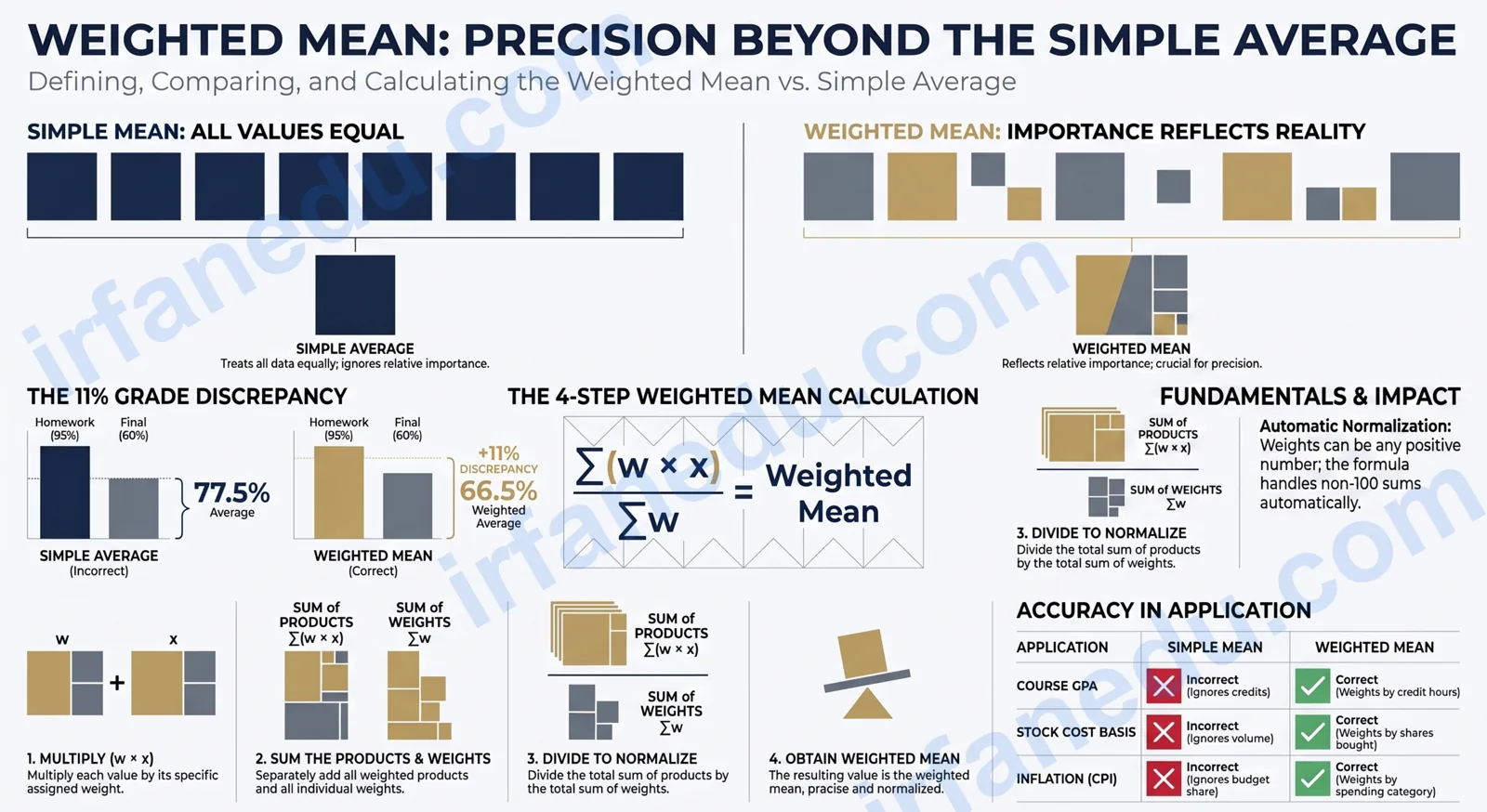
| “GPA is a simple average of your grades.” | GPA is a weighted mean. Each course’s grade is weighted by its credit hours, so a 4-credit course counts more than a 1-credit course. |
| “You can only use whole numbers as weights.” | Weights can be decimals, fractions, percentages, or any positive real number. |
What Is a Weighted Mean?
A weighted mean is an average that accounts for the relative importance of each value. Instead of adding all values and dividing by the count, you multiply each value by its weight, sum those products, and divide by the total weight. It is the correct tool whenever some data points matter more than others.
You run into weighted means constantly in American academic and financial life: your GPA, your final course grade when the final exam counts 40%, the average price you paid per share of a stock bought at different prices, and even the way the Bureau of Labor Statistics calculates the Consumer Price Index (CPI) — all weighted means.
In my experience tutoring students across the US, the single biggest source of grade calculation errors is treating a weighted grading scale as a simple average. A student who scores 95% on homework (worth 10%) and 60% on the final (worth 50%) does not average 77.5% — they average 66.5%. That gap can mean the difference between a B and a D.
A weighted mean equals the sum of each value multiplied by its weight, divided by the total of all weights: Weighted Mean = Σ(w×x) ÷ Σw. For a course grade where the final exam is worth 50%, midterm 30%, and homework 20%, multiply each score by its weight, add the products, then divide by 1.0 (or 100). The result reflects each component’s true importance.
📌 Quick Summary
- Weighted mean = Σ(weight × value) ÷ Σ(weights) — not a simple sum divided by count.
- Use it when some values matter more than others (grades, GPA, stock cost basis, CPI).
- Weights do not need to sum to 1 or 100 — the formula normalizes automatically.
- GPA is a weighted mean: credit hours are the weights, grade points are the values.
- The result always falls between your smallest and largest value — never outside that range.
- A simple average is just a weighted mean where every weight equals 1.
Quick Facts: Weighted Mean at a Glance
| Property | Detail |
|---|---|
| Formula | Σ(w×x) ÷ Σw |
| Also called | Weighted average, weighted arithmetic mean |
| When to use | Values have unequal importance or frequency |
| Result range | Always between min and max of the data set |
| US applications | GPA, final grades, CPI, stock cost basis, prorated rent |
| Equals simple mean when | All weights are identical |
| Minimum data points | 2 (one weight-value pair is trivially the value itself) |
Weighted Mean Calculator
Enter your values and weights below. Click + Add Row to include more data points (up to 10). Hit Calculate to see the weighted mean and a full step-by-step solution.
Weighted Mean Calculator
Weight (w)
Step-by-Step Solution
How to Use This Weighted Mean Calculator
- Enter a Value (the data point, e.g., a test score) in the left column of each row.
- Enter the corresponding Weight (e.g., 0.50 for 50%, or 3 for 3 credit hours) in the right column.
- Click + Add Row if you have more than three data points (up to 10 rows total).
- Click Calculate. The result card shows the weighted mean and a numbered step-by-step solution using your exact values.
- Click Reset to clear everything and start a new calculation.
The Weighted Mean Formula Explained
The formula has two moving parts. The numerator is the sum of every (weight × value) product. The denominator is the sum of all weights. Dividing normalizes the result so it sits on the same scale as the original values — not inflated by large weights.
Variables & Symbols Table
| Symbol | Meaning | Example |
|---|---|---|
| xᵢ | Each individual value | Test score: 88 |
| wᵢ | Weight assigned to xᵢ | 0.40 (40% of grade) |
| Σ(wᵢ × xᵢ) | Sum of all weighted products | 88 × 0.40 + 72 × 0.60 = 78.4 |
| Σwᵢ | Sum of all weights | 0.40 + 0.60 = 1.00 |
| x̄ | Weighted mean (result) | 78.4 ÷ 1.00 = 78.4 |
Worked Examples
Example 1: Course Final Grade
A US college course has this grading breakdown: Homework 20%, Midterm 30%, Final Exam 50%. A student scores 95, 74, and 82 respectively.
Step 1 — Multiply: (0.20 × 95) + (0.30 × 74) + (0.50 × 82) = 19 + 22.2 + 41 = 82.2
Step 2 — Sum weights: 0.20 + 0.30 + 0.50 = 1.00
Step 3 — Divide: 82.2 ÷ 1.00 = 82.2%
A simple average of 95, 74, and 82 would give 83.67% — almost 1.5 points higher, which misrepresents the student’s actual standing.
Example 2: GPA Calculation (Credit Hours as Weights)
A student takes three courses: English (3 credits, B = 3.0), Calculus (4 credits, A = 4.0), and PE (1 credit, A = 4.0).
Step 1 — Multiply: (3 × 3.0) + (4 × 4.0) + (1 × 4.0) = 9 + 16 + 4 = 29
Step 2 — Sum weights: 3 + 4 + 1 = 8 credit hours
Step 3 — Divide: 29 ÷ 8 = 3.625 GPA
A simple average of 3.0, 4.0, 4.0 = 3.67 — it overstates the GPA because it ignores that Calculus carries four times the weight of PE.
Example 3: Stock Cost Basis (Dollar-Cost Averaging)
An investor buys 10 shares at $120, 25 shares at $95, and 5 shares at $140. What is the average cost per share?
Step 1: (10 × 120) + (25 × 95) + (5 × 140) = 1200 + 2375 + 700 = 4275
Step 2: 10 + 25 + 5 = 40 shares
Step 3: 4275 ÷ 40 = $106.88 per share
A simple average of $120, $95, $140 = $118.33 — wildly off because it ignores that you bought far more shares at $95.
  WEIGHTED MEAN — Visual Balance

  Value:   95 ──────────── 74 ──────────── 82
  Weight:  0.20            0.30            0.50

  Products:
  ┌──────────┐  ┌──────────┐  ┌──────────┐
  │ 0.20×95  │  │ 0.30×74  │  │ 0.50×82  │
  │  = 19.0  │  │  = 22.2  │  │  = 41.0  │
  └──────────┘  └──────────┘  └──────────┘
        │              │              │
        └──────────────┴──────────────┘
                       │
              Sum = 82.2
                       │
              ÷ (0.20+0.30+0.50)
                       │
              ÷ 1.00 = 82.2
                       │
          ┌────────────────────┐
          │  Weighted Mean = 82.2  │
          └────────────────────┘
Weighted Mean vs. Simple Mean: Side-by-Side Comparison
| Feature | Simple Mean | Weighted Mean |
|---|---|---|
| Formula | Σx ÷ n | Σ(w×x) ÷ Σw |
| Treats all values equally? | Yes | No — weights differ |
| Requires weights? | No | Yes |
| Best for | Equal-importance data | Unequal-importance data |
| GPA calculation? | Incorrect | Correct |
| CPI calculation? | Incorrect | Correct |
| Result when all weights equal? | Same result | Same as simple mean |
Common Mistakes and How to Avoid Them
In my experience reviewing hundreds of student grade disputes, these four errors account for nearly every miscalculation.
| Wrong Approach | Right Approach |
|---|---|
| Adding scores and dividing by count when weights differ | Multiply each score by its weight first, then divide by the sum of weights |
| Forgetting to divide by the sum of weights (not by the count) | Always divide by Σw, not by the number of items |
| Using weights that sum to more than 100% without realizing it | Double-check that your weights reflect the actual grading policy; the formula handles non-100 sums automatically |
| Treating a missing assignment as zero weight instead of zero score | A missing assignment is a score of 0 with its full weight still applied — that is very different from removing it |
In my view, the most underused application of the weighted mean in American education is predicting your final grade before the semester ends. Most students wait until grades are posted. But if you know your current scores and the remaining weights, you can calculate exactly what score you need on the final exam to hit your target grade — and that changes how you study. I walk students through this calculation in every tutoring session, and it consistently reduces test anxiety because the math replaces the guesswork.
The weighted mean is not just for grades. Most guides focus on GPA. But the US Bureau of Labor Statistics CPI is a weighted mean where each category of spending (housing, food, energy, medical care) is weighted by its share of a typical American household’s budget. When housing costs rise sharply, CPI rises more than if food prices rise by the same percentage — because housing carries a higher weight (~33% of the index). Understanding this is why economists say “inflation hit renters harder” — it is a weighted mean argument, not a simple average one. Most introductory statistics guides never make this connection.
Quick Check: Test Your Understanding
1. A student scores 80 on a quiz (weight 1) and 60 on an exam (weight 3). What is the weighted mean?
2. If all weights in a weighted mean are equal, the result equals:
3. Weights in the weighted mean formula must sum to exactly 1.0 or 100%.
Practice Problems
Problem 1: A student’s semester grades are: Participation 10% (score 100), Quizzes 20% (score 85), Midterm 30% (score 72), Final 40% (score 78). What is the final grade?
Step 1: (0.10×100) + (0.20×85) + (0.30×72) + (0.40×78)
= 10 + 17 + 21.6 + 31.2 = 79.8
Step 2: 0.10+0.20+0.30+0.40 = 1.00
Step 3: 79.8 ÷ 1.00 = 79.8%
Problem 2: An investor buys 50 shares at $30, 100 shares at $25, and 50 shares at $35. What is the average cost per share?
Step 1: (50×30) + (100×25) + (50×35) = 1500 + 2500 + 1750 = 5750
Step 2: 50+100+50 = 200 shares
Step 3: 5750 ÷ 200 = $28.75 per share
Problem 3: A professor weights three exams as 1, 2, and 3. Scores are 70, 80, and 90. Find the weighted mean.
Step 1: (1×70) + (2×80) + (3×90) = 70 + 160 + 270 = 500
Step 2: 1+2+3 = 6
Step 3: 500 ÷ 6 = 83.33
Frequently Asked Questions
What is a weighted mean?
A weighted mean is an average where each value is multiplied by a weight that reflects its relative importance before summing. The total is divided by the sum of all weights. It is used when some data points matter more than others, such as in GPA calculations or course grading systems.
How is a weighted mean different from a simple average?
A simple average adds all values and divides by the count, treating every value equally. A weighted mean multiplies each value by its