
Your Pool’s Exact Gallon Count, Calculated in Seconds
Last summer, a neighbor of mine — a first-time pool owner in Phoenix, Arizona — called me in a panic. She had shocked her 18,000-gallon pool using the dosing chart for a 10,000-gallon pool. The water turned milky white within an hour. The culprit? She had never calculated her pool’s actual volume. She just guessed.
Knowing your pool’s volume in gallons is not optional maintenance trivia — it is the single number that controls every chemical decision you make. Get it wrong and you either waste money or swim in an unsafe pool. This calculator gives you that number in under 30 seconds.
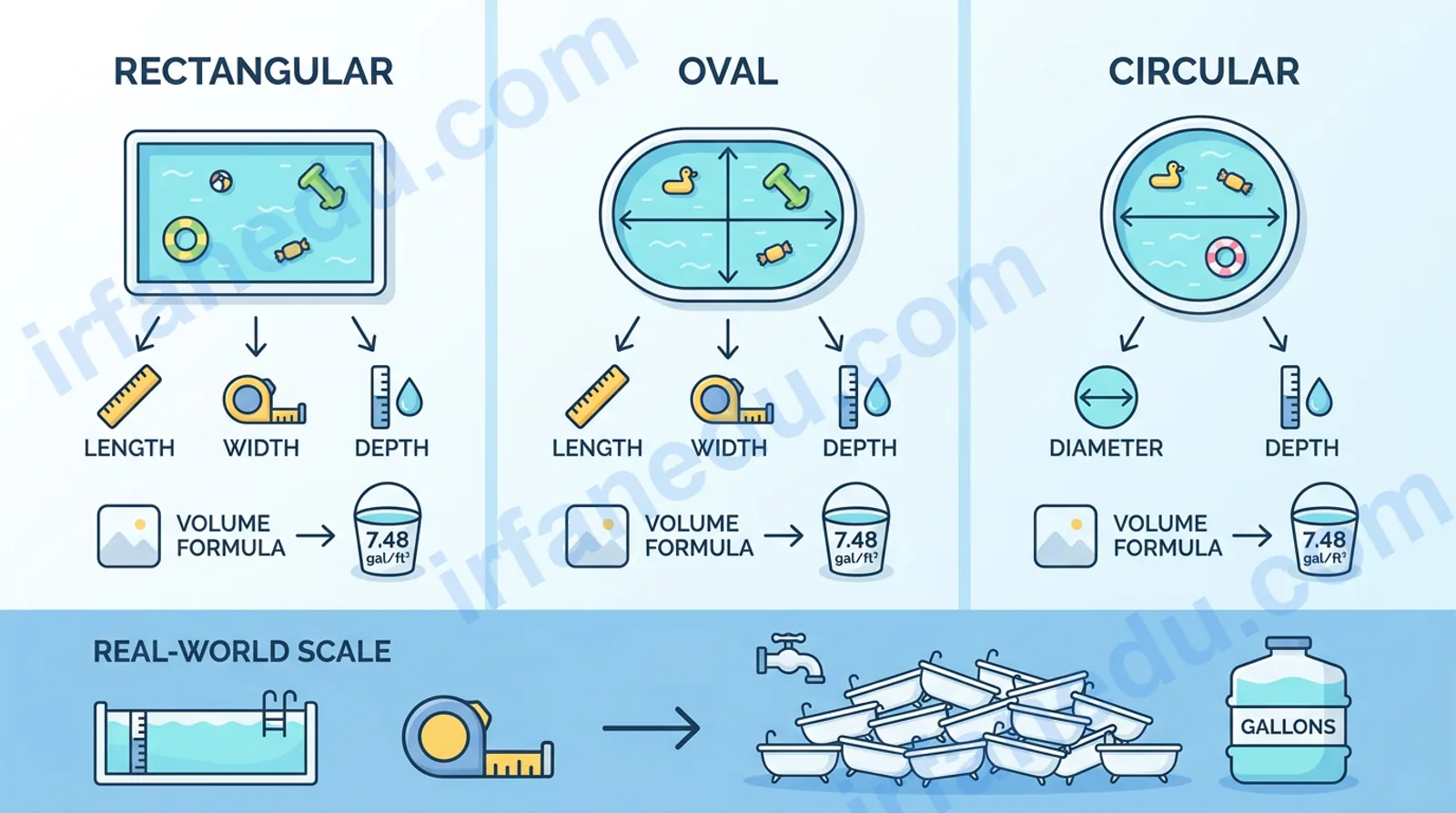
- Calculate volume for rectangular, oval, and circular pools
- Get instant results in US gallons, cubic feet, and liters
- See a numbered step-by-step solution using your exact numbers
- Understand why the formula works and where most people go wrong
A pool volume calculator multiplies your pool’s length × width × average depth (in feet) to get cubic feet, then multiplies by 7.48 to convert to US gallons. A 15 × 30 ft rectangular pool at 5 ft average depth holds about 16,830 gallons. Oval pools use a 0.89 shape factor; circular pools use π × radius² × depth × 7.48.
⚡ In Short
- 🏊 Rectangular pool formula: L × W × Avg Depth × 7.48 = gallons
- 🥚 Oval pool: same formula × 0.89 shape factor
- ⭕ Circular pool: π × r² × Avg Depth × 7.48
- 📏 Average depth = (shallow end + deep end) ÷ 2
- 💧 Every chemical dosing label is calibrated per 10,000 gallons — accuracy matters
- 🔢 1 cubic foot of water = 7.48 US gallons (exact conversion)
🏊 Pool Volume Calculator
Enter your pool dimensions in feet. Results in US gallons.
Step-by-step solution
How to use this pool volume calculator
The calculator handles three common pool shapes. Here is how to get an accurate result in four steps:
- Pick your pool shape — tap Rectangular, Oval, or Circular at the top of the widget.
- Measure length and width (or diameter) in feet. Measure the water surface, not the deck edge.
- Find your average depth — measure the depth at the shallowest point and the deepest point. The calculator averages them automatically.
- Tap "Calculate Volume" — your result appears in gallons with a full step-by-step breakdown and unit-conversion chips.
In my experience working with pool owners, the single biggest source of error is measuring the deck instead of the waterline. A 12-inch coping overhang on all four sides of a 30-foot pool adds 2 feet of phantom length and 2 feet of phantom width — that is a 14% volume overestimate. Measure the water surface only.
The pool volume formula explained
Every pool volume calculation starts with the same principle: find the volume in cubic feet, then convert to gallons. One cubic foot of water holds exactly 7.48052 US gallons — that is the fixed conversion factor you will see on every pool-chemical dosing chart in the United States.
| Pool shape | Formula | Shape factor | Notes |
|---|---|---|---|
| Rectangular / Square | L × W × Avg Depth × 7.48 | 1.00 | Most in-ground pools |
| Oval | L × W × Avg Depth × 0.89 × 7.48 | 0.89 | Above-ground ovals; 0.89 ≈ π/4 × (4/π) correction |
| Circular | π × r² × Avg Depth × 7.48 | 0.785 (= π/4) | Above-ground round pools; r = diameter ÷ 2 |
| Kidney / Freeform | (A + B) × 0.45 × L × Avg Depth × 7.48 | 0.45 | A = widest width, B = narrowest width, L = length |
Variables & symbols
| Symbol | Meaning | US unit |
|---|---|---|
| L | Pool length (water surface) | feet (ft) |
| W | Pool width (water surface) | feet (ft) |
| r | Radius of circular pool | feet (ft) |
| Davg | Average depth = (shallow + deep) ÷ 2 | feet (ft) |
| Vft³ | Volume in cubic feet | ft³ |
| Vgal | Volume in US gallons | gal |
| 7.48 | Gallons per cubic foot (exact: 7.48052) | gal/ft³ |
📐 Visual: rectangular pool volume
  ┌─────────────────────────────────── L = 30 ft ───────────────────────────────┐
  │                                                                              │
  W = 15 ft                                                                      │
  │                                                                              │
  └──────────────────────────────────────────────────────────────────────────────┘
         │                                                    │
    Shallow = 3 ft                                      Deep = 8 ft
         └──────────────── Avg Depth = (3+8)÷2 = 5.5 ft ────┘

  Step 1:  30 × 15 × 5.5  = 2,475 ft³
  Step 2:  2,475 × 7.48   = 18,513 gallons
Worked examples
Example 1 — Rectangular in-ground pool (Phoenix, AZ)
Dimensions: 30 ft long × 15 ft wide. Shallow end: 3 ft. Deep end: 8 ft.
- Average depth = (3 + 8) ÷ 2 = 5.5 ft
- Volume = 30 × 15 × 5.5 = 2,475 ft³
- Gallons = 2,475 × 7.48 = 18,513 gallons
Chemical dosing: this pool needs 1.85× the dose shown on a "per 10,000 gallon" label.
Example 2 — Oval above-ground pool (suburban Texas)
Dimensions: 25 ft × 15 ft. Uniform depth: 4 ft.
- Average depth = 4 ft (uniform)
- Rectangular volume = 25 × 15 × 4 = 1,500 ft³
- Apply oval factor: 1,500 × 0.89 = 1,335 ft³
- Gallons = 1,335 × 7.48 = 9,986 gallons
Just under 10,000 gallons — one standard chemical dose per label is correct.
Example 3 — Circular above-ground pool (Florida)
Dimensions: 24 ft diameter. Uniform depth: 4.5 ft.
- Radius = 24 ÷ 2 = 12 ft
- Volume = π × 12² × 4.5 = 3.14159 × 144 × 4.5 = 2,035.75 ft³
- Gallons = 2,035.75 × 7.48 = 15,227 gallons
I always tell pool owners to add 5–8% to their calculated volume as a "dead zone" buffer. The water at the very bottom of the main drain and inside the filter plumbing does not circulate well. Treating that volume as if it is fully mixed leads to slightly under-dosed chemicals. A 5% buffer on an 18,000-gallon pool means treating it as 18,900 gallons — a small cost that makes a real safety difference.
Common mistakes that throw off your pool volume
Getting the volume wrong by even 15–20% has real consequences for water safety. Here are the four mistakes I see most often.
| ❌ Wrong approach | ✅ Right approach | Impact |
|---|---|---|
| Using the deep-end depth as the average | Average the shallow and deep ends | Overestimates volume by 20–40% |
| Measuring the deck edge, not the water surface | Measure inside the coping at water level | Adds 1–2 ft per dimension (big error) |
| Using 7.5 instead of 7.48 as the conversion | Use 7.48 (exact: 7.48052) | Adds ~0.3% — minor but avoidable |
| Treating an oval pool as rectangular | Multiply by the 0.89 shape factor | Overestimates by ~12% |
🔑 The Part Most Guides Miss
Every pool volume guide tells you to multiply length × width × depth × 7.48. What almost none of them mention: that formula assumes a flat-bottom pool. Most in-ground pools have a hopper bottomSources & References
Written and fact-checked by Dr Irfan Mansuri. External links open in a new tab and are provided for further reading and verification.