
How to Calculate High School GPA: Exact Steps & Free Calculator
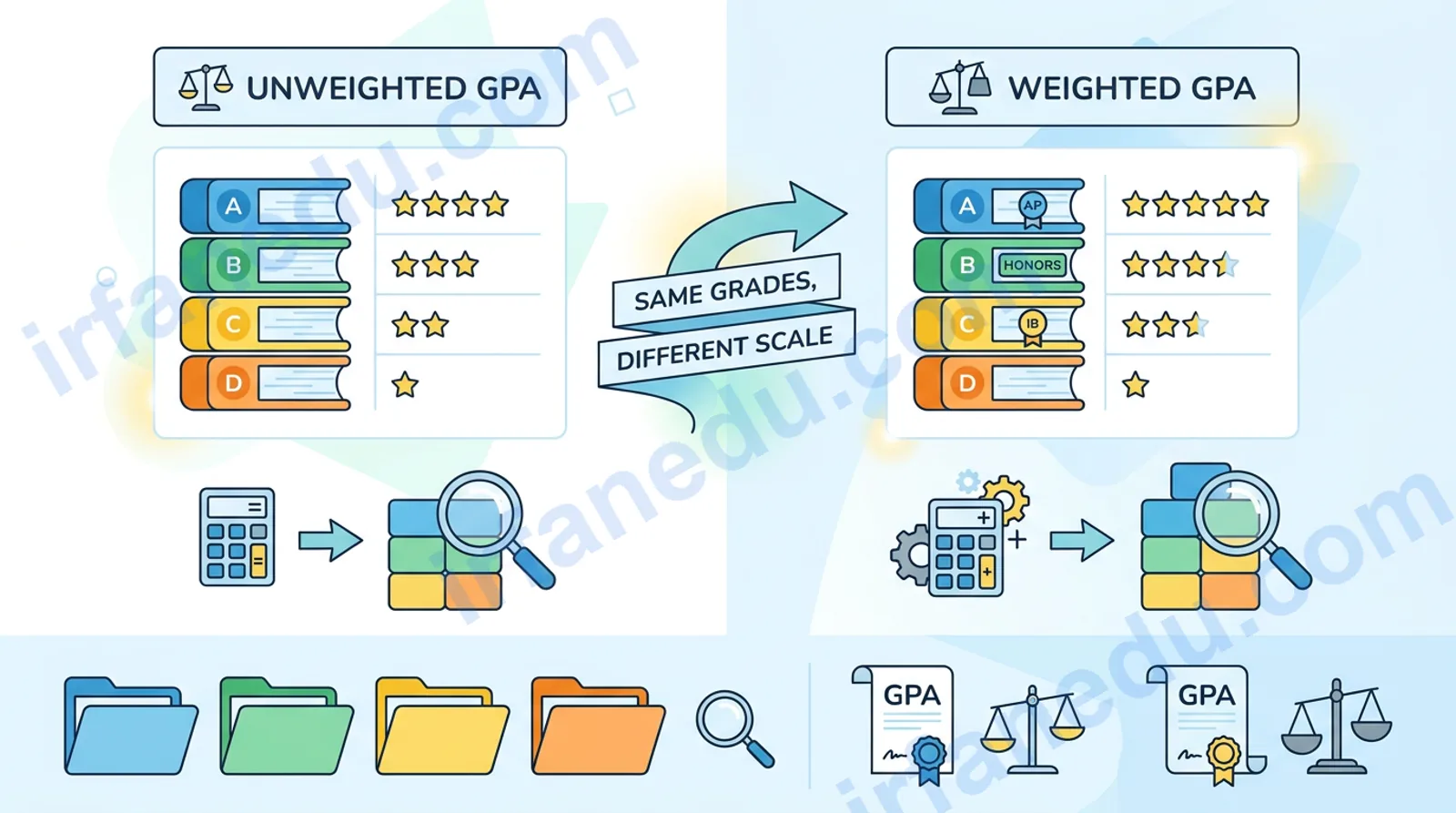
Most GPA tutorials jump straight to the formula. That’s the wrong starting point. Before you punch a single number into a calculator, you need to know which GPA you’re computing — because your school may report three different versions of it, and colleges may recalculate a fourth. Getting that context wrong means you could spend an entire semester chasing a number that isn’t even the one admissions offices look at.
To calculate your high school GPA, convert each letter grade to a grade-point value on the 4.0 scale, multiply by the course’s credit hours, sum those products, then divide by total credit hours. For a weighted GPA, add 1.0 for AP or IB courses and 0.5 for Honors courses before averaging. The result is your cumulative GPA.
- ✅ Understand the difference between unweighted and weighted GPA before calculating
- ✅ Use the interactive calculator below to get your exact GPA in under 60 seconds
- ✅ See two fully worked examples that match the calculator’s step-by-step output
- ✅ Learn the one mistake that makes most self-calculated GPAs inaccurate
To calculate your high school GPA: convert each letter grade to grade points (A=4, B=3, C=2, D=1, F=0), multiply each by the course’s credit hours, add all those products, then divide by total credit hours. For a weighted GPA, add 1.0 for AP/IB and 0.5 for Honors before averaging. A perfect unweighted GPA is 4.0; a perfect weighted GPA can reach 5.0 or higher.
🎯 The Short Version
- 📌 GPA = Total Quality Points ÷ Total Credit Hours
- 📌 Quality Points = Grade Points × Credit Hours per course
- 📌 Unweighted scale tops out at 4.0; weighted scale often reaches 5.0
- 📌 AP/IB courses add +1.0 bonus; Honors courses add +0.5 (most US schools)
- 📌 Never average semester GPAs — always recalculate from raw quality points
- 📌 Many colleges recalculate your GPA on their own scale — know both numbers
🚦 The first step most tutorials skip
Before you convert a single grade, identify your school’s exact grading scale. This sounds obvious, but it’s where most self-calculated GPAs go wrong.
US high schools use at least three different scales:
- Standard 4.0 scale: A=4, B=3, C=2, D=1, F=0. No plus/minus distinctions.
- Plus/minus 4.3 scale: A+=4.3, A=4.0, A-=3.7, B+=3.3, B=3.0, B-=2.7, and so on.
- 100-point scale: Some schools report a numeric average (e.g., 93.4) rather than letter grades. Conversion tables vary by school.
If your school uses a plus/minus scale and you calculate using the standard 4.0 scale, your result can be off by 0.15 to 0.25 GPA points — enough to misread your college competitiveness. Check your transcript or ask your counselor which scale your school officially uses before proceeding.
| Fact | Detail |
|---|---|
| Standard unweighted scale | 4.0 maximum |
| Weighted scale (AP/IB) | 5.0 maximum (most schools) |
| AP/IB bonus | +1.0 grade point |
| Honors bonus | +0.5 grade point (varies by school) |
| Typical credit per semester course | 0.5 credits |
| Typical credit per year-long course | 1.0 credit |
| National average HS GPA (unweighted) | ~3.0 (varies by school) |
| Colleges that recalculate GPA | Most selective universities (UC system, Ivies, etc.) |
🧮 High school GPA calculator
Enter your courses below. Select the course type (Regular, Honors, AP/IB) and the letter grade you earned, then enter the credit hours. Add as many courses as you need, then click Calculate GPA.
High School GPA Calculator
Unweighted & Weighted · US 4.0 Scale
📋 Step-by-step solution
How to use this calculator
- Enter your course name (optional — for your own reference).
- Select your letter grade from the dropdown (A through F, including plus/minus).
- Select the course type — Regular, Honors, or AP/IB. This controls the weighting bonus.
- Enter credit hours — typically 1.0 for a year-long course or 0.5 for a semester course.
- Click “+ Add Course” to add more rows. Add every course on your transcript for a cumulative GPA.
- Click “Calculate GPA” to see your unweighted and weighted GPA with a full step-by-step breakdown.
What is GPA, exactly?
GPA stands for Grade Point Average. It is a single number that summarizes your academic performance across all courses by converting letter grades into a numeric scale and averaging them, weighted by credit hours.
In the US, the standard unweighted GPA scale runs from 0.0 to 4.0. A weighted GPA scale — used to reward students who take more rigorous courses — typically runs from 0.0 to 5.0, though some schools go higher. According to the College Board, GPA is one of the most important factors in college admissions, alongside standardized test scores and course rigor.
In my experience helping students prepare for college applications, the single biggest GPA misconception I see is treating the weighted and unweighted GPA as interchangeable. They are not. When a student tells me their GPA is 4.2, I always ask: “Is that weighted?” A 4.2 weighted GPA from a school that offers many AP courses might translate to a 3.6 unweighted — a meaningful difference when comparing to a school that reports only unweighted GPAs. Always know both numbers.
The formula explained
The GPA formula is a credit-weighted average, not a simple mean. Here it is in plain terms:
📐 GPA Formula — Visual Breakdown
  GPA = Σ (Grade Points × Credit Hours)
        ─────────────────────────────────
              Σ (Credit Hours)

  Where:
  ┌──────────────┬────────────────┬──────────────────────────────┐
  │ Letter Grade │ Unweighted GP  │ Weighted GP (AP/IB, Honors)  │
  ├──────────────┼────────────────┼──────────────────────────────┤
  │ A  / A+      │ 4.0            │ AP/IB: 5.0 | Honors: 4.5    │
  │ A-           │ 3.7            │ AP/IB: 4.7 | Honors: 4.2    │
  │ B+           │ 3.3            │ AP/IB: 4.3 | Honors: 3.8    │
  │ B            │ 3.0            │ AP/IB: 4.0 | Honors: 3.5    │
  │ B-           │ 2.7            │ AP/IB: 3.7 | Honors: 3.2    │
  │ C+           │ 2.3            │ AP/IB: 3.3 | Honors: 2.8    │
  │ C            │ 2.0            │ AP/IB: 3.0 | Honors: 2.5    │
  │ D            │ 1.0            │ AP/IB: 2.0 | Honors: 1.5    │
  │ F            │ 0.0            │ 0.0                          │
  └──────────────┴────────────────┴──────────────────────────────┘

  Quality Points (per course) = Grade Points × Credit Hours
Variables & symbols table
| Symbol | Meaning | Typical range |
|---|---|---|
| GP | Grade Points for a course | 0.0 – 4.0 (unweighted); 0.0 – 5.0 (weighted) |
| CR | Credit Hours for a course | 0.5 (semester) or 1.0 (year-long) |
| QP | Quality Points = GP × CR | Varies |
| Σ QP | Sum of all Quality Points | Varies by course load |
| Σ CR | Sum of all Credit Hours | Typically 22–28 over 4 years |
| GPA | Grade Point Average = Σ QP ÷ Σ CR | 0.0 – 4.0 (unweighted) |
Worked examples
Example 1 — Unweighted GPA (standard 4.0 scale)
Suppose a student completes these four year-long courses (1.0 credit each):
| Course | Grade | GP (unweighted) | Credits | Quality Points |
|---|---|---|---|---|
| English 10 | A | 4.0 | 1.0 | 4.0 |
| Algebra II | B+ | 3.3 | 1.0 | 3.3 |
| US History | B | 3.0 | 1.0 | 3.0 |
| Chemistry | A- | 3.7 | 1.0 | 3.7 |
GPA = (4.0 + 3.3 + 3.0 + 3.7) ÷ 4.0 = 14.0 ÷ 4.0 = 3.50
Example 2 — Weighted GPA (AP and Honors courses)
Same student, next year, with more rigorous courses:
| Course | Type | Grade | GP (weighted) | Credits | Quality Points |
|---|---|---|---|---|---|
| AP English Lang | AP/IB | B+ | 3.3 + 1.0 = 4.3 | 1.0 | 4.3 |
| AP Calculus AB | AP/IB | A- | 3.7 + 1.0 = 4.7 | 1.0 | 4.7 |
| Honors Physics | Honors | B | 3.0 + 0.5 = 3.5 | 1.0 | 3.5 |
| AP US History | AP/IB | A | 4.0 + 1.0 = 5.0 | 1.0 | 5.0 |
Weighted GPA = (4.3 + 4.7 + 3.5 + 5.0) ÷ 4.0 = 17.5 ÷ 4.0 = 4.38
Unweighted GPA (same grades, no bonus) = (3.3 + 3.7 + 3.0 + 4.0) ÷ 4.0 = 14.0 ÷ 4.0 = 3.50
Notice: the unweighted GPA is identical to Example 1 — the same letter grades produce the same unweighted result regardless of course type. The weighted GPA is higher because the student took harder courses.
I always tell students to run Example 2 themselves in the calculator above and compare the two outputs. Seeing your own numbers side by side — weighted vs. unweighted — makes the concept click faster than any explanation. The moment a student realizes their weighted 4.38 is actually a 3.50 unweighted, they start thinking more strategically about which courses to take and how hard to push in each one.
Weighted vs. unweighted GPA — what’s the real difference?
| Feature | Unweighted GPA | Weighted GPA |
|---|---|---|
| Maximum value | 4.0 | 5.0 (most schools) |
| Reflects course difficulty? | No | Yes |
| AP/IB bonus | None | +1.0 |
| Honors bonus | None | +0.5 (varies) |
| Used by most colleges for comparison | Yes (standardized) | Supplementary |
| Can exceed 4.0? | No | Yes |
| Reported on transcript | Usually yes | Often yes (if school weights) |
Common mistakes when calculating GPA
⚠️ Wrong: Averaging your semester GPAs together to get your cumulative GPA.
Right: Always recalculate from the raw quality points and credit hours across all semesters. Averaging averages ignores the fact that semesters may have different total credit loads.
- Ignoring credit hours: A 3-credit course and a 1-credit course do not count equally. Always multiply grade points by credits first.
- Applying the wrong scale: Using a standard 4.0 scale when your school uses a 4.3 plus/minus scale inflates or deflates your result.
- Including non-academic credits: Many colleges strip out PE, study hall, and aide periods when recalculating. Know which courses your school counts toward GPA.
- Confusing weighted and unweighted: Reporting a weighted GPA as if it were unweighted misrepresents your record to colleges.
📐 Explore the Complete Geometry Formula Sheet →
Most GPA guides treat the 4.0 scale as universal. It is not — and the gap matters more than students realize. The University of California system, for example, caps its weighted GPA at 5.0 and only counts grades from 10th and 11th grade in its initial eligibility calculation, ignoring 9th grade entirely. Meanwhile, some private colleges recalculate using only a core academic set (English, math, science, social studies, foreign language) and discard electives. This means a student with a school-reported 3.8 weighted GPA could have a UC-calculated 3.6 and a private-college-calculated 3.9 — three different numbers from the same transcript. In my experience, students who understand this going into junior year make smarter course-selection decisions: they prioritize core academic rigor over elective padding, which is exactly what selective admissions offices reward.
The most underrated GPA strategy I share with juniors: an upward trend in GPA is often more compelling to admissions readers than a flat high GPA. A student who earned a 3.2 freshman year and a 3.9 junior year demonstrates growth, resilience, and academic maturity. I have seen students with a 3.6 cumulative GPA outperform applicants with a 3.8 simply because their trajectory told a better story. Calculate your GPA by year, not just cumulatively, and use that trend intentionally in your application narrative.
🧠 Quick quiz — test yourself
GPA Knowledge Check
1. A student earns an A (4.0) in a 1-credit AP course. What is the weighted grade-point value?