
Discriminant Calculator: Find b²−4ac with Steps 🔢
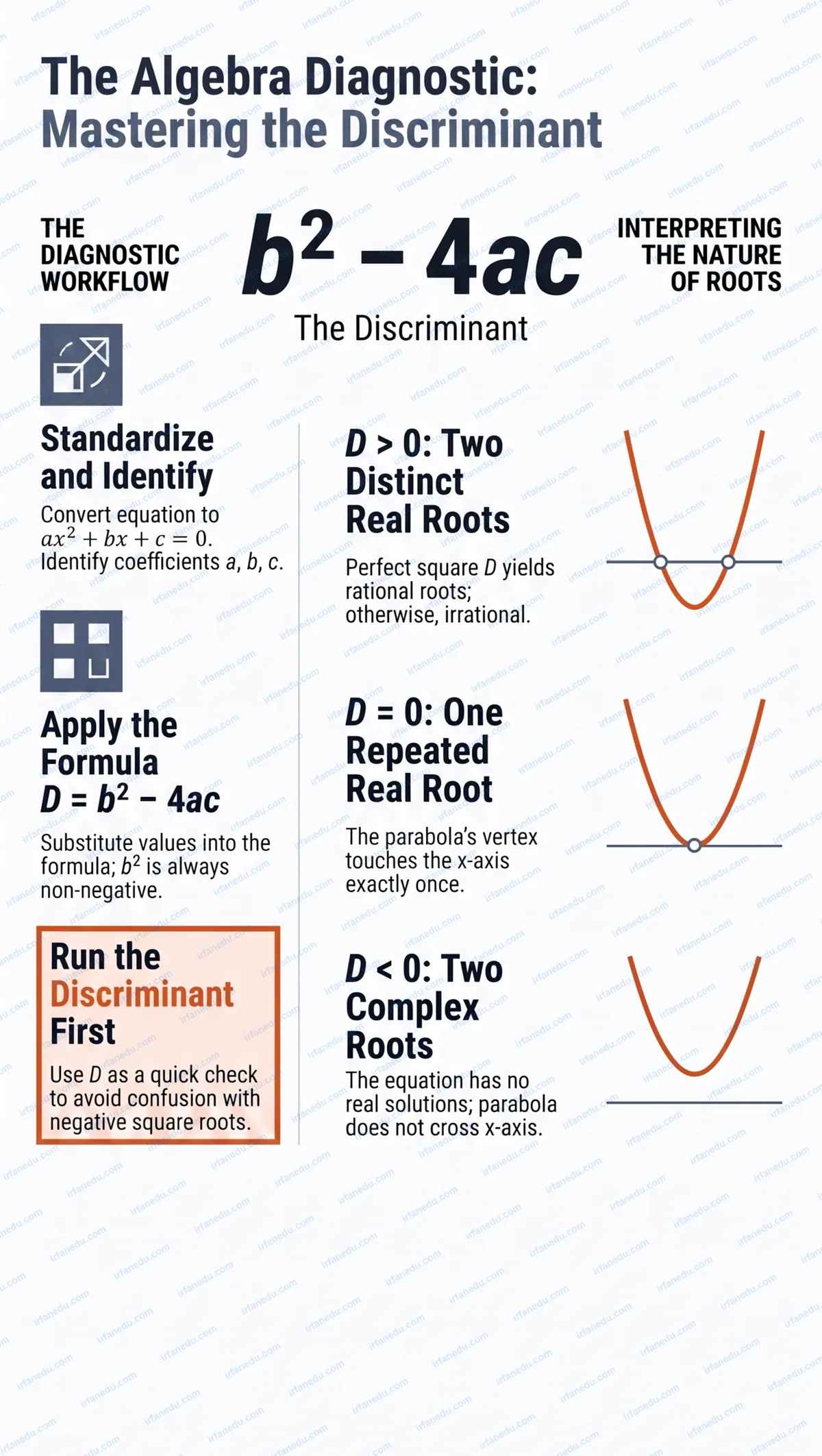
The first time I taught the discriminant, a student raised her hand mid-lesson and said, “So it tells us the answer before we actually solve it?” I paused, smiled, and said: “Exactly. That’s the whole point.” That single expression — b²−4ac — is one of the most efficient tools in all of algebra.
The discriminant of a quadratic equation ax²+bx+c=0 is the value D = b²−4ac. It tells you instantly whether the equation has two distinct real roots (D > 0), one repeated real root (D = 0), or two complex roots (D < 0) — without solving the full equation.
Use the free interactive calculator below to compute the discriminant of any quadratic equation in seconds, with a full numbered step-by-step solution. Then scroll down for the worked examples, formula breakdown, and everything else you need to master this concept.
- 🎯 Compute b²−4ac for any quadratic equation instantly
- 📋 See a numbered step-by-step solution with your actual values
- 🔍 Understand what the result means (real, repeated, or complex roots)
- 📐 Learn the formula, common mistakes, and real-world applications
⚡ TL;DR – Quick Summary
- ✅ Discriminant formula: D = b²−4ac for ax²+bx+c=0
- ✅ D > 0: two distinct real roots (rational if D is a perfect square)
- ✅ D = 0: one repeated real root (the vertex touches the x-axis)
- ✅ D < 0: no real roots — two complex conjugate roots
- ✅ Enter a, b, c above to get the result and full steps instantly
- ✅ The discriminant lives inside the quadratic formula under the square root sign
📑 Table of Contents
| Property | Detail |
|---|---|
| Formula | D = b²−4ac |
| Applies to | Quadratic equations ax²+bx+c=0 (a ≠ 0) |
| D > 0 | Two distinct real roots |
| D = 0 | One repeated real root |
| D < 0 | Two complex (imaginary) roots |
| D = perfect square & D > 0 | Two distinct rational roots |
| Named after | Derived from the Latin discriminare (to distinguish) |
🧮 Worked Example First — See It in Action
Before I define anything formally, let me show you exactly what the discriminant does with a real equation. This is how I open every lesson on this topic — example first, definition second.
Example: Solve x² − 5x + 6 = 0 using the discriminant
Step 1 — Identify a, b, c:
Comparing x² − 5x + 6 = 0 with ax² + bx + c = 0:
a = 1, b = −5, c = 6
Step 2 — Apply the formula:
D = b² − 4ac
D = (−5)² − 4(1)(6)
D = 25 − 24
D = 1
Step 3 — Interpret:
D = 1 > 0, and 1 is a perfect square (√1 = 1).
∴ The equation has two distinct rational real roots.
Step 4 — Find the roots (optional, using the full formula):
x = (−b ± √D) / (2a) = (5 ± 1) / 2
x = 3 or x = 2 ✓
Notice how the discriminant (D = 1) told us the outcome before we computed the roots. That is its superpower. Now let me show you the interactive calculator that automates every one of those steps.
🖩 Interactive Discriminant Calculator
Discriminant Calculator
Enter a, b, c for ax² + bx + c = 0
Enter the coefficients of your quadratic equation in standard form: ax² + bx + c = 0
a
b
c
📋 Step-by-Step Solution
For the quadratic equation ax² + bx + c = 0, the discriminant D determines the nature of the roots without fully solving the equation.
| Symbol | Meaning | Notes |
|---|---|---|
| D | Discriminant | The key value: b²−4ac |
| a | Leading coefficient (x²) | Must be ≠ 0 |
| b | Coefficient of x | Can be any real number |
| c | Constant term | Can be any real number |
| √D | Square root of discriminant | Real if D ≥ 0; imaginary if D < 0 |
The full quadratic formula is: x = (−b ± √(b²−4ac)) / (2a). The discriminant is the expression under the radical sign.
What Does the Discriminant Tell You?
| Value of D | Nature of Roots | Graph Behavior |
|---|---|---|
| D > 0 (perfect square) | Two distinct rational real roots | Parabola crosses x-axis at 2 rational points |
| D > 0 (not perfect square) | Two distinct irrational real roots | Parabola crosses x-axis at 2 irrational points |
| D = 0 | One repeated real root (double root) | Parabola touches x-axis at vertex |
| D < 0 | Two complex conjugate roots | Parabola does not touch x-axis |
📋 How to Use This Discriminant Calculator
Using the calculator takes under 30 seconds. Here is the exact process:
- Write your quadratic in standard form: Make sure it looks like ax² + bx + c = 0. Move all terms to one side if needed.
- Identify a, b, and c: a is the coefficient of x², b is the coefficient of x, and c is the constant. If a term is missing, its coefficient is 0.
- Enter the values: Type a, b, and c into the three labeled input fields. Decimals and negatives are fully supported.
- Click “Calculate D = b²−4ac” (or press Enter inside any field).
- Read the result: You will see the discriminant value, a color-coded nature badge, unit-conversion chips with key sub-values, and a numbered step-by-step solution using your actual numbers.
- Click Reset to clear all fields and start a new calculation.
💡 Pro Tip
If your equation has fractions (e.g. ½x² + ¾x − 2 = 0), multiply through by the LCD first to get integer coefficients. The discriminant value will be the same — and the arithmetic is much cleaner.
📖 What Is the Discriminant?
The discriminant is the expression b² − 4ac that appears under the square root sign in the quadratic formula. It “discriminates” between the three possible types of solutions a quadratic equation can have.
The word comes from the Latin discriminare, meaning “to distinguish” or “to separate.” That is precisely what it does: it separates the three cases — two real roots, one real root, or no real roots — without requiring you to compute the roots themselves.
In graphical terms, the discriminant tells you how many times the parabola y = ax² + bx + c crosses or touches the x-axis. This connects algebra directly to geometry, which is one reason I find it so elegant to teach.
In my 15+ years of teaching algebra, I have found that students who internalize the discriminant early make far fewer errors on quadratic problems. Instead of blindly applying the quadratic formula and getting confused by a negative under the radical, they check D first. It takes five seconds and saves minutes of confusion. I always tell my students: “Run the discriminant before you run the formula.”
📐 The Formula Explained + Variables Table
The discriminant formula is derived directly from the quadratic formula. When you write x = (−b ± √(b²−4ac)) / (2a), the expression inside the square root is the discriminant. Its sign determines whether that square root produces a real number or an imaginary one.
| Symbol | Meaning | SI / Standard Unit | Notes |
|---|---|---|---|
| D | Discriminant | Dimensionless (pure number) | The key output of the formula |
| a | Coefficient of x² | Real number ≠ 0 | Determines parabola direction |
| b | Coefficient of x | Any real number | Can be 0 (no x term) |
| c | Constant term | Any real number | y-intercept of the parabola |
| b² | Square of b | Always ≥ 0 | Always non-negative |
| 4ac | Four times a times c | Real number | Can be positive, negative, or zero |
🎨 Visual Solution — Three Cases of the Discriminant
  D > 0: Two distinct real roots
  ─────────────────────────────────
        y
        │     *       *
        │   *   *   *   *
  ──────┼──*─────*─────*──────── x
        │         (two crossings)

  D = 0: One repeated real root
  ─────────────────────────────────
        y
        │
        │   *       *
        │     *   *
  ──────┼───────*─────────────── x
        │      (touches once)

  D < 0: No real roots (complex)
  ─────────────────────────────────
        y
        │     *   *
        │   *       *
  ──────┼─────────────────────── x
        │  (never crosses)
The visual above shows the three parabola behaviors. When D > 0, the parabola cuts through the x-axis at two points. When D = 0, it just grazes the axis at the vertex. When D < 0, it floats entirely above or below the axis (depending on the sign of a).
🔬 More Worked Examples
These two examples mirror exactly what the calculator's step-by-step output produces. Use them to verify your understanding.
Example 2: 2x² + 4x + 2 = 0 (D = 0 case)
Step 1: a = 2, b = 4, c = 2
Step 2: D = b² − 4ac = (4)² − 4(2)(2) = 16 − 16 = 0
Step 3: D = 0 → one repeated real root
Step 4: x = −b / (2a) = −4 / 4 = −1 (double root)
✅ The parabola touches the x-axis exactly once at x = −1.
Example 3: x² + x + 1 = 0 (D < 0 case)
Step 1: a = 1, b = 1, c = 1
Step 2: D = b² − 4ac = (1)² − 4(1)(1) = 1 − 4 = −3
Step 3: D = −3 < 0 → two complex conjugate roots (no real roots)
Step 4: x = (−1 ± √(−3)) / 2 = −½ ± (√3/2)i
✅ The parabola never crosses the x-axis. The roots are imaginary.
💡 Rational vs. Irrational Roots
When D > 0, check if D
Sources & References
Reviewed by Dr. Irfan Mansuri. External links open in a new tab and are provided for further reading and verification.