
✓ Expert Reviewed by Dr. Irfan Mansuri | Last Updated: July 2026
Wuthering Heights Chapter Summaries: The Complete Student Guide
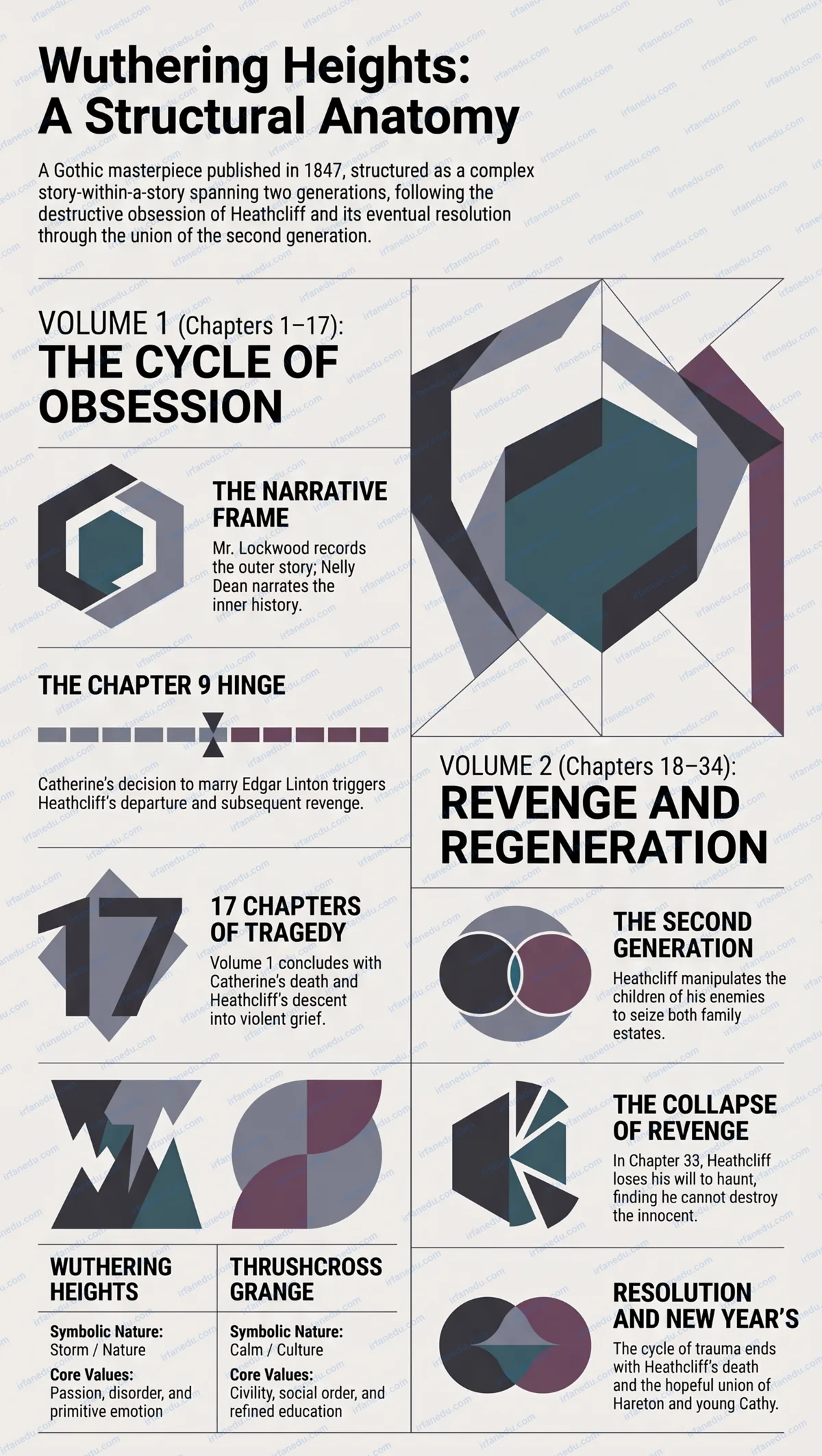
Table of Contents
- What Is Wuthering Heights — Key Facts
- Why It Matters — Themes and Significance
- How to Read It — Structure and Narrators
- Volume 1 Chapter Summaries (Ch. 1–17)
- Volume 2 Chapter Summaries (Ch. 18–34)
- Key Characters at a Glance
- Common Mistakes Students Make
- Visual Structure of the Novel
- Quick Knowledge Quiz
- Practice Problems
- Frequently Asked Questions
- Sources & References
Wuthering Heights has 34 chapters split into two volumes. Volume 1 (Chapters 1–17) covers Heathcliff’s arrival, his bond with Catherine, her marriage to Edgar Linton, and her death. Volume 2 (Chapters 18–34) follows the second generation — young Cathy, Hareton, and Linton Heathcliff — as Heathcliff’s revenge plays out and finally collapses under the weight of his own grief.
I have taught this novel at multiple levels, and I can tell you that students who struggle with it almost always have the same problem: they lose track of who is who and when things happen. This guide solves that. I walk you through every chapter, every key character, and every major theme — clearly and without filler.
- Understand the full plot of all 34 chapters
- Identify the two narrators and why they matter
- Trace Heathcliff’s arc from orphan to avenger to broken man
- Recognize the novel’s major themes for essays and exams
- Spot common student errors in analysis
TL;DR – Quick Summary
- 34 chapters, two volumes, two narrators (Lockwood and Nelly Dean)
- Volume 1: Heathcliff’s rise, Catherine’s marriage, and her tragic death
- Volume 2: Heathcliff’s revenge on the second generation, then his collapse
- Two symbolic settings: wild Wuthering Heights vs. refined Thrushcross Grange
- Central theme: destructive love and the cycle of revenge across two families
- Ends with Heathcliff’s death and a hopeful future for Hareton and young Cathy
What Is Wuthering Heights — Key Facts
Before diving into chapter summaries, you need a solid factual foundation. These facts come up constantly in exams and essays.
| Fact | Detail |
|---|---|
| Author | Emily Brontë (pen name: Ellis Bell) |
| Published | 1847, by Thomas Cautley Newby |
| Genre | Gothic fiction, Victorian novel |
| Setting | Yorkshire moors, England; late 18th century |
| Total chapters | 34 (Volume 1: Ch. 1–17; Volume 2: Ch. 18–34) |
| Primary narrator | Mr. Lockwood (outer frame) |
| Secondary narrator | Nelly Dean (inner story) |
| Central characters | Heathcliff, Catherine Earnshaw, Edgar Linton |
| Time span | Approximately 1771–1802 |
| Key symbol | The moors — wild, boundless, untamed |
Why It Matters — Themes and Significance
Wuthering Heights is studied worldwide because it does something rare: it refuses to make its central character sympathetic in a conventional way. Heathcliff is cruel, calculating, and at times monstrous — yet readers feel his pain.
The novel matters for four core reasons. First, it explores how social class shapes identity and destroys relationships. Second, it shows how trauma, when left unaddressed, becomes a weapon turned on others. Third, it questions whether love can exist without possession. Fourth, it uses the natural landscape — the moors, the storms, the cold — as a direct mirror of its characters’ inner states.
In my experience, students who read Wuthering Heights as a romance miss the point entirely. Brontë is writing a warning, not a love story. The relationship between Heathcliff and Catherine is not one to admire — it is one to understand and analyze. Once you see it that way, every chapter becomes far more interesting.
The novel also pioneered the unreliable narrator technique. Both Lockwood and Nelly have blind spots, biases, and limited knowledge. Part of the intellectual challenge is figuring out what they are not telling you — or what they cannot see.
How to Read It — Structure and Narrators
The structure of Wuthering Heights is more complex than most Victorian novels. Understanding it before you read saves enormous confusion.
The novel opens in 1801 with Lockwood, a newcomer who rents Thrushcross Grange. He visits Heathcliff at Wuthering Heights, gets snowed in, and has a terrifying dream involving a ghost named Catherine. Curious, he asks Nelly Dean to explain the history — and she does, taking the story back to roughly 1771. Most of the novel is Nelly’s account, told to Lockwood.
This layered structure means you should always ask: who is telling this part of the story, and what might they be leaving out or distorting?
Volume 1 Chapter Summaries (Chapters 1–17)
Volume 1 establishes the world, the central relationship, and the catastrophe that drives the rest of the novel. Here is a clear, chapter-by-chapter breakdown.
Chapters 1–3: Lockwood Arrives
Chapter 1: Lockwood visits his landlord Heathcliff at Wuthering Heights. The house is bleak, the inhabitants hostile. He meets a young woman and a rough young man. Heathcliff is cold but allows Lockwood inside. The atmosphere is immediately unsettling.
Chapter 2: Lockwood returns to Wuthering Heights and is forced to stay the night due to snow. He meets young Cathy (Heathcliff’s daughter-in-law) and Hareton Earnshaw, who is illiterate and sullen. The household dynamic is tense and strange.
Chapter 3: Lockwood sleeps in a closet-bed and finds old diaries by a girl named Catherine Earnshaw. He has a nightmare in which a ghost-child, Catherine, scratches at the window begging to be let in. He wakes screaming. Heathcliff’s reaction to the dream is one of raw, barely controlled anguish — a key moment for understanding his character.
Chapters 4–7: Heathcliff’s Origins and Early Life
Chapter 4: Back at Thrushcross Grange, Nelly Dean begins her account. Mr. Earnshaw brings a dark, homeless boy — Heathcliff — home from a trip to Liverpool. The family reacts with hostility, except for Catherine, who bonds with him immediately.
Chapter 5: Mr. Earnshaw grows increasingly fond of Heathcliff and increasingly distant from his own son, Hindley. Hindley’s resentment deepens. Mr. Earnshaw dies, and Hindley inherits Wuthering Heights.
Chapter 6: Hindley returns with a wife, Frances, and immediately demotes Heathcliff to servant status. Catherine and Heathcliff spy on Thrushcross Grange and observe the Linton children — Edgar and Isabella — in their refined, comfortable world. Catherine is bitten by a dog and stays at the Grange for five weeks to recover, returning noticeably more refined.
Chapter 7: Catherine returns changed — polished and genteel. The contrast between her new refinement and Heathcliff’s rough servitude is stark. Heathcliff vows to seek revenge on Hindley.
Chapters 8–12: Love, Marriage, and Fracture
Chapter 8: Frances Earnshaw dies after giving birth to Hareton. Hindley descends into alcoholism and neglect. Heathcliff and Catherine grow closer, but Edgar Linton is also courting Catherine.
Chapter 9: This is one of the novel’s most important chapters. Catherine tells Nelly she has accepted Edgar’s marriage proposal. She also tells Nelly that her love for Edgar is like the leaves in the woods — it will change — but her love for Heathcliff is like the eternal rocks beneath. Heathcliff overhears only the first part and leaves Wuthering Heights. He disappears for three years.
Chapter 10: Three years later, Heathcliff returns — transformed. He is now wealthy, well-dressed, and composed. No one knows where he has been or how he acquired his money. He moves into Wuthering Heights as Hindley’s lodger and begins gambling with Hindley, systematically ruining him.
Chapter 11: Heathcliff begins paying attention to Isabella Linton, Edgar’s sister. Catherine is disturbed and jealous. She confronts Heathcliff. The tension between Catherine and Edgar escalates into a serious quarrel.
Chapter 12: Catherine locks herself in her room, refuses to eat, and becomes feverish and delirious. She hallucinates and talks wildly about her childhood on the moors. This chapter marks the beginning of her physical and mental collapse.
Chapter 9 is the hinge of the entire novel. Everything that follows — Heathcliff’s revenge, Catherine’s illness, the second generation’s suffering — flows from that one overheard conversation. I always tell my students: if you understand Chapter 9, you understand the book.
Chapters 13–17: Elopement, Crisis, and Death
Chapter 13: Isabella has eloped with Heathcliff. She writes a letter to Nelly describing her miserable life at Wuthering Heights. Heathcliff treats her with contempt. It is clear he married her purely to gain access to the Linton property and to wound Edgar.
Chapter 14: Nelly visits Isabella at Wuthering Heights. Heathcliff asks Nelly to arrange a meeting with Catherine. His obsession with Catherine is absolute and terrifying.
Chapter 15: Heathcliff visits the dying Catherine at Thrushcross Grange while Edgar is at church. Their reunion is passionate and agonizing. Catherine blames Heathcliff for her suffering; he blames her for choosing Edgar. She dies shortly after giving birth to a daughter, also named Catherine (young Cathy).
Chapter 16: Catherine dies. Heathcliff is told of her death by Nelly. His grief is violent and almost supernatural — he begs her ghost to haunt him, to never leave him in peace. Edgar mourns quietly. The contrast between the two men’s grief is one of the novel’s most powerful moments.
Chapter 17: Isabella flees Wuthering Heights after a violent confrontation with Heathcliff. She tells Nelly what life there has been like. She settles in the south and later gives birth to Linton Heathcliff. Hindley dies, and Heathcliff — through the gambling debts — takes possession of Wuthering Heights.
[IMAGE: A diagram showing the two houses and the characters associated with each | ALT: Wuthering Heights vs Thrushcross Grange character map diagram]
Volume 2 Chapter Summaries (Chapters 18–34)
Volume 2 shifts focus to the second generation. Young Cathy grows up at Thrushcross Grange, sheltered and educated. Hareton grows up at Wuthering Heights, neglected and illiterate. Linton Heathcliff — sickly and weak — becomes Heathcliff’s instrument of revenge.
Chapters 18–21: The Second Generation
Chapter 18: Young Cathy is now thirteen. She is curious, spirited, and confined to the Grange by her protective father. She discovers the moors and Wuthering Heights for the first time and meets Hareton, not knowing who he is.
Chapter 19: Linton Heathcliff arrives at Thrushcross Grange after his mother Isabella’s death. He is delicate and timid. Edgar is kind to him, but Heathcliff demands his son be sent to Wuthering Heights.
Chapter 20: Nelly takes Linton to Wuthering Heights. Heathcliff is contemptuous of his own son’s weakness but sees him as a legal tool to inherit the Linton property through marriage to young Cathy.
Chapter 21: Three years later, young Cathy meets Linton on the moors. They begin a secret correspondence. Heathcliff encourages the relationship, manipulating both young people toward his goal.
Chapters 22–27: The Trap Closes
Chapter 22: Edgar Linton falls seriously ill. Young Cathy, worried about Linton, is drawn further toward Wuthering Heights. Heathcliff plays on her sympathy.
Chapter 23: Young Cathy visits Linton, who is also ill and petulant. The visit is uncomfortable, but young Cathy feels responsible for him.
Chapter 24: Young Cathy tells Nelly about her secret visits to Wuthering Heights. Nelly informs Edgar, who forbids further contact. The letters are confiscated.
Chapter 25: Edgar is dying. He agrees to let young Cathy meet Linton on the moors, hoping a marriage might still be possible and that Linton might be a kind companion for his daughter after his death.
Chapter 26: Young Cathy and Nelly meet Linton on the moors. He is clearly terrified of Heathcliff and begs young Cathy to stay with him. Something is clearly very wrong.
Chapter 27: Heathcliff lures young Cathy and Nelly to Wuthering Heights and locks them in. He forces young Cathy to marry Linton before Edgar dies — so that the Linton property will pass to Linton and then to Heathcliff. Edgar dies without seeing his daughter. Young Cathy is a prisoner.
Chapters 28–34: Collapse and Resolution
Chapter 28: Young Cathy escapes briefly to see her dying father but arrives after his death. She returns to Wuthering Heights as Heathcliff’s prisoner. Linton dies shortly after, leaving everything to Heathcliff as planned.
Chapter 29: Heathcliff has Catherine’s grave opened and arranges to be buried beside her. He tells Nelly that Catherine’s presence has haunted him since her death — he has felt her everywhere, in everything, for eighteen years.
Chapter 30: Zillah, the housekeeper, describes life at Wuthering Heights to Nelly. Young Cathy is isolated and miserable. Hareton tries to befriend her but she rebuffs him initially.
Chapter 31: Lockwood visits Wuthering Heights and observes young Cathy and Hareton. He sees Hareton trying to read — young Cathy has begun teaching him. A tentative friendship is forming.
Chapter 32: Lockwood returns to the area months later. He learns from Nelly that young Cathy and Hareton have grown close. Young Cathy is teaching Hareton to read and write. Their relationship mirrors the original bond between Catherine and Heathcliff — but without the destruction.
Chapter 33: Heathcliff confronts young Cathy and Hareton but finds he cannot harm them. He tells Nelly that he has lost the desire for revenge. He sees in Hareton’s face the image of Catherine, and it undoes him. He stops eating and becomes increasingly detached from the world.
Chapter 34: Heathcliff is found dead in the closet-bed where Lockwood once slept — the same room where Catherine’s ghost appeared. His face is described as having a strange, satisfied expression. Hareton and young Cathy plan to marry on New Year’s Day. Lockwood visits the three graves on the moors — Catherine, Edgar, and Heathcliff — and the novel ends.
VOLUME 1 (Ch. 1-17)                    VOLUME 2 (Ch. 18-34)
|                                       |
Ch.1-3   Lockwood's frame / Ghost       Ch.18-21  Second generation introduced
  |                                         |
Ch.4-7   Heathcliff arrives / Hindley   Ch.22-27  Heathcliff's trap closes
  |       demotes him                       |
Ch.8-9   Catherine chooses Edgar        Ch.28-31  Young Cathy imprisoned / Linton dies
  |       Heathcliff LEAVES                 |
Ch.10-12 Heathcliff RETURNS wealthy     Ch.32-33  Heathcliff loses will for revenge
  |
Ch.13-17 Isabella elopes / Catherine    Ch.34     Heathcliff dies / Hareton + Cathy
          DIES / Hindley dies                      plan to marry / Lockwood at graves

KEY TENSION:
Wuthering Heights [passion / nature / disorder]
        vs.
Thrushcross Grange [civility / order / refinement]
Key Characters at a Glance
Keeping track of characters is the single biggest challenge for new readers. This table gives you the essentials for every major figure.
| Character | Role | Key Trait | Fate |
|---|---|---|---|
| Heathcliff | Protagonist / Antagonist | Obsessive, vengeful, passionate | Dies in Chapter 34 |
| Catherine Earnshaw | Central love interest | Passionate, selfish, torn | Dies in Chapter 15 (Volume 1) |
| Edgar Linton | Catherine’s husband | Refined, gentle, steady | Dies in Chapter 28 |
| Hindley Earnshaw | Catherine’s brother | Resentful, self-destructive | Dies in Chapter 17 |
| Isabella Linton | Edgar’s sister / Heathcliff’s wife | Naive, then disillusioned | Dies off-page before Ch. 19 |
| Nelly Dean | Inner narrator / housekeeper | Practical, moralistic | Survives; tells the story |
| Mr. Lockwood | Outer narrator / tenant | Self-important, naive | Survives; frames the story |
| Young Cathy | Second-generation heroine | Spirited, compassionate | Plans to marry Hareton |
| Hareton Earnshaw | Second-generation hero | Rough but kind-hearted | Plans to marry young Cathy |
| Linton Heathcliff | Heathcliff’s son | Sickly, petulant, fearful | Dies in Chapter 28 |
Common Mistakes Students Make
After years of teaching this novel, I have seen the same errors appear in essays and exams again and again. Here is how to avoid them.
| Wrong Approach | Correct Approach |
|---|---|
| Calling Heathcliff and Catherine’s love “romantic” or “ideal” | Recognizing it as obsessive, mutually destructive, and rooted in childhood trauma |
| Treating Nelly Dean as a reliable, neutral narrator | Questioning Nelly’s perspective — she is involved, biased, and sometimes complicit |
| Confusing Catherine Earnshaw with young Cathy Linton | Keeping a clear character map — they are mother and daughter, not the same person |
| Saying the novel ends tragically | Noting the qualified hope in the ending — Hareton and young Cathy represent regeneration |
| Ignoring the class theme | Analyzing how Heathcliff’s exclusion from the social order drives his entire revenge plot |
| Reading the moors as mere setting | Treating the moors as an active symbol — of freedom, wildness, and the characters’ inner states |
How to Read It — Step-by-Step Approach
If you are reading Wuthering Heights for the first time — or re-reading it for an exam — this five-step method will help you get the most from every chapter.
- Identify the narrator for each section. Is this Lockwood writing in his journal, or Nelly speaking to Lockwood, or a letter from Isabella? The narrator changes what you can trust.
- Map the two generations. Keep a simple list: Generation 1 (Heathcliff, Catherine Earnshaw, Edgar, Hindley, Isabella) and Generation 2 (young Cathy, Hareton, Linton Heathcliff). The novel mirrors one generation in the other.
- Track the two houses. Note which characters are at Wuthering Heights and which are at Thrushcross Grange in each chapter. Movement between the houses signals social and emotional change.
- Follow Heathcliff’s motivation. In every chapter, ask: what does Heathcliff want right now, and why? His motivation shifts from love to revenge to exhaustion.
- Note the weather and landscape. Brontë uses storms, frost, and the moors deliberately. When the weather is extreme, the emotional stakes are extreme.
Quick Knowledge Quiz
Test Your Knowledge: Wuthering Heights
Select an answer to see if you are correct. Green = correct. Red = incorrect.
1. In which chapter does Heathcliff leave Wuthering Heights after overhearing Catherine?
2. Who is the inner narrator of Wuthering Heights — the person who tells most of the story?
3. What is Heathcliff’s primary motivation in Volume 2 of the novel?
Practice Problems — Reveal on Click
Practice Q1: What does Catherine mean when she says her love for Heathcliff is “like the eternal rocks beneath”?
Catherine is contrasting her love for Edgar (pleasant but changeable, like foliage) with her love for Heathcliff (permanent, foundational, part of her identity). She says: “He’s more myself than I am.” This quote, from Chapter 9, is the novel’s most famous expression of the Heathcliff-Catherine bond. In an essay, you would analyze it as evidence of Catherine’s self-division — she wants social respectability (Edgar) and spiritual completeness (Heathcliff) simultaneously, and that impossibility destroys her.
Practice Q2: How does Brontë use the two houses as symbols throughout the novel?
Wuthering Heights represents raw nature, passion, disorder, and the working-class world Heathcliff inhabits. Thrushcross Grange represents civilization, refinement, wealth, and the social order that excludes Heathcliff. Characters who move between the houses (Catherine, young Cathy) are caught between these two worlds. The novel’s resolution — Hareton and young Cathy planning to leave Wuthering Heights for the Grange — suggests a synthesis: passion tempered by education and kindness.
Practice Q3: Why is Nelly Dean considered an unreliable narrator?
Nelly is not a neutral observer. She is personally involved in many of the events she describes, she makes moral judgments that color her account, and she sometimes withholds information or acts in ways that worsen situations (for example, not telling Edgar about Catherine’s deteriorating mental state quickly enough). Scholars like Britannica’s literary analysis note that Nelly’s reliability is a central interpretive question in the novel. A strong essay will interrogate her perspective rather than accept it at face value.
Frequently Asked Questions
How many chapters does Wuthering Heights have?
Wuthering Heights has 34 chapters divided into two volumes. Volume 1 covers Chapters 1 through 17, and Volume 2 covers Chapters 18 through 34. The novel was first published in 1847 by Emily Brontë under the pen name Ellis Bell. Most modern editions present all 34 chapters in a single continuous sequence.
Who narrates Wuthering Heights?
Wuthering Heights uses a frame narrative with two main narrators. Mr. Lockwood, a tenant at Thrushcross Grange, is the outer narrator. Nelly Dean, the housekeeper, is the inner narrator who tells most of the story from her firsthand experience with the Earnshaw and Linton families. Other voices — Isabella’s letter, Zillah’s account — appear within Nelly’s narrative.
What happens in Chapter 1 of Wuthering Heights?
In Chapter 1, Mr. Lockwood visits his landlord Heathcliff at Wuthering Heights. He observes the bleak, unwelcoming atmosphere of the house and the cold, hostile behavior of Heathcliff and the other inhabitants. This chapter establishes the gothic setting, introduces Heathcliff as a brooding and antisocial figure, and sets up Lockwood’s role as an outsider narrator who will ask Nelly Dean to explain the history.
What is the main theme of Wuthering Heights?
The central theme is destructive, obsessive love — particularly the bond between Heathcliff and Catherine Earnshaw. Other major themes include class and social ambition, revenge and cruelty, the conflict between nature and civilization, and the cycle of suffering passed from one generation to the next. The moors function as a symbol of freedom and wildness that runs through all these themes.
Why does Heathcliff leave Wuthering Heights?
Heathcliff leaves in Chapter 9 after overhearing Catherine tell Nelly that marrying him would degrade her socially, even though she claims her soul is bound to his. He hears only the damaging part and disappears for three years. He returns in Chapter 10, wealthy and transformed, consumed by a desire for revenge against Hindley Earnshaw and Edgar Linton — the men who, in his view, stole Catherine from him.
How does Wuthering Heights end?
In the final chapters, Heathcliff loses his will for revenge as he sees the younger Catherine and Hareton remind him of his lost love. He stops eating, becomes haunted by visions of Catherine, and dies alone in Chapter 34. Hareton and young Cathy plan to marry on New Year’s Day. Lockwood visits the three graves on the moors — Catherine, Edgar, and Heathcliff — and the novel ends on a quietly hopeful note.
What is the significance of the two houses in Wuthering Heights?
Wuthering Heights and Thrushcross Grange represent opposing worlds. Wuthering Heights symbolizes raw passion, nature