
🧮 Binomial Theorem Expansion Calculator: Expand (a+b)^n Instantly
🎯 Imagine you’re sitting in an exam and the question asks you to expand (2x + 3)^6. You know the formula exists, but multiplying it out term by term by hand would eat up 10 minutes — and one arithmetic slip ruins the whole answer. That’s exactly the situation this binomial theorem expansion calculator was built to solve.
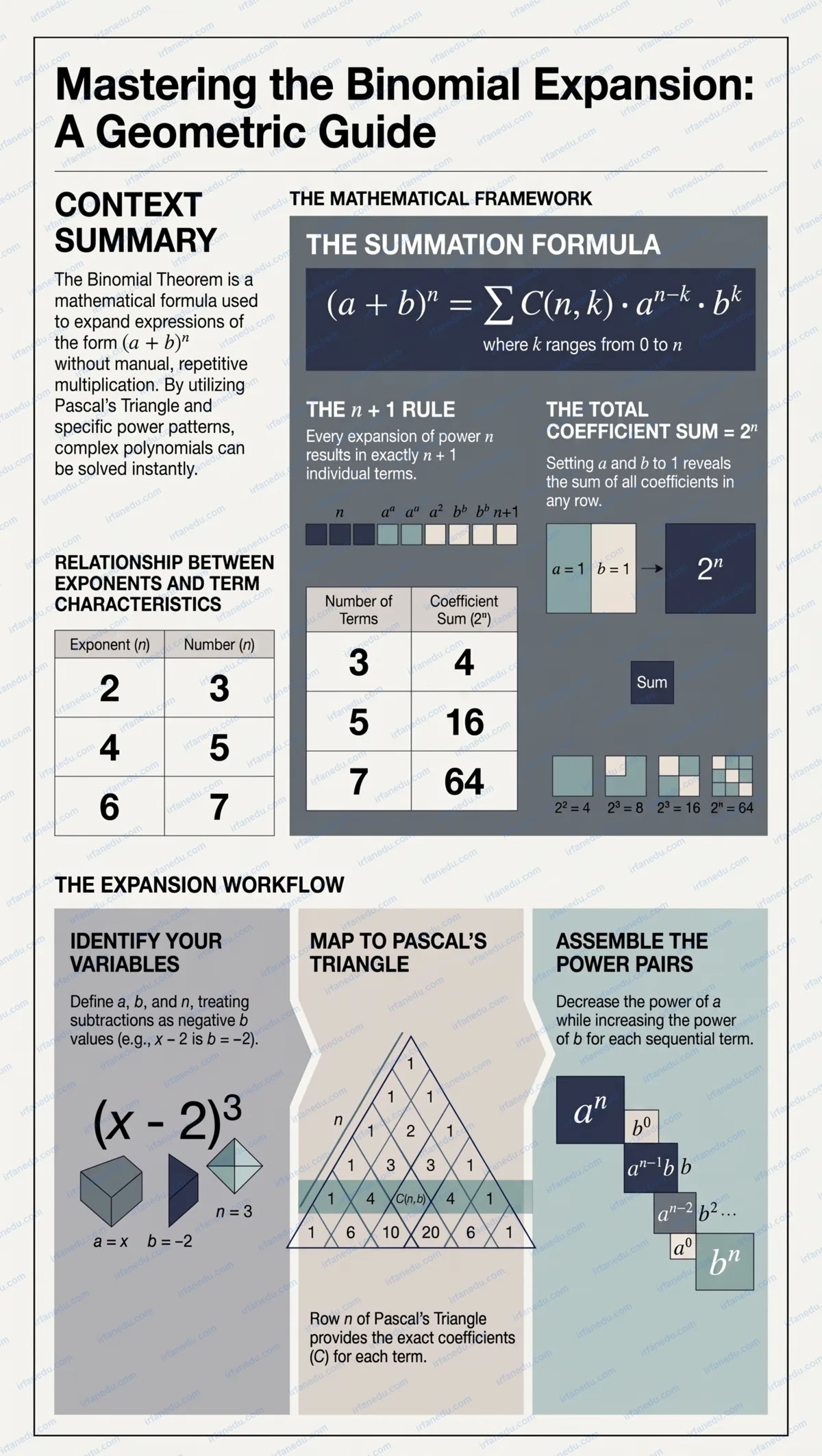
The binomial theorem expansion calculator expands any expression of the form (a + b)^n into its full polynomial form using the formula C(n,k) × a^(n−k) × b^k, showing every term, its binomial coefficient, and a numbered step-by-step solution — all instantly in your browser.
In my experience teaching algebra to hundreds of students, the binomial theorem is one of those topics where the formula looks intimidating but the pattern is actually beautiful once you see it. This page gives you the working calculator first, then the theory — because understanding why it works sticks better after you’ve seen it in action.
- ✅ Expand any
(a+b)^nfor n = 0 to 15 - ✅ See every term with its coefficient, power pair, and value
- ✅ Get the matching Pascal’s triangle row
- ✅ Understand the formula with worked examples and a visual diagram
- ✅ Avoid the 3 most common expansion mistakes
⚡ TL;DR – Quick Summary
- 🔢 (a+b)^n expands into n+1 terms using C(n,k) × a^(n−k) × b^k
- 📐 Binomial coefficients come from Pascal’s triangle row n
- 🧮 Use the calculator above: enter a, b, n — get the full expansion instantly
- ⚠️ Most common mistake: forgetting to raise both a and b to their respective powers
- 🎯 The general term is T(r+1) = C(n,r) × a^(n−r) × b^r
- 📊 For n=4: coefficients are 1, 4, 6, 4, 1 — always symmetric
| 📌 Property | 📋 Detail |
|---|---|
| Full name | Binomial Theorem (Newton’s Binomial) |
| Formula | (a+b)^n = Σ C(n,k) · a^(n−k) · b^k, k=0 to n |
| Number of terms | n + 1 (always) |
| Coefficient source | Row n of Pascal’s triangle |
| Sum of all coefficients | 2^n (set a=b=1) |
| Alternating sum of coefficients | 0 (set a=1, b=−1) |
| Valid for | All real/complex a, b; n a non-negative integer (finite expansion) |
| First proved rigorously by | Isaac Newton (general case, 1665) |
📑 Table of Contents
- 🧮 Interactive Binomial Expansion Calculator
- 📖 How to Use This Calculator
- 🎨 Visual: Pascal’s Triangle Diagram
- 📚 What Is the Binomial Theorem?
- 🔢 The Formula Explained
- ✏️ 3 Fully Worked Examples
- ⚠️ Common Mistakes
- 🌍 Real-World Applications
- 💡 Unique Insight
- 🎯 Quick Quiz
- 🏋️ Practice Problems
- ❓ FAQ
- ✅ Key Takeaways
- 🔗 Related Articles
- 👤 About the Author
- 📚 Sources & References
Binomial Theorem Expansion Calculator
Enter a, b, and n to expand (a + b)^n with full step-by-step working
| Term # | k | C(n,k) | a^(n−k) | b^k | Value |
|---|
🔢 Step-by-Step Working
📖 How to Use This Calculator
Using this tool takes under 30 seconds. Here's the exact process:
- 🔢 Enter a — the first term of your binomial. For
(3x + 5)^4, if you're treating the coefficient as a, enter3. For a symbolic expansion, enter1and read the coefficients. - 🔢 Enter b — the second term. Use a negative number for subtraction:
(x − 2)^5means b = −2. - 🔢 Enter n — the exponent. Must be a whole number from 0 to 15.
- 🚀 Click "Expand Now" — the result card appears with the full expansion, a term table, Pascal's triangle row, and numbered steps.
- ↺ Click "Reset" to clear everything and start fresh.
(x + 2)^5, enter a = 1, b = 2, n = 5. The calculator gives you the numeric coefficients; you then multiply each coefficient by the corresponding power of x.
🎨 Visual: Pascal's Triangle & Binomial Coefficients
Every row of Pascal's triangle gives the coefficients for one power of (a+b)^n. Row 0 is the top. Each number is the sum of the two numbers directly above it.
  n=0:              1
  n=1:            1   1
  n=2:          1   2   1
  n=3:        1   3   3   1
  n=4:      1   4   6   4   1
  n=5:    1   5  10  10   5   1
  n=6:  1   6  15  20  15   6   1

  ┌─────────────────────────────────────────────┐
  │  (a+b)^0 = 1                                │
  │  (a+b)^1 = a + b                            │
  │  (a+b)^2 = a² + 2ab + b²                   │
  │  (a+b)^3 = a³ + 3a²b + 3ab² + b³          │
  │  (a+b)^4 = a⁴+4a³b+6a²b²+4ab³+b⁴         │
  │  (a+b)^5 = a⁵+5a⁴b+10a³b²+10a²b³+5ab⁴+b⁵│
  └─────────────────────────────────────────────┘

  🔑 Rule: Each entry = sum of the two above it.
  🔑 Row n has exactly n+1 entries.
  🔑 Entries are always symmetric (palindrome).
  🔑 Sum of row n = 2^n.
Notice how the coefficients in row 4 (1, 4, 6, 4, 1) map perfectly to the five terms of (a+b)^4. This visual is what makes the theorem click for most students.
📚 What Is the Binomial Theorem?
The binomial theorem gives a direct formula to expand any expression of the form (a + b)^n without multiplying it out step by step. It states that the k-th term (starting from k=0) equals C(n,k) × a^(n−k) × b^k.
The word "binomial" means two terms — "bi" (two) + "nomial" (terms). The theorem was known in various forms to ancient Indian and Chinese mathematicians, but Isaac Newton generalized it to non-integer exponents in 1665, according to Encyclopaedia Britannica.
In plain terms: instead of multiplying (a+b) by itself n times, you jump straight to any term you need using the formula. This is especially powerful when n is large — imagine expanding (x+1)^{12} by hand versus using the formula.
In my experience teaching this topic, the single biggest "aha moment" for students is realizing that Pascal's triangle isn't just a pretty pattern — it's a lookup table for the binomial theorem. Once a student sees that row 5 of the triangle is exactly the coefficients of (a+b)^5, the formula stops being abstract and becomes a tool they actually want to use. I always draw the triangle first, then derive the formula from it — never the other way around.
🔢 The Binomial Theorem Formula Explained
📌 The Core Formula
(a + b)^n = Σ C(n,k) × a^(n−k) × b^k [k = 0 to n]
Where: C(n,k) = n! / (k! × (n−k)!) is the binomial coefficient (also written ⁿCₖ or "n choose k").
🔣 Variables & Symbols Table
| Symbol | Meaning | Notes |
|---|---|---|
a |
First term of the binomial | Any real number |
b |
Second term of the binomial | Can be negative (for subtraction) |
n |
Exponent / power | Non-negative integer for finite expansion |
k |
Term index (runs 0 to n) | k=0 gives first term, k=n gives last |
C(n,k) |
Binomial coefficient ("n choose k") | = n! / (k!(n−k)!) |
T(r+1) |
General (r+1)-th term | = C(n,r) × a^(n−r) × b^r |
n! |
n factorial | n × (n−1) × ... × 2 × 1; 0! = 1 |
📏 Key Properties
- 🔢 Number of terms: always n + 1
- 🔄 Symmetry: C(n,k) = C(n, n−k) — coefficients are a palindrome
- ➕ Sum of coefficients: set a=b=1 → 2^n
- ➖ Alternating sum: set a=1, b=−1 → 0 (for n ≥ 1)
- 🏆 Largest coefficient: the middle term(s) when n is even/odd
✏️ 3 Fully Worked Examples
These examples mirror exactly what the calculator's step-by-step output produces. Try each one in the calculator above to verify