
Transition words for argumentative essays are words and phrases that signal the logical relationship between two ideas — such as contrast, cause, concession, or conclusion — helping the reader follow your argument from one point to the next without confusion.
Transition Words for Argumentative Essays: The Complete Guide
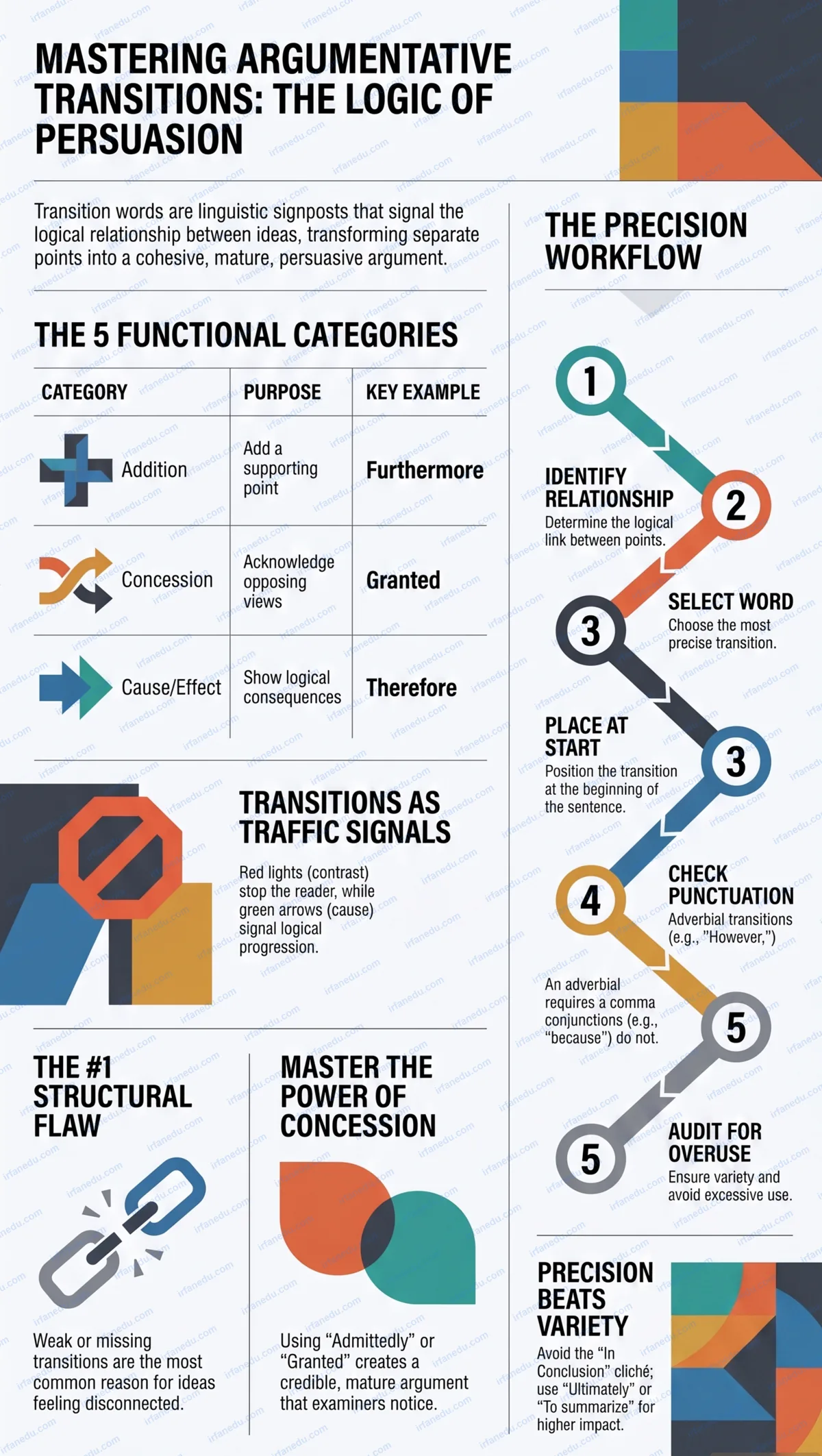
Transition words for argumentative essays are linking phrases — such as “However,” “As a result,” and “Admittedly” — that connect sentences and paragraphs by signalling the logical relationship between ideas. Using them precisely makes your argument easier to follow, signals strong reasoning to the reader, and is one of the fastest ways to raise the quality of any persuasive piece.
If you have ever read your own essay back and felt like the ideas were floating separately rather than building toward a conclusion, the problem is almost certainly missing or misused transitions. I have reviewed thousands of student essays over 15 years, and weak transitions are the single most common structural flaw I see — even in otherwise strong writing.
This guide covers every category of argumentative transition, shows you real before-and-after examples, corrects the mistakes most guides ignore, and gives you a step-by-step process for placing transitions with precision.
- The five functional categories of argumentative transitions and when to use each
- How to introduce, support, concede, and conclude an argument with the right words
- The most common transition mistakes and exactly how to fix them
- A visual map of transitions organised by purpose
- A 3-question quiz and reveal-on-click practice problems
- Transition words signal logical relationships: contrast, cause, addition, concession, conclusion.
- Match the transition to the exact relationship — precision beats variety.
- Concession transitions (“Admittedly,” “Granted”) are the most underused and most powerful.
- One strong transition per paragraph opening is enough; overuse weakens writing.
- Adverbial transitions need a comma after them; conjunctions do not.
- The biggest mistake: using “however” when you mean “therefore” — they signal opposite logic.
| Category | Purpose | Key Examples |
|---|---|---|
| Addition | Add a supporting point | Furthermore, In addition, Besides |
| Contrast | Introduce an opposing idea | However, In contrast, On the other hand |
| Concession | Acknowledge the opposing view before refuting it | Admittedly, Granted, It is true that |
| Cause & Effect | Show a result or consequence | Therefore, Consequently, As a result |
| Conclusion | Summarise or close the argument | Ultimately, To summarise, All things considered |
What Are Transition Words?
Transition words are words and phrases that link one idea to the next. They act as signposts, telling the reader what kind of logical move you are making before they read the next sentence.
Think of them as traffic signals for your argument. A red light (contrast) tells the reader: “Stop — the next idea pushes back against what I just said.” A green arrow (cause and effect) says: “Keep going — this next point follows logically from the last.” Without these signals, the reader has to guess your logic, and guessing is exhausting.
In argumentative writing specifically, transitions do more than just connect sentences. They reveal the structure of your reasoning. A well-placed “Admittedly” tells the reader you are about to acknowledge a weakness in your own position — which is a mark of intellectual honesty that actually strengthens your argument. A precise “Therefore” tells the reader you have just drawn a logical conclusion from evidence.
[IMAGE: A simple diagram showing two paragraphs connected by a transition phrase arrow | ALT: diagram showing how transition words connect argumentative essay paragraphs]
Why Transition Words Matter in Argument
Strong arguments are not just about having good evidence. They are about making the logical path from evidence to conclusion feel inevitable. Transition words are the mechanism that creates that feeling.
In my experience marking undergraduate essays, the difference between a B-grade and an A-grade piece is often not the quality of the ideas — it is the quality of the connections between them. A student who writes “The policy reduced crime rates. There were still concerns about civil liberties.” has two valid points floating in space. A student who writes “The policy reduced crime rates. Even so, serious concerns about civil liberties remained” has an argument with a clear internal tension that demands resolution.
The most neglected category of transitions is concession. Most students know “however” and “therefore.” Very few use “admittedly,” “granted,” or “it must be acknowledged that.” In my experience, a single well-placed concession transition transforms a one-sided rant into a mature, credible argument. Examiners notice this immediately. If you want to stand out, master concession transitions before anything else.
Transitions also help with passage indexing in academic search. When Google or a database indexes your writing, clear logical connectors help the system understand the structure of your argument. For students writing for online publication or academic submission systems, this is a practical advantage worth knowing.
The Five Core Categories of Argumentative Transitions
Every transition word in an argumentative essay belongs to one of five functional categories. Knowing the category tells you exactly when to use each word.
1. Addition Transitions
Use these when you are adding a new supporting point that reinforces the same argument.
| Transition | Formality | Best used when |
|---|---|---|
| Furthermore | Formal | Adding a second, equally strong point |
| In addition | Neutral | Adding a supporting detail or statistic |
| Besides | Semi-formal | Adding a point that feels supplementary |
| Not only that, but | Emphatic | Adding a point that escalates the argument |
| What is more | Formal | Stacking evidence that builds momentum |
Weak: “Renewable energy reduces carbon emissions. It creates jobs.”
Strong: “Renewable energy reduces carbon emissions. What is more, the sector creates significantly more jobs per unit of energy produced than fossil fuel industries.”
2. Contrast Transitions
Use these when the next idea stands in opposition to the previous one.
| Transition | Formality | Best used when |
|---|---|---|
| However | Formal | Introducing a direct contradiction or qualification |
| In contrast | Formal | Comparing two clearly different things |
| On the other hand | Neutral | Presenting the other side of a two-sided issue |
| Nevertheless | Formal | Continuing your argument despite a complication |
| Yet | Semi-formal | A sharper, more concise contrast |
3. Concession Transitions
Concession transitions are the most sophisticated tool in argumentative writing. They signal that you are acknowledging the opposing view before you refute or qualify it.
| Transition | What it signals |
|---|---|
| Admittedly | “I accept this point, but it does not defeat my argument.” |
| Granted | “I concede this fact, but here is why it does not change my conclusion.” |
| It is true that | “The opposing view has merit, but consider this.” |
| Although / Even though | Introduces a concessive clause within a sentence |
| While it may be argued that | Formal academic concession before rebuttal |
Without concession: “Standardised testing is harmful and should be abolished.”
With concession: “Admittedly, standardised testing provides a consistent benchmark that is difficult to replicate through other means. Nevertheless, the evidence consistently shows that it disadvantages students from lower-income backgrounds, which undermines its claim to fairness.”
4. Cause and Effect Transitions
Use these when you are showing that one thing results from or leads to another.
- Therefore / Thus / Hence — for logical conclusions drawn from evidence
- As a result / Consequently — for outcomes that follow from actions or events
- For this reason — links a cause directly to its effect in plain language
- This leads to / This results in — useful for chain-of-causation arguments
- Because / Since — conjunctions that introduce the cause within a sentence
Use “therefore” and “thus” for logical conclusions — where the conclusion follows from reasoning. Use “as a result” and “consequently” for causal outcomes — where one event causes another. Mixing them up is a subtle but real error that careful readers notice.
5. Conclusion and Summary Transitions
These signal that you are drawing the argument to a close or summarising your position.
- Ultimately — signals the final, most important takeaway
- To summarise — a clean, direct signal that you are condensing your argument
- All things considered — signals a balanced final judgement
- In short — brief and direct; works well after a long section
- The evidence suggests that — keeps the conclusion grounded in your argument
“In conclusion” is overused to the point of being invisible. Every examiner and editor has read it ten thousand times. Replace it with “Ultimately,” “To summarise,” or “The evidence presented here suggests that.” Your conclusion will immediately sound more confident and original.
How to Use Transition Words: Step-by-Step
Knowing the categories is the foundation. Using them correctly in your writing requires a five-step process I teach to every student I work with.
- Identify the logical relationship first. Before you write the transition, ask: am I adding, contrasting, conceding, showing cause, or concluding? The answer determines the category.
- Select the most precise word in that category. “However” and “Nevertheless” are both contrast transitions, but “nevertheless” signals that you are continuing your argument despite the complication, while “however” simply introduces a contradiction. Choose the one that fits your exact meaning.
- Place it at the start of the paragraph or clause. Paragraph-opening transitions signal the move before the reader reads the new point. Mid-sentence transitions (conjunctions like “although” and “because”) connect two clauses within a single sentence.
- Check your punctuation. Adverbial transitions (However, Therefore, Consequently, Admittedly) need a comma after them when they open a sentence. Conjunctions (although, because, since, while) do not take a comma after them — the comma, if needed, goes at the end of the dependent clause.
- Audit for overuse. Read the draft aloud. If you hear a transition at the start of every sentence, remove the weaker ones. One well-chosen transition per paragraph opening is enough.
Worked Examples: Before and After
The fastest way to internalise transition use is to see the same paragraph written without transitions and then with them. Below are two complete examples.
Before (no transitions):
“Plastic waste is a serious environmental problem. Governments have introduced bans on single-use plastics. The bans have reduced plastic bag use in many countries. Some critics argue the bans place an unfair burden on low-income consumers. The long-term environmental benefit outweighs the short-term inconvenience.”
After (transitions added):
“Plastic waste is a serious environmental problem. In response, governments have introduced bans on single-use plastics, and the results have been measurable: plastic bag use has fallen sharply in many countries that adopted such policies. Admittedly, critics argue that these bans place an unfair financial burden on low-income consumers. Nevertheless, the long-term environmental benefit — and the cost savings from reduced waste management — outweighs the short-term inconvenience for most households.”
Before:
“Remote learning became widespread during the pandemic. Students in rural areas gained access to courses they could not attend in person. Many students struggled without face-to-face support. Remote learning is not a complete replacement for classroom education.”
After:
“Remote learning became widespread during the pandemic, and for students in rural areas, it opened access to courses that were previously unavailable to them. However, a significant number of students struggled without the immediate, face-to-face support that a physical classroom provides. For this reason, remote learning is best understood as a powerful supplement to traditional education, not a complete replacement.”
Common Mistakes: Wrong vs. Right
Most guides list transitions without explaining the errors students make. Here are the five mistakes I see most often, with direct corrections.
| Mistake | Wrong | Right | Why |
|---|---|---|---|
| Using “however” when you mean “therefore” | “The data is clear. However, we must act.” | “The data is clear. Therefore, we must act.” | “However” signals contrast; “therefore” signals a conclusion drawn from evidence. |
| Missing comma after adverbial transition | “Consequently the policy failed.” | “Consequently, the policy failed.” | Adverbial transitions opening a sentence always need a comma after them. |
| Using “furthermore” to introduce a contrast | “The plan is affordable. Furthermore, it has been criticised.” | “The plan is affordable. However, it has attracted significant criticism.” | “Furthermore” adds a supporting point; it cannot introduce an opposing idea. |
| Overloading with transitions | “Firstly, … Secondly, … Thirdly, … Finally, …” | Use numbered transitions sparingly; vary with substantive transitions. | Mechanical numbering replaces reasoning with a list. It signals weak argument structure. |
| Using “in conclusion” in the final paragraph | “In conclusion, this essay has shown…” | “Ultimately, the evidence presented here demonstrates…” | “In conclusion” is a cliche that weakens the impact of your closing argument. |
In my experience, the single most mark-costly transition error is using “furthermore” to introduce a counterargument. I see it constantly. “Furthermore” is an addition signal — it tells the reader you are about to reinforce your current point. When the next sentence actually contradicts that point, the reader is confused and your argument loses credibility. If you are introducing a contrasting idea, always use “however,” “nevertheless,” or “on the other hand.” Never “furthermore.”
Visual Transition Map
  ┌─────────────────────────────────────────────────────────────┐
  │         ARGUMENTATIVE ESSAY TRANSITION MAP                  │
  ├──────────────┬──────────────────────────────────────────────┤
  │  ADDITION    │  Furthermore · In addition · What is more    │
  │  (support)   │  Besides · Not only that, but                │
  ├──────────────┼──────────────────────────────────────────────┤
  │  CONTRAST    │  However · In contrast · On the other hand   │
  │  (oppose)    │  Nevertheless · Yet · Despite this           │
  ├──────────────┼──────────────────────────────────────────────┤
  │  CONCESSION  │  Admittedly · Granted · It is true that      │
  │  (acknowledge│  Although · Even though · While it may be    │
  │   + refute)  │  argued that                                 │
  ├──────────────┼──────────────────────────────────────────────┤
  │  CAUSE &     │  Therefore · Thus · Consequently             │
  │  EFFECT      │  As a result · For this reason · Hence       │
  │  (conclude)  │  This leads to · Because · Since             │
  ├──────────────┼──────────────────────────────────────────────┤
  │  CONCLUSION  │  Ultimately · To summarise · All things      │
  │  (close)     │  considered · In short · The evidence        │
  │              │  suggests that                               │
  └──────────────┴──────────────────────────────────────────────┘

  ARGUMENT FLOW:
  [Claim] ──(In addition)──► [Support]
         ──(However)────────► [Counterpoint]
         ──(Admittedly)─────► [Concession] ──(Nevertheless)──► [Rebuttal]
         ──(Therefore)──────► [Conclusion]
Most transition word lists treat all contrast transitions as interchangeable. They are not. “However” simply introduces a contradiction. “Nevertheless” signals that you are continuing your argument despite the complication you just acknowledged — it is a persistence signal. “On the other hand” signals a two-sided comparison where both sides have merit. Using “nevertheless” where “however” belongs, or vice versa, sends the wrong logical signal to the reader. In my 15 years of teaching, I have never seen a mainstream student guide make this distinction clearly. When you choose the right contrast transition, you are not just connecting sentences — you are telling the reader exactly how confident you are in your position.
Quick Quiz: Test Your Knowledge
Transition Words Quiz
1. Which transition correctly completes this sentence? “The study found strong evidence for the policy. _____, critics raised concerns about its cost.”
2. A student writes: “Admittedly, the counterargument has some merit. _____, the weight of evidence still supports the original claim.” Which transition fits best?
3. Which of the following transition words signals a logical conclusion drawn from evidence?
Practice Problems
Practice 1: Choose the correct transition (click to reveal answer)
Sentence: “The new curriculum increased student engagement scores by 22%. _____, teacher workload also increased significantly.”
Options: A) Therefore B) However C) Admittedly
Answer: B) However. The increased workload stands in contrast to the positive engagement result. “However” signals this opposition clearly. “Therefore” would wrongly imply the workload increase is a logical conclusion of the engagement improvement.
Practice 2: Rewrite the paragraph using appropriate transitions (click to reveal model answer)
Original: “Electric vehicles produce zero direct emissions. They are expensive. Battery production has an environmental cost. The overall lifecycle emissions are lower than petrol vehicles.”
Model Answer: “Electric vehicles produce zero direct emissions at the point of use. Admittedly, they carry a higher purchase price, and battery production does involve a significant environmental cost. Nevertheless, lifecycle analyses consistently show that total emissions over the vehicle’s lifespan remain substantially lower than those of petrol-powered alternatives.”
Transitions used: “Admittedly” (concession), “Nevertheless” (rebuttal after concession). Note how the argument now has a clear three-part structure: claim, concession, rebuttal.
Practice 3: Identify the error and correct it (click to reveal answer)
Sentence: “The research clearly demonstrates a link between sleep deprivation and reduced academic performance. Furthermore, some researchers have questioned the methodology of these studies.”
Error: “Furthermore” is an addition transition — it signals a supporting point. But the second sentence introduces a challenge to the first, not a supporting point.
Correction: “The research clearly demonstrates a link between sleep deprivation and reduced academic performance. However, some researchers have questioned the methodology of these studies.”
Frequently Asked Questions
What are transition words in an argumentative essay?
What is the best transition word to introduce a counterargument?
How many transition words should I use per paragraph?
Can I start a sentence with “However” in a formal essay?
What is the difference between “although” and “even though”?
Are transition words the same as connectives?
Which transition words signal cause and effect?
Sources & References
Reviewed by Dr. Irfan Mansuri. External links open in a new tab and are provided for further reading and verification.