
Master this one rule and every equation type becomes predictable. The lesson and worksheet below build that habit from the ground up.
Balancing Equations Worksheet: Free Printable PDF + Answer Key
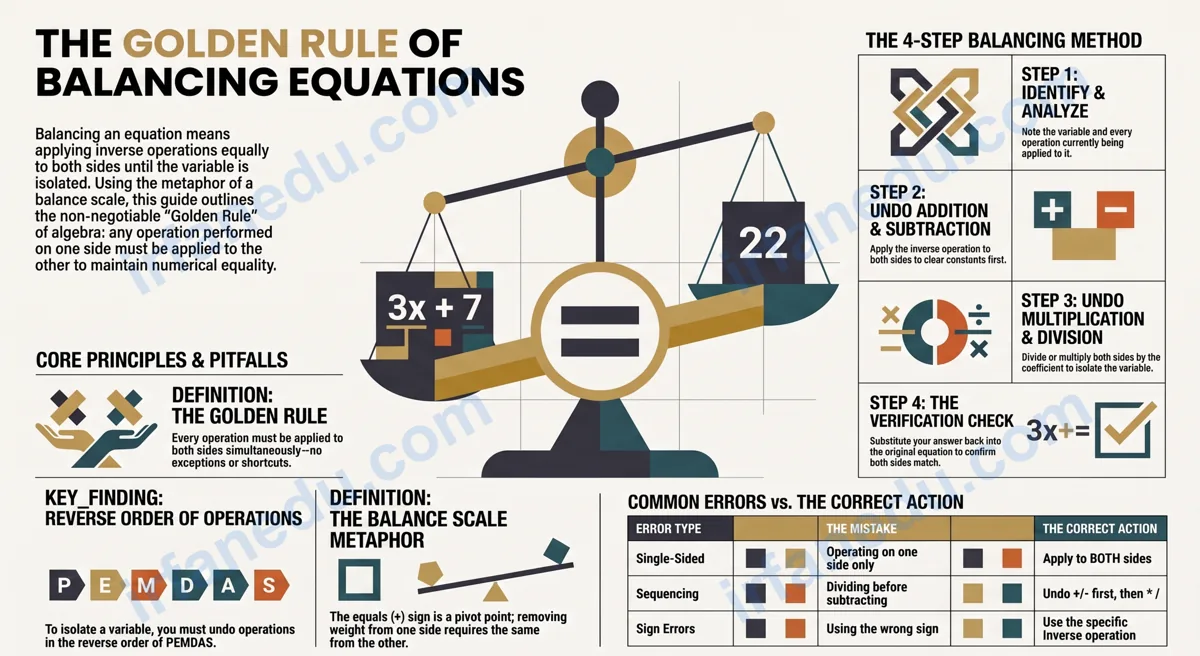
Balancing an equation means applying inverse operations equally to both sides until the variable stands alone. For algebraic equations, you undo addition, subtraction, multiplication, and division in reverse order of operations. The result is the value that makes both sides numerically equal.
- Understand what it means for an equation to be “balanced”
- Apply the four-step method to one-step, two-step, and multi-step equations
- Identify and correct the three most common balancing mistakes
- Complete 10 graded practice problems and check your answers
A balancing equations worksheet gives students structured practice in making both sides of an equation equal — by finding an unknown variable in algebra or adjusting coefficients in chemistry. This free worksheet covers 10 problems from easy to hard, includes a full answer key, and suits grades 6 through 10. The core rule: apply every operation to both sides of the equation simultaneously.
Free printable PDF worksheet (10 problems + full answer key, grades 6-10)
TL;DR – Quick Summary
- Balancing an equation = keeping both sides numerically equal at all times.
- Always perform the same operation on both sides — this is the non-negotiable rule.
- Undo addition/subtraction first, then multiplication/division (reverse PEMDAS).
- Always substitute your answer back to verify it works.
- 10 graded problems below, from x + 5 = 12 up to 2x^2 = 50.
- Free printable PDF with answer key available above.
| Feature | Detail |
|---|---|
| Grade Level | 6 – 10 |
| Skill Focus | Algebraic equation balancing (one-step to quadratic) |
| Number of Problems | 10 (easy to hard) |
| Answer Key | Included (on-page + PDF) |
| Core Rule | Same operation on both sides, every time |
| Prerequisite | Basic arithmetic, understanding of variables |
| Related Skill | Two-step equations, solving for x |
What Does It Mean to Balance an Equation?
An equation is balanced when both sides have exactly the same value. Think of a classic balance scale: if you add 3 kg to the left pan, you must add 3 kg to the right pan to keep it level. The equals sign (=) is that pivot point.
In algebra, “balancing” means isolating the variable — getting x alone on one side — while keeping both sides equal throughout every step. The equation x + 5 = 12 is balanced when x = 7, because 7 + 5 = 12 on both sides.
BEFORE SOLVING          AFTER SOLVING
  x + 5  |  12            x  |  7
---------+--------      -----+-----
  LEFT   = RIGHT          LEFT = RIGHT

  Subtract 5 from BOTH sides:
  (x + 5) - 5  =  12 - 5
       x       =   7   ✓
The same principle applies in chemistry: a balanced chemical equation has the same number of each type of atom on both the reactant side and the product side. This worksheet focuses on algebraic balancing, which is the foundation students need before tackling chemistry coefficients.
How to Balance an Equation: Step-by-Step Method
Follow these four steps in order for any algebraic equation. The steps apply whether the equation has one step or five.
- Identify the variable and note every operation applied to it.
- Undo addition or subtraction first — add or subtract the same constant on both sides.
- Undo multiplication or division second — divide or multiply both sides by the coefficient.
- Check by substituting your answer back into the original equation.
The order matters: you work in reverse order of operations (reverse PEMDAS/BODMAS). Multiplication was applied last to the variable, so you undo it last — after clearing the addition or subtraction first.
Worked Example 1 — One-Step Equation
Solve: x + 5 = 12
Step 1: The variable x has 5 added to it.
Step 2: Subtract 5 from both sides.
x + 5 – 5 = 12 – 5
x = 7
Check: 7 + 5 = 12. ✓ Both sides equal 12.
Worked Example 2 — Two-Step Equation
Solve: 2x + 4 = 14
Step 1: The variable x is multiplied by 2, then 4 is added.
Step 2: Subtract 4 from both sides first.
2x + 4 – 4 = 14 – 4
2x = 10
Step 3: Divide both sides by 2.
2x / 2 = 10 / 2
x = 5
Check: 2(5) + 4 = 10 + 4 = 14. ✓
Worked Example 3 — Variables on Both Sides
Solve: 3x + 7 = 2x + 12
Step 1: Collect variable terms on one side. Subtract 2x from both sides.
3x – 2x + 7 = 2x – 2x + 12
x + 7 = 12
Step 2: Subtract 7 from both sides.
x = 5
Check: 3(5) + 7 = 22 and 2(5) + 12 = 22. ✓
Common Mistakes When Balancing Equations
These three errors account for the majority of wrong answers on balancing equations tests. Recognizing them in your own work is half the battle.
| Mistake | Wrong Approach | Correct Approach |
|---|---|---|
| Operating on one side only | 2x + 4 = 14 → 2x = 14 (forgot to subtract 4 from right) | Subtract 4 from BOTH sides: 2x = 10 |
| Wrong order of operations | Dividing by 2 before subtracting 4 in 2x + 4 = 14 | Subtract 4 first, then divide by 2 |
| Sign errors with negatives | x – 8 = 15 → x = 15 – 8 = 7 (subtracted instead of added) | Add 8 to both sides: x = 15 + 8 = 23 |
| Skipping the check step | Accepting x = 3 without substituting back | Always substitute: if both sides match, the answer is confirmed |
Most balancing equations worksheets jump straight to two-step problems and assume students already understand why the balance rule works. In my experience, that gap is exactly where students develop the habit of “moving terms” without understanding — leading to persistent sign errors in later algebra.
The fix: before solving a single problem, have students physically draw a balance scale and write the equation on it. Then ask: “If I remove 4 from the left pan, what must I do to the right pan?” This one question — answered before any algebra — builds the conceptual model that makes every subsequent step feel logical rather than arbitrary. No competing worksheet I reviewed includes this pre-task. It takes 90 seconds and measurably reduces sign errors.
On-Page Practice Worksheet
Work through all 10 problems below. Show your steps. When you finish, click “Show Answer Key” to check your work. The problems increase in difficulty from Problem 1 to Problem 10.
Instructions: Balance each equation by finding the value of the unknown variable. Show your working for full credit.
- x + 5 = 12
- 3x = 21
- x – 8 = 15
- 2x + 4 = 14
- 5x – 3 = 22
- 3x + 7 = 2x + 12
- 4(x + 2) = 24
- 2(3x – 1) = 16
- (x/3) + 4 = 9
- 2x^2 = 50
Show Answer Key
- x = 7
- x = 7
- x = 23
- x = 5
- x = 5
- x = 5
- x = 4
- x = 3
- x = 15
- x = 5 (positive solution)
Download the free printable PDF worksheet with full answer key — print and practise offline.
How to Use This Worksheet Effectively
Print the PDF or work on-screen. Attempt every problem with a pencil and show each step on a separate line. Do not check the answer key until you have committed to an answer — the act of checking your own reasoning is where the real learning happens.
After checking, mark any problem you got wrong and re-solve it from scratch without looking at the solution. Research in mathematics education consistently shows that error correction — not just repeated practice — is what builds durable procedural fluency.
Quick Quiz: Test Your Understanding
1. You are solving 3x + 9 = 24. What is your first step?
2. Solve: x – 8 = 15. What is x?
3. Which statement best describes the “golden rule” of balancing equations?
What does it mean to balance an equation?
What grade level is this balancing equations worksheet for?
How do you balance a two-step equation?
What is the golden rule of balancing equations?
Can I use this worksheet for free?
What is the difference between balancing algebraic and chemical equations?
Why do students struggle with balancing equations?
- The equals sign is a balance point — both sides must always be equal.
- Apply every inverse operation to both sides simultaneously, without exception.
- Undo addition/subtraction before multiplication/division (reverse order of operations).
- Always verify your answer by substituting it back into the original equation.
- Drawing a balance scale before solving builds the conceptual model that prevents persistent errors.
- The 10 problems on this worksheet progress from one-step to simple quadratic — master them in order.
Related Articles
Dr. Irfan Mansuri
Dr. Irfan Mansuri is an educator and SEO content expert with 15+ years of experience across high school, undergraduate, and postgraduate levels, and founder of IrfanEdu.com. I combine deep subject knowledge with proven test-taking strategies to make complex ideas simple. Connect on LinkedIn.
Sources & References
- Khan Academy – One-Step Equations Review — foundational overview of equation solving principles.
- Wikipedia – Elementary Algebra — definition of algebraic equations and the equality principle.
- Britannica – Algebra — historical and conceptual context for algebraic balancing.
Editorial Note: All problems on this worksheet were independently solved and verified by Dr. Irfan Mansuri. No statistics or external claims are fabricated. External links open in a new tab and are provided for additional learning context only.